


Banknotes often depict motifs of special importance to the issuing country. Prominent historical figures, recognizable locations, objects of cultural and artistic importance, flora and fauna, architectural and artistic works, as well as monuments, appear on them.
When we speak of monuments, we also mean public sculptures in open spaces. Among them, equestrian monuments, or depictions of people on horses, stand out in particular. Most often these are emperors and kings, military commanders, warriors, or heroes from national history and mythology. By placing the figure on a strong and impressive animal like a horse, their importance, power, and symbolic weight are further emphasized. The horse in this context enhances the impression of authority and grandeur.
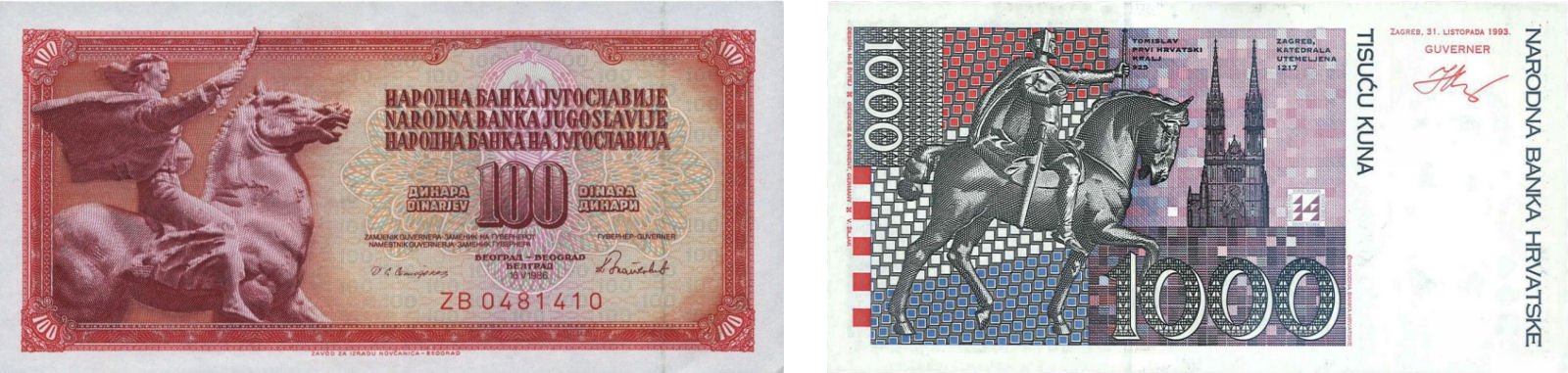
Source: Numex – Coins, Banknotes & Militaria Store [www.numex.hr].
When thinking of horses and horsemen on banknotes, two examples will immediately come to mind for many: the Yugoslav red 100 dinar banknote (1965–1986), and the Croatian 1000 kuna banknote (1993). On the 100 dinar banknote, the equestrian motif is located on the obverse and is visually very dominant, while on the 1000 kuna banknote it is placed on the reverse, where it serves as a secondary, yet still very recognizable motif.
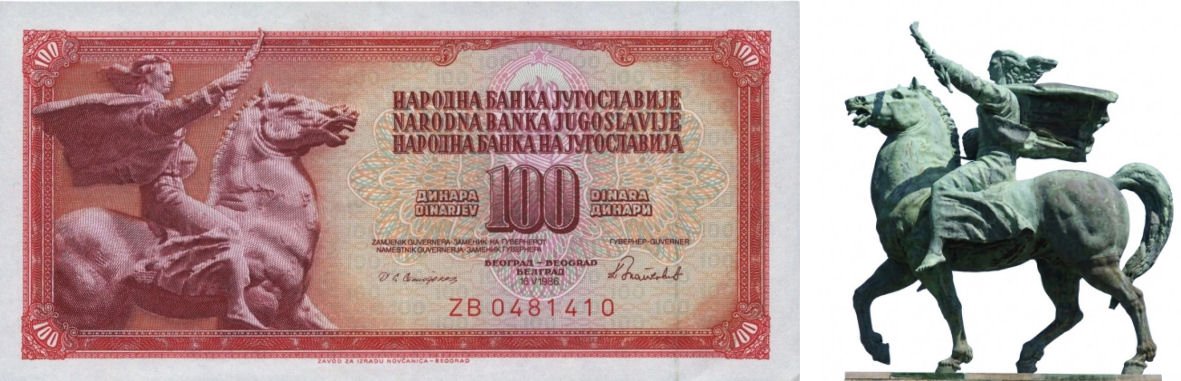
Aside from the obvious common elements—a horse with one raised leg, a human figure riding it, a sphere in one hand, and another raised hand with an additional attribute—these two sculptures are connected by another, considerably more interesting feature: both are depicted mirrored on the banknotes, that is, inversely to their actual appearance.
One of the popular „activities“ among numismatists and collectors is taking a photo with a banknote in front of the motif depicted on it. In some such situations, surprises tend to happen because it is noticed that the depiction on the banknote does not match reality—what is actually on the money is, relatively speaking, „backwards.“.
Banknote artists and designers work within given frameworks and are often constrained by the rules of composition, security features, and aesthetic balance. Because of this, they sometimes adapt or modify the original motif, which most often goes unnoticed by the general public, but not by those who know the original subject well and have an eye for detail. Whether such an approach is justified or not is an open question and is open to debate.
In the case of the previously mentioned banknotes, the situation is particularly interesting.

Yugoslav 100 dinar banknote
The Yugoslav 100 dinar banknote, issued from 1965 to 1986, depicts the sculpture „Peace“ by the Croatian sculptor Antun Augustinčić. The sculpture was erected in 1954 in front of the United Nations General Assembly building in New York.
After World War II, a decision was made for the headquarters of the United Nations to be in the United States of America. The construction of the complex began in 1949, and member states were tasked with contributing to the interior design of the space. The Yugoslav government of the time decided to donate a sculpture that would symbolize the commitment to world peace, and the realization was entrusted to Antun Augustinčić.
Cyprus proposed an equestrian figure as a symbol of peace. It opted for a female figure, considering it more appropriate for this symbolism, with the explanation that peace would be more secure if women decided upon it rather than men. To the remark that the horse is a warlike animal, he replied that peace must also be fought for. He finished the sketch in 1952, and it depicts a triumphant female figure with a stern gaze directed straight ahead, riding a moving horse. In her right hand, she holds a globe, and in her raised left hand, she holds an olive branch. The cloak fluttering behind her back and the dynamic posture of the horse suggest a strong forward movement, symbolically leading the peoples of the world toward peace.
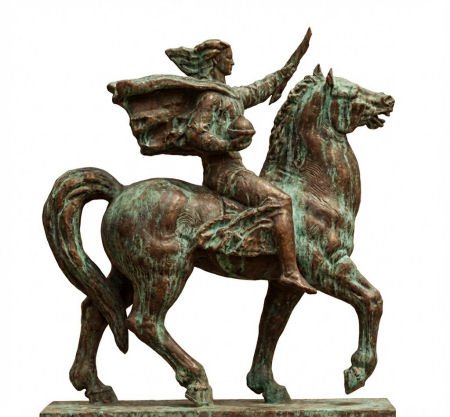
Comparing the actual sculpture with its depiction on the banknote clearly shows that the motif is mirrored. Moreover, the banknote depicts the back, i.e., the secondary side of the sculpture – the one where the globe is partially obscured by the rider's body, and the hand holding it is not visible. It remains unclear why the main, „front“ view of the sculpture was not used, on which the hands and all symbolic elements are more clearly visible. If the composition required the horse to move to the right, this could have been resolved without mirroring the motif.
Croatian 1000 kuna banknote
„The 1993 Croatian 1,000 kuna banknote features the sculpture „King Tomislav“ by the sculptor Robert Frangeš Mihanović. This is his most monumental work, created between 1928 and 1938 and erected in 1947 in Zagreb.
The Society for the Erection of the Monument to King Tomislav was founded in 1925. In 1930, the sculptor created a plaster model, and the sculpture was cast in bronze in 1933/34. The pedestal was completed in 1940, and during the war years, it was placed in front of the Main Railway Station. The monument was officially erected only after the Second World War, in 1947. Initially, the monument was erected without the sculptor's original reliefs and coat of arms, but they were added later, only in 1991.
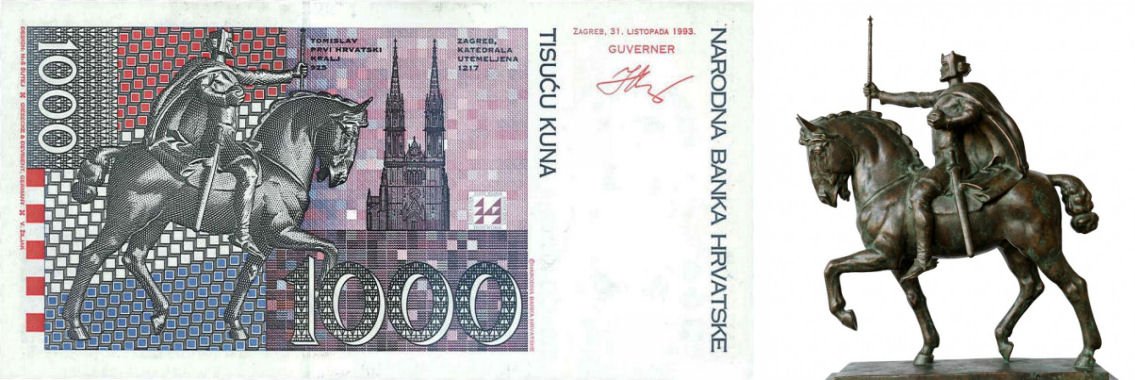
Unlike the previous example, the banknote features the main, front side of the monument, on which King Tomislav is clearly visible with the orb in his left hand and the scepter in his right. However, the motif is mirrored here as well. On the banknote, the orb is thus in the right hand and the scepter in the left, which deviates from the actual appearance of the monument.
Although symbolically it would be expected for the scepter to be held in the right hand, that detail probably escapes most observers.
The composition may have required this placement of the sculpture so that the rider, or rather the horse, would move to the right. However, this could have been avoided with a different solution: the sculpture of King Tomislav could have been placed above the one-thousand-kuna denomination mark, while the Zagreb Cathedral would be positioned on the left side of the banknote. This way, the equestrian sculpture would be in the central part of the reverse, and the cathedral would be shifted to the left. In the end, however, the existing solution was chosen, which turned out to be visually successful and probably did not pose a problem to the majority of banknote users.
Inverted reality
Both banknotes are very successful in terms of design, crafted tastefully and in accordance with the visual standards of the era in which they were created. The adaptation of the motifs to the overall composition does not diminish their artistic value. Nevertheless, the mirrored depiction of the equestrian sculptures represents an interesting curiosity and a departure from reality.
Such examples are not uncommon in numismatics. Quite the contrary – they serve as a reminder that what is depicted on currency is not always a literal reflection of reality, but rather its interpretation, sometimes even an inverted perception. It is precisely in such details that the added charm and reason lie why numismatics remains a permanently interesting and stimulating field of study.
Author: Zlatko Viščević
Photos: Numex – Coins, Banknotes & Militaria Store [www.numex.hr]