

Banknotes of the National Bank of the Kingdom of Yugoslavia – wartime monetary reserves (banknotes “for the needs of national defense” and “for completely extraordinary needs”)
The money of the Kingdom of Yugoslavia, from 1929 to 1941, like any other money in the past and today, sends many symbolic messages on multiple levels. By reading them, one can understand the state, national, political, ideological, economic, and cultural orientation of the Yugoslav monarchy, as well as the most important changes it went through. The article presents the political and ideological background of the design and iconography of the National Bank of the Kingdom of Yugoslavia banknotes for wartime monetary reserves (banknotes “for the needs of national defense” and “for completely extraordinary needs”). These banknotes were not intended for regular circulation, and thus either were not issued or were put into circulation (by all indications only on April 8, 1941) just at the beginning of the war in Yugoslavia. Therefore, they were in monetary circulation only for a short time, until their withdrawal and replacement, predominantly during 1941.
Advance word
Starting in 1929 and during the 1930s, the National Bank of the Kingdom of Yugoslavia produced and put into circulation 4 banknotes of the regular (“permanent”) issue: 10 dinars and 100 dinars banknotes (dated December 1, 1929), 1,000 dinars (dated December 1, 1931), and 500 dinars (dated September 6, 1935). During the 1930s, several banknotes of the National Bank of the Kingdom of Yugoslavia for war monetary reserves were produced at the Banknote Printing Works. These are banknotes “for the needs of national defense” and “for completely extraordinary needs” in denominations of: 50 dinars (dated December 1, 1931), 100 dinars (dated July 15, 1934), 1000 dinars (dated September 6, 1935), 20 dinars and 10,000 dinars (dated September 6, 1936), and 10 dinars (dated September 22, 1939).(1) The banknotes of the National Bank of the Kingdom of Yugoslavia for war monetary reserves were not intended for regular circulation. They were either not issued or were put into circulation (according to all indicators only on April 8, 1941) at the beginning of the war in Yugoslavia. Thus, they were in monetary circulation only for a short time, until their withdrawal and replacement, predominantly during 1941.(2)
The design and iconography of the banknotes of the National Bank of the Kingdom of Yugoslavia from 1929 to 1941 have been written about unsystematically, most often in passing, as part of generally shorter overviews of the artistic design of Yugoslav currency.(3) Worthy of attention is Bogdan Šarunc’s article “Iconography of the 100-Dinar Banknote of the Kingdom of Yugoslavia from 1934,” published in 2006 in the journal Dinar,(4) which discusses the design and iconography of the 100-dinar banknote (dated July 15, 1934) intended for wartime currency reserves. However, works that examine the design and iconography of Yugoslav currency from 1929 to 1941 sometimes present arbitrary and scientifically unfounded interpretations.(5)
More systematic overviews of the history of Yugoslav currency only briefly present the most important data on currency design and iconography. An exception is the book by Jovan Hadži-Pešić on the currency of the Kingdom of SCS/Yugoslavia, published in 1995. In it, based on the Official Gazette of the Kingdom of Yugoslavia and the archival material of the National Bank, the author presents
data on the design and iconography of the banknotes as well. For understanding the design and iconography of the banknotes of the Kingdom of Yugoslavia, the catalog-books of Yugoslav banknotes by Željko Stojanović (7) are also indispensable, though they provide only basic data, mainly based on Hadži-Pešić's statements, but also according to the archival material of the National Bank and his own research.
Money has always signified more than just material value. Money is a medium of exchange and trade, but at the same time, it is also a historical, economic, cultural, linguistic, and artistic document of the environment and time in which it was created. The role of money is economic, but also promotional. Therefore, it is understandable that efforts are made to make its visual design as attractive as possible. The appearance of coins and banknotes is typically decided by committees of national banks based on various design and iconographic proposals. The designer of the currency's visual design, in addition to the constant and mandated elements, is usually given guidelines for selecting the main motifs. A banknote represents the pinnacle of graphic technology at the time of its creation and is an important part of a people's or nation's visual identity, as well as a symbol of statehood. The production of banknotes is a fusion of artistic and technological work, in which numerous details are presented in a limited, small format. Indeed, it is particularly important to aesthetically integrate all prescribed graphic and typographic data and elements onto the banknote, while respecting technological and security requirements. To prevent or at least significantly hinder the production of counterfeit banknotes, the engraving and printing are done in a special way using security paper, most often with a watermark. Special colors and printing are also used, and the quality of the execution depends on the technical and material capabilities. With their technical execution, visual expression, and iconography, banknotes are always a reflection of the time in which they were created. The messages on money may seem simple, but they are actually complex and multi-layered. The choice of iconography for currency, which at first glance seems purely decorative, has always been driven by the need to convey important and representative messages that must have ultimately positive effects. However, propaganda dictates a certain content, and the information within it can be embellished or incorrect. The appearance of money is never haphazard; it is carefully designed for propaganda, and its visual content, design, and iconography have always carried diverse and intertwined meanings, primarily political and ideological. Money is one of the important symbols of the issuer, which in the modern world is most often the state. For this reason, the symbols of state sovereignty are always featured on currency. The legibility of the symbolic messages on currency is paramount, both for the general domestic population and in the international community. Most often, traditional national symbols and emblems are combined with selected symbols that are universally recognized. Through the symbols of statehood and sovereignty, each national currency seeks to evoke a sense of national pride and unity among its own people through effective visual messages. Artistic, iconographic, and semantic analyses of banknotes from various countries show that they prominently feature historical and national symbols. The iconography on currency is never random; it is in accordance with state policy and the prevailing ideology.(8)
The currency of the Kingdom of Yugoslavia, from 1929 to 1941, transmits many symbolic messages on multiple levels. By reading them, one can understand the state, national, economic, cultural, and above all, political and ideological orientation of the Yugoslav monarchy, as well as the most important changes through which that monarchy passed.
After King Alexander I Karađorđević abolished the National Assembly, banned political parties, and instituted a personal dictatorship on January 6, 1929, justifying his action as a response to a state crisis that parliamentarians had failed to resolve, on October 3, 1929, the Law on the Name and Division of the Kingdom into Administrative Areas changed the country's name to the Kingdom of Yugoslavia. National distinctiveness was officially abolished, and a Yugoslav nation and the “Yugoslav” language were proclaimed as official.(9)
Design and iconography of the banknotes of the National Bank of the Kingdom of Yugoslavia for wartime cash reserves (“for the needs of national defense” and “for completely extraordinary needs”)
Declared Yugoslav unitarism is also expressed and omnipresent on banknotes. First of all, the inscriptions on the banknotes of the National Bank of the Kingdom of Yugoslavia are no longer trilingual (Serbian in Cyrillic, Croatian and Slovenian in Latin), as was previously, from 1919 to 1929, regularly printed on the banknotes of the Kingdom respectively the Kingdom of Serbs, Croats and Slovenes. The inscriptions on all banknotes of the National Bank of the Kingdom of Yugoslavia were in “Yugoslav”, more precisely in the Serbian language, on the obverse in Cyrillic, on the reverse in Latin. Yugoslav unitarism is also vividly portrayed by the iconography on the banknotes of the Kingdom of Yugoslavia. More elaborate design and iconographic solutions are applied, which were mostly outlined already during the 1920s on the banknotes of the National Bank of the Kingdom of Serbs, Croats and Slovenes. (10)
To guarantee a timely and fast supply of money to the market, the National Bank of the Kingdom of SCS, with the help of the Banque de France, began the construction and equipping of the Institute for Banknote Printing in Topčider, Belgrade, in 1927, and it was completed in October 1929. The Institute for Banknote Printing was established modeled after the French one, and the technology was identical, lagging behind no contemporary highest European standards. The first banknotes were printed by the Institute for Banknote Printing of the National Bank of the Kingdom of Yugoslavia in early 1930. The coin-making department (mint) began operating in September 1938, and since then, Yugoslav regular circulating coins and most commemorative coins have been produced in the Institute for Banknote and Coin Production. (11)
The artistic solutions (design) of the banknotes of the National Bank of the Kingdom of Yugoslavia were entrusted to prominent fine artists because the banknotes also had the role of presenting the Kingdom of Yugoslavia as representatively as possible, both to its own people and abroad. Undoubtedly, banknotes were a powerful rhetorical tool by which the Yugoslav monarchy and the ruling Karađorđević dynasty sought to instill desirable political and ideological patterns in their own people. This did not immediately cause a break with the French banknote design that was accepted and favored in the Kingdom of Yugoslavia. However, several interesting departures from the French school of banknote design occurred during the 1930s in the production of the banknotes of the National Bank of the Kingdom of Yugoslavia.
The banknote designs for the National Bank of the Kingdom of Yugoslavia for wartime currency reserves were created by: Panta Stojićević for the 50 dinar (1931) and 20 dinar (1936) notes, Vasa Pomorišac and Panta Stojićević for the 100 dinar (1934) note, Vasa Pomorišac for the 1000 dinar (1935) note, Vojislav Đokić and Panta Stojićević for the 10,000 dinar (1936) note, and Paja Jovanović for the 10 dinar (1939) note. The printing plates for these banknotes were engraved by Veljko Andrejević Kun. (13)
During the 1930s, the banknote designers of the National Bank of the Kingdom of Yugoslavia frequently used “Miroslav's script.” This is a typeface created in 1921 by the graphic artist Panta (Pantelija) Stojićević, a lithographer at the State Printing Office in Belgrade, later the head of the Printing Department at the Institute for Banknote Manufacturing in Topčider, and one of the most prominent creators of artistic designs for the banknotes of the National Bank of the Kingdom of Yugoslavia. This typeface immediately came into wider use. “Miroslav's script” is a stylization of the Cyrillic alphabet, and its name suggests that its appearance is related to the ductus of the Miroslav Gospel [a 12th-century codex or manuscript book written in Old Church Slavonic in the Cyrillic script; globally known as a representative text of the oldest Serbian literacy], although it is actually different from the original. “Miroslav's script” was also used in the design of banknotes of the National Bank of the Kingdom of Yugoslavia, both for regular (“permanent”) issue banknotes and for wartime monetary reserve banknotes. Among the wartime monetary reserve banknotes, those featuring the “Miroslav's script” typeface are the 50 dinar banknote (dated December 1, 1931), the 100 dinar banknote (dated July 15, 1934), and the (obverse of the) 20 dinar banknote (dated September 6, 1936). “Miroslav's script” was also used in coinage, in the 1920s in the design of several coins of the National Bank of the Kingdom of SCS, and in the 1930s in the design of several coins of the National Bank of the Kingdom of Yugoslavia. On money—both coins and banknotes—of the National Bank of the Kingdom of SCS/Yugoslavia, “Miroslav's script” was used in both Cyrillic and Latin versions.

The first in a series of banknotes by the National Bank of the Kingdom of Yugoslavia for the war banknote reserves is the 50 dinar note dated December 1, 1931, It is printed in multiple colors with a predominantly brown color scheme, on paper measuring 149 x 94 mm (drawing 134 x 78 mm). The banknote features a simplified design, free of the numerous allegorical figures and colorfulness that were common and prevalent on Yugoslav banknotes. A slight departure from French banknote design is noticeable. On the obverse, to the left, is a portrait (an face) of King Alexander I of Yugoslavia, bareheaded, in his general's uniform, and wearing the Order of the Karađorđe Star, 3rd class, with swords (18). In the center of the obverse is a view of the Bay of Kotor, the entrance to the Bay of Kotor near Verige, as seen from above. To the right on the obverse is the watermark: a bust in three-quarter profile (to the left) of Crown Prince Peter II of Karađorđević wearing a falconer's cap. Initially, the Banknote Printing Bureau proposed the likeness of King Peter I Karađorđević for the watermark, but the Governing Board of the National Bank of the Kingdom of Yugoslavia then decided that the watermark would be the state coat of arms(19) (which, had it been adopted, would have been the first and only time in Yugoslavian banking). The Yugoslav Falcon was a domestic standard-bearer of the state ideology, representing Integral Yugoslavism(20), so the understandable iconographic solution with Crown Prince Peter II of Karađorđević wearing a falconer's cap was adopted as the final design. The obverse of the banknote is framed by a wide, stylized ornament from the Miroslav Gospel. On the reverse of the banknote, the central depiction is of Prince Marko on his horse Šarac, based on Ivan Meštrović's sculpture for the Kosovo Cycle. To the left is the watermark, and to the right is a stylized white eagle with spread wings, a multicolored shield on its breast—the coat of arms of the Kingdom of Yugoslavia—and a golden crown on its head. Stylized interlaces and decorative floral motifs, and occasionally lilies (stylized lilies), are incorporated into the main design of the obverse and reverse of the banknote in varying degrees of visibility.(21) The inscriptions on the obverse of the banknote are in Cyrillic (in a typeface resembling the Miroslav Gospel), while on the reverse they are in Latin script (in the same typeface). Meštrović's *King Mark on Horseback*, the epic hero of Serbian history, is a symbol of imposed Yugoslavism, as it lacks any Serbian attributes—namely, it is completely nude, which many Serbs resented against Meštrović at the time the sculpture was created in 1910.(22) The 50-dinar note of the National Bank of the Kingdom of Yugoslavia (December 1, 1931) was the first multicolored note printed at the Banknote Printing Plant, created by Yugoslav artists (drawing by Panta Stojićević, engraving by Veljko Andrejević Kun).(23)
The Bay of Kotor will also appear as a motif on the 1000-dinar banknote of the National Bank of the Kingdom of Yugoslavia, in a series of Yugoslav banknotes produced in 1943 by the decision of the Government-in-Exile of the Kingdom of Yugoslavia in London [printed by Bradbury, Wilkinson & Company Ltd. New Malden (Surrey)], which were never put into circulation. (24)
The significance of the Kosovo myth in promoting the ideology of Yugoslavism, as well as Meštrović's works for the Kosovo Cycle, is pronounced and unquestionable. Therefore, Meštrović's motif from the Kosovo Cycle—the relief "The Kosovo Maiden" for the Vidovdan Temple—would for many years (in fact, decades) also appear on the face of the 5,000-dinar banknote of the FPR Yugoslavia from 1955, respectively the 5,000-dinar banknote of the SFR Yugoslavia from 1963, and the 50-dinar banknote of the SFR Yugoslavia from 1965, 1968, 1978, and 1981.(25)


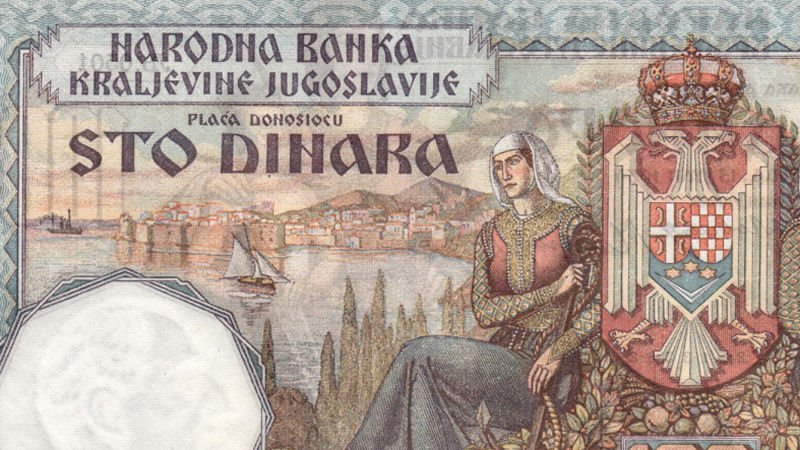
In terms of design and especially iconography, the most interesting banknote of the National Bank of the Kingdom of Yugoslavia is the 100-dinar banknote dated July 15, 1934, featuring multicolor printing and a paper size of 164 x 96 (design 157 x 89) mm. The date on this banknote is unusual, for example, December 1st (the day of unification, i.e., the creation of the Kingdom of Serbs, Croats and Slovenes). This commemorates the 50th anniversary of the beginning of operations (i.e., the issuance of the first banknote) of the Privileged National Bank of the Kingdom of Serbia(26). On the obverse of the banknote, the dominant background tones are bluish, framed by a geometric triple-interlace pattern. In the foreground on the right is the figure of a seated young woman holding an exceptionally long quill in her right hand, while her left arm embraces a young boy wearing a falconer's cap with a feather who stands leaning on a sword. Next to the boy, on the lower right in the watermark, is a profile portrait of King Alexander I Karađorđević (facing left). In the background on the left is the Church of Saint George in Oplenac near Topola, Serbia, the mausoleum of the Karađorđević dynasty.(27) It is a widespread opinion that the figures of the woman and child represent Queen Maria Karađorđević [Queen of the Kingdom of SCS/Yugoslavia from 1922 to 1934, born as Romanian Princess Marie von Hohenzollern-Sigmaringen(28)] and the young King Peter II Karađorđević, primarily due to his age at the time. The Serbian numismatist Šarunac believes that it is nevertheless an allegorical depiction. However, Šarunac is mistaken when he claims that “the figure of the queen as a born member of a foreign dynasty, with all due respect, would not be an appropriate and unambiguous national symbol”(29), because on the 1,000-dinar banknote from 1931, which was in circulation at the time, the obverse features the likeness of Queen Maria Karađorđević.(30)
The Balkan mentality, which dictates and patriachally inherits that the man is the head of the family and the woman is always in the background, is a possible cause for the extremely rare appearance of personalized women on currency. Thus, Queen Maria Karađorđević also appears rarely on Yugoslav currency, only on the 1,000-dinar banknote from 1931, and on the metal quadruple ducat coin (also known and referred to as the “wedding dress”) minted from 1931 to 1933, alongside her husband, King Alexander I Karađorđević. However, the use of a woman's figure on the banknotes of the Kingdom of SCS/Yugoslavia was frequent, featuring symbolic depictions of the countryside and agriculture—female peasants or various allegorical figures.
The assumption that the young falconer depicts the young Peter II of Karađorđević, who in the early 1930s often appeared in public in a falconer's uniform, is not unfounded. After all, on the 50-dinar note (December 1, 1931), the watermark features a portrait (head) of Crown Prince Peter II of Karađorđević wearing a falconer's cap. The female figure, dressed in a purple cloak covering a purple gown decorated with symbolic motifs of animals and plants in gold, is undoubtedly an allegorical representation of the state and supreme authority. Therefore, the most likely interpretation is that the female figure is an allegory of the Kingdom of Yugoslavia, with a young member of the "Soko[l]" Chivalric Organization. The dress is adorned with rich medieval Christian symbolism – a stag, a peacock, two doves facing each other (which is reminiscent of the initials from the Gospel of Miracles), and the fruits that the animals are eating are an allegory for the fruits of the tree of life that is in the middle of the Garden of Eden. The dress also features the motif of the "unbowed eagle," which represents Christ's victory over Hades (hell, or death), as well as stylized "healing herbs"—the elixir of immortality. The purple color of the garment and cloak signifies the state's royal dignity. Opened before the woman's feet is a closed book—a sign of a constitutional order based on knowledge—and a microscope and a cluster of grapes, symbols of science and abundance. According to Šaruncu, the figure of the boy with a sword, although reminiscent of a young "falconer" (the cap the boy wears is called a shako), is most likely an allegorical depiction of a victorious warrior or a victorious warrior nation.(33) On the reverse of the banknote, in the foreground on the right side around the state coat of arms, two girls are seated wearing vests (gilets) and long blue dresses, with white scarves on their heads, which iconographically recalls Serbian medieval times, and thus unequivocally indicates tradition. Behind the girls in the left part is a depiction of Dubrovnik from the sea (which can indicate the centuries-old statehood and independence of Dubrovnik, as well as the independence of the young Yugoslav state). Lower left in the watermark is the portrait of King Alexander I of Karadjordjevic. The girl on the left holds an anchor (a symbol of seafaring and also a symbol of hope), and the girl on the right holds a sheaf of wheat. In front of her are a pumpkin, grapes, pears, and apples, and behind her is a depiction of a factory and factory smokestacks (symbols of agriculture and abundance, as well as industry). Undoubtedly, the girls symbolize the coastal and continental parts of the country, as well as diversity and abundance, the accelerated trade and industrialization of a traditionally agrarian country.(34) The inscriptions on the obverse are in Cyrillic, while the inscriptions on the reverse are in Latin, using a typeface similar to the "Miroslav Gospel script." The drawing on the banknote, created in the style of French banknote design, is a special stylization, somewhat Mannerist.


Dubrovnik, as a city of exceptional historical and cultural significance, would later appear as a motif on both Yugoslav and Croatian currency: on the 100 dinar banknote of the National Bank of the Federal People's Republic of Yugoslavia in 1955 and on the 1963 issue of that banknote by the National Bank of the Socialist Federal Republic of Yugoslavia, then on the 50,000 dinar banknote of the National Bank of the SFR Yugoslavia in 1988, as well as on the 50 kuna banknote of the Croatian National Bank in 1993 and a later issue in 2002. In 2018, the Croatian National Bank also issued a commemorative 200 kuna silver coin featuring the motif of Dubrovnik.
In the style of the French school of banknote printing, the 1,000-dinar banknote of the National Bank of the Kingdom of Yugoslavia was also produced, dated September 6, 1935, multicolored, with a paper size of 190 x 122 mm (drawing 182 x 113 mm). The obverse features a multicolored, monumental composition with several allegorical figures. The central figure is a woman in a stylized white dress in three-quarter profile (from the left), who holds a laurel branch in her right hand—a symbol of eternal glory. With her left hand raised, she points forward, in the direction she is also facing, and has turned her head toward the female figures on horseback she leads. (In numismatic literature, they are also inaccurately described as a "group of three horsemen"(36), although they are depicted as female figures.) All three female figures have stylized, multicolored mantles that billow, thus conveying the movement of the horses, which are fully reared on their hind legs. The first woman on horseback in the background holds an upraised caduceus or staff of Mercury (Hermes) (a short messenger's staff entwined with two snakes in a spiral shape) - a symbol of travel and commerce. The woman on horseback in the center holds an upraised torch—a symbol of light and enlightenment, freedom, and new ideas. The woman on horseback in the foreground, in a stylized dark purple dress (with a gold-embroidered trim), holds a raised sword in her right hand—a symbol of fearlessness and strength—and in her left hand, a shield bearing the multicolored coat of arms of the Kingdom of Yugoslavia. The message is clear – the state guarantees material and spiritual progress, as well as freedom, and maintains peace and justice. In the lower left part of the banknote's face, a female figure in a stylized dress (reminiscent of a classical type), facing the central figures, records what she sees, and next to her sits a boy—an obvious symbol of new generations—and peacefully lying beside him with its head held high is a lion—a symbol of the highest power, supreme authority on earth. Behind them in the background is the Church of St. Peter and Paul in Đakovo, which is undoubtedly also an allusion to the Yugoslavism of Bishop Josip Juraj Strossmayer. According to the original drawing(37) by the painter Vasa Pomorišac(38), the Đakovo cathedral was not supposed to be depicted on the 1,000-dinar note, as is evident from the sketch of the note preserved in the archive of the National Bank of Yugoslavia in Belgrade (in the original drawing, the depiction is of some fortress [most likely the Petrovaradin Fortress])(39) and was incorporated into the final multicolored drawing of the banknote.(40) The reverse features the central part of the Knightly King Alexander I the Unifier Bridge over the Sava into Belgrade, better known as the Zemun Bridge, which is one of the most important engineering feats (1929–1934). in the Kingdom of SHS/Yugoslavia, and two seated, half-naked men – allegories of industry and fishing.(41) In the original sketch, and then in the bill's drawing, the date on the bill was supposed to be December 1 (the day of unification – the creation of the Kingdom of SHS), and not September 6 (the birthday of King Peter II of Karađorđević), as it was ultimately executed.(42) The banknote is distinguished by its outstanding drawing perspective and pleasant colors, and is a masterpiece of Yugoslav banknote design. As such, it is also featured in presentations of the world's most beautiful banknotes.(43) The International Banknote Society ranked the 1,000-dinar note of the National Bank of the Kingdom of Yugoslavia (September 6, 1935) among the ten most beautiful banknotes in the world.(44) The 1,000-dinar note from the National Bank of the Kingdom of Yugoslavia from 1935 was never put into circulation.


Following the assassination of King Alexander I Karađorđević in the autumn of 1934 in Marseille, the image of the new monarch – King Peter II Karađorđević – understandably began to appear frequently on postage stamps (45), coins, and banknotes (46) of the Kingdom of Yugoslavia. To strengthen the authority of the young king and the Karađorđević dynasty, the watermarks on the banknotes regularly featured the likenesses of his predecessors alongside him: his grandfather, King Peter I Karađorđević, and (or) his father, King Alexander I Karađorđević.
From a design and graphic standpoint, the 20-dinar banknote of the National Bank of the Kingdom of Yugoslavia dated September 6, 1936, The brown-dominant multicolored design, on paper measuring 137 x 81 mm (drawing 125 x 70 mm), marks a complete break with French influence.(47) The banknote is also interesting for its printing execution, as it was produced using both the Lambert multicolor printing process and the Orlov multicolor printing process.(48) The design is refined and stripped of numerous allegorical figures and colorfulness. On the obverse of the banknote, the central feature is the portrait (in a right-facing three-quarter profile) of King Peter II of Karađorđević, bareheaded, with a partially visible ermine cloak (a symbol of moral purity and uncorrupted authority) and a sash. The portrait is bordered by a stylized interlacement, and flanked on the left and right by stylized decorative, and at the same time protective, circular shapes for the banknote with prominent floral details. On the reverse of the banknote, to the left, in a wreath of intertwined agricultural produce, grain, corn, and grapes, is a depiction (in right profile) of a woman's portrait with a laurel wreath on her head. (reminiscent of a classical type) – an obvious symbol of the glorious statehood founded in the past [an allegorical depiction in which the figure of a young woman symbolizes the state, a convention common at the time on the banknotes of numerous countries(49)], and to the right is the coat of arms of the Kingdom of Yugoslavia – a stylized eagle with spread wings, a shield on its breast, and a crown on its head (all in white), overlaid with the issuer's name (printed in brown) and an indication of the bill's value. Stylized decorative floral motifs and lilies in various shades are incorporated into the main design of the obverse and reverse.(50) The inscriptions on the banknote are in the Serbian language, in Cyrillic script on the obverse (in a typeface resembling the Miroslav Gospel), and in Latin script on the reverse (in the same typeface). The banknote paper has no watermark, but it has protective colored fibers on the right side outside the banknote's design, which points to paper from the contemporary German banknote manufacturer Giesecke & Devrient, Leipzig.(51) Furthermore, the design and graphics of this banknote also point to German influence.(52)

The 10,000 dinar banknote of the National Bank of the Kingdom of Yugoslavia dated September 6, 1936, in a multicolored execution with prevailing shades of brown, as well as yellow-green and blue, with a paper size of 219 x 131 (design 202 x 115) mm (53), both by denomination and by dimensions (the paper size also indicated the value of the banknote), is the largest banknote of the Kingdom of Yugoslavia. The banknote is also interesting and unique in its printing execution because it was produced using both the Lambert multi-color printing and the Orlov multi-color printing (54). The neoclassical banknote design by Vojislav Đokić (55) and Pante Stojićević, free of numerous allegorical figures and colorfulness, is a departure from French monetary design (56). On the obverse of the banknote to the left is a portrait (in right profile) of King Peter II Karađorđević, bareheaded, in a stylized uniform and with the Order of the White Eagle, 3rd class. To the right, in the watermark, is a portrait (in left profile) of King Peter I Karađorđević, in uniform, bareheaded. In the central part of the obverse of the banknote, between the depictions of the figures of King Peter II and Peter I, is the coat of arms of the Kingdom of Yugoslavia with a golden crown above it. [This is the Serbian (later Yugoslav) royal crown of the Karađorđevićs, i.e., the crown of King Peter I Karađorđević from 1904 (57).] On the left and right sides of the obverse in the upper part is a depiction of a double-headed eagle, and the central part around the coat of arms and the crown above it is decorated with a series of agricultural produce (corn, wheat, apples, grapes) – symbols of abundance. On the reverse of the banknote is a depiction of a wheat field and to the right a young man with a scythe and a girl with a sheaf of wheat, while to the left, branches of trees are visible, obscuring the watermark. The obverse and reverse of the banknote are richly decorated with zoomorphic and floral motifs and interlacings. The drawing of the figures and symbolic representations and ornaments, as well as the large inscriptions (typography) on the banknote, are almost architectural and produce an impressive effect (58). The 10,000 dinar banknote of the National Bank of the Kingdom of Yugoslavia (1936) was never put into circulation.


A complete departure from French banknote design is the 10-dinar banknote of the National Bank of the Kingdom of Yugoslavia dated September 22, 1939, made in shades of green, with a paper size of 128 x 72 (artwork 115 x 60) mm, devoid of the numerous allegorical figures and colorfulness that prevailed on Yugoslav banknotes. On the obverse of the banknote, on the left, is a waist-length portrait (full-face) of King Peter II Karađorđević in Montenegrin-Herzegovinian national costume, bareheaded, with the Order of Karađorđe's Star, 2nd class, below his neck and on the left side of his chest. To the left and above King Peter II hangs a laurel branch—a symbol of eternal glory. In the middle, in the background, is the recognizable veduta of Mostar with the Old Bridge, and on the left is the watermark: King Peter I Karađorđević (in profile from the left) bareheaded in a general's uniform. On the reverse of the banknote, on the right, is a depiction (in semi-profile from the left) of a waist-length female figure (a medieval noblewoman type with a veil and a crown (tiara) on her head, a sword in her right hand—a symbol of authority—and a closed book on her chest on the left—a symbol of knowledge), and on the left is the watermark. The model for the main figure on the reverse of the banknote was the painter Paja Jovanović and his painting “Medieval Female Ruler,” which he had just created at that time, in 1939. (59) The obverse and reverse of the banknote are richly decorated with stylized floral interlace and, on the reverse, with motifs of folk embroidery. (60) The 10-dinar banknote (September 22, 1939) is iconographically unique because, unlike other banknotes of the National Bank of the Kingdom of Yugoslavia issued between 1929 and 1941, it does not feature the coat of arms of the Kingdom of Yugoslavia.
The artistic design and printing plates for the 10-dinar banknote (September 22, 1939) of the National Bank of the Kingdom of Yugoslavia were later also used for printing the 10-dinar banknote (May 1, 1941) of the Serbian National Bank. The obverse of the banknote was changed by omitting the image of King Peter I Karađorđević and the depiction of the Mostar bridge, while the reverse remained the same (“Medieval Female Ruler”) with an overprint of the earlier inscriptions.(61) The depiction of Mostar, or rather the old Mostar bridge, would, however, appear again on currency only much later, on the banknotes of the National Bank of the Republic of Bosnia and Herzegovina issued in 1992, 1993, and 1994.(62)


Just before the war and the occupation of the Kingdom of Yugoslavia, a 500 dinar banknote of the National Bank of the Kingdom of Yugoslavia was being produced at the Banknote Printing Institute. The design for this multi-colored banknote, measuring 184 x 114 mm for the paper size (170 x 100 mm for the drawing), was created by the Serbian painter Mladen Josić (63), who in 1939 and 1940 was involved in creating several artistic designs for banknotes of the National Bank of the Kingdom of Yugoslavia, while the printing plates for the banknote were engraved by V. Andrejević Kun. The banknote was produced in the style of the French school of banknote engraving, which was favored in the Kingdom of Yugoslavia. In numismatic literature, there are various claims regarding the date on the 500 dinar banknote. The numismatist Jelinčič states May 8, 1939, and Stojanović states May 6, 1939, which is then adopted by the museum curator Mulić and the numismatist Škrabo. The banknote was undoubtedly printed in larger quantities and was most likely intended for wartime currency reserves. Records about this banknote, apart from the sketch and the multi-colored drawing of the obverse and reverse, have not been found. Neither are any specimens of the banknote without a later overprint (alteration) known, although according to some claims, they allegedly exist. (64)
The banknote, with overprints (on both the obverse and reverse) of the issuer's name, a new date (May 1, 1941), and new signatures, and with a changed denomination, was put into circulation in early May 1941 as a 1,000-dinar note of the National Bank of Serbia.(65) According to Stojanović, the three female figures on the banknote represent a Serb, a Croat, and a Slovenian, (as Dara Ristić explained to him; she, as an official of the National Bank of the Kingdom of Yugoslavia, had posed with two other National Bank officials for the painter Josić in 1940.(66) Škrabo repeats a similar explanation, stating that the three young women are "like the 'SHS' symbolism of a Serb, a Croat, and a Slovene." (67) However, the female figures on the 1939 500-dinar note (or 1,000 dinars from 1941) in no way indicate national/ethnic affiliation, and they are unquestionably allegorical figures. On the obverse of the banknote, the central depiction is of three young women seated in a slight three-quarter profile, their heads turned to the right. To their left is a portrait (an face) of King Peter II of Karađorđević, bareheaded, in uniform, and draped in the royal porphyry (cloak), within a golden wreath of stylized floral, zoomorphic, and anthropomorphic motifs, with the Karađorđević royal crown above the wreath. The first woman in the group, on the left in the highest position, holds a sword (an allegory of the state and a symbol of strength), and a cross is prominently displayed on her embroidered dress (a symbol of devotion to Christianity). The woman in the middle holds a closed book (a symbol of knowledge), and the third woman on the right holds various fruits (a symbol of abundance). On the front of the banknote, to the left of the portrait of King Peter II on a purple cushion, are depicted the regalia, or the royal insignia (royal symbols) of the Karađorđević dynasty: sceptre (cudgel), orb or sar (a ball with a cross – the royal apple), and a brooch with the heraldic motif of a two-headed white eagle, which secures the cloak to the chest) [along with the golden crown, golden scepter, and royal cloak (of purple-dark red velvet, embroidered with gold thread and lined with white ermine fur), the symbol of the highest authority and honor of the ruler is the golden royal orb—a symbol of strength and the universal dominion of the Christian ruler.] These are the regalia of the Serbian or Yugoslav Karađorđević dynasty [made for the coronation of King Peter I of Karađorđević in 1904. The crown, sceptre, and royal orb are decorated with semi-precious stones found in Serbia, and enamel in the Serbian national colors (red, blue, and white)](68), which are shown together for the first time on this banknote. To the right is a laurel wreath (a symbol of eternal glory) tied with a ribbon – the Yugoslav tricolor (blue, white, red) – and leaning against the coat of arms of the Kingdom of Yugoslavia. In the lower left corner, a large open book (a symbol of legitimacy) is visible. On the right side of the front of the banknote, in the watermark, is a portrait (in left profile) of King Alexander I of Yugoslavia, bareheaded and in uniform. The three young women are also seated on the back of the banknote. The first woman on the left holds a sheaf of grain in her right hand and fruit (grapes and an apple) in her left; the second woman on the right holds a distaff; and the third woman, in the foreground, wearing a dress with an embroidered cross, holds a naked child. These are allegories of abundance, diligence, and motherhood, or care for the helpless. On the right side of the reverse, the background depicts a peasant plowing a field with an ox team, and in the distance is a view of a river, a lake, and a mountain. The border of the obverse and reverse is richly decorated with stylized floral and zoomorphic motifs and numerous various objects. Filled with allegories, symbols, and decorative details, the 1939 500-dinar (or 1941 1,000-dinar) note is the most colorful banknote in the history of Yugoslav (and Serbian) banknote design.


Closing argument
Banknotes of the National Bank of the Kingdom of Yugoslavia, from 1929 to 1941, for wartime monetary reserves, as well as banknotes of the regular (“permanent”) issue, clearly express the national and state identity of the Kingdom of Yugoslavia. The basis of this identity is Serbian history and tradition, Christianity, and proclaimed integral Yugoslavism, headed by the Karađorđević dynasty. The proclaimed Yugoslav unitarianism is also vividly depicted by the iconographic solutions on the banknotes of the Kingdom of Yugoslavia. More elaborate design and iconographic solutions were applied, which had largely been outlined as early as the 1920s on the banknotes of the National Bank of the Kingdom of Serbs, Croats and Slovenes. The inscriptions on the banknotes of the National Bank of the Kingdom of Yugoslavia are not trilingual, as had previously been regularly printed on the banknotes of the Kingdom or the Kingdom of SCS from 1919 to 1929 (Serbian in Cyrillic, Croatian and Slovenian in Latin). The inscriptions on all banknotes of the National Bank of the Kingdom of Yugoslavia are written in “Yugoslav,” more precisely in the Serbian language: on the obverse in Cyrillic, on the reverse in Latin. Serbian medieval and modern history and tradition are emphasized – a medieval noblewoman (100 dinars from 1934) and a medieval female ruler (10 dinars from 1939), as well as Prince Marko on a horse (50 dinars from 1931). Furthermore, the use of the “Miroslav Gospel” typography on the banknotes of the National Bank of the Kingdom of Yugoslavia (50 dinars from 1931, 100 dinars from 1934, and 20 dinars from 1936) is unquestionably a reference to Serbian medieval history and culture.
The usual depiction of rulers on the currency and banknotes of the National Bank of the Kingdom of Yugoslavia includes: King Peter I Karađorđević (10,000 dinars from 1936 and 10 dinars from 1939), King Alexander I Karađorđević (50 dinars from 1931, 100 dinars from 1934, and 500 dinars from 1939), and Crown Prince, later King Peter II Karađorđević (50 dinars from 1931, 1000 dinars from 1934, 20 dinars and 10,000 dinars from 1936, 10 dinars and 500 dinars from 1939). King Peter I Karađorđević and King Alexander I Karađorđević are regularly depicted as warriors, i.e., soldiers in uniform. Peter II Karađorđević is depicted as crown prince first as a young falconer (50 dinars from 1931), and then from 1934 as the Yugoslav king, in Montenegrin-Herzegovinian folk costume (10 dinars from 1939), and with royal regalia (10,000 dinars from 1936 and 500 dinars from 1939). To strengthen the authority of the young king and the Karađorđević dynasty, the watermarks on the banknotes regularly feature the likenesses of his predecessors, his grandfather King Peter I Karađorđević (10,000 dinars from 1936, 10 dinars and 500 dinars from 1939) and(or) his father King Alexander I Karađorđević (500 dinars from 1939). The Balkan mentality, which dictates and patriarchally inherits that the man is the head of the family while the woman is always in the background, is a possible cause for the extremely rare appearance of personalized women on currency. However, female figures are frequent on Yugoslav banknotes from 1919 to 1941, when symbolic representations of the countryside and agriculture are shown—female peasants or various allegorical figures (100 dinars from 1934, 1000 dinars from 1935, 20 dinars and 10,000 dinars from 1936, 10 dinars and 500 dinars from 1939).
The Kingdom of Yugoslavia is symbolized on banknotes alongside the ruler—the king, primarily by the state coat of arms (50 dinars from 1931, 100 dinars from 1934, 1000 dinars from 1935, and 20 dinars from 1936) or the Karađorđević royal crown (10,000 dinars from 1936) and royal insignia (500 dinars from 1939). The Yugoslav Sokol was an internal political standard-bearer of state ideology, advocating for integral Yugoslavism, and thus the depiction of a young Sokol member or warrior (100 dinars from 1934) and Crown Prince Peter II Karađorđević as a young Sokol member (50 dinars from 1931) is understandable. Classical Greco-Renaissance iconography, which was more significantly represented earlier from 1919 to 1929 on Yugoslav and previously on Serbian banknotes, became an exception on the banknotes of the National Bank of the Kingdom of Yugoslavia (1000 dinars from 1935). Realistic depictions that are easier for the common man to understand are applied, which of course also carry their own symbolism. Featured on the banknotes are landscapes of Boka Kotorska (50 dinars from 1931), Dubrovnik (100 dinars from 1934), Mostar (10 dinars from 1939), as well as the Church of Saint George in Oplenac near Topola in Serbia, the mausoleum of the Karađorđević dynasty (100 dinars from 1934), and the Cathedral of Saints Peter and Paul in Đakovo, which is undoubtedly also an association with the Yugoslavism of Bishop Josip Juraj Strossmayer (1000 dinars from 1935). Neither the symbolic nor the realistic representation of the technical and industrial progress of the Kingdom of Yugoslavia has been neglected (100 dinars from 1934 and 1000 dinars from 1935). This is regularly a depiction or a combination of modernity and a glorious past (as a rule, and exclusively Serbian). The Kingdom of Yugoslavia is stereotypically and idealizedly portrayed as the homeland of hardworking and contented peasants as well as workers, as a strong Christian state with a glorious past and continuity of government, as a state that guarantees peace and prosperity and fosters labor, knowledge, and overall progress.
Notes
(1) See Zmago Jelinčič, Catalog bankovcev jugoslovanskih dežel / Catalog novčanica jugoslavenskih zemalja / Paper money catalogue of Yugoslav countries, 1. del – redne izdaje/1. dio – redovna izdanja/ Part 1 – regular issues (Ljubljana: Samozaložba [Self-published], 1988), 80-84; Jovan Hadži-Pešić, Money of the Kingdom of Yugoslavia 1918–1941 (Belgrade: National Bank of Yugoslavia, 1995.), 113–126, 137–141, 157–176; Banknotes of Yugoslavia 1918–1997, eds. Vojislav Tomić, Stanko Cvijan (Belgrade: National Bank of Yugoslavia, 1997), 54–60; Željko Stojanović, Paper Money of Yugoslavia / Das Papiergeld Jugoslawiens 1929–1994 (Belgrade: National Bank of Yugoslavia, 1994), 179–184; Željko Stojanović, Papirni novac Srbije i Jugoslavije / Das Papiergeld Serbiens und Jugoslawiens / Paper Money of Serbia and Yugoslavia (Belgrade: Željko Stojanović [Self-published], 1996.), 103.-114.; Miodrag Ugričić, Money in Yugoslavia during World War II with Special Reference to the Methods of Financing the Occupation (Belgrade: Jugoslovenski pregled, 2000), 16–18, 37–53, 66–71; Borna Barac, Banknotes of the Yugoslavia and the States of the Former Yugoslavia 1767. – 2002. (Zagreb: Obol – naklada. d.o.o., 2002.), 179.-182.; Željko Stojanović, Banknotes of the National Bank 1884–2004 (Belgrade: Jugoslovenski pregled, 2004), [76–77, 82–91]; Željko Stojanović, National Catalog of Serbian and Yugoslav Banknotes / Standardkatalog für das Papiergeld Serbiens und Jugoslawiens / Standard Reference Guide to Serbian and Yugoslav Paper Money (Belgrade: Sanimex, 2007.), 93.-94., 96.-103.; Zlatko Viščević, Coins and Banknotes of Yugoslavia, Slovenia, Croatia, Bosnia and Herzegovina, Serbia, Montenegro and Macedonia (Rijeka: Numismatic Society "Castua" Kastav, 2011.), 405–408 or Zlatko Viščević, Coins and Banknotes of Yugoslavia, Slovenia, Croatia, Bosnia and Herzegovina, Serbia, Montenegro and Macedonia (Rijeka: Numismatic Society "Castua" Kastav, 2011.), 881-887.
(2) In numismatic literature, primarily money catalogs, there are various statements as to which banknotes from the wartime monetary reserve, “for the needs of national defense” and “for completely extraordinary needs,” were put into circulation on April 8, 1941. Cf. J. Hadži-Pešić, Novac Kraljevine Jugoslavije 1918. – 1941., pp. 157–159, assuming on the basis of sources that the 10 dinar (1939), 20 dinar (1936), and 50 dinar (1931) banknotes were put into circulation on April 8, 1941. Ž. Stojanović, Papirni novac Srbije i Jugoslavije, p. 109; Ž. Stojanović, Novčanice Narodne banke 1884. – 2004., [p. 86], and Ž. Stojanović, Nacionalni katalog novčanica Srbije i Jugoslavije, p. 98, however, citing sources, state that the 100 dinar (1934) banknote was also put into circulation on April 8, 1941. This is undoubtedly confirmed by the book based on numerous sources by M. Ugričić, Novac u Jugoslaviji za vreme Drugog svetskog rata s naročitim osvrtom na metode finansiranja okupacije, pp. 53–71.
(3) Cf. Jovan Hadži-Pešić, "The Correspondence of Paja Jovanović Regarding His Drawing for the 1931 1000-Dinar Banknote," Yearbook of the City of Belgrade, Vol. XXXV (1988), 219–255; Siniša Bizović, "The Sad History of a Single Dinar," Start Magazine, no. 526, Zagreb, March 18, 1989, 44–47; Željko Stojanović, "Great Works of Art in a Small Format and in a Large Print Run," Numismatic Journal Dinar, no. 3 (1996), 37–39; Mileta Prodanović, "Three Times Yugoslavia on Banknotes," in: *New States - New Images?* Visuelle Kultur im Dienst staatlicher Selbstdarstellung in Zentral- und Osteuropa seit 1918., eds. Arnold Bartetzky, Marina Dmitrieva, and Stefan Troebst (Cologne – Weimar – Vienna: Böhlau Verlag, 2005.), 291–300; Mileta Prodanović, "How to Read Banknotes," http://bif.rs/2014/07/mileta-prodanovic-kakocitati-novcanice/ (accessed April 20, 2017) or Милета Продановић, "Како читати новчанице," https:// www.nb.rs/view_file.php?file_id=971 (accessed April 20, 2017); Ivan Škrabo, "1939 500 Dinar Note Without Overprint. Are There 5,440 Unreprinted Specimens of the 500-Dinar Banknote Dated May 6, 1939?", Numismatic Journal Dinar, no. 29 (2007), 34–36; Ivana Živančević Sekeruš, "Banknote Imagery of Serbia," in: Balkan Memories. Media Constructions of National and Transnational History, ed. Tanja Zimmermann (Bielefeld: Transcript Verlag, 2012.), 41–48; Sonja Ćirić, "Art on Banknotes: A Short Visual History of the Dinar," http://www.vreme.com/cms/view.php?id=1131661 (accessed April 20, 2017); Miodrag Kirsanov, "100 dinara – Jedna priča" / "100 Dinars - One Story," Bankar, vol. 8, no. 29 (2015), 104–110; Ljiljana Bakić, "Paja Jovanović, designer of the Kingdom of Yugoslavia banknotes," http://notafilija-numizmatika-paja2609.blogspot. hr/2013/06/paja-jovanovic-dizajner-novcanica.html (accessed March 10, 2017); Adam N. Crnobrnja, "Govor novca", http://www.yurope.com/zines/republika/arhiva/2002/279/279_18.html (accessed April 20, 2017); Milorad Stokin, "Notafilija. Novčanice Kraljevine Jugoslavije," http://fragmentikulture. com/novcanice-kraljevine-jugoslavije/ (accessed July 10, 2018); "Yugoslav Dinar," https://sr.wikipedia.org/wiki/Југословенски_динар (accessed July 15, 2018).
(4) Cf. Bogdan Šarunac, “The Iconography of the 100-Dinar Banknote of the Kingdom of Yugoslavia from 1934”, Numizmatički časopis Dinar, no. 26, (2006), 47. or “The Iconography of the 100-Dinar Banknote of the Kingdom of Yugoslavia from 1934”, http://klubkolekcionara.blogspot.hr/2010/01/ikonografija-novcanice-kraljevine.html (accessed January 10, 2018).
(5) Usp. primjerice: Sandra Maljavac, Problemi interpretacije vizualnih elemenata novčanica: jugoslavenski dinar u kontekstu političke ikonografije (diplomski rad, Sveučilište u Rijeci, Filozofski fakultet u Rijeci, Odsjek za povijest umjetnosti, 2015.), https://repository.ffri.uniri.hr/islandora/object/ffri%3A62/ datastream/PDF/view (pristupljeno 10. 1. 2018.).
(6) Cf. J. Hadži-Pešić, Coinage of the Kingdom of Yugoslavia 1918 – 1941.
(7) Cf. Ž. Stojanović, Novčanice Narodne banke 1884–2004, [82–91]; Ž. Stojanović, Nacionalni katalog novčanica Srbije i Jugoslavije, 93–103.
(8) Cf. for example: Eric Helleiner, “National Currencies and National Identities”, American Behavioral Scientist, Vol. 41, No. 10, (1998), 4009-4036; Emily Gilbert and Eric Helleiner, eds., Nation-States and Money. The past, present and future of national currencies, (London – New York: Routledge, 1999); Tim Unwin and Virginia Hewitt, “Banknotes and National Identity in Central and Eastern Europe”, Political Geography, Vol. 20, No. 1, (2001), 1005-1028; Eric Helleiner, The Making of National Money: Territorial Currencies in Historical Perspective (New York: Cornell University Press, 2003); Jacques E. C. Hymans, “The Changing Color of Money: European Currency Iconography and Collective Identity”, European Journal of International Relations, Vol. 10, No. 1, (2004), 5-31; Jacques E. C. Hymans, “East is East, and West is West? Currency iconography as national-branding in the wider Europe”, Political Geography, Vol. 29, No. 2, (2010), 97-108; Jan Penrose, “Designing the nation: Banknotes, banal nationalism and alternative conceptions of the state”, Political Geography, Vol. 30, No. 8, (2011), 429-440; Hans de Heij, “Designing Banknote Identity”, DNB Occasional Studies, Vol. 10, No. 3 (2012), 5-392; Kathleen Loock, “Cold Hard Cash: Paper Money and National Identity”, Margin, Vol. 3 (2014), 12-25; Stefan Hartmann and Christian Thiel, eds., Der schöne Schein. Symbolik und Ästhetik von Banknoten. Band zur gleichnamigen Tagung an der Universität Augsburg vom 17. bis 19. Oktober 2014 (Regenstauf: Battenberg Gietl Verlag GmbH, 2016); Patrick Ladoue, “Histoire et iconographie du billet”, http://sceco.univ-poitiers.fr/franc-euro/articles/Hbillet.pdf (accessed January 20, 2019); Richard Zeid, Money. The branding of a country through the design of its currency, http://www.underconsideration.com/speakup/archives/Money-Branding.pdf (accessed January 10, 2018).
(9) See Svetozar Pribićević, Dictatorship of King Alexander (Zagreb: Nakladni zavod Globus d.o.o., 1990).
(10) See Vladimir Geiger, "The Political and Ideological Background of the Design and Iconography of Yugoslav Banknotes, 1919–1929," in: Yugoslavia Between Unity and Disunity. Croatian-Serbian Relations in the Context of the Social Development of the Two Yugoslavias, 1918–1991, eds. Bojan Dimitrijević and Mario Jareb (Belgrade: Institute for Contemporary History – Zagreb: Croatian Institute of History, 2018), 71–106.
(11) See Народна банка 1884 -1934 ([Belgrade]: Zavod za izradu novčanica - Topčider, [1934]), 265-267; Miodrag Ugričić, Novčani sistem Jugoslavije (Belgrade: Institute for the Publication of Textbooks of the Socialist Republic of Serbia, 1967), 110-112; Ž. Stojanović, Papirni novac Jugoslavije / Paper Money of Yugoslavia / Das Papiergeld Jugoslawiens 1929 – 1994, 43-47, 128-131; Zavod za izradu novčanica i kovanog novca / The Institute for manufacturing Banknotes and Coins (Belgrade – Belgrade: National Bank of Yugoslavia, 1994) or Завод за израду новчаница и кованог новца / Монетный двор (Београд – Белграде: Народна банка Југославије, 1994); J. Hadži-Pešić, Money of the Kingdom of Yugoslavia 1918–1941, 113–114; Banknotes of Yugoslavia 1918–1997, 8, 16, 22, 30; "Zavod for the Production of Banknotes and Coins – Topčider. Production of Coins," Numismatic Journal Dinar, no. 3, (1996), 42; Ž. Stojanović, Paper Money of Serbia and Yugoslavia, 22-24, 44-46, 55-57; Ž. Stojanović, Banknotes of the National Bank 1884-2004, 73-75; Vesna Kovač, "The Production of Banknotes of the National Bank of Serbia at the Banque de France 1885-1930.", https://finansijskoposlovanje.files.wordpress.com/2013/09/novcanice-iumetnici-sr.pdf (accessed January 10, 2018); Saša Mihajlov, The Mint Building / National Mint (Belgrade: Institute for the Protection of Cultural Monuments of the City of Belgrade, 2012). Mihajlov incorrectly states that the mint began operating in September 1937.
(12) M. Stokin, "Notaphily. Banknotes of the Kingdom of Yugoslavia," http://fragmentikulture.com/novcanice-kraljevine-jugoslavije/.
(13) Cf. Vladimir Geiger, “Naši likovni umjetnici, autori jugoslavenskih novčanica međuratnog razdoblja (1918. – 1941.)”, Numizmatičke vijesti, vol. XXVII, no. 38, (1984), 93-97 and Vladimir Geiger and Osman Hasanpašić, “Grafički dizajn novca. Naši likovni umjetnici autori jugoslavenskih novčanica međuratnog razdoblja (1918 – 1941)” (3), Pogled, List Radne zajednice Zagrebačka banka, vol. III, no. 18, (1985), 3 and Vladimir Geiger, Osman Hasanpašić, “Grafički dizajn novca. Naši likovni umjetnici autori jugoslavenskih novčanica međuratnog razdoblja (1918 – 1941)” (4), Pogled, vol. III, no. 19, (1985), 4-5; J. Hadži Pešić, Novac Kraljevine Jugoslavije 1918 – 1941., 159, 161, 162, 164, 165, 167, 168, 169, 173; Ž. Stojanović, Papirni novac Srbije i Jugoslavije, 106, 109, 111-114; Ž. Stojanović, “Velika umetnička dela na malom formatu i u velikom tiražu”, 39; Novčanice Jugoslavije 1918 – 1997, 7, 14-15, 21, 29; M. Ugričić, Novac u Jugoslaviji za vreme Drugog svetskog rata s naročitim osvrtom na metode finansiranja okupacije, 39-40; Ž. Stojanović, Novčanice Narodne banke 1884 – 2004, [84, 86, 88-91]; Ž. Stojanović, Nacionalni katalog novčanica Srbije i Jugoslavije, 96, 98, 100-103; M. Đorđević, “Majstor obojenog novca” [Veljko Andrejević Kun], http://www.politika.rs/sr/clanak/27760/Мајсторобојеног-новца (accessed Jan 10, 2018); M. Stokin, “Notafilija. Novčanice Kraljevine Jugoslavije”, http://fragmentikulture.com/novcanice-kraljevine-jugoslavije/
(14) Cf. “Miroslav's Gospel”, https://sr.wikipedia.org/wiki//МирослављевоGospel (accessed January 10, 2019) and “Miroslav Gospel”, https://hr.wikipedia.org/wiki//Miroslavljevo Gospel (accessed Jan 10, 2019).
(15) See Vedran Eraković, "Miroslav's Gospel in Typography," http://www.tipometar.org/kolumne/ Miroslav/IndexLat.html (accessed January 10, 2019); Mileta Prodanović, "Patopolis. Beogradska fin-desiécle slikovnica," Reč, Journal for Literature, Culture, and Social Issues, no. 58 (2000), 102–103, http://fabrikaknjiga.co.rs/rec/58/71.pdf (accessed July 10, 2018) or Mileta Prodanović, "Patopolis. Beogradska fin-de-siécle slikovnica," https://pescanik.net/patopolis/ (accessed July 10, 2018).
(16) Cf. Z. Jelinčič, Catalog of Banknotes of the Yugoslav Lands, Part 1 – Regular Issues, 80-84; J. Hadži-Pešić, The Currency of the Kingdom of Yugoslavia 1918–1941, 113-126, 137-141, 157-176; Banknotes of Yugoslavia 1918-1997, 54-60; Ž. Stojanović, Paper Money of Yugoslavia 1929 – 1994, 179-184; Ž. Stojanović, Paper Money of Serbia and Yugoslavia, 103-114; B. Barac, Paper Money of the Former Yugoslavia and Countries in the Area of the Former Yugoslavia 1767 – 2002, 179-182; Ž. Stojanović, Banknotes of the National Bank 1884–2004, [8291]; Ž. Stojanović, National Catalog of Banknotes of Serbia and Yugoslavia, 93–103; Z. Viščević, The Guide to Coins and Banknotes of Yugoslavia, Slovenia, Croatia, Bosnia and Herzegovina, Serbia, Montenegro and Macedonia, 405-408 or Z. Viščević, Kovanice i novčanice Jugoslavije, Slovenije, Hrvatske, Bosne i Hercegovine, Srbije, Crne Gore i Makedonije, 881-887.
(17) See Ranko Mandić, Catalog of Metal Coinage 1868–1984. Serbia – Montenegro – Occupation Issues – Yugoslavia (Belgrade: Jugoslavica Moderna, 1985), 66–67; J. Hadži-Pešić, Novac Kraljevine Jugoslavije 1918 -1941., 97-99, 143-149; Ranko Mandić, Katalog metalnog novca Jugoslavije i jugoslovenskih zemalja 1700 – 1994 (Belgrade: Balcan Numismatic Heritage, 1995), 28, 31-32; Ranko Mandić, Metalni novac Srbije, Crne Gore i Jugoslavije. Sa dodatkom: Katalog metalnog novca izdatog u ostalim zemljama bivše Jugoslavije. Bosna i Hercegovina – Hrvatska – Makedonija – Slovenija (Belgrade: Serbian Numismatic Society, 2006), 113, 125-127; Z. Viščević, The Guide to Coins and Banknotes of Yugoslavia, Slovenia, Croatia, Bosnia and Herzegovina, Serbia, Montenegro and Macedonia, 153-155; Z. Viščević, Coins and Banknotes of Yugoslavia, Slovenia, Croatia, Bosnia and Herzegovina, Serbia, Montenegro and Macedonia, 326-329; Ranko Mandić, Metal Money Struck in the Territory of the Former Yugoslavia from 1700 to the Present Day. Encyclopedic Catalog, co-authors Dragan Stanisavljević and Marko Mandić (Belgrade: Kupola Citizens' Association, 2013), 60-61, 66-67; "Yugoslav Dinar", https://sr.wikipedia.org/wiki/ Југословенски_динар.
(18) I express my gratitude for the identification of the decorations depicted on the banknotes of the National Bank of the Kingdom of Yugoslavia to Boris Prister, Croatian Numismatic Society, Zagreb.
(19) Cf. Archives of Yugoslavia, Belgrade, fond 65, Ministry of Trade and Industry [of the Kingdom of Yugoslavia], 1083-2058, National Bank of the Kingdom of Yugoslavia to the Minister of Trade and Industry, Belgrade, March 2, 1931 [notice on the preparation of the design and description of the 50 dinar banknote]; J. Hadži-Pešić, Novac Kraljevine Jugoslavije 1918 – 1941., 160.
(20) Cf. Nikola Žutić, Sokoli. Ideologija u fizičkoj kulturi Kraljevine Jugoslavije, 1929 – 1941 (Beograd: Angrotrade, 1991). And the literature cited therein.
(21) Cf. J. Hadži-Pešić, Novac Kraljevine Jugoslavije 1918 – 1941., 159-162; Novčanice Jugoslavije 1918 -1997, 58; Ž. Stojanović, Novčanice Narodne banke 1884 -2004, [84]; M. Prodanović, “Dreimal Jugoslawien auf Banknoten”, 292; M. Prodanović, “Kako čitati novčanice”, http://bif.rs/2014/07/mileta-prodanovic-kako-citati-novcanice/ or M. Prodanović, “Kako čitati novčanice”, https://www.nb.rs/view_file.php?file_id=971; M. Stokin, “Notafilija. Novčanice Kraljevine Jugoslavije”, http://fragmentikulture.com/novcanice-kraljevine-jugoslavije/.
(22) Cf. Dragica Hammer Tomić, Jugoslavenstvo Ivana Meštrovića (Zagreb: Srednja Europa, 2011), 21-22. And the literature cited therein.
(23) Cf. Ž. Stojanović, Novčanice Narodne banke 1884 – 2004, [84]; M. Đorđević, “Majstor obojenog novca” [Veljko Andrejević Kun], http://www.politika.rs/sr/clanak/27760/Мајстор-обојеног-новца and “130 godina od rođenja ksilografa i grafičara Veljka A. Kuna autora prve novčanice u više boja u našoj zemlji”, http://veselinovic.org/ (accessed July 10, 2018); “Југословенски динар”, https://sr.wikipedia.org/wiki/Југословенски_динар.
(24) Cf. B.[ranislav] Zlatković, "Banknotes of the Emigrant Government of King Peter II Printed During World War II in England," Numismatic News, vol. XX, no. 31, (1973), 49, 52-53 + Plate XI; Petar Antonijević, "The Dinar of the Yugoslav Exile Government in London during World War II," Numismatic Journal, Vol. XII, No. 12 (1984), 53–55; Z. Jelinčič, Catalog of Banknotes of the Yugoslav Lands, Part 1 – Ordinary Issues, 86; Ž. Stojanović, Paper Money of Yugoslavia 1929 – 1994, 189; Ž. Stojanović, Paper Money of Serbia and Yugoslavia, 118; B. Barac, Paper Money of the former Yugoslavia and countries in the territory of the former Yugoslavia 1767 -2002, 183; Ž. Stojanović, Banknotes of the National Bank 1884 - 2004, [105]; Ž. Stojanović, National Catalog of Banknotes of Serbia and Yugoslavia, 109; Z. Viščević, The Guide to Coins and Banknotes of Yugoslavia, Slovenia, Croatia, Bosnia and Herzegovina, Serbia, Montenegro and Macedonia, 410 or Z. Viščević, Coins and Banknotes of Yugoslavia, Slovenia, Croatia, Bosnia and Herzegovina, Serbia, Montenegro and Macedonia, 890; Milorad Stokin, "Notaphily. Banknotes of the Government of the Kingdom of Yugoslavia in Exile," http://fragmentikulture.com/novcanice-vlade-kraljevine-jugoslavije-u-izbeglistvu/ (accessed January 10, 2019).
(25) Cf. Z. Jelinčič, Katalog bankovcev jugoslovanskih dežel, Part 1 – Regular Issues, 157-158, 160, 163-164, 166-167, 170; Jovan Hadži-Pešić, Novac Jugoslavije 1944 – 1992 (Belgrade: National Bank of Yugoslavia, 1995), 46, 48-49, 51, 58, 61; Novčanice Jugoslavije 1918 – 1997, 79, 83, 86, 92-93, 100, 106; Ž. Stojanović, Papirni novac Jugoslavije 1929 – 1994, 219, 221, 223, 226, 230, 232; Ž. Stojanović, Papirni novac Srbije i Jugoslavije, 163, 167, 170, 174, 180, 187; B. Barac, Papirni novac bivše Jugoslavije i zemalja na području bivše Jugoslavije 1767 -2002, 192-193, 195; Ž. Stojanović, Novčanice Narodne banke 1884 – 2004, [174, 193, 196, 200, 206]; Ž. Stojanović, Nacionalni katalog novčanica Srbije i Jugoslavije, 158, 162, 165, 170, 176, 184; Z. Viščević, The Guide to Coins and Banknotes of Yugoslavia, Slovenia, Croatia, Bosnia and Herzegovina, Serbia, Montenegro and Macedonia, 424, 434-435, 447 or Z. Viščević, Kovanice i novčanice Jugoslavije, Slovenije, Hrvatske, Bosne i Hercegovine, Srbije, Crne Gore i Makedonije, 914, 929-931, 946; Milorad Stokin, “Notafilija. Novčanice Federativne Narodne Republike Jugoslavije”, http://fragmentikulture.com/novcanice-federativne-narodne-republikejugoslavije/ (accessed December 20, 2018) and Milorad Stokin, “Notafilija. Novčanice SFRJ (1963 – 1985)”, http://fragmentikulture.com/novcanice-sfrj-1963 – 1985/ (accessed December 20, 2018); “Југословенски динар”, https://sr.wikipedia.org/wiki/Југословенски_динар.
(26) Ž. Stojanović, “Great Works of Art in Small Format and Large Circulation”, 39.
(27) Cf. J. Hadži-Pešić, Money of the Kingdom of Yugoslavia 1918-1941, 162-165; Ž. Stojanović, Banknotes of the National Bank 1884-2004, [86]; Ivan Škrabo, "The Mysterious Short-Lived Circulation of the 100-Dinar Note of the National Bank of the Kingdom of Yugoslavia on July 15, 1934," Numismatic Journal Dinar, no. 26 (2006), 45–46; S. Ćirić, "Art on Banknotes: A Brief Pictorial History of the Dinar," http://www.vreme. com/cms/view.php?id=1131661; M. Stokin, "Notaphily. Banknotes of the Kingdom of Yugoslavia," http://fragmentikulture.com/novcanice-kraljevine-jugoslavije/; "Yugoslav Dinar," https://sr.wikipedia.org/wiki/Yugoslav_dinar.
(28) See “Marija Karađorđević”, https://sr.wikipedia.org/wiki//МаријаКарађорђевић (accessed January 10, 2019).
(29) B. Šarunac, “Ikonografija novčanice Kraljevine Jugoslavije od 100 dinara iz 1934. godine”, 47 ili “Ikonografija novčanice Kraljevine Jugoslavije od 100 dinara iz 1934. godine”, http://klubkolekcionara. blogspot.hr/2010/01/ikonografija-novcanice-kraljevine.html.
(30) Cf. J. Hadži-Pešić, Money of the Kingdom of Yugoslavia 1918–1941, 119–125; Banknotes of Yugoslavia 1918–1997, 56; Ž. Stojanić, Banknotes of the National Bank 1884–2004, [85]; M. Stokin, "Notafilija. Banknotes of the Kingdom of Yugoslavia," http://fragmentikulture.com/novcanice-kraljevine-jugoslavije/.
(31) See Zvonimir Habuš, "Overview of the Mintage of Gold Coinage and Gold-like Issues of Yugoslavia in the Period 1918–1941," Numismatic Vjesnik, vol. II, no. 2 (1981), pp. 24, 26; R. Mandić, Catalog of Metal Coinage 1868–1984. Serbia – Montenegro – Occupation Issues – Yugoslavia, 64–66; R. Mandić, Catalog of Metal Coinage of Yugoslavia and the Yugoslav Countries 1700–1994, 30–31; Rista Miletić, "Portrait of a Woman on Coin (4.)", Numismatic Journal Dinar, no. 10, (1998), 41; R. Mandić, Metal Coinage of Serbia, Montenegro and Yugoslavia. With an Addendum: Catalog of Metal Coinage Issued in Other Countries of the Former Yugoslavia. Bosnia and Herzegovina – Croatia – Macedonia – Slovenia, 119-122; Z. Viščević, The Guide to Coins and Banknotes of Yugoslavia, Slovenia, Croatia, Bosnia and Herzegovina, Serbia, Montenegro and Macedonia, 159-160 or Z. Viščević, Coins and Banknotes of Yugoslavia, Slovenia, Croatia, Bosnia and Herzegovina, Serbia, Montenegro and Macedonia, 335-336; R. Mandić, Metalni novac kovan na području bivše Jugoslavije od 1700. godine do danas, 64-65; "Quadruple Dukat King Alexander and Queen Marie," https://zlatnici.com/ex-yu/jugoslavija/jugoslavija-kraljevina-numizmatika/cetverostruki-dukat-kralj-aleksandar-i-kraljica-marija/ (accessed January 10, 2018).
(32) M. Stokin, “Notafilija. Novčanice Kraljevine Jugoslavije”, http://fragmentikulture.com/novcanice-kraljevine-jugoslavije/.
(33) B. Šarunac, “Iconography of the 100-Dinar Banknote of the Kingdom of Yugoslavia from 1934”, 47 or “Iconography of the 100-Dinar Banknote of the Kingdom of Yugoslavia from 1934”, http://klubkolekcionara.blogspot.hr/2010/01/ikonografija-novcanice-kraljevine.html.
(34) See B. Šarunac, "Ikonografija novčanice Kraljevine Jugoslavije od 100 dinara iz 1934. godine," 47 or "Ikonografija novčanice Kraljevine Jugoslavije od 100 dinara iz 1934. godine," http://klubkolekcionara. blogspot.hr/2010/01/ikonografija-novcanice-kraljevine.html; S. Ćirić, "Art on Banknotes: A Brief Visual History of the Dinar," http://www.vreme.com/cms/view.php?id=1131661; M. Stokin, "Notaphily. Banknotes of the Kingdom of Yugoslavia," http://fragmentikulture.com/novcanice-kraljevine-jugoslavije/; "Yugoslav Dinar," https://sr.wikipedia.org/wiki/Југословенски_динар.
(35) Cf. Z. Jelinčič, Catalog of Yugoslav banknotes, Part 1 – regular issues, 155, 157, 174; J. HadžiPešić, The Money of Yugoslavia 1944–1992, 45, 47, 66; Yugoslav Banknotes 1918–1997, 76, 80, 114; Ž. Stojanović, Yugoslav Paper Money 1929–1994, 217, 220, 238; Borna Barac, Paper Money of Croatia 1778 – 1998. (Zagreb: Obol – naklada d.o.o., 1998), 84-85, 91, 107; B. Barac, Paper Money of the Former Yugoslavia and Countries in the Area of the Former Yugoslavia 1767–2002, 116, 191–192, 197; Romana Sinković, ed., Numismatic Issues of the Croatian National Bank 1994. – 2004 (Zagreb: Croatian National Bank, 2004), 85 and HNB – Croatian National Bank, Numismatic Issues Croatian National Bank 1994 – 2014 (Zagreb: Croatian National Bank, 2014), 128; Ž. Stojanović, Banknotes of the National Bank 1884 – 2004, [171, 190, 215]; Ž. Stojanović, National Catalog of Banknotes of Serbia and Yugoslavia, 155, 159, 192; Z. Viščević, The Guide to Coins and Banknotes of Yugoslavia, Slovenia, Croatia, Bosnia and Herzegovina, Serbia, Montenegro and Macedonia, 322-420, 437, 449, or Z. Viščević, Coins and Banknotes of Yugoslavia, Slovenia, Croatia, Bosnia and Herzegovina, Serbia, Montenegro and Macedonia, 732-733, 907, 933, 950; M. Stokin, "Notafilija. Novčanice Kraljevine Jugoslavije", http://fragmentikulture.com/novcanice-kraljevinejugoslavije/; "Yugoslav Dinar," https://sr.wikipedia.org/wiki/Југословенски_динар; Croatian National Bank, "Prigodni kovani novac" / "Dubrovnik," https://www.hnb.hr/-/dubrovnik (accessed January 10, 2019).
(36) See J. Hadži-Pešić, Money of the Kingdom of Yugoslavia 1918–1941, p. 165; M. Stokin, "Notafilija. Banknotes of the Kingdom of Yugoslavia," http://fragmentikulture.com/novcanice-kraljevine-jugoslavije/.
(37) Ž. Stojanović, Nacionalni katalog novčanica Srbije i Jugoslavije, on page 100 incorrectly states the authors of the 1,000-dinars banknote design (1935) were Vasa Pomorišac and Panta Stojićević, although Vasa Pomorišac is credited on the banknote as the author of the design for both the obverse and reverse.
(38) Cf. Vasa Pomorišac 1893 – 1961. Retrospective Exhibition 1907 – 1961, Museum of Contemporary Art Belgrade, November 1986 – January 1987. Introductory text, organization and setup [exhibition and catalogue] Ljiljana Stojanović.
(39) Usp. Ž. Stojanović, Papirni novac Srbije i Jugoslavije, 38; Vladimir Geiger, “Đakovo i Đakovčani na novčanicama”, 45. Đakovački vezovi. Jubilarna revija, god. XLII, br. 41, (2011), 60.
(40) Usp. Бојан Радовановић, 110 година Народне банке 1884-1994. Оснивање и почетак рада Привилеговане Народне Банке Краљевине Србије (Београд: Народна банка Југославије, 1994), 74; Zavod za izradu novčanica i kovanog novca / The Institute for manufacturing Banknotes and Coins, 32 ili Завод за израду новчаница и кованог новца / Монетный двор, 32.
(41) Usp. Ј. Хаџи-Пешић, Новац Краљевине Југославије 1918 – 1941., 165-167; Ж. Стојановић, Новчанице Народне банке 1884 – 2004, [88]; M. Stokin, “Notafilija. Novčanice Kraljevine Jugoslavije”, http:// fragmentikulture.com/novcanice-kraljevine-jugoslavije/
(42) Usp. Ž. Stojanović, Papirni novac Srbije i Jugoslavije, 38; Б. Радовановић, 110 година Народне банке 1884 – 1994., 74; Zavod za izradu novčanica i kovanog novca / The Institute for manufacturing Banknotes and Coins, 32. ili Завод за израду новчаница и кованог новца / Монетный двор, 32.
(43) Usp. Albert Pick, Altes Papiergeld (Dortmund: Harenberg Kommunikation, 1980), 226-227.
(44) Ж. Стојановић, Новчанице Народне банке 1884 – 2004, [88]; S. Ćirić, “Umetnost na banknotama: Kratka likovna istorija dinara”, http://www.vreme.com/cms/view.php?id=1131661; M. Stokin, “Notafilija. Novčanice Kraljevine Jugoslavije”, http://fragmentikulture.com/novcanice-kraljevine-jugoslavije/; “Југословенски динар”, https://sr.wikipedia.org/wiki/Југословенски_динар.
(45) Usp. Katalog maraka Jugoslavije, Srbije, Crne Gore i Bosne i Hercegovine (Beograd: Udruženje trgovaca maraka Kraljevine Jugoslavije Sedište u Beogradu, 1940), 31, 37; Vesna Dimitrijević, Istorijsko na poštanskim markama (1931 – 1952) (Beograd: Zadužbina Andrejević, 1999), 7.
(46) Usp. R. Mandić, Katalog metalnog novca 1868 -1984. Srbija -Crna Gora -okupaciona izdanja -Jugoslavija, 68-69; Ј. Хаџи-Пешић, Новац Краљевине Југославије 1918 – 1941., 137-175; Новчанице Југославије 1918 – 1997, 57, 60; Ж. Стојановић, Новчанице Народне банке 1884 – 2004, [87-88, 90-91]; R. Mandić, Katalog metalnog novca Jugoslavije i jugoslovenskih zemalja 1700 – 1994, 127129; R. Mandić, Metalni novac Srbije, Crne Gore i Jugoslavije. Sa dodatkom: Katalog metalnog novca izdatog u ostalim zemljama bivše Jugoslavije. Bosna i Hercegovina – Hrvatska – Makedonija – Slovenija, 32-33; Z. Viščević, The Guide to Coins and Banknotes of Yugoslavia, Slovenia, Croatia, Bosnia and Herzegovina, Serbia, Montenegro and Macedonia, 156-158, 405, 407-408 ili Z. Viščević, Kovanice i novčanice Jugoslavije, Slovenije, Hrvatske, Bosne i Hercegovine, Srbije, Crne Gore i Makedonije, 330331, 333, 882-883, 885-887; R. Mandić, Metalni novac kovan na području bivše Jugoslavije od 1700. godine do danas, 66-68; “Југословенски динар”, https://sr.wikipedia.org/wiki/Југословенски_динар.
(47) Ž. Stojanović, Papirni novac Srbije i Jugoslavije, 112; M. Stokin, “Notafilija. Novčanice Kraljevine Jugoslavije”, http://fragmentikulture.com/novcanice-kraljevine-jugoslavije/ Ž. Stojanović, Nacionalni katalog novčanica Srbije i Jugoslavije, 101 navodi netočno kao autore crteža novčanice 20 dinara (1936.) Vojislava Đokića i Pantu Stojićevića, iako je na novčanici kao autor crteža, i lica i naličja, naveden Panta Stojićević.
(48) Usp. Zbyšek Šustek, “Jugoslovenske rezervne novčanice od 20 i 10.000 dinara iz 1936. godine. Jedinstvena u svetu kombinacija štamparskih tehnika”, Numizmatički časopis Dinar, br. 29, (2007), 37, 39-40.
(49) Usp. Virginia Hewitt, Beauty and the Banknote. Images of Women on Paper Money (London: British Museum Press, 1994), zatim i Albert Pick, Papiergeld-Katalog Europa seit 1900 (München: Battenberg Verlag, 1970); Albert Pick, Catalogue of European Paper Money since 1900 (New York: Sterling Publishing Co. Inc., 1971) [ili kasnija njemačka odnosno USA izdanja ovog kataloga], te i Albert Pick, Standard Catalog of World Paper Money (Iola Wisconsin: Krause Publications – München: Battenberg Verlag, 1975) [ili kasnija izdanja ovog kataloga, te i izdanja u svescima: Standard Catalog of World Paper Money by Albert Pick. Specijalized Issues, Volume One i Standard Catalog of World Paper Money by Albert Pick. General Issues, Volume Two].
(50) Usp. Ј. Хаџи-Пешић, Новац Краљевине Југославије 1918 – 1941., 167-169; Новчанице Југославије 1918 – 1997, 59; Ж. Стојановић, Новчанице Народне банке 1884 – 2004, [89]; M. Stokin, “Notafilija. Novčanice Kraljevine Jugoslavije”, http://fragmentikulture.com/novcanice-kraljevine-jugoslavije/.
(51) Usp. Ž. Stojanović, Papirni novac Jugoslavije 1929 – 1994, 52; В. Дугалић, Народна банка 1884 – 1941, 217; Ж. Стојановић, Новчанице Народне банке 1884 – 2004, [75]; M. Stokin, “Notafilija. Novčanice Kraljevine Jugoslavije”, http://fragmentikulture.com/novcanice-kraljevine-jugoslavije/.
(52) Usp. primjerice: Kurt Jaeger, Urlich Haevecker, Die deutschen Banknoten seit 1871 (Basel: Münzen und Medaillen A. G., 1969); Dieter Hoffmann, “Das Notenbuch”. Katalog der deutschen Banknoten ab 1874 (Regenstauf: Heinrich Gietl Verlag, 1989); Holger Rosenberg, Hans-Ludwig Grabowski, Die deutschen Banknoten ab 1871 (Regenstauf: H. Gietl Verlag & Publikationsservice GmbH, 2005), te Franziska Jungmann-Stadler, Ludwig DeVrient, Giesecke & DeVrient Banknotendruck 1854 – 1943 / Banknote Printing 1854 – 1943 (Regenstauf: H. Gietl Verlag & Publikationsservice GmbH, 2009).
(53) Z. Jelinčič, Katalog bankovcev jugoslovanskih dežel, 1. del – redne izdaje, 83, navodi da je novčanica od 10.000 dinara (1936.) veličine papira 218 x 140 mm.
(54) Usp. Z. Šustek, “Jugoslovenske rezervne novčanice od 20 i 10.000 dinara iz 1936. godine. Jedinstvena u svetu kombinacija štamparskih tehnika”, 37, 40.
(55) Usp. O. Mć. [Oliver Minić], “Đokić, Vojislav”, u: Enciklopedija likovnih umjetnosti, 2 D – Ini (Zagreb: Izdanje i naklada Leksikografskog zavoda FNRJ, 1962), 161.
(56) Ž. Stojanović, Papirni novac Srbije i Jugoslavije, 113 i Ž. Stojanović, Nacionalni katalog novčanica Srbije i Jugoslavije, 102 navodi netočno kao autora crteža novčanice slikara Paju Jovanovića.
(57) Usp. Драгомир М. Ацовић, Хералдика у Срба (Београд: Завод за уџбенике, 2008), 509-510; “Kruna kralja Petra I Karađorđevića”, https://sr.wikipedia.org/sr-el/КрунакраљаПетраIКарађорђевића (pristupljeno 20.8.2018).
(58) Usp. Ј. Хаџи-Пешић, Новац Краљевине Југославије 1918 -1941., 169-171; Ж. Стојановић, Новчанице Народне банке 1884 – 2004, [90]; Ivan Škrabo, “Novčanica Kraljevine Jugoslavije 10.000 dinara 6.9.1936.”, Numizmatički časopis Dinar, br. 27, (2006), 41-43; M. Stokin, “Notafilija. Novčanice Kraljevine Jugoslavije”, http://fragmentikulture.com/novcanice-kraljevine-jugoslavije/; “Југословенски динар”, https://sr.wikipedia.org/wiki/Југословенски_динар.
(59) Usp. M. Stokin, “Notafilija. Novčanice Kraljevine Jugoslavije”, http://fragmentikulture.com/novcanicekraljevine-jugoslavije/ i Фрагменти прошлости / “Паја Јовановић | Средњoвековна владарка | 1939.”, https://www.facebook.com/fragmentiproslosti/photos/a.762168447243215.1073741832.586126768180 718/1368744083252312/?type=3&theater (pristupljeno 10.1.2018).
(60) Usp. Ј. Хаџи-Пешић, Новац Краљевине Југославије 1918 – 1941., 171-173; Новчанице Југославије 1918 – 1997, 60; Ж. Стојановић, Новчанице Народне банке 1884 – 2004, [91]; S. Ćirić, “Umetnost na banknotama: Kratka likovna istorija dinara”, http://www.vreme.com/cms/view.php?id=1131661; M. Stokin, “Notafilija. Novčanice Kraljevine Jugoslavije”, http://fragmentikulture.com/novcanice-kraljevinejugoslavije/; “Југословенски динар”, https://sr.wikipedia.org/wiki/Југословенски_динар.
(61) Usp. Ž. Stojanović, Papirni novac Srbije i Jugoslavije, 119; B. Barac, Papirni novac bivše Jugoslavije i zemalja na području bivše Jugoslavije 1767 – 2002, 237; Ж. Стојановић, Новчанице Народне банке 1884 – 2004, [114]; Ž. Stojanović, Nacionalni katalog novčanica Srbije i Jugoslavije, 110; Aleksandar Bašić, Paper money of Serbia 1876 – 2006 (Apatin: [Vlastita naklada], s.a.), s.p.; Z. Viščević, The Guide to Coins and Banknotes of Yugoslavia, Slovenia, Croatia, Bosnia and Herzegovina, Serbia, Montenegro and Macedonia, 489 ili Z. Viščević, Kovanice i novčanice Jugoslavije, Slovenije, Hrvatske, Bosne i Hercegovine, Srbije, Crne Gore i Makedonije, 1073; Milorad Stokin, “Notafilija. Novčanice Srbije pod nemačkom okupacijom”, http://fragmentikulture.com/novcanice-srbije-pod-nemackom-okupacijom/ (pristupljeno 10.8.2018).
(62) Jürgen Klotz, “Mostarski most”, Numizmatički časopis Dinar, br. 22, (2004), 69-70. Usp. Hubert Fritzinger i Valentin Welzenbach, Papiergeld aus dem Krieg in Bosnien-Herzegovina 1992 – 1995 (Regenstauf: H. Gietl Verlag & Publikationsservice GmbH, 1996), 19-20, 22-26; Jusuf Mulić, Papirni novac na tlu Bosne i Hercegovine od 1918. godine do danas / Paper money in the territory of Bosnia and Herzegovina from 1918 to the present (Sarajevo: Historijski muzej Bosne i Hercegovine, 2000), 51-52; B. Barac, Papirni novac bivše Jugoslavije i zemalja na području bivše Jugoslavije 1767 -2002, 158-163; Aleksandar Janković i Albin Zidar, Katalog papirnog novca Bosne i Hercegovine / The Catalogue of Bosnia and Herzegovina Paper Money (Banjaluka: Grafomark, 2007), 61, 63, 66, 71, 92-95, 98, 100, 102, 104; Z. Viščević, The Guide to Coins and Banknotes of Yugoslavia, Slovenia, Croatia, Bosnia and Herzegovina, Serbia, Montenegro and Macedonia, 352-354, 356-359 ili Z. Viščević, Kovanice i novčanice Jugoslavije, Slovenije, Hrvatske, Bosne i Hercegovine, Srbije, Crne Gore i Makedonije, 793-796, 798-799, 801, 802803, 805, 822, 824.
(63) Usp. “Mladen Josić”, https://en.wikipedia.org//wiki/Mladen_Josić (pristupljeno 20.1.2019) i “Bečejska likovna tradicija: Mladen Josić – velikan iz Bečeja”, https://becejski-mozaik.co.rs/component/k2/7809becejska-likovna-tradicija-mladen-josic-velikan-iz-beceja (pristupljeno 10.1.2018). U numizmatičkoj literaturi postoji i netočan navod, da je autor crteža novčanice od 500 dinara slikar V. Pomorišac. “Zavod za izradu novčanica i kovanog novca – Topčider. Proizvodnja novčanica”, Numizmatički časopis Dinar, br. 4, (1997), 23.
(64) I. Škrabo, “Novčanica od 500 dinara 1939. bez pretiska. Postoji li 5.440 nepretisnutih primeraka novčanice 500 dinara sa datumom 6.5.1939?”, 36.
(65) Usp. Z. Jelinčič, Katalog bankovcev jugoslovanskih dežel, 1. del – redne izdaje, 84, 110; Б. Радовановић, 110 година Народне банке 1884 – 1994., 75; Ž. Stojanović, Papirni novac Jugoslavije 1929 – 1994, 191; Zavod za izradu novčanica i kovanog novca / The Institute for manufacturing Banknotes and Coins, [33] ili Завод за израду новчаница и кованог новца / Монетный двор, [33]; Ž. Stojanović, Papirni novac Srbije i Jugoslavije, 122; Ž. Stojanović, “Velika umetnička dela na malom formatu i u velikom tiražu”, 39; J. Mulić, Papirni novac na tlu Bosne i Hercegovine od 1918. godine do danas, 18; B. Barac, Papirni novac bivše Jugoslavije i zemalja na području bivše Jugoslavije 1767 – 2002, 238. Ж. Стојановић, Новчанице Народне банке 1884 – 2004, [117]; Ž. Stojanović, Nacionalni katalog novčanica Srbije i Jugoslavije, 113; I. Škrabo, “Novčanica od 500 dinara 1939. bez pretiska. Postoji li 5.440 nepretisnutih primeraka novčanice 500 dinara sa datumom 6.5.1939?”, 34-36; Z. Viščević, The Guide to Coins and Banknotes of Yugoslavia, Slovenia, Croatia, Bosnia and Herzegovina, Serbia, Montenegro and Macedonia, 492 ili Z. Viščević, Kovanice i novčanice Jugoslavije, Slovenije, Hrvatske, Bosne i Hercegovine, Srbije, Crne Gore i Makedonije, 1078; A. Bašić, Paper money of Serbia 1876 – 2006, s.p.; S. Ćirić, “Umetnost na banknotama: Kratka likovna istorija dinara”, http://www.vreme.com/cms/view.php?id=1131661; M. Stokin, “Notafilija. Novčanice Srbije pod nemačkom okupacijom”, http://fragmentikulture.com/novcanice-srbije-pod-nemackom-okupacijom/; “Aukcija SPINK: Kraljevina Jugoslavija, 500 dinara 1939., proba naličja”, http://blog.dnevnik.hr/hrvatskanumizmatika/2011/01/1628919024/aukcija-spinkkraljevina-jugoslavija-500-dinara-1939-proba-nalicja.html (pristupljeno 10.1.2018);
(66) Usp. Ž. Stojanović, Papirni novac Srbije i Jugoslavije, 122; Ž. Stojanović, Nacionalni katalog novčanica Srbije i Jugoslavije, 113.
(67) I. Škrabo, “Novčanica od 500 dinara 1939. bez pretiska. Postoji li 5.440 nepretisnutih primeraka novčanice 500 dinara sa datumom 6.5.1939?”, 34.
(68) Usp. Д. М. Ацовић, Хералдика у Срба, 483-485, 487-489, 509-510; “Kraljevska porodica Srbije” / “Regalije”, http://www.royalfamily.org/the-regalia/?lang=lat (pristupljeno 20.8.2018).
Autori: Vladimir Geiger i Suzana Leček
Izvor: Numizmatičke vijesti, broj 72., Zagreb, 2019.
Članak je objavljen u Numizmatičkim vijestima kao izvorni znanstveni rad, a prenesen je ovdje uz dopuštenje autora, na čemu im se zahvaljujemo.