






2.1. What is numismatics?
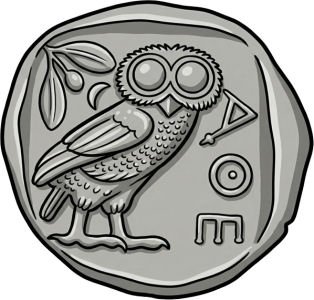
Numismatics is an auxiliary historical science that deals with the study of old currency and money-like objects such as medals and tokens. Through the analysis of shape, material, inscriptions, iconography, and the context of creation, numismatics helps historians understand the economy, politics, culture, and society of past civilizations. Numismatics is a sort of „bridge“ between archaeology, history, economics, and art.
Likewise, numismatics is also a popular collecting hobby. Collectors gather numismatic items, classify them, study their stories, and preserve them from decay and oblivion. Thanks to collectors, many currency specimens have survived the centuries and today reside in museum collections, representing a precious source of knowledge for future generations.
The very word „numismatics“ originates from the Greek word „nomisma“ (νόμισμα), which means „money in circulation“ or „that which is authenticated,“ that is, „recognized as a legal tender.“ This word is derived from the verb „nomizein,“ which means “to hold,“ or „to possess according to custom.” The verb itself has its source in the word „nomos“ (“custom, practice”), and that word is again derived from the word „nemein“ (“to distribute, to allocate, to hold”). This etymological analysis points us to the deep connection between money, social norms, and human behavior.
Regarding the ways of dealing with numismatics, we can distinguish three main ways, two approaches: scientific, commercial, and collecting (collector's).
Scientific study of numismatics it entails: systematic study of money and scientific research; writing of expert papers; analysis of the historical context and economic conditions in which a currency appears; comparison of various forms and types of money; cataloging and documentation of money and archaeological finds. Scientific numismatists often operate within institutions such as museums, universities, and archaeological institutes.
Commercial numismatics involves the buying and selling of coins, banknotes, and related items with the aim of making a profit, with an emphasis on market value, condition, and demand. Unlike scientific numismatics, it is not concerned with researching the historical context, but rather with the practical valuation, acquisition, and sale of numismatic material.
Collecting numismatics It gathers a larger number of people who engage in it out of a love for money (as an object), but without academic or commercial ambitions. Collectors usually collect different types of money; they look for specimens that interest them; they exchange coins and banknotes with other collectors; they study numismatic catalogs and literature; they organize collections according to their own criteria. This form of engaging in numismatics brings joy, passion, and personal satisfaction.
It must be emphasized here that the scientific and collecting approaches are not mutually exclusive. Many collectors have developed a scientific interest over time, while numerous scientists are also passionate collectors. Numismatics naturally connects both ways of thinking. Likewise, there is an intertwining with the numismatic trade. Very often the dealers themselves are also collectors, and some collectors eventually decide to engage in numismatic trade.
2.2. How to get into numismatics?
2.2.1. Scientific study of numismatics

Numismatics as a scientific discipline differs from hobbyist coin collecting and the trade of old money. In the scientific sense, numismatics is an auxiliary historical science that studies money as a historical source. Its goal is not to determine the market value of coins, but to understand their role in the society, economy, and politics of a given period.
A scientific numismatist studies how money originated, how it was used, and what it tells us about the era in which it was in circulation. The motifs and inscriptions on coins are analyzed, along with their weight, dimensions, and metallic composition. Numismatic finds are used as a valuable source for history, archaeology, and economic history, and the research results are published in academic papers, catalogs, and specialized publications. Therefore, numismatics is closely connected to history and archaeology.
The path toward scientific numismatics is most often academic. There is no special numismatics study program; instead, one begins by studying history, archaeology, or related disciplines. During graduate and doctoral studies, further specialization takes place, and a scientific career almost always requires a doctorate. In addition to formal education, it is necessary to have a knowledge of Latin and Greek, the basics of metrology, and experience working with scientific literature and museum collections.
Professional numismatists most often work in museums, universities, and research institutes. It is a narrowly specialized and demanding field, but academic numismatics provides a deeper understanding of money and its historical role.
2.2.2. Commercial dealing in numismatics

Commercial numismatics is based on the buying and selling of coins, banknotes, and related items with the goal of making a profit. Unlike scientific numismatics, the commercial approach places emphasis on the market value of an item rather than its scholarly analysis. Market demand, the rarity of a specific specimen, and its condition play a key role.
In practice, a coin dealer buys material from citizens, collectors, heirs, or other dealers and resells it to their buyers on the numismatic market. The dealer's task is to evaluate a coin or banknote in a short time, taking into account its rarity, condition, historical and collector appeal, and the current market state. Based on this evaluation, a decision is made regarding the purchase and the future selling price.
The sale of numismatic material takes place through specialized shops, fairs, auctions, and the internet. In the process, the dealer must have a good knowledge of the market and price trends, as well as the ability to recognize counterfeits and forgeries. A basic knowledge of the history of money is also necessary, as it helps in the proper identification and valuation of items.
Working in numismatic trade often involves making decisions under time pressure and with the constant risk of market price fluctuations. Therefore, experience and caution are of crucial importance. Equally important are client trust and reputation, which are built through long-term and fair work.
Although commercial numismatics often overlaps with collecting, it remains primarily a market activity. It does not require an academic education, but it demands continuous learning, market monitoring, and practical experience. For many people, the commercial approach is precisely the first step into a deeper understanding of the world of numismatics.
2.2.3. Collecting numismatics

Numismatic collecting is an activity in which coins, banknotes, and other similar items falling under numismatics are systematically collected and studied. It can be practiced for a short period of time, but also throughout a lifetime. The primary goal of collecting is, first and foremost, owning the items of interest, followed by understanding their origin, meaning, and place in history.
In practice, numismatic collecting begins with an interest in a specific theme. This can be the currency of a single country, a particular historical period, an individual ruler, or a special type of issue. Over time, the collection generally develops according to a plan, with the collector striving to acquire specimens that fit into the chosen field. Collecting can also be less systematic and without a clear direction, depending on the collector's preferences.
Numismatic collecting involves recognizing and identifying coins and banknotes, assessing their state of preservation, and determining their rarity and market value. An important part of the activity is also learning, as the collector constantly encounters new issues, variants, and information relevant to the money they collect. Because of this, specialized literature such as numismatic catalogs and other sources of important information is often used in collecting.
In everyday practice, numismatics is collected through purchase, exchange, or inheritance. Items are acquired at fairs, auctions, in specialized shops, or via the internet. Acquisition is followed by proper systematization, storage, and preservation. Collecting numismatics requires patience, consistency, and a critical approach. Mistakes are common in the beginning, but they are an integral part of learning. Over time, experience, confidence in evaluation, and clearer selection criteria develop. It is precisely this gradual development of knowledge and the collection that makes collecting numismatics a lasting and fulfilling activity.
2.2.3.1. Historical overview
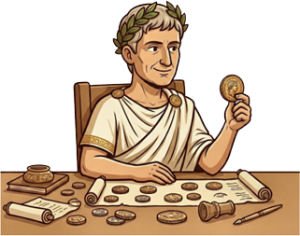
Collecting old money dates back to antiquity. It is known that the Roman Emperor Augustus liked to collect rare antiquities, including money. However, collecting in the modern sense began in the Renaissance, when the European aristocracy discovered the beauty of ancient money and began collecting it systematically. Already in the 17th and 18th centuries, the first numismatic literature, catalogs, and numismatic scientific papers were published.
In the 19th century, the study of ancient coins became a true academic discipline. The first significant numismatic museums and numismatic societies were established:
- Royal Numismatic Society (The Royal Numismatic Society), London, United Kingdom, 1836.
- Royal Numismatic Society of Belgium (Royal Numismatic Society of Belgium), Brussels, Belgium, 1841.
- Numismatic Society of Berlin (Numismatic Society in Berlin), Berlin, Prussia, 1843.
- American Numismatic Society (American Numismatic Society), New York, United States of America, 1858.
- French Numismatic Society (French Numismatic Society), Paris, France, 1865.
- Numismatic Society in Vienna (Numismatic Society in Vienna), Vienna, Austria, 1870.
- Italian Numismatic Society (Italian Numismatic Society), Milan, Italy, 1892.
- Royal Dutch Numismatic Society (Royal Dutch Society for Numismatics and Medallic Art), Amsterdam, Netherlands, 1892.
In the 20th century, mass production of money begins in large quantities. Alongside regular money, commemorative editions in silver and gold intended for the numismatic market are increasingly minted. Numismatics is becoming popular among the general population. In Croatia, the first numismatic society is also founded in 1928 – Numismatic Society in Zagreb (today: Croatian Numismatic Society). Numismatic fairs and clubs are experiencing a boom, and the advent of the internet at the end of the century also brings significant changes to the numismatic world.
The 21st century brings even greater changes to life, and consequently to numismatics. Digital platforms, online auctions, and databases enable the accessibility of information and broaden the collecting community globally. Although numismatics is perceived as an „outdated hobby,“ it is gaining more and more followers and enthusiasts worldwide. The focus of interest is increasingly shifting from Europe and America to Southeast Asia.
2.2.3.2. Why collect numismatics?

People collect numismatics for various reasons. Every numismatist has their own personal motive, but most reasons can be categorized into a few main groups. Collecting often begins with curiosity, and over time it grows into a lasting and more meaningful activity.
The main motives for collecting numismatics are:
- Love for history and culture. Coins and banknotes bear witness to past times, rulers and states, as well as the art of that era.
- Aesthetic appeal. Coins and banknotes are small works of art, shaped by top artists and as such they attract people who like that.
- Preservation of cultural heritage. By collecting and preserving old money, we preserve small pieces of historical and cultural heritage.
- Investing. Some collectors see their collection as a form of long-term savings or preservation of value and expect that one day they will sell that collection for more money than they paid.
- Personal curiosity. Some have a desire to explore and learn new things.
Engaging in numismatics also brings a number of concrete benefits for the collector that go beyond mere item collecting:
- Fun. The hunt for new specimens and completing the collection bring satisfaction.
- Relaxation. The study of coins and banknotes requires peace and concentration, and allows for relaxation and an „escape from reality.“.
- Learning. Every coin and banknote opens a door to a historical period, empire, or economic story that can be very interesting.
- Socializing. Numismatists connect through clubs, fairs, internet forums, and social networks. It is a hobby that brings together people of all generations who frequently socialize and share common interests.
- Material heritage. Collections of numismatic items can become valuable legacies for descendants, museums, or scientists.
The combination of personal motives, knowledge, and long-term value is precisely what makes numismatic collecting an attractive and enduring activity for people of various interests and ages.
Supplementary video:
• Why do people collect coinsAtiku?
2.2.3.3. Conceptual frameworks in numismatics
2.2.3.3.1. Numismatics as art collecting

Coins and banknotes are not only means of payment, they are also poor works of art shaped by sculptors, engravers, printmakers, and designers. Each issue represents a blend of technique and aesthetics. Coins and banknotes are, on the one hand, works of art, yet with a practical function. This makes them one of the most fascinating forms of applied art in human history.
Coins can also be viewed as small plastic (medallic art). In sculpture, small-scale plastics refer to miniature sculptural works and reliefs, and coins are precisely that: miniature sculptures (reliefs) and the result of the work of master medallists who create scenes of great expressiveness within a few millimeters of metal.
Banknotes, on the other hand, are reminiscent of graphics. Banknotes are in any case a type of graphic print, but they have their own utilitarian function. Like prints, they are produced in series—often with a clearly defined number of identical copies, and as a rule, they also state a serial number.
The differences between numismatics and collections of paintings or sculptures are essentially minimal. All three activities stem from the same fundamental human need for aesthetic experience and an understanding of the material traces of the past:
- all rely on the human need for aesthetics and visual expression;
- all require knowledge, patience, and systematic organization;
- all contribute to the preservation of cultural and historical heritage.
In that sense, numismatics does not differ essentially from art collecting, but rather represents one of the forms of the same universal urge: the endeavor to recognize, preserve, and pass on beauty, history, and human creativity to future generations.
2.2.3.3.2. Numismatics as a contact with history and the world
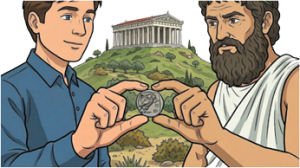
Coins and paper money have passed through countless hands throughout history. Who knows how many people paid, traded, or saved with the very money that is found in our collections today. That thought is especially powerful with ancient coins, whose age often exceeds two thousand years, and which were part of the everyday life of long-vanished empires and states.
Certain specimens of money were tied to particularly significant historical periods and events: money issued during the time of great statesmen, money of medieval cities in which we still live today, money from times of war or political upheaval, as well as money from one's own youth, which carries a strong emotional charge and evokes memories of childhood and formative years.
On the other hand, some money originates from distant and exotic places that we may never have the opportunity to visit personally. Such items become a window into other cultures and worlds. At the same time, money can also be a personal memento of travels, of countries and landmarks that we have experienced with our own eyes and which are immortalized on coins or banknotes.
In this way, money transcends its basic function as a medium of exchange and becomes a bearer of time, space, and human experience. It establishes a quiet yet profound philosophical connection with the past and with the countless people who have come into contact with it, making it a unique witness to history and everyday human life.
2.2.3.3.3. Numismatics as an investment and savings
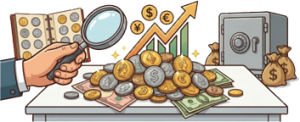
Part of coin and banknote collectors approach numismatics with a distinct investment motive, counting on the future growth in the value of their specimens. The premise is that the coins and banknotes they own today will be worth significantly more over time than at the time of acquisition, with the difference between the invested and realized funds representing potential earnings or profit.
This approach is particularly pronounced among numismatists who focus on collecting coins made of precious metals, the price of which generally rises in the long term, either as a consequence of inflation or due to increased market demand. In addition, certain areas of numismatics have recorded significant price growth over the past twenty years or so. Of particular interest are examples of national numismatic markets in countries where there has been an increase in the standard of living and the purchasing power of the population, which has resulted in greater demand and consequently higher prices for numismatic material.
Significant changes have also been recorded in the paper money market. Banknotes that once had a relatively narrow circle of collectors experienced a true price expansion with the advent of the internet and the development of cross-border trade, which made the market global and significantly more transparent. At the same time, additional impetus to value growth was provided by precious metals, which have recently recorded a noticeable increase in prices.
On the other hand, some collectors do not view numismatics primarily as a means of making a profit, but rather as a way to preserve capital value and protect against inflation, which diminishes the purchasing power of money in the long term.
However, although numismatics is often perceived as an attractive investment instrument and an opportunity for significant profit, it is essential to emphasize that, like any other market, it carries certain risks. The value of numismatic material can decrease due to a decline in interest, changes in collecting trends, or a drop in the purchasing power of collectors. Therefore, an investment approach to numismatics requires caution, experience, and a thorough knowledge of the field in which one is investing.
2.3. Famous numismatists throughout history
Coin collecting for centuries was known as the „hobby of kings” because it was practiced by rulers, nobles, scholars, and other prominent individuals.
- August car (63 BC – AD 14) He collected old, rare, and foreign coins, which he sometimes gave as gifts to friends during the Saturnalia.
- Gaius Julius Caesar (100 BC – 44 BC) – He is considered one of the first known Roman collectors of ancient and commemorative coins.
- Francesco Petrarca (1304. – 1374.) – He collected Roman coins for their historical and artistic value and is often called the „father of modern numismatics”.
- Cosimo de’ Medici i Lorenzo the Magnificent – They created one of the most important Renaissance collections of ancient coins and medals.
- Maximilian I. i Ferdinand I, Holy Roman Emperor By systematically collecting coins, they contributed to the creation of large Habsburg museum collections.
- Louis XIV. (1638. – 1715.) The French king was personally interested in ancient coins and regularly inspected specimens from the royal collection.
- Victor Emmanuel III. (1869. – 1947.) – Italian king and one of the greatest numismatists in history. His collection contained more than 100,000 coins, and he also participated in the creation of a monumental work Corpus Nummorum Italicorum.
- King Farouk I. (1920. – 1965.) – He owned one of the most famous collections of the 20th century, including a rare American gold coin Double Eagle from 1933.
- Thomas Jefferson He studied foreign currency and monetary systems while shaping the American monetary system.
- John Quincy Adams – He was a famous American coin collector, and his family collection was later sold at public auction.
- Franklin D. Roosevelt – Although better known as a philatelist, he was also interested in coins and American monetary history.
- Nicole Kidman – A well-known actress who was publicly associated with collecting ancient Greek and Roman coins.
- James Earl Jones – Actor and collector who was the narrator of the numismatic documentary film Money: History in Your Hands.
- Friar Matija Petar Katančić (1750. – 1825.) - One of the first professors of numismatics in Europe and author of the work Elements of Numismatics.
- Don Šime Ljubić (1822. – 1896.) – Author of the work Description of Yugoslav currency, which laid the foundations of professional numismatics in these regions.
- Milan Rešetar (1860. – 1942.) – Philologist and numismatist particularly deserving for the study of the currency of the Republic of Dubrovnik.
- Counts Drašković i Zrinski bans - Historical sources record that they already possessed private collections of ancient coins in the 17th century.
Supplementary video:
• Money: History in Your Hands – Part
• Money: History in Your Hands – Part II
