






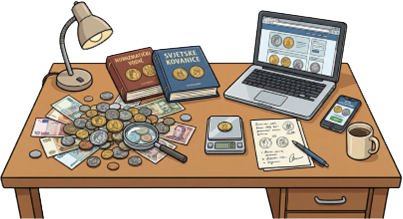
A large number of numismatists begin collecting old coins in their childhood. Others take up this hobby in their more mature years, while some discover numismatics only upon retirement, looking for a meaningful and stimulating pastime.
The most common incentive to start collecting stems from encounters with foreign money or during periods of currency replacement in circulation, for example during denominations or the introduction of a new currency. Since foreign money differs visually and contextually from domestic money, it often arouses the curiosity and interest of the future collector. A similar effect occurs when existing money is replaced by new money, whether by a new currency or a new design. It is precisely then that the whole numismatic story begins for many.
In the initial phase of collecting, coins and banknotes are most often gathered without a clear order and system, and everything considered interesting is „piled up.“ However, as the interest deepens and the collector becomes familiar with the basic rules and numismatic principles, the collection gradually takes on a systematic and meaningful shape. Over time, the approach to collecting also changes, becoming more thoughtful, selective, and aligned with personal interests and capabilities.
To make the collection process easier and ensure its long-term sustainability, it is recommended to clearly define several key elements right from the start:
The purpose of collection. The question every collector should ask themselves is: Why am I collecting? Numismatics should primarily bring satisfaction, joy, and relaxation. The purpose can be learning, preserving value, aesthetic pleasure, or simply leisure. It is important that the purpose is clearly defined, as this makes decision-making easier later on. At the same time, collecting must not turn into an obsession or addiction, because then it ceases to be a hobby and becomes a problem.
Collection area. The next important question is: What am I collecting? Determining the area or criteria of collecting (period, country, theme, material, and the like) greatly facilitates the organization of the collection. These criteria are not permanent and can change over time. It is not necessary to remain tied to one area for your entire life, but the initial focus reduces indecision and frustration.
Collection goal. The third question relates to what you want to achieve. Do you want to collect at least one specimen from each country, complete a certain series, collect coins with the same year, or with a specific motif? A clearly defined goal gives meaning to the search and brings satisfaction with every new step towards its achievement.
Financial budget. It is equally important to determine how much can and wants to be spent on a hobby. The purchase of numismatics should be aligned with personal financial capabilities. If a monthly amount is predetermined, for example 50 or 100 euros, it is advisable to stick to it. Collecting is not a competition and there is no need for a „race“ with others. The collection is built gradually, without financial pressure and without endangering personal financial stability. When the planned budget is spent, the acquisition of new items is temporarily paused and one enjoys a little bit of what has already been acquired and included in the collection.
3.1. Initial Steps in Numismatics

Anyone who is just starting out in numismatics should take the following initial steps:
Inventory of existing material. At the beginning, when entering the world of coin collecting, the first step is to see what we actually have. This awaits us with the extraction of coins and banknotes from boxes, drawers, and envelopes, and arranging them into clear groups. As an initial criterion, it is recommended to group the coins and banknotes by country, which provides a basic insight into the scope and structure of the collection. Only after that does a thoughtful decision follow regarding the area and direction of further collecting.
Extracting duplicate copies. After determining the basic collection criteria, it is necessary to extract duplicate specimens from the collection in accordance with those criteria. Such specimens will later be used for exchange with other collectors or for sale, which can fund the further expansion of the collection.
Education about the collection area. In the initial phase, it is especially important to educate oneself about the field of collecting. Familiarizing oneself with the basics of numismatics, the history of money, technical characteristics, and the market values of coins and banknotes makes the collecting process simpler, safer, and significantly more interesting. Professional numismatic catalogs and literature are an indispensable part of this education, and useful information can also be found on the internet. It is equally important to consult with more experienced colleagues, whose practical experience often complements our basic theoretical knowledge.
Contact with other numismatists. Contacting other numismatists enables the exchange of knowledge, experiences, and materials. More experienced collectors can help beginners find their way, warn against common mistakes, and provide valuable advice on buying, trading, and developing a collection. In this way, reliable numismatic dealers can also be met. Visiting and joining a local numismatic club, as well as joining regional, national, or international numismatic societies, is especially recommended.
Acquisition of new copies. For the collection to develop and grow, the gradual acquisition of new coins and banknotes is essential. It is good to start in one's own environment by asking friends and acquaintances if they have any old or foreign money they do not need. Many people possess such money and often throw it in the trash, unaware that it may have numismatic value. In addition, new specimens can be obtained through exchange with other collectors, purchasing from specialized dealers, participating in numismatic auctions, and via online platforms. These forms of acquisition will be discussed in more detail below.
3.2. Five Key Tips for New Numismatists

Many new numismatists initially encounter a sense of insecurity, frustration, or a lack of self-confidence. Sometimes they are discouraged by the fact that their collection is still small, sometimes by the way they are treated by more experienced collectors and dealers, and quite often by their own feeling that they do not have enough knowledge about the items they are collecting. All of these are completely normal and expected phenomena in the early stages of engaging in numismatics.
To make it easier for beginners to enter the world of numismatics, it is important to keep in mind a few fundamental guidelines that can significantly improve the collecting experience, help avoid common mistakes, and encourage personal progress.
Knowledge is the foundation of numismatics. The greatest advantage a numismatist can have is a thorough knowledge of the coins and banknotes they collect, their history, technical characteristics, actual value, and market trends. Anyone who knows their field of interest is always at an advantage over a collector who buys randomly and without a deeper understanding. Systematic learning through specialized literature, numismatic catalogs, magazines, internet sources, and the exchange of information with others reduces the risk of misjudgments, overpaying, and buying counterfeits, which are the most common mistakes made by inexperienced collectors.
Patience and the gradual building of the collection. Collecting coins and banknotes is not a race and brings no satisfaction if the collection expands rapidly and uncontrollably. Buying a large number of items in a short time often leads to the collector failing to get acquainted with individual specimens or understand them in a broader historical and numismatic context. A quality approach implies a slower pace, carefully thought-out acquisitions, and time dedicated to each individual item. There are numerous examples of collectors who, in a rush, created extensive collections without having a clear overview of what they actually owned, which ultimately leads to a superficial attitude towards the hobby and a feeling of being overwhelmed.
Connecting with others and sharing experiences. The numismatic community brings together people of very diverse backgrounds, professions, and life experiences, and the exchange of knowledge and experience with others often brings new insights and broadens perspectives. Through such contacts, it is easier to learn the rules of the numismatic world and market, recognize mistakes, and avoid scams, and lasting friendships based on a shared interest are frequently developed as well. Of course, as in any environment, there are both honest and dishonest individuals in numismatics, but that too is part of the learning and navigating process.
Age is not a measure of expertise. It is a common false assumption that older collectors necessarily know more. A young numismatist collector can acquire knowledge in a relatively short time that surpasses that of someone who has been engaged in the hobby for decades, especially if they actively learn, research, and participate in discussions. In numismatics, knowledge, experience, and engagement are valued, not years. Therefore, new and younger collectors should be encouraged to be active, ask questions, share their observations, and participate equally in numismatic life.
Enjoying numismatics as the most important goal. Collecting should always remain a source of pleasure, personal development, and intellectual curiosity. A collection should bring joy, not stress or financial pressure. Obsessive collecting, comparing oneself to others, frustration over rare and unattainable specimens, and going into debt to buy an expensive piece lead in the long run to a loss of mental balance and dissatisfaction. Healthy collecting is only possible when it is in line with one's personal means and when it contributes to a positive experience of numismatics as a hobby.
3.3. Coin collecting
The answer to the question of which coins to collect primarily depends on the collector's affinities and interests. Each person has their own preferences and sees „something of their own“ in numismatics, as a reflection of personal interests, desires, and motives.
There are many ways and criteria for collecting coins, which can include different countries, continents, historical periods, motifs, metal types, and other aspects. Below are some of the most common ways and criteria for collecting.
Collection by countries, territories, or cities. This is one of the most widespread approaches. In this case, coins of a specific country, territory, or city are collected. Among numismatists, collecting national numismatics, which encompasses the currency of the home country and often the currency of predecessor states, colonies, or associated political entities, is a very common phenomenon. Some collectors focus on the broader area in which they live, for example, their own region or province, while others opt for municipal currency if the city historically had its own coinage. Within this criterion, it is also possible to apply other criteria that can be combined with this approach.
Collection by ruler. Some coins bear the images of emperors, kings, princes, or other rulers. Some numismatists collect coins exclusively of one specific ruler or several of them. For example, in ancient coinage, it is common practice to collect coins with the images of one or more emperors, while in modern numismatics, collecting all coins featuring the English Queen Elizabeth II or Napoleon Bonaparte is well known.
Collection by type. This is a very widespread form of coin collecting. In this case, different types of a specific currency are collected, regardless of the year of minting. In this way, coins from the entire world can be collected, as well as coins within a narrower area, combined with some other criteria. For this approach, it is crucial that each specimen differs in its basic appearance, while the year of minting, mint mark, and minor details are not as important.
Collection by variants. This is a collecting method that usually includes collecting by type as well, but with an emphasis on smaller differences that occur within the same coin type. These are differences in design details, inscriptions, or other elements, where the year of minting is often not as important.
Collection by year. This method of collecting is based on a chronological approach and generally includes collecting by type as well. The goal is to collect all coins with the issue years that appear. Very frequentely, this way of collecting also encompasses varieties, mint marks, and other details. Some would call this approach „collecting everything.“ It is one of the most comprehensive ways of collecting, especially when it comes to collecting all world coins. However, in practice, it is more commonly present when collecting only a single country or a limited area (province, city, etc.).
Mint collection. This is a collecting method where only coins minted in a specific mint are collected. It is quite unusual in modern numismatics, but very common in collecting ancient coins. Thus, for example, some numismatists in our country exclusively collect Roman coins minted in the Siscia mint, present-day Sisak.
Collection by type of currency. There are numismatists who collect exclusively coins that were in everyday circulation, others focus only on commemorative issues, while a third group collects both. This group can also include the collection of „specialties“ such as trial strikes, special mintages, or coins with errors.
Collecting by motif. This method of collecting is based on the themes depicted on the coins. Motifs from the animal and plant kingdoms, depictions of ships, buildings, coats of arms, sports, or other thematic elements are often collected. This criterion can also include collecting coins related to a specific historical period, such as World War II, as well as collecting coins with a specific year, like a birth year. Each collector chooses a motif that is personally interesting to them and that encourages them to collect.
Scrap metal collection. In most cases, this refers to collecting coins made of precious metals such as gold, silver, and platinum. This method of collecting is often present among investors, but this is not a rule. There are also numismatists who collect only gold or silver coins for exclusively numismatic reasons.
Size sorting. Some numismatists collect coins of various extreme sizes, so miniature coins are collected as well as huge specimens. Very often the collection consists of large thaler-sized silver coins.
Collecting by oddity. It includes coins of unusual shapes or made of atypical materials. Although most coins are metallic and round, there are also square, elliptical, triangular, and even spherical specimens. In addition, there are coins made of materials such as ceramics or plastic. Precisely such deviations from the ordinary often arouse special interest among collector numismatists.
All of the listed criteria can be combined with one another, resulting in a large number of possible collecting methods. Some numismatists, ultimately, simply collect what they like. And that is a completely valid criterion. Collecting coins that one likes and enjoys holds equal value to any systematic approach.
Collecting criteria should remain flexible. Every collector has the right to their own choice and their own perspective on numismatics. It is important not to judge others based on the criteria by which they collect, because what brings joy and fulfillment to one person does not have to be the same for everyone. It is precisely in this diversity that the richness of the numismatic world lies.
3.4. Collecting banknotes
Methods of collecting banknotes are largely similar to those of coin collecting, with the exception that banknote collecting has certain specific characteristics of its own. Below are some of the most common ways banknotes are collected.
Collection by countries, territories, or cities. Similar to coins, numismatists who collect this way collect banknotes of a specific country or political entity, often with an emphasis on national notaphily. However, it is common to collect multiple different countries, and sometimes even all the countries in the world.
Collection by type. As with coins, in this case different types of banknotes are collected, regardless of the date shown on them, serial number, or signatures. This is a very widespread and popular way of collecting banknotes. Therefore, banknotes of different denominations and appearances are collected. This method of collecting is often combined with some of the other collecting methods listed here.
Collection by variants. This is already a more detailed way of collecting, because, in addition to the type, it also includes collecting smaller differences within the same banknote type. These can be differences in the signatures of governors or ministers, in the serial number, minor color differences, small graphic elements, or security features. This approach requires a higher level of engagement and is most commonly found among more experienced numismatists.
Grouping by date. This method of collecting is based on a chronological approach, just like with coins, where the goal is to collect all the different issue dates of a specific banknote. This collecting criterion incorporates collecting by types and very often includes collecting different variants as well. Some might even call this approach „collecting everything.“.
Collection by denomination of banknotes. Some numismatists collect exclusively banknotes that were in regular circulation, while some also collect „specialties“ such as banknote proofs, unissued banknotes, unadopted designs, replacement series, and even banknote sketches. Likewise, some also collect banknotes with printing errors.
Collection by serial numbers. This is one of the criteria specific only to banknotes. Namely, the vast majority of banknotes have a serial number on them. Likewise, with serial numbers, there can be differences such as: the number of digits, letter prefixes and suffixes, the color of the serial number, special marks in the serial number such as asterisks or №, etc. Some numismatists collect banknotes with special serial numbers, such as numbers made up entirely of zeros, the same digits, consecutive sequences, the so-called „radar numbers“ that read the same from both sides, or repeating patterns. In some cultures, for example in China and other Asian countries, numerology has a strong significance, so special attention is paid to numbers considered lucky or unlucky. When it comes to banknote serial numbers, a large proportion of numismatists value the so-called replacement series of banknotes.
Collecting „specimen“ banknotes. Collecting this type of banknote falls under „specialty“ collecting. These are banknotes that were not intended for circulation, but served as samples for banks, institutions, or for presentation. Such banknotes often feature additional markings, perforations, or overprints (SPECIMEN), and due to their limited purpose and small number of printed copies, they are particularly interesting to collectors.
Collection by material. Banknotes can be printed on various materials. Most commonly, this is a special type of security paper, but there are banknotes printed on plastic (polymer), as well as those printed on extremely unusual materials such as cardboard, fabric, or wood. An increasing number of numismatists today collect plastic (polymer) banknotes, which are known for their visual appeal.
Collecting by banknote visual style. With this method of collecting, the emphasis is placed on the design style of the banknote. Namely, certain printing houses have their own design style, and all the banknotes they print are in some way similar, while some even share the same motifs or graphic elements. In the world of notaphily, banknotes printed in the American style (most commonly by the American Bank Note Company) and those in the French style (most commonly produced by the Banque de France, but also other printers) are well known. Some numismatists choose precisely the visual style of the banknote that they like as their collecting criterion.
Collecting by motif. This method of collecting is equally present in banknotes as it is in coins. Banknotes often depict portraits of historical figures, architecture, monuments, landscapes, animals, plants, or state symbolism. Collectors choose motifs that personally interest them or with which they emotionally connect. In a way, collecting by a specific theme, such as wartime, occupation, camp, and similar issues, can also be linked to this method of collecting. Likewise, banknotes with various overprints and stamps can be categorized under this heading.
As with coins, all of these listed criteria can be combined with each other, resulting in a large number of possible approaches to collecting banknotes.
