


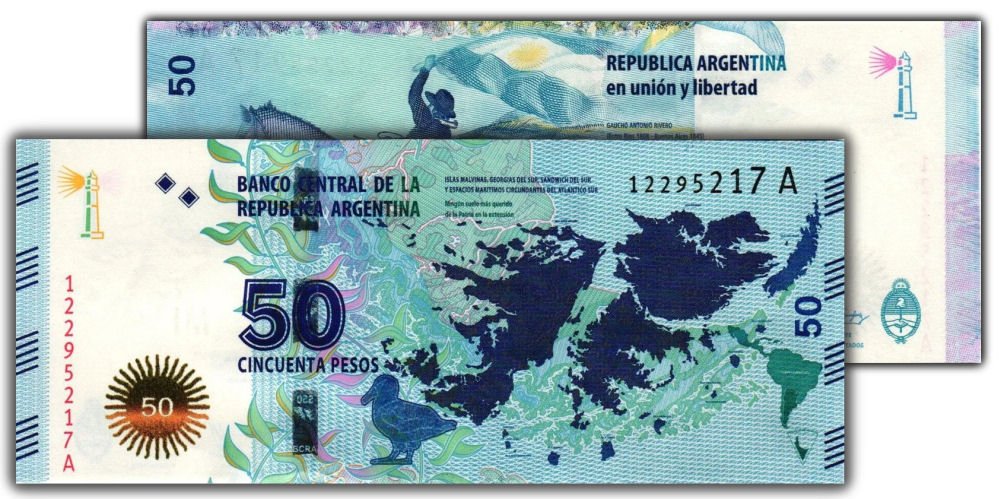
The 2015 Argentine 50-peso banknote is one of the more interesting modern world banknotes, not only because of its engaging artistic and security features, but also because of the strong political message it carries. At first glance, it is a commemorative circulation banknote dedicated to the archipelago that Argentina calls Islas Malvinas, and which in British and international usage is most commonly called the Falkland Islands. However, behind this motif lies one of the longest-standing territorial disputes of the modern era.
The banknote was issued by the Central Bank of the Argentine Republic, Banco Central de la República Argentina, and was officially put into circulation on March 2, 2015. It is a circulating commemorative paper banknote, measuring 155 × 65 mm, catalog number Pick P-362, or according to Argentine literature Bottero (Billetes de la República Argentina) 4201 to 4203. The banknote belongs to a series commonly associated with state-building and historical themes, and its motif openly expresses the Argentine stance on sovereignty over the Falkland Islands (Malvinas), South Georgia, the South Sandwich Islands, and the surrounding maritime areas of the South Atlantic.
Basic banknote information
Country: Argentina
Issuer: Central Bank of the Argentine Republic
Face value: 50 pesos
Release year: 2015.
Type: circulating commemorative banknote
Material: paper
Dimensions: 155 × 65 mm
Catalog number: Pick P-362
Mint: Casa de Moneda, Argentina
Signatures: Alejandro Vanoli and Julián Domínguez
Subject: Falkland Islands, South Georgia, South Sandwich Islands and the Argentine view of sovereignty in the South Atlantic
Obverse of the banknote
The obverse of the banknote is executed in dark blue print on a light background in tones of turquoise, pink, yellow, and multicolored blue. The serial numbers are printed in red and black. The main motif features the outline of Islas Malvinas, or the Falkland Islands, along with a depiction of South Georgia and the South Sandwich Islands. Thus, a political message is clearly established right on the obverse of the banknote: Argentina portrays these territories as part of its national and maritime space.
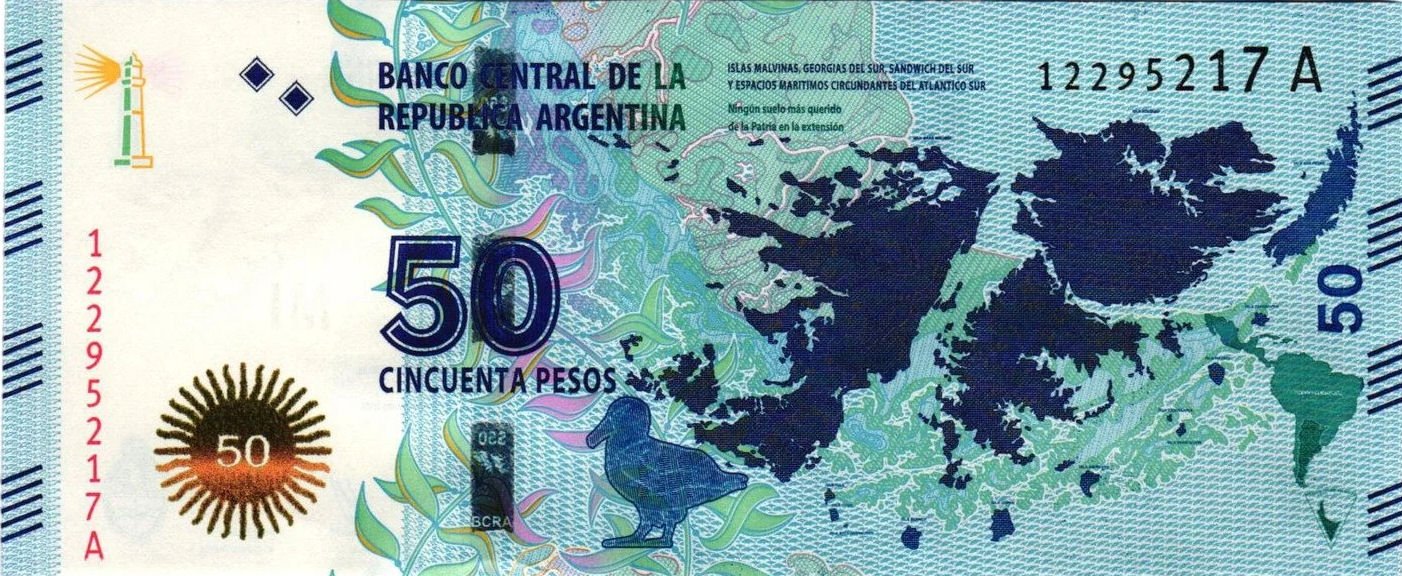
In the upper part there is the inscription “BANCO CENTRAL DE LA REPUBLICA ARGENTINA”, and to the right of it the text: “ISLAS MALVINAS, GEORGIAS DEL SUR Y SANDWICH DEL SUR Y ESPACIOS MARÍTIMOS CIRCUNDANTES DEL ATLÁNTICO SUR”. Below is a poetic quote: “Ningún suelo más querido de la Patria en la extensión”, which could be translated as: “No soil is dearer to the Homeland in its expanse.”
In the lower right part of the face, a map of Latin America, the Caribbean, and the Argentine Antarctic sector is shown. According to the interpretation of the Argentine Central Bank, this motif is intended to emphasize the regional dimension of the Malvinas issue, specifically the Argentine view that support for this claim belongs to the broader Latin American political community. As secondary motifs, marine vegetation and an albatross appear, placing the banknote within the natural environment of the South Atlantic. Above the watermark is a lighthouse, and at the bottom is the “May Sun” (Sol de Mayo), one of the most recognizable Argentine state symbols.
Back of the banknote
The back of the banknote is even more strongly politically marked. The main image features the gaucho Antonio Rivero on a horse, holding the Argentine flag in his hand. Next to his figure is text introducing him as the “first defender of national sovereignty in the Falkland Islands,” claiming that in 1833 he restored Argentine sovereignty and fought for the social rights of workers on the islands.
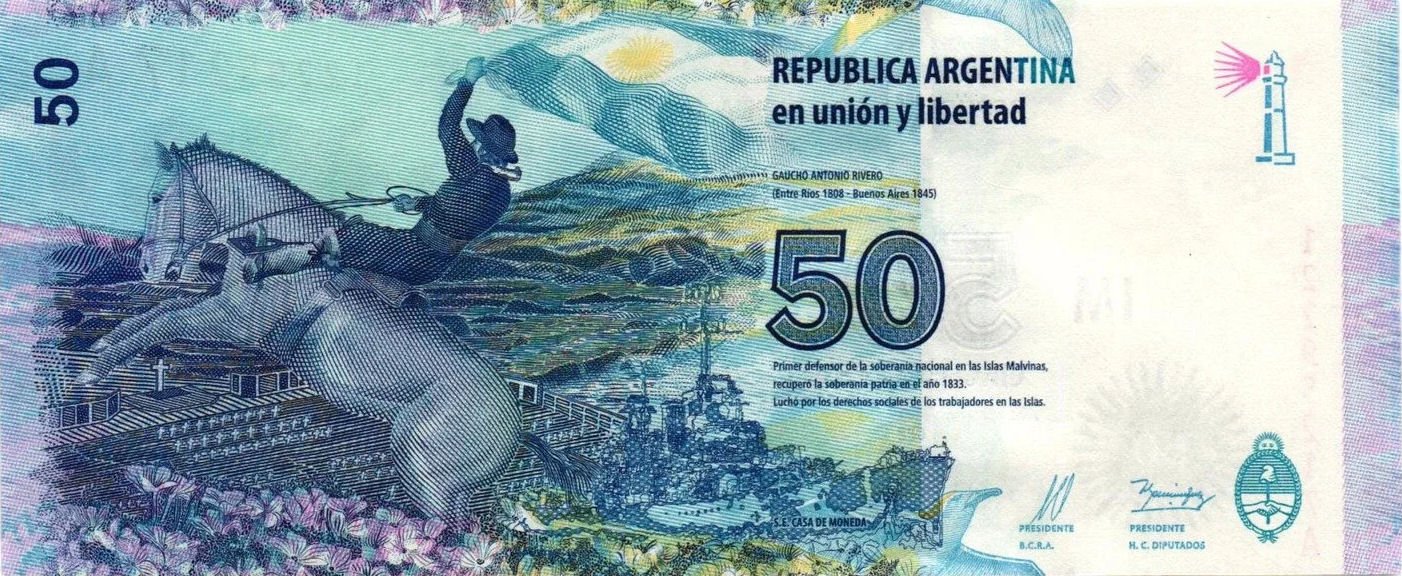
The lower part of the reverse side depicts the Argentine light cruiser “General Belgrano,” sunk on May 2, 1982, during the Falklands War. This motif is particularly strong in the Argentine collective memory, as a large number of Argentine sailors died in the sinking of the ship. The Central Bank of Argentina states there were 323 crew members killed.
On the reverse side, there are also depictions of the Falkland Islands landscape, the Argentine Darwin military cemetery in the Falklands, a Falkland steamer duck, a native flower, and the Argentine coat of arms. Everything is arranged as a visual narrative: homeland, territory, war memory, sacrifice, and sovereignty. Precisely for this reason, this banknote is not a neutral depiction of geography, but a small paper manifesto of the Argentine state stance.
Security features
The banknote features several security elements. The watermark displays a map of the Falkland Islands, also known as the Malvinas, alongside the electrotype design “IM”. The security thread is windowed and visible on the obverse in three segments, and when held up to the light, the markings “BCRA $50” and the map of the islands repeat. In the Argentine “May Sun”, the denomination 50 is printed in optically variable ink, which changes tone from gold to greenish when tilted, featuring a moving band effect.
The UV effect is also interesting. Under long-wave UV light, for example UVA 365 nm, green fluorescence appears on the leaves and on the denomination mark in the security thread on the face. Under short-wave UVC light, 254 nm, the leaves change their reaction to red, and the left serial number fluoresces red. This makes the banknote interesting for collectors who deal with the security features of modern paper money.
It is particularly interesting that this banknote, despite the political controversy, also received recognition for its design. The Central Bank of Argentina states that it won first place in the LatiNum 2014/2015 competition in the best circulating banknote category.
Historical background of the dispute
The Falkland Islands are located in the South Atlantic, east of the Argentine coast of Patagonia. Argentina calls them the Islas Malvinas and considers them part of its national territory. The United Kingdom considers them a British Overseas Territory. Today's dispute is particularly linked to 1833, when Britain re-established rule over the islands, while Argentina interprets that event as an illegal occupation and a break in its sovereignty. The Argentine Ministry of Foreign Affairs emphasizes that Argentina has never abandoned its claim to sovereignty over the Malvinas, South Georgia, the South Sandwich Islands, and the surrounding maritime areas.
The most dramatic phase of the dispute occurred in 1982, when the Argentine military junta occupied the islands. The United Kingdom sent a military expedition, and the war lasted 74 days. It ended with the Argentine defeat and the return of British administration over the islands. The war claimed the lives of 649 Argentine soldiers, 255 British soldiers, and three Falkland residents.
For Argentines, the Falklands are a powerful national symbol. It is not just a matter of territory, but also of historical memory, national dignity, colonialism, and war sacrifice. Therefore, it is no surprise that the motif of the Falklands ended up on a banknote. Money circulates daily, passes from hand to hand, and becomes a constant reminder of a political claim. Precisely in this lies the strength of this banknote, but also the reason for its controversy.

How Argentines view banknotes
From an Argentine perspective, the banknote is an expression of state continuity and national right. The official interpretation of the Central Bank clearly states that the design depicts the symbols and geography of the Falkland Islands, South Georgia, and the South Sandwich Islands as an expression of Argentine sovereignty over the archipelago.
For many Argentines, this banknote holds emotional value. It serves as a reminder of those who died in the 1982 war, the Darwin Argentine Military Cemetery, and the ongoing diplomatic struggle for what Argentina considers its territory. In this sense, the banknote is not only a medium of exchange, but also part of a broader state iconography.
However, reactions within Argentina itself were not exclusively patriotic. A segment of the public greeted the banknote quite coldly, not necessarily because they rejected the Malvinas motif, but because under inflationary conditions, it was considered more practical to issue a higher denomination, for example 500 pesos, rather than a new 50-peso banknote. According to reports at the time, the debate in Argentina revolved partly around purchasing power and the need for larger denominations, rather than just the political motive.
How the British and Falkland Islanders view this
The British side and the majority of the Falkland Islands residents view this banknote quite differently. For them, it is a political provocation and an attempt to introduce the Argentine territorial claim into everyday life through money. The British argument in this dispute is primarily based on the right of the island's residents to self-determination. In a referendum held in March 2013, 99.8 percent of voters voted in favor of the Falklands remaining a British Overseas Territory. The British government cites this result as proof of the islanders' political will.
The Falkland Islands government also issues its own currency, the Falkland Islands pound, which is at parity with the British pound sterling. Both Falkland Islands and British banknotes and coins are used on the islands. This fact is numismatically interesting, as it shows that the same disputed territory exists both on Argentine paper money and within the Falkland Islands' own local monetary system.
In 2015, the residents of the Falklands largely did not welcome the Argentine banknote as an admirable piece of currency, but rather as an object of ridicule and criticism. Comments from the island at the time often associated the banknote with Argentina's economic crisis and inflation, rather than just the territorial dispute. In British-Falkland circles, the banknote was judged as a propaganda stunt rather than a neutral numismatic issue.
The controversy surrounding Antonio Rivero
The most sensitive motif on the banknote is certainly the gaucho Antonio Rivero. The Argentine side depicts him as an early defender of national sovereignty over the Malvinas. According to the text on the back of the banknote, in 1833 he “restored patriotic sovereignty” and fought for the social rights of workers on the islands. That is a strong and clearly political formulation.

However, Rivero is precisely one of the main points of contention. The Falkland Islands Association, an organization representing the British-Falkland perspective on the entire situation, claims that the portrayal of Rivero as an Argentine national hero is a historical myth. According to that interpretation, the events of 1833 were not a patriotic uprising against British rule, but rather a violent conflict related to wages and working conditions in the settlement at the time, in which people associated with the entrepreneur Luis Vernet were killed. That side also emphasizes that at the time of the attack, there was no official British presence on the islands, and therefore disputes the claim that it was an anti-British uprising.
For numismatists, precisely that difference in interpretation is particularly interesting. The banknote does not depict only a historical figure, but rather an official version of history. When a state chooses a motif for a banknote, it simultaneously chooses the message it wants to spread. In the case of this Argentine banknote, that message is very clear: the Falklands are depicted as Argentine national territory, and Rivero as a symbol of early resistance and sovereignty.
Banknote as a political document
Banknotes often depict rulers, presidents, writers, scientists, monuments, flora, fauna, or cultural heritage. However, in this case, the banknote depicts a territory that is the subject of an active international dispute. Precisely for this reason, the 2015 Argentine 50-peso banknote transcends the usual framework of notaphily.
It is simultaneously a medium of exchange, an object that evokes emotion and memory, a political statement, and a part of contemporary propaganda iconography. Geography, war memory, diplomacy, state symbols, and collective emotion meet on it. In this, its numismatic value is considerably greater than its face value.
This banknote also shows how modern paper money can be used as a means of shaping public memory. While for Argentina it is an expression of “sovereign love” for the Malvinas, for the British and the inhabitants of the Falklands it is an expression of the unilateral appropriation of someone else's territory. For collectors, however, it is precisely these conflicting meanings that make it particularly interesting.
Numismatic significance
On the market, this banknote is not rare and is most frequently found in high grades of preservation. Its value in the collecting sense does not lie in its rarity, but in its theme, symbolism, and political background. It is a typical example of a modern banknote whose story is more important than its market price.
It is particularly interesting to collectors of thematic banknotes, political iconography, war memorabilia, territorial disputes, Latin American currency, and modern security features. Due to its striking colors, rich design, maps, animal motifs, and historical references, the banknote is visually very attractive. At the same time, it is a good example of how a seemingly ordinary circulation denomination can open up a whole range of questions: who has the right to depict a territory, whose history is found on money, and can a banknote be a tool for a diplomatic message?
The Argentine 50-peso banknote featuring the Malvinas motif remains one of the most interesting examples of modern notaphily. It is not expensive, rare, or old, but it is exceptionally powerful as a historical and political object. In a single banknote, the 1982 war, the 1833 dispute, Argentine national memory, the British argument of self-determination, and the daily life of the Falkland Islanders who do not see themselves as part of Argentina are all summarized. Precisely for this reason, this banknote deserves a special place in any collection that views money not merely as a medium of exchange, but as a document of its time.
Author: Zlatko Viščević with AI assistance
Photos: Numex – Coins, Banknotes & Militaria Store [www.numex.hr], Wikipedia.