







4.1. Basic Numismatic Terminology

When dealing with numismatics, regardless of the method or level of involvement, it is extremely important to know numismatic terminology. These are specific terms and expressions used in the numismatic world that have clearly defined, often very precise meanings. The proper understanding and use of these terms is necessary to avoid misunderstandings in communication with other numismatists, dealers, and experts.
This chapter lists and explains only the basic numismatic terms, while other, more complex or specialized concepts will be covered in greater detail in the individual chapters of this book.
Money is a universally accepted medium of exchange used for the payment of goods and services, the calculation of value, and the store of value. In a historical and numismatic sense, money encompasses various forms of payment, primarily coins and paper money, but also other forms such as vouchers, tokens, and similar issues. Money is simultaneously an economic, political, legal, and cultural phenomenon, as well as an important historical source.
Currency is the official name of a country's money. Currency can exist in the form of coins and paper money, and in the modern world, also in cashless form. In numismatics, the term currency is often used to designate a specific monetary system in a historical or geographical context.
Circulation It denotes the period during which money was in active use as a medium of payment or the current status of money as a medium of payment. Money with which payments could be made in a given period or can be made now as legal tender is called circulating money. However, there may also be money that is not intended for circulation, but is produced for the collector market. Such money is often legal tender, but is not used in practice for payments, in which case it is non-circulating money.
Coins (coins, die Münzen, monnaies) are physical money most commonly appearing in the form of a round metal disk, depicting certain content in the form of artistic representations and/or inscriptions. Coins are often also called metal money. Exceptionally, coins can also be of other shapes and made of different materials, which will be discussed in other parts of this book. In the Croatian language, the terms kovanice, kovani novac, and metalni novac are used for this type of money. In the numismatic world, the terms novčići or metalni novčići are practically never used. It is also completely wrong to use expressions like metalne novčanice. Likewise, it is inappropriate to use the term koini, borrowed from the English language.
Banknotes (banknotes, die Banknoten, billetes) are physical money that most often appears in the form of a rectangular sheet of paper or similar material, on which artistic representations and/or inscriptions are printed. Banknotes are often also called paper money. Exceptionally, they can also be made of other materials, such as polymers, and in various shapes. In Croatian practice, the terms novčanice (banknotes), papirni novac (paper money), and less frequently banknote (banknotes) are used. In the numismatic and notaphilic environment, the term papirne novčanice (paper banknotes) is not used, just as it is incorrect to speak of paper coins.
Numismatics is an auxiliary historical science that deals with the study of money and money-related objects, such as vouchers, tokens, and similar issues. At the same time, numismatics also refers to the collecting activity in which money is collected out of interest, as a hobby, or for professional reasons, most often with the aim of building a numismatic collection. In a broader sense, numismatics encompasses the study of all forms of money, while in a narrower sense it refers exclusively to coins.
Notaphily, which in some languages is also called bonistics, represents the field of collecting and studying paper money. Although closely related to numismatics, notaphily specifically deals with banknotes, their design, printing, security elements, historical context, and varieties.
Mint is an institution or workshop where coins are produced. In a mint, coins are manufactured through the process of stamping or casting, using special tools and molds. Historically, mints were often under the direct control of the state, ruler, or city authorities, as the right to coin money represented an important symbol of sovereignty.
Money printer is a specialized institution where banknotes and other security printings are produced. Due to the complexity of production and the need for a high level of security, money printing works use special printing techniques, papers, and security elements. Like mints, printing works are usually under the supervision of the state or central banks.
Numismatic collection, often called a collection, represents a set of coins, banknotes, and other numismatic items that form a meaningful and systematically shaped whole. A collection can encompass currency from a specific country, historical period, thematic motif, design author, or manufacturer, such as a particular mint or printing office. There are numerous criteria according to which a collection can be formed, but what all numismatic collections have in common is the existence of a clear idea, order, and systematization. A mere accumulation of money without criteria and structure is not considered a numismatic collection.
4.2. Numismatic Education

Numismatic education, or learning, as well as the acquisition of new knowledge and skills related to numismatics, represents an exceptionally important component of engaging in this field. Without a certain level of knowledge and understanding, numismatics loses its full meaning and becomes a mere accumulation of objects without deeper insight into their origin, significance, and value.
It is safe to say that engaging in numismatics without any education is essentially meaningless. If someone is involved in something, it is logical and natural for them to possess at least basic knowledge about the subject of their interest. Likewise, it would be unusual for someone to be interested in something without showing a desire to understand the field and systematically deepen their knowledge.
- Acquiring knowledge about numismatics through education is significant for several reasons, the most important of which are the following:
- enables proper identification and attribution of coins and banknotes;
- provides an overview of the kinds and types of money that exist, along with relevant data related to them;
- explains the historical background and context of the issuance of individual coins;
- it provides information on the rarity of individual specimens and their numismatic value;
- deepens knowledge in history, economics, culture and other related fields, and enriches general culture;
- encourages learning about other languages, scripts, peoples, and cultures;
- eliminates misconceptions and reduces the possibility of fraud;
- gives the numismatist security and self-confidence in dealing with numismatics;
- enables equal participation in discussions and communication with other numismatists.
Sources of knowledge and education in numismatics can be very diverse, but among them, numismatic literature holds a special place.
4.2.1. Numismatic literature
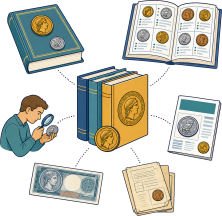
Numismatic literature encompasses all written works dealing with money, its history, technical characteristics, and accompanying phenomena. It represents the foundation of any serious study of numismatics and an indispensable tool in collecting, identifying, and evaluating numismatic items.
Basically, numismatic literature can be divided into numismatic books, catalogs, and professional journals, which together form the foundation of knowledge for every collector numismatist.
4.2.1.1. Numismatic books
General numismatic books feature texts and illustrations about money, and generally cover a specific numismatic field in detail. They discuss the origins of money, the historical and social context of its use, the operation of mints, artistic design, and the broader historical background of individual monetary systems.
This term refers to classical books that cover a specific numismatic topic, such as the history of money, the origin and development of a particular monetary system, the operation of mints, or the description of coinage from a specific period, country, or geographical area. Such works have a distinct educational and informative value and are often richly illustrated.
Numismatic books of this type are intended for a wide range of readers, from beginners to experienced numismatists. They most frequently cover the historical circumstances of the creation and use of money, the symbolism and design of coins and banknotes, the economic and social factors that influenced their issuance, as well as the cultural significance of money through various periods.
For this type of literature, the term „numismatic prose“ is also sometimes used. Numismatic prose is read primarily as educational literature and provides a good foundation for understanding the broader picture of numismatics, its historical development, and the place that money occupies in society and culture.
4.2.1.2. Numismatic catalogs
The second important group of numismatic literature consists of numismatic catalogs. These are specialized works that represent a sort of database on specific groups of money. Their primary purpose is to systematize, describe, and evaluate coins and banknotes according to predefined criteria.
Numismatic catalogs most frequently cover the currency of a single country, a specific geographic region, a historical period, or a ruler. There are also comprehensive catalogs that encompass almost all world currency, such as the „Standard Catalog of World Coins“ and the „Standard Catalog of World Paper Money,“ which are considered fundamental references in international numismatic practice.
Coin catalogs generally contain a series of detailed technical and descriptive data, among which the most important are:
- description of the obverse and reverse,
- mass, diameter and metallic composition,
- forging technique and type of rotation (Latin or Germanic),
- year of issue and, when known, the number of specimens minted,
- names of the author, engraver or mint,
- catalog and benchmark market values.
The banknote catalog code also lists additional data specific to paper money, such as:
- dimensions and basic colors,
- description of the motif, the design author, and the printing house,
- paper type, security and protective features,
- series, signatures and variants,
- catalog values according to the state of preservation and rarity.
A particularly important element of every catalog is catalog numbers, which serve as universal designations for individual types and variants of currency. They enable easier identification, comparison, and communication among numismatist collectors, dealers, and authors of literature.
The most famous international catalog designations are:
- KM, or Krause–Mishler, according to the Standard Catalog of World Coins,
- P or Pick, according to the Standard Catalog of World Paper Money.
In domestic numismatic literature, catalogs designated by the authors' surnames are also frequently used, such as the catalogs by Viščević, Dundović, Rešetar, Mimica, Rengjeo, and others, which are particularly important for the study of national and regional numismatics.
In addition to general and reference catalogs, there are other types of catalogs with a specific purpose:
- auction house sales catalogs, which display material offered at auction, often with detailed descriptions and, sometimes, with attached auction results,
- catalogs of museum collections, which document exclusively objects stored in the museum holdings,
- exhibition catalogs, which present the money displayed at a particular exhibition, often with an emphasis on the historical and educational context.
4.2.1.2.1. How to Read and Properly Use a Numismatic Catalog
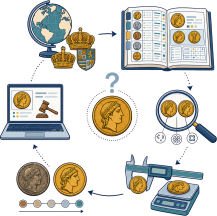
A numismatic catalog is not a book that is read linearly from beginning to end, but rather a reference tool used selectively and with a specific purpose. Its purpose is to enable the identification, classification, and basic orientation regarding coins and banknotes, rather than to provide a definitive answer on everything concerning a particular specimen.
The first step in using the catalog is the accurate identification of the item. For coins, this means recognizing the country or issuer, the ruler or political authority, the denomination, the year of issue, and the basic type. For banknotes, this includes the country, the issue, the denomination, the series, and the basic type. Only when these basic elements are clearly established is it possible to find the corresponding entry in the catalog.
After finding the catalog record, it is important to read the type description carefully. Catalogs often use concise but precise language, so it is necessary to understand basic numismatic terminology. Attention should be paid to the differences between types and varieties, as they sometimes differ only in minor details, such as inscriptions, mint marks, signatures, or the position of individual design elements.
Special attention should be paid to technical data. For coins, this includes mass, diameter, metal, and rotation, while for banknotes, dimensions, colors, paper type, security features, serial numbers, and signatures are important. This data serves as additional confirmation of identification and helps in detecting counterfeits or misattributions.
A very important element of the catalog are the catalog numbers. They represent a standardized designation of a type or variant and are used as a common language among coin collectors, dealers, and auction houses. In practice, the catalog is not used by saying „I have a coin from such and such a year,“ but rather the specific catalog designation is stated.
The catalog should be used critically and comparatively. No catalog is either perfect or completely up to date. It is advisable to use multiple sources, especially for rare or expensive specimens, and to compare data from different catalogs, specialized literature, and auction results if we are interested in value.
4.2.1.2.2. Differences between catalog and actual market prices

One of the most common beginner mistakes is treating catalog prices as exact and guaranteed market values. Catalog prices are not realistic selling prices, but rather orientational values that serve as a framework for estimation.
Catalog prices typically represent the average or idealized value for a specific type of currency in a given state of preservation, under stable market conditions. They are often updated more slowly than the market changes and cannot take into account all the specific circumstances of an individual sale.
The actual market price depends on a large number of factors. Among the most important are the actual condition of preservation, current supply and demand, the popularity of a specific area, economic conditions, the place of sale, and trust in the seller. Two identical catalog specimens can achieve significantly different prices on the market.
It is important to understand that catalog prices often refer to ideal specimens, while most money in reality has certain flaws. With banknotes, even the smallest crease, sign of use, or stain can significantly reduce the value compared to the catalog price. With coins, minor damage, cleaning, or patina can have a major impact on the price.
Another important factor is market liquidity. Some catalog-rare specimens are difficult to sell in practice because there is a small number of interested buyers. Conversely, some relatively common specimens can fetch high prices because they are currently in high demand.
Due to all of the above, the catalog should be viewed as a tool for comparison and orientation, rather than as a price list. The actual picture of market value is obtained by monitoring auction results, dealer offers, sales at fairs, and long-term observation of market trends.
An experienced numismatist collector uses a catalog to understand the structure and hierarchy of a particular field, while the actual value of an item is decided only after comparison with real market data and personal experience.
The second part of this book is dedicated to the catalogue of coins and paper money of the Republic of Croatia from 1991 to the present day. This part explains how to use the numismatic catalogue and the meaning of individual terms and designations that appear in it.
Supplementary article:
• Numismatic catalogs: what they are, how they are used, and how much can we trust them?
4.2.1.3. Numismatic magazines
Apart from books and catalogs, numismatic magazines also constitute an important part of numismatic literature. They represent a continuous source of new information, research, and current events from the world of numismatics, and enable the monitoring of the profession's development and collecting trends.
Numismatic magazines can be divided into two basic groups.
- The first group consists of professional and scientific journals. As a rule, these are collections of numismatic papers that feature original research, scholarly articles, and expert analyses. Such publications are intended primarily for researchers, museum professionals, and advanced numismatists. In Croatia, this role is fulfilled by the journal „Numizmatičke vijesti“ (Numismatic News), published by the Croatian Numismatic Society.
- The second group consists of popular and hobby magazines, which in format and approach are closer to periodicals and are intended for a broader collecting audience. They cover topics in a more accessible way, with an emphasis on interesting facts, reviews of new material, and practical advice. In Croatia, such an example is the magazine „Obol,“ also published by the Croatian Numismatic Society.
Numismatic magazines often publish news from the world of numismatics, information on new discoveries, reviews of newly printed catalogs and books, overviews of auctions and market trends, as well as advice related to collecting, preservation, and the identification of numismatic material. There is a large number of such publications in the world, while in our regions they are rarer, but therefore no less valuable as a source of knowledge and exchange of information.
One of the important advantages of classical numismatic literature, including journals, is the fact that the published texts are usually backed by well-known authors, editorial boards, or institutions. This provides the reader with a certain level of security and trust in the published data. Of course, the quality of the literature can vary, as there are very high-quality works, but also mediocre or unsuccessful editions. Nevertheless, this is a significant difference compared to internet sources, where there is a much greater heterogeneity of content, while a clearly recognizable authority and verification of data accuracy are often lacking.
4.2.2. Internet sources
Today, it is the main source of information and knowledge. There is a lot of it, there is great heterogeneity, but also a noticeable absence of authority, which often leads to confusion. Contradictory information is found, especially in discussion groups (such as forums, social networks, etc.). Therefore, such information should always be taken with a grain of salt. Not everything someone publishes is correct.
4.2.2.1. Websites and numismatic portals
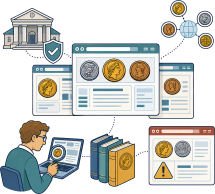
Websites represent one of the fundamental sources of modern numismatic knowledge. These are primarily specialized websites dedicated to numismatics, such as numismatic portals, websites of numismatic societies, and related platforms.
Such pages can be a very valuable source of information, especially if they are backed by expert authors, institutions, or recognized authorities in the field of numismatics. However, there is also a large number of websites on the internet that publish unverified, inaccurate, or even false information, which makes a high level of selectivity necessary.
For serious numismatic study, it is recommended to use exclusively verified and high-quality online sources that offer reliable, well-argued, and expertly grounded content.
4.2.2.2. Internet catalog

In recent times, online numismatic catalogs have been playing an increasingly important role in numismatic education and practice. These are online databases containing information about coins, banknotes, medals, and related items from around the world. Such catalogs provide quick access to a large amount of data and have become an indispensable tool, especially in the initial stages of engaging with numismatics.
Online catalogs can be roughly divided into collaborative, amateur projects and more professional, institutional databases. Among the collaborative catalogs, the best known is Numista, while the group of more serious and scientifically oriented projects includes, for example, Online Coins of the Roman Empire (OCRE). In addition to these, there are other similar platforms such as uCoin, Colnect, and related projects.
The main advantages of online catalogs are numerous. First of all, their easy accessibility and the possibility of quick searching stand out, regardless of place and time. Such catalogs often contain a very large number of displayed items, frequently accompanied by photographs. Many of them also allow for maintaining personal records, i.e., a digital collection, which is useful for organizing and reviewing one's own material. In addition, they provide quick access to basic information about a specimen, making them a practical tool for everyday use.
On the other hand, the main drawback of online catalogs is their lack of authority. Most popular online catalogs are based on a contributory model, in which content is entered by the users themselves. Although there are often editors or moderators who check the entered data, the level of verification still does not reach the standards of scientific and professional literature. It is particularly important to emphasize that the values listed in such catalogs are often the result of estimates or entries by the members themselves, which is why these prices are not always reliable nor do they reflect the actual state of the market.
Despite these limitations, online catalogs have a clear and justified role. They are very useful as a quick reference source „at hand,“ especially for beginners and collector numismatists who want to quickly identify an item, gain a basic insight into its origin, and keep track of their own collection. As with all sources, their value needs to be viewed critically and used in combination with printed catalogs, expert literature, and verified market data.
4.2.2.3. YouTube channel

YouTube channels are especially popular today, primarily among younger generations who prefer video content over written text. In the field of numismatics, there is a certain number of such channels, some of which are very informative and useful.
On the other hand, a significant portion of YouTube content about numismatics covers the topic superficially or sensationally, often focusing exclusively on rarities and market values, without deeper historical and scientific context. Such channels frequently misinform rather than inform.
As with internet portals, it is necessary to follow only those channels that offer verified, accurate, and professionally grounded information, while avoiding those based on sensationalism and oversimplification.
4.2.2.4. Podcasts

Podcasts represent a rarer, but often higher-quality form of numismatic content. In the Croatian language, podcasts dedicated to numismatics almost do not exist, while significantly more are available in English.
As a rule, podcasts are less sensationalistic and focused on deeper analysis and information. Their great advantage is the possibility of passive listening, for example while driving, which enables efficient knowledge acquisition.
Some podcasts are available exclusively in audio format, while others are linked to video content and available via YouTube.
4.2.2.5. Forums

Internet forums used to be an extremely popular form of communication among coin collectors. Although they have been partially displaced by social networks today, there are still active and high-quality specialized forums.
Forums enable discussions with other collectors and experts, the exchange of opinions, and seeking help or advice regarding specific numismatic topics. It is precisely this interaction with more experienced colleagues that makes forums still a very valuable source of knowledge.
4.2.2.6. Social Networks
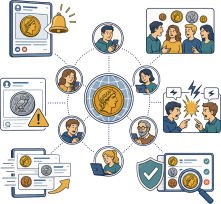
Social networks today are the most widespread communication channel among numismatists. Through them, new information is reached quickly, and various groups dedicated to numismatics are especially popular.
However, social media require special caution. The first problem is the fact that anyone can publish content, regardless of expertise, which leads to a large number of inaccurate or misleading information. The second problem relates to the quality of discussions, which often veer in an inappropriate direction, including insults and behavior unbecoming of a professional community.
Despite these shortcomings, social networks can be useful for connecting with other numismatists and following current events, but they need to be used with a dose of criticism and reserve.
4.2.3. Numismatists

Besides literature and catalogs, other people who deal with it can also be an important source of knowledge in numismatics. The exchange of experiences and information with colleagues often has great educational value, especially in practical matters that cannot always be found in books.
More experienced numismatic collectors can play an important role in passing on knowledge to younger or less experienced colleagues. Some of them deal with numismatics professionally, some are specialists in certain areas, while numismatic dealers generally know the market well, its rules and price trends. Such knowledge can be very useful, especially in the phases of learning and orientation.
However, it is important to emphasize that not all sources are of equal quality. Some numismatists gladly share their knowledge and experience, while others are more closed off or reluctant to share information. Also, years of involvement in numismatics do not in themselves guarantee knowledge, expertise, or a correct approach. There are individuals with long experience who are very well-versed in their field, but also those who, despite many years of involvement, possess superficial knowledge or incorrect information.
That is why it is extremely important to carefully choose from whom you learn. Learning from individuals who lack sufficient knowledge, who spread inaccurate information, or who lack developed professional and ethical responsibility can be harmful and lead to wrong conclusions, bad habits, and financial losses. Critical thinking, verifying information from multiple sources, and gradually building one's own knowledge are key prerequisites for safe and high-quality progress in numismatics.
