



Numismatic catalog is one of the essential tools of every numismatist and collector, regardless of whether they deal with ancient, medieval, or modern money, coins of a specific country, paper money, or some narrower specialized field. Almost everyone who starts dealing with numismatics more seriously sooner or later comes across a catalog, catalog numbers, emission data, rarity degrees, and, of course, catalog values (prices).
For a beginner, a catalog usually first serves as an aid in answering simple questions: what is this, from which period is it, when was it issued, and how much is something worth (at least according to the catalog)? As knowledge grows, the way the catalog is used also changes. A more experienced numismatist looks to it for data on coins and/or banknotes, varieties, weights, diameters, dimensions, emission data, differences between individual types, or links to other specialized literature. A specialist might build their entire collection precisely through the cataloging system, and quite often the catalogs themselves serve as a guide to someone on what to collect and in what way.
A numismatic catalog is therefore not just a book with photographs of coins and prices. Its primary task is much broader: systematize a specific area of numismatic material and enable its identification, differentiation, description, and comparison.
Simultaneously, The catalog is not infallible. It may contain incorrect data, outdated estimates, and questionable classifications. It is an even bigger mistake to treat catalog prices as some sort of “official price list” according to which a coin is simply “worth that much.”.
Good knowledge of numismatic catalogs therefore does not only mean knowing how to find a specific number under which a coin or banknote is listed and its catalog value. It is equally important to understand how the catalog was created, what a certain piece of data actually means, and how much we can trust it.
What is a numismatic catalog actually?
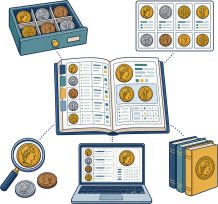
We can describe a numismatic catalog most easily as organized database of numismatic material. Traditionally, such databases were published in the form of books, but today they can also be digital, meaning they are available as websites and specialized online databases.
The essence of the catalog is therefore not in its physical form, but in the way the data is organized.
Let us imagine, for example, that we want to process all the coins of a single country over a period of one hundred years. Without a specific system, we would end up with an unmanageable mass of different denominations, years, mints, metals, portraits, and varieties. A catalog introduces order into this mass of data. It determines the criteria by which the material will be classified, and assigns each type, variety, year, or date a place within a common system.
Precisely for this reason, a good catalog makes it possible to determine relatively quickly where a certain item belongs.
Depending on its purpose, using the catalog we can determine:
- country, territory, or other money issuer
- rulers on coins and/or historical period
- nominal value
- year of publication
- mint and mint mark
- basic type and its variants
- accurate description and meaning of the motif on it
- meaning of the inscription on the money
- technical data
- emission volume
- degree of rarity
- approximate catalogue value.
All of the above shows why a catalog should not be viewed merely as a price list. Prices (catalog values) are only one of its possible elements, and the one that becomes outdated the fastest. A well-made classification can remain useful for decades after all the prices listed in the book lose touch with the market.
How is numismatic material classified?
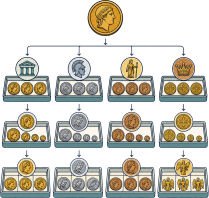
There is no single universal system which would suit all types of numismatic material.
With modern currency of a country, it is very natural to start with the period of issue (e.g., political system), followed by the denomination, basic type, year, and mint. In the case of ancient or medieval currency, such a division would often not be particularly practical. There, the ruler, region, mint, style, inscription, depiction, or individual features of the die may play a more important role.
With banknotes, other criteria appear again. In addition to denomination and date, the series, signatures, numbering, watermark, or printing works can be important.
One possible layout in the modern coin catalog would look like this:
country → period → denomination → basic type → variant → year → mint
But that is just one example. In a specialized catalog, the same material can be organized completely differently if such a system better suits the subject of research.
Here the difference between a general and a specialized catalog can also be seen.
The general catalog must cover a large amount of material, so it is necessarily more concise. It may present a particular coin as a single basic type, with several variants, years, and prices.
A specialized catalog dedicated solely to that coin series may reveal that within what a general catalog treats as a single type, there are numerous minor variants: a different position of the mint mark, a differently shaped year digit, a difference in the inscription, a different shape of the crown, star, or coat of arms, a modified ruler's bust, and so on.
For a collector whose goal is to have one of each basic type, such a detailed division might not be crucial. For a specialist, those very differences can represent the very essence of collecting.
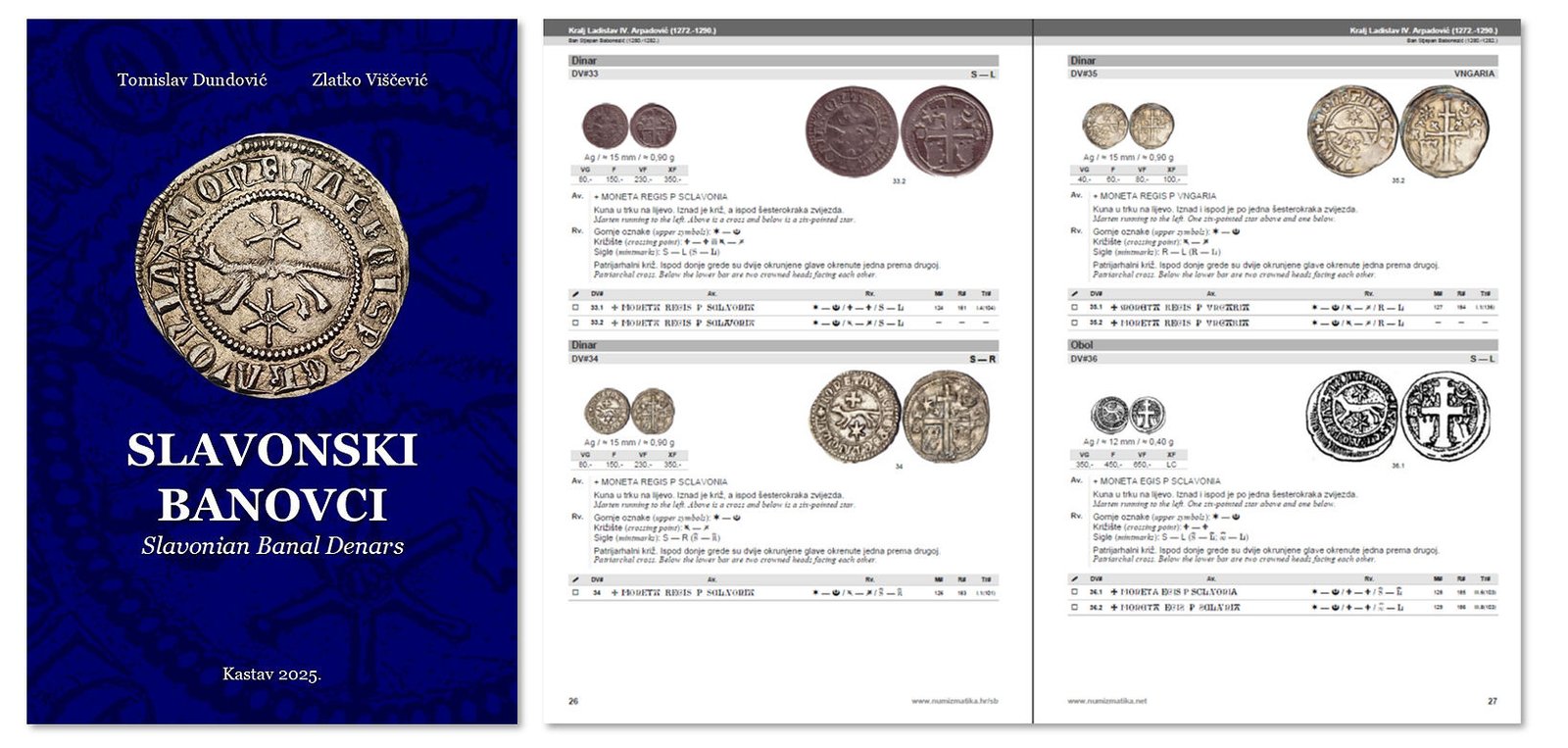
Catalog number as a “common language” of numismatists
One of the most practical “products” (results) of cataloging is the catalog number.
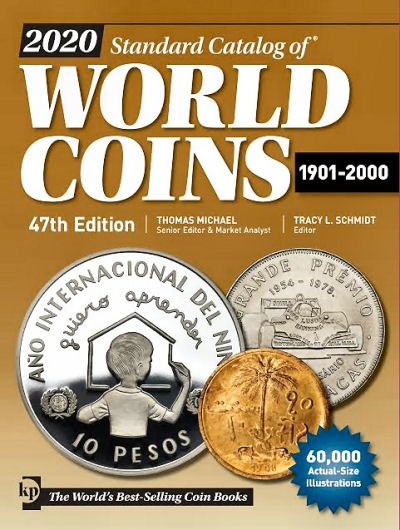
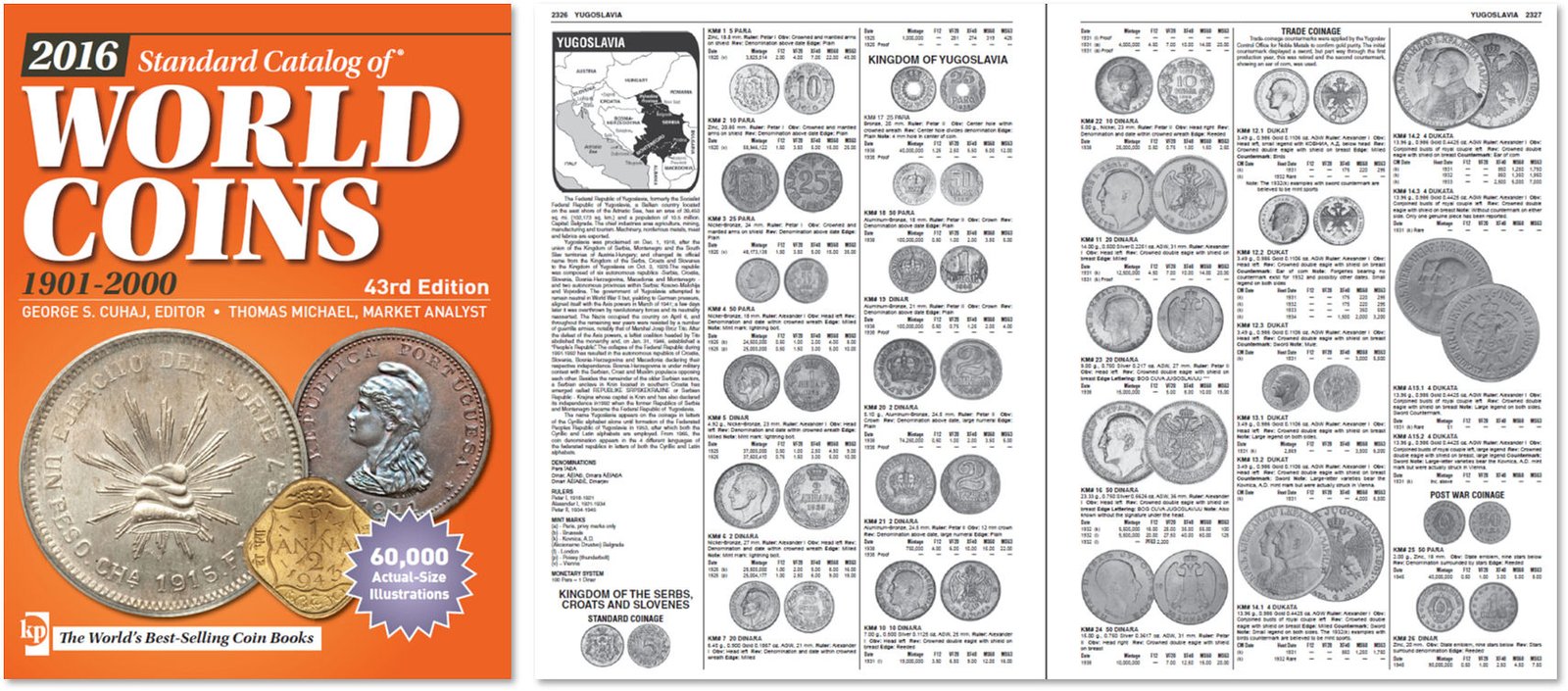
If a certain type of money within a catalog is marked with a number, then it is no longer necessary to describe it every time with a few sentences. It is enough to state the catalog abbreviation and the number. This is very common among numismatists who deal with banknotes, so we can hear them mention, for example, “Pick-55”. Beginners sometimes do not understand this, but it is actually a banknote of a certain country that is registered under catalog number 55 in “Standard Catalog of World Paper Money”.
Because of this, certain successful catalog systems over time become almost a “common language” for numismatists, collectors, dealers, and auction houses.
However, there is a common misunderstanding here. The catalog number is not the official number of the coin or banknote itself. It exists only within a specific directory.
The same item can therefore have several completely different designations. A national catalog may assign it one number, an international one a second, and a specialized monograph a third.
Because of this, the label “55” without further explanation does not actually say much. Only when we know that it refers, for example, to a specific author's mark or catalog does the number become useful.
A good catalog system must be consistent and logical. If base types and variants are distinguished according to clear criteria, a numismatist can understand how the entire system is constructed. If similar differences are treated as separate variants one time and completely ignored the next, the catalog quickly becomes confusing.
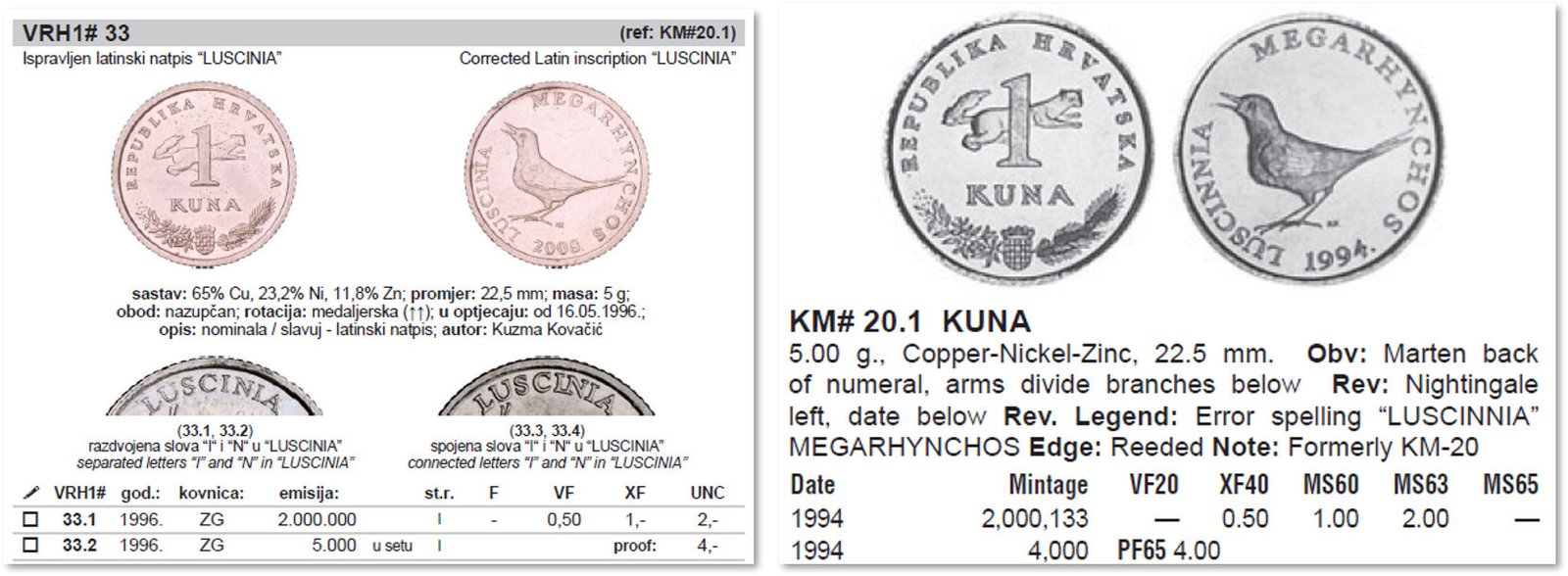
What can we find in a numismatic catalog?

The amount of data depends on the purpose of the catalog. Thus, a small pocket catalog intended for daily field use cannot contain the same amount of information as an extensive specialized monograph. This in itself does not mean that one is better and the other worse. They simply have a different purpose.
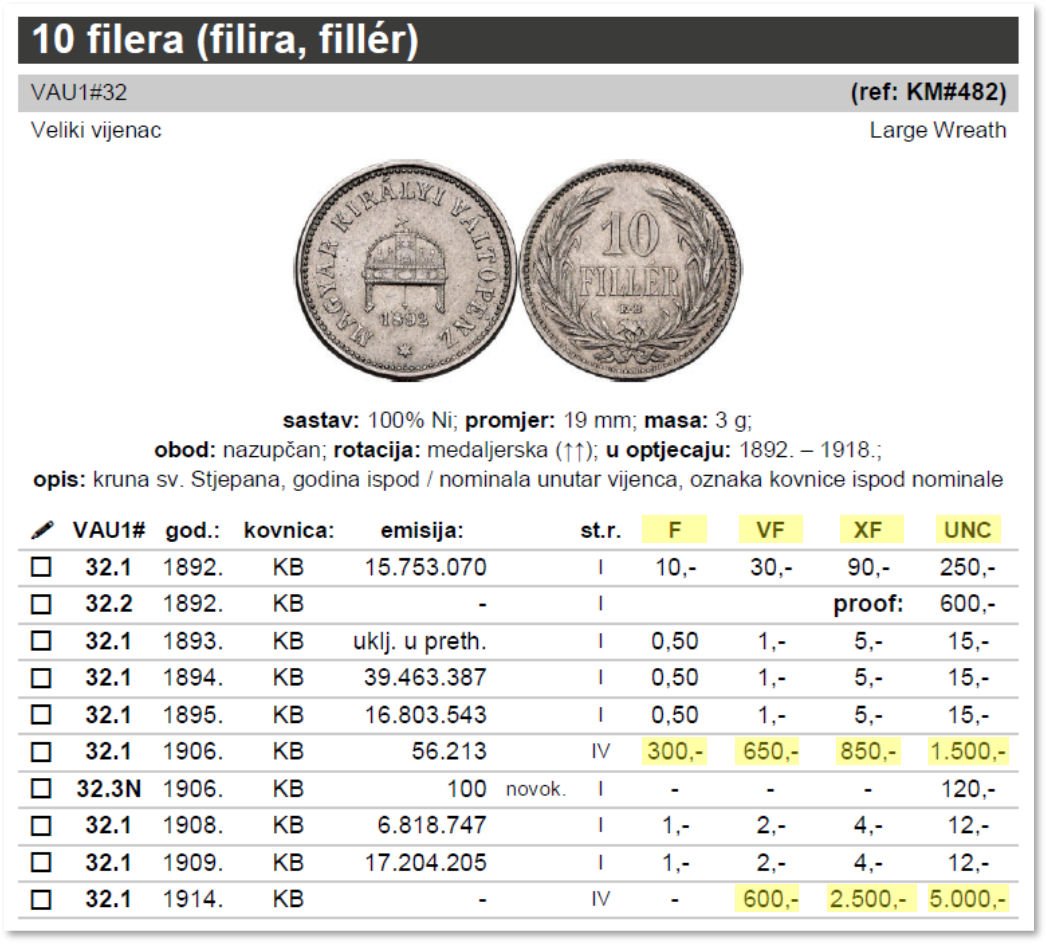
Basic information about the issuer, denomination, year, and mint can most often be found on coins, while more detailed catalogs also provide a whole range of technical and descriptive data, as well as descriptions of varieties.
Besides the image itself, these can also be:
- metal and metal fineness
- table
- diameter and thickness
- form
- rim type
- axis position (rotation)
- description of the obverse and reverse
- inscriptions
- information on the design author and/or engraver
- emission levels
- variants and common mistakes
- rarity assessment
- catalog values
- auction results
- references to other specialized literature
In the case of paper money, the nature of the item also requires other data. In addition to the denomination and date, dimensions, printing house, signatures, series, numbering, watermarks, and other security features are often listed. In some catalogs, we also have data on the size of the emission.
Such an amount of information shows how wrong it is to reduce a catalog to the question: „How much is this worth?”
Value is only part of the story.
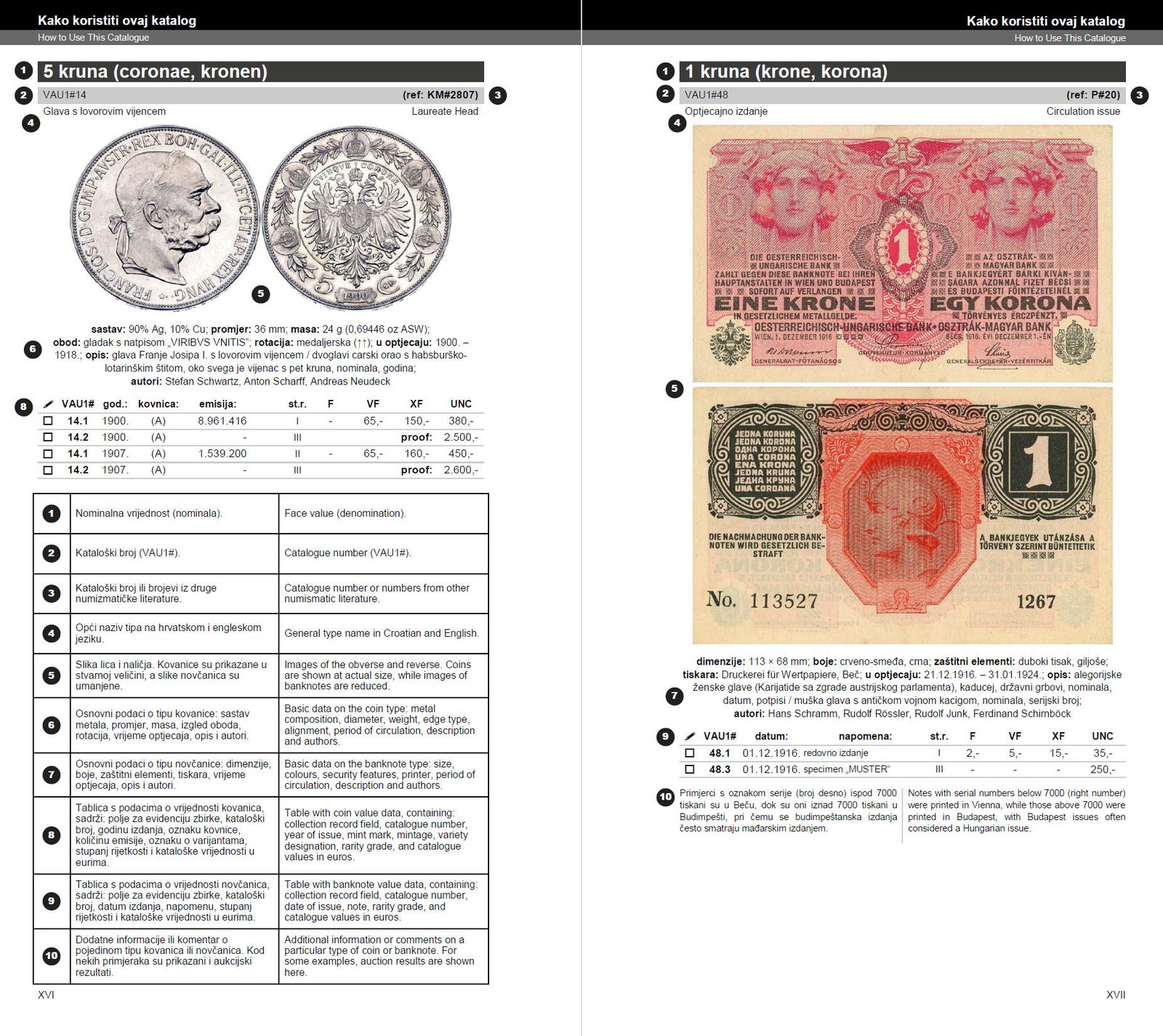
General and specialized catalogs have different tasks

If one were to attempt to create a single catalog that would simultaneously cover every coin in the world down to the smallest known variety, the result would be nearly unusable.
That is why general and specialized catalogs necessarily coexist.
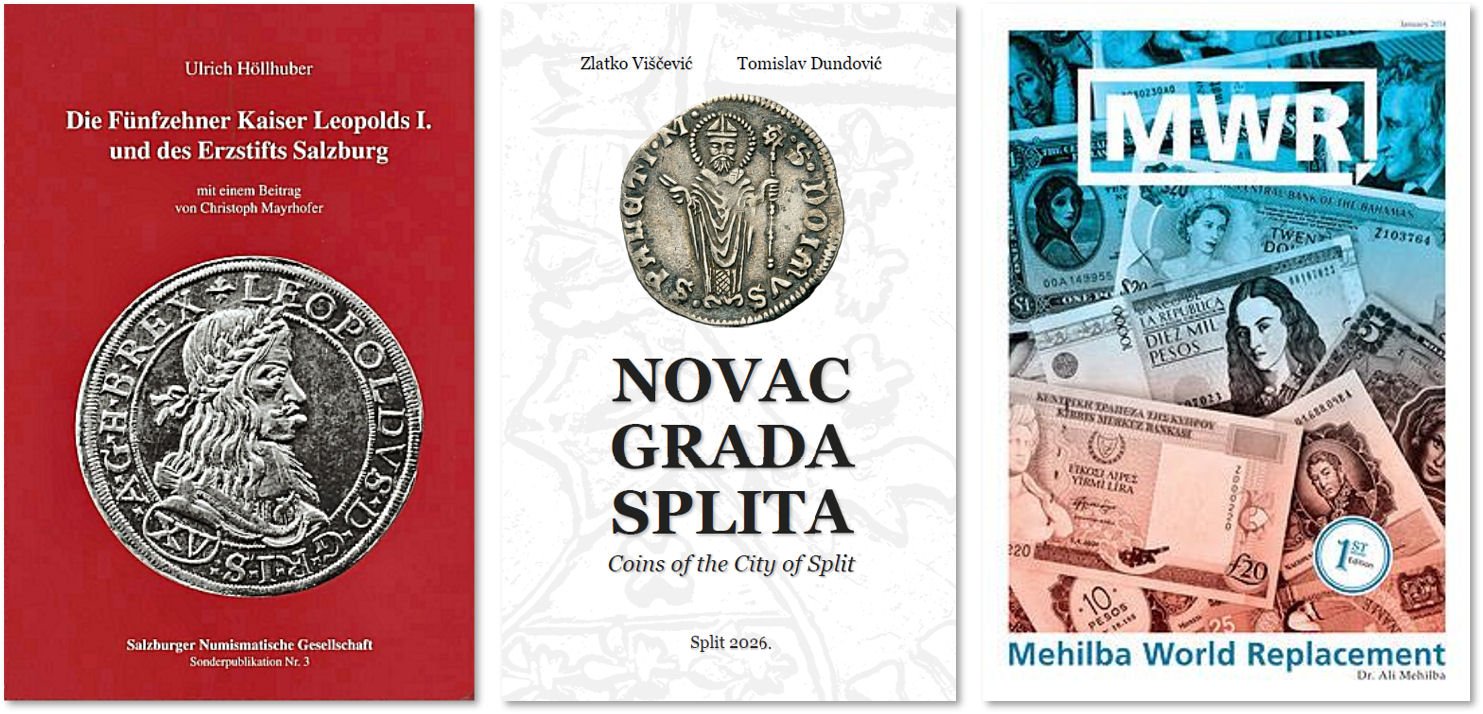
General catalog It provides an overview. Its great advantage is precisely that it covers a wide area in one place. A numismatist can relatively quickly identify coins from different countries and periods without needing an entire library of specialized literature. The price of such breadth is less depth.
Specialized catalog It goes in the opposite direction. The area is narrower, but it can be processed in much more detail. Sometimes an entire book covers only a single denomination, a single mint, a short period, or a few basic types of money.
Such a catalog can also present the results of years of research: mold reconstructions, data on rare variants, the history of individual coin issues, and detailed lists of known specimens.
Because of this, serious collectors often use multiple catalogs simultaneously. One serves as a basic reference, a second for variants, a third for historical background, and a fourth for comparing market data.
Printed catalog or online database?

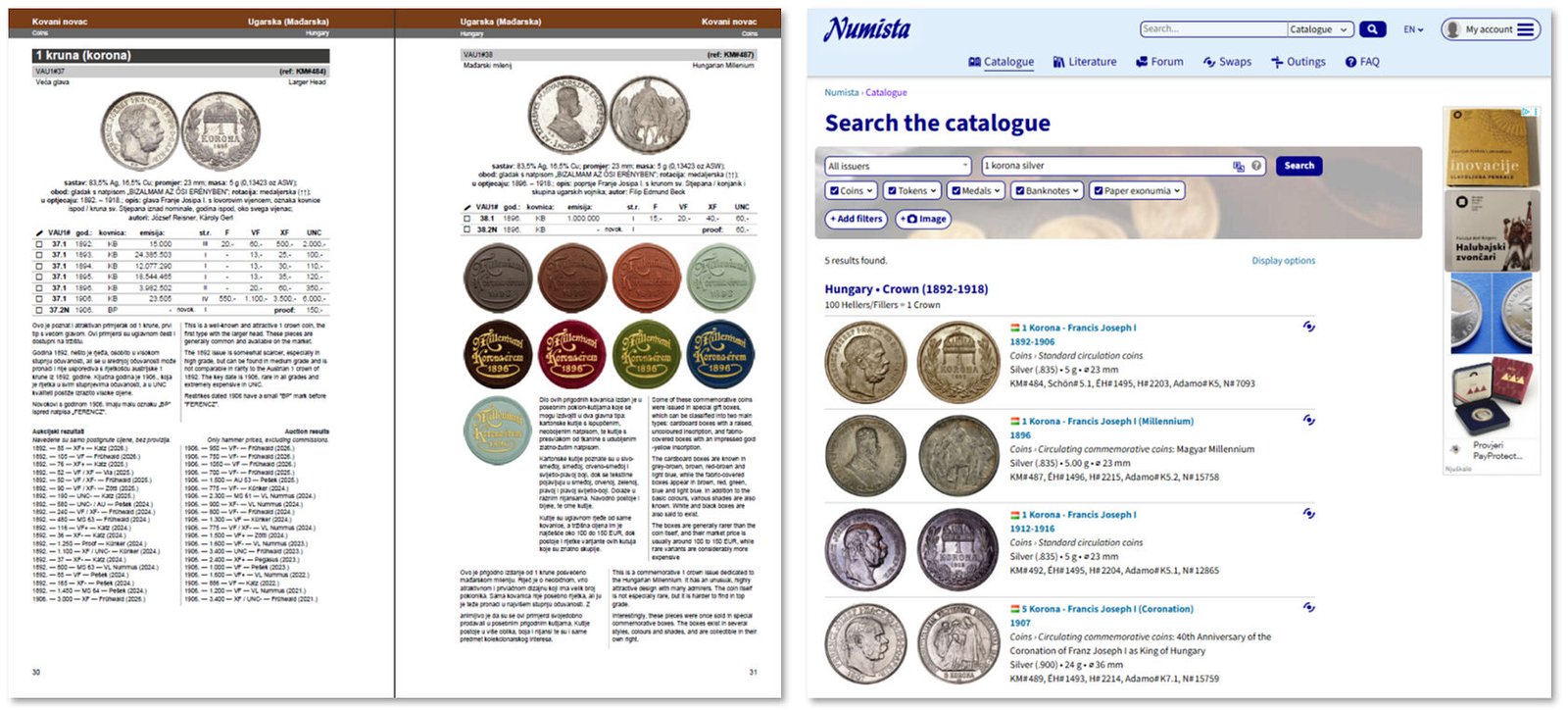
With the advent of the internet, a catalog is no longer necessarily a physical book.
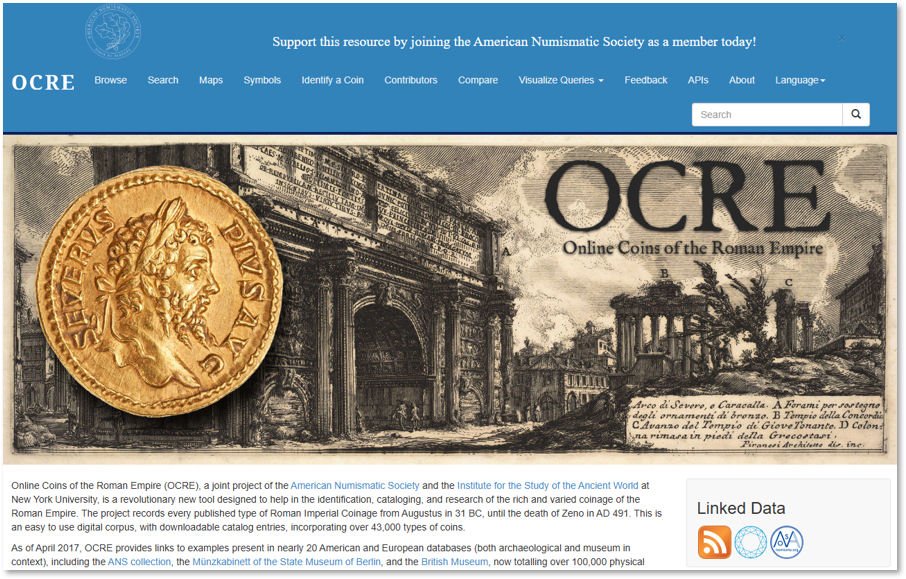
Classic printed catalog I have one major advantage that we sometimes underestimate: he represents a fixed point in time. If we open an edition published in a specific year, we can accurately determine what the author wrote at that time. Once printed, the information can no longer be altered imperceptibly. This is very important for citation and academic research.
On the other hand, precisely that immutability is also its main drawback. If an error is discovered after printing, it remains in the book. If a new variety is discovered, it can only be included in the next edition. And catalog prices inevitably become outdated over time.
The online catalog does not have that limitation. New data can be entered practically immediately, existing errors can be corrected, and a large number of photographs, links, and auction results can be displayed alongside a single catalog record.
Digital catalog at the same time, it makes possible what is difficult to achieve in a printed book: quick searching and filtering of thousands of items by year, denomination, mint, metal, or some other criterion.
Neither the online format is without flaws. A website can disappear. The database owner can change how it operates. Old data can be modified without a clear record of what it previously said.
Neither print nor digital publications should be considered more reliable in advance. The author's expertise, the quality of the sources, and the methodology are crucial.
We must not forget the numismatic audience itself, as well as its usual behavior. Namely, numismatists like to own physical objects (coins, banknotes) and be in contact with them. Accordingly, a large number of numismatists prefer the physical catalog as something they want to have.
Furthermore, there is also the issue of authority. A classic, printed catalog usually has one or whose first and last names, along with their numismatic authority, stand behind the published work. On the other hand, the most famous online catalogs are mostly collaborative projects worked on by a large number of individuals with varying degrees of control by the site editors or owners. The consequence of this is a large number of errors, deviations, inconsistencies, and unreliability of data, as well as the absence of numismatic authority.
Of course, there are also exceptions – online catalogs edited by numismatic experts whose quality can rival printed editions.
Catalog values: the data that causes the most misunderstandings
Many numismatists and collectors, especially beginners, first open the catalog because of the price.
That is understandable. Everyone is interested in how much their item is worth.
The problem arises when the number printed in the catalog starts to be perceived as the definitive market value.
The catalog value is actually estimate by the author or catalog publisher of the value of a certain item in a certain state of preservation and at a given time.
How the author arrived at that figure can vary greatly. They can analyze public auctions, monitor dealers, use their own sales data, compare internet results, and track supply at fairs. A more serious approach usually combines multiple sources and a larger number of sales.
It would be good if the catalog explained the methodology by which the values were determined. The user can then understand what the number represents.
Because between the catalog value and the market price stand a whole range of factors.
Catalog and market value are not the same
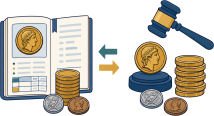
If the catalog lists a value of 100 euros, that does not mean that every specimen of that coin is worth exactly 100 euros.
One might be sold for 60 euros, another for 90, and an exceptionally high-quality specimen for 180 euros. At a certain point, perhaps none of them could be sold even for 70 euros simply because there is no interested buyer.
Market value is not determined by a catalog. It is determined by the market.
The final price of an individual coin or banknote is influenced, among other things, by:
- rarity of the specimen
- state of preservation
- potential damage or cleaning
- aesthetic quality of the specimen
- market demand and current market trends
- provenance
- certification
- place and method of sale
- general state of purchasing power in the market
When it comes to precious metal coins, the market price of that metal also plays a major role. Furthermore, in the case of banknotes that are legal tender, it can play a role whether they are still legal tender or demonetization is pending.
Even two coins that, according to the catalog, belong to the exact same catalog entry can achieve significantly different prices at an auction, for example.
This is especially pronounced in top-tier specimens. A coin with a nice natural patina, good centering, sharp details, and no unpleasant damage can be much more appealing to buyers than an average specimen of the same formal grade of preservation.
A catalog table of values for such a difference simply cannot express it precisely.
Why do prices in catalogs become outdated?

Catalogue values should be viewed as a kind of snapshot of the market at the time the data was collected.
The market continues to move after that.
Some areas are becoming more popular, while interest in others is declining. New buyers are emerging. Larger collections are coming onto the market. New quantities of material are being discovered. Sometimes a few important auctions completely change the perception of prices in a certain area.
For gold and silver coins, changes in the value of the precious metals can also have an additional impact. Therefore, the prices of such specimens can both rise and fall.
With printed catalogs, there is another time lag. A book published, for example, in one year is often based on data that was collected months earlier.
That is why a catalog can be completely new, and its prices already somewhat behind the current market.
The more dynamic the market, the more cautiously catalog prices should be used. However, they still come in handy for establishing relative relationships between the value or rarity of different specimens.
The price someone asks for is not proof of value
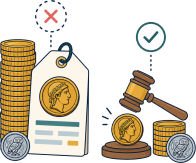
The internet has brought a vast amount of market data, but also a new kind of confusion.
Today it is very easy to find a coin offered at an extremely high price. This is then often used as an argument: „The exact same one costs 500 euros on the internet.”
But the fact that someone search 500 euros doesn't mean anyone is willing to pay that much.
The seller can ask for as much as they want for the item.
That is why they are much more important for market assessment achieved results, or the prices at which the item was actually sold.
No single result is sufficient. At an auction, two highly motivated buyers sometimes appear and the price “flies” far above the usual level. In another situation, an important item goes unnoticed and is sold unusually cheaply.
The best picture is provided by a series of comparable realized sales.
How to more realistically assess market value?

The catalog is a good starting point, as it can give us basic information about value and rarity, but for a more precise assessment, market sources should also be included.
In practice, it is best to combine:
- catalog values
- public auction results
- auction house archives
- realized online sales
- offer of professional traders
- personal experience and market knowledge.
In doing so, it is important to compare truly comparable items.
It is not enough to find the same denomination and year. It is necessary to see if it is the same mint and variety, and what the condition of the sold specimen is.
When comparing a mint condition specimen to a heavily worn coin, the fact that they share the same catalog number means very little for price estimation.
Condition can change the value multiple times
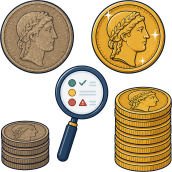
The degree of preservation is one of the key elements of catalog values.
With some very common coins, the difference between a lower- and a better-preserved specimen may not be dramatic. With others, preservation is precisely what determines the majority of the value.
A coin that has been in circulation for decades can lose a large portion of its fine details. The same coin with preserved original surfaces, relief, and luster can be many times more expensive.
Another problem arises here: people most often view their items subjectively.
To the owner, their coin is often „excellently preserved,” while an experienced collector would grade it several points lower. If they then read a price in a catalog that refers to a significantly better grade of preservation, an unrealistic expectation arises very quickly.
Therefore, the catalog value must always be read together with the corresponding grade of preservation.
Rare does not automatically mean expensive

Another frequently encountered mistake is equating rarity with value.
Rarity speaks to how difficult something is to find. Value speaks to how much the market is willing to pay for it.
Those two concepts are related, but they are not the same.
We can have a very rare item that interests only a few specialized collectors. If there is no strong competition among them, the price can be relatively low.
On the other hand, a certain coin can be quite accessible, but so popular that high demand keeps the price high.
That is why the claim „it is rare, so it must be valuable” is an oversimplification.
Market value arises from a combination of rarity, demand, condition, the quality of the individual specimen, and the broader market context.
Not all catalogs are good catalogs
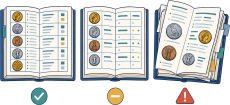
On the numismatic literature market, there is everything and anything: from major expert works to publications that are barely anything more than a superficially put-together list.
Some catalogs are the result of decades of research and represent foundational literature for a specific field. Others are quality practical guides that may not have scientific ambitions, but serve collectors exceptionally well.
There are also mediocre catalogs with useful information, but also quite a few errors.
And there are also complete “scribbles” that are of little or no use.
Such publications often uncritically copy older literature, fail to cite sources, use inconsistent criteria, and present value judgments that are not clearly determined. Some even contain fabricated data.
At the same time, the graphical appearance does not have to say anything about its professional value. A book can be luxuriously printed, have a nice hardcover and excellent photographs, while at the same time having very poor systematization and cataloging. Sometimes poor numismatic literature is referred to in professional circles as a “picture book,” because it contains almost exclusively pictures of items and prices.
How to evaluate the quality of a catalog?
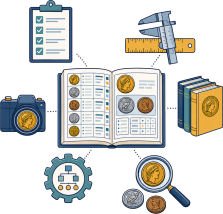
First, we need to see what the author was even trying to do.
Is the processing area clearly defined? Is it explained what is included and what is not? Are the criteria for division into types and variants understandable?
A quality catalog generally has several characteristics:
- clearly defined scope
- logical and consistent structure
- explained methodology
- precise descriptions
- verifiable sources
- the cited literature
- good photographs or illustrations
- transparently displayed additions and corrections
- clearly explained preservation grades and evaluation criteria.
Transparency is particularly important.
If the author claims that a certain coin is known in only a few specimens, it is very useful to know what such a conclusion is based on. If they state market values, it is good to know whether they are derived from actual sales results or represent only a personal estimate.
The easier a user can verify the author's claims, the more serious of a source the catalog is.
It is important to know who is behind the catalog

The catalog did not create itself. Behind it stands an author, a group of authors, a publisher, or an institution.
Because of this, it is not unimportant who made it.
Does the author know the area they are cataloging? Have they studied this material for years? Do they cite specialized literature? Did they have access to museum, private, or auction collections? Do they present their own research or mostly copy existing data?
Of course, even a reputable author is not infallible, and it is often the case that a lesser-known author writes an excellent catalog. This is not a matter of the author's authority, but rather of whether serious research can be recognized.
An important indicator of professionalism is also the attitude towards one's own mistakes. A serious author corrects a mistake when it is identified, rather than defending it just because it has already been published.
Errors from the catalog can propagate for decades
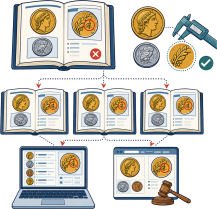
Errors in catalogs are by no means rare.
The mass or diameter may be incorrectly listed. The image of the coin may be substituted. The issue may be mistranscribed. The variety may be misidentified or completely missed.
Sometimes even the attribution itself is wrong.
The most interesting problem arises when such an error starts to be copied.
If an influential old catalog lists incorrect data, the next author may copy it. The third author then copies the second, the fourth the third, and thus after a few decades, you get ten books that all cite the same inaccurate information.
At first glance, it seems we have ten sources confirming the same claim.
In reality, we may have only one source and nine copies.
That is one of the reasons why in serious numismatic research it is good to try to get as close as possible to the original data.
When a catalog becomes a tool of market manipulation
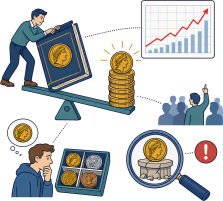
A particularly sensitive issue with numismatic catalogs is almost always the catalog values, as these can directly influence the behavior of buyers and sellers. Among numismatists and collectors, the catalog holds a certain authority, especially among beginners. The number printed in the book often appears more convincing than a regular selling price, even when it is not backed by serious market analysis.
Very superficial catalogs, created without a clear methodology and without serious data verification, also occasionally appear on the market. Such publications often attract audiences with low prices or an attractive appearance, but they can contain unreliable data, arbitrary classifications, and unrealistic values. For a beginner, such a catalog can do more harm than good, because they do not yet have enough experience to recognize false data or a fabricated „rarity.”.
A special problem arises when the business interest of the author or publisher begins to determine the content of the catalog.
This does not mean that every catalog issued by a merchant is unreliable. On the contrary, professional merchants often know the market very well. The problem arises when a catalog is consciously used to create a market image that suits the interests of the author or publisher.
A manipulative approach may include:
- deliberately setting catalog values too high
- artificial scarcity of available items
- selective use of only the highest auction results
- ignoring results that do not match the desired image
- presenting requested prices as actual market values
- favoring materials that the author or affiliated merchants have for sale.
The most problematic case is when someone produces a reference value themselves and then relies on it when selling.
For example, the author estimates a coin at 2,000 euros in their own catalog and then sells it for 1,500 euros, claiming that it is “25 percent below catalog value.” If comparable specimens on the market regularly sell for 500 or 600 euros, the catalog is then no longer a neutral source of data, but a means of creating an artificial reference price.
Such an approach is particularly problematic when directed at inexperienced collectors. An experienced collector can check auction results and quickly spot the discrepancy, while a beginner might believe they have received an exceptionally good deal.
Today, such manipulations are nevertheless harder to sustain than before. Auction archives, online databases, and the availability of market data allow numismatists and collectors to verify actual selling prices relatively quickly. Because of this, attempts to create artificial catalog values among more experienced numismatists often provoke more mockery than actual authority.
Over time, the author's reputation also forms. If unrealistic prices, unexplained “rarities,” and valuations that always unusually well align with their own commercial interests regularly appear in their publications, the community begins to recognize this.
However, an individual miscalculation is not automatically proof of manipulation. It is more justifiable to speak of that when there is a clear and recurring pattern, especially if unrealistic values and the author's business interest appear together.
Therefore, the best protection for a collector remains their own knowledge and research. Catalog value should not be accepted in isolation, but compared with realized auction results, actual supply and demand, and the prices of comparable specimens.
A catalog can only be an authority to the extent of the quality of the data, methodology, and professional integrity behind it. The price printed in the catalog in itself is not proof of market value.
A catalog is not a price list
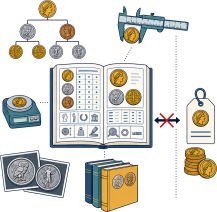
If one practical message is to be singled out from all of the above, it is this – A numismatic catalog is not a price list.
This is especially important for beginners, as the price is often the first thing they look for.
Therefore, the most enduring part of a good catalog is not the prices, but its systematization of numismatic material.
A catalog published fifty years ago may have completely useless prices today, but its division into types and variants can still be the standard used by collectors and auction houses. This best demonstrates the true value of a good catalog.
How to use the catalog in practice?
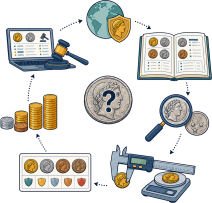
When we are faced with an unknown coin, it is not good to immediately look for the price column.
First, it is necessary to determine what we actually have.
First, the basic elements are determined: the issuer, face value, and period. After that, the corresponding basic type is searched for, and then details such as the year, mint, inscription, and any variants are checked.
Only then can we compare the technical data and assess the preservation state.
A reasonable sequence would be:
- identify the object
- find the appropriate basic catalog type
- determine the year, mint, and variety
- check the technical data
- assess the degree of preservation
- check the catalogue value
- check actual market results
- compare your own copy with the sold copies.
In this way, the catalog becomes exactly what it should be: a tool for making an informed assessment, rather than a substitute for one's own thinking.
One catalog is often not enough
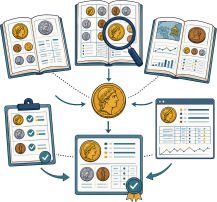
The deeper you go into a subject, the more important source comparison becomes.
One catalog may best show the basic types, but doesn't distinguish variants at all. Another has an excellent classification, but outdated market values. The third contains historical data not found in either of the previous two.
If two reputable catalogs disagree with each other, that is not necessarily a reason for frustration. Precisely such differences are often the beginning of serious research.
Why does one catalog list a mintage of 10,000 copies, while another lists 20,000? Why does one consider a certain difference a separate variety, while another does not? Why does one label an item as very rare, while it appears in auction archives several times a year?
Such questions encourage a person to explore and upgrade their numismatic knowledge.
The catalog is a starting point, not the final word

A good catalog does not have to answer every question.
Its great value lies precisely in showing the user where they are located within a given area and in which direction they should explore further.
If we find information about a rare variety in the catalog, the next step may be to search for copies in auction archives. If the catalog mentions a specific historical document, we can try to find the original document. If the author cites older professional literature, we can move towards that literature.
In this way, the catalog functions like a map.
The map does not contain every stone and every tree, but it enables us to orient ourselves.
Old catalogs as witnesses of numismatic history
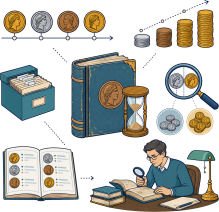
Numismatic catalogs have another value that is not always immediately obvious.
Over time, they themselves become historical sources.
An old catalog shows how numismatists of a certain era viewed the material they collected. From it, we can see what was considered rare, what was popular, which variants were known, and what prices individual items fetched.
That can be extremely interesting.
An item that was considered a great rarity a hundred years ago may have later been found in greater numbers. On the other hand, something that was considered common back then may be very difficult to find today.
Old catalog prices also allow for tracking changes in collector interests. Some coins experience strong growth in value over the decades, while others remain almost at the same relative level.
That is why old catalogs should not be discarded just because their prices are no longer current.
When does a catalogue become standard literature?

The best catalogs often outlive their own authors and the times in which they were created.
Their prices become outdated, new editions appear, and new variants are discovered, but their basic cataloging system remains in use.
When auction houses, museums, collectors, and other authors have used the catalog numbers of a single work for decades, it ceases to be just a book and becomes a reference system.
That is probably the greatest success a numismatic catalog can achieve.
It is not crucial that every piece of data in it remains accurate forever. That is not even possible to expect. It is more important that the author created a system clear and useful enough for further work to be based upon it.
The catalog should be read critically
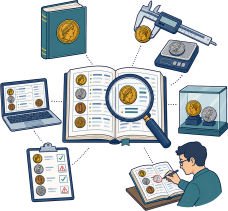
A proper attitude toward the catalog lies between two extremes.
- One thing is blind belief in everything that is printed.
- The second is the belief that no catalog is worth anything because each may contain an error.
Neither is reasonable.
If the catalog lists a mass, we can check it in other literature or measure our own specimen. If it labels something as extremely rare, we can review auction archives. If it lists a high price, we can see if the market confirms it.
Such critical use of sources does not diminish the value of the catalog. On the contrary, this is precisely the correct method of professional work.
Numismatics evolves because existing data are constantly checked, supplemented, and, when necessary, corrected.
The catalog is not “Holy Scripture”
A numismatic catalog is one of the most important tools for any serious numismatist and collector, but it remains merely a tool.
The catalog number is not an official designation assigned to a coin when it was minted. The catalog value is not a binding market price. The degree of rarity is not an immutable historical fact, and information published in a book is not thereby exempt from the possibility of error.
A good catalog helps us identify an object, understand its position within a particular monetary system, distinguish between types and varieties, and gain an initial idea of its rarity and value.
An excellent catalog goes a step further: it shows us what its data is based on and allows us to verify it ourselves.
It is therefore most useful to view the catalog as a starting point for understanding and research, rather than as a final answer to every numismatic question.
A numismatist who knows how to use a catalog gets much more from it than just a price. They get a system by which they can understand the object they are holding in their hand, compare it with other specimens, and place it in a broader numismatic and historical context.
“Buy the book before you buy the coin!”
— That is how the late fellow numismatist and author Ranko Mandić used to say back then.
Author: Zlatko Viščević with AI assistance
Photos: Numex – Coins, Banknotes & Militaria Store [www.numex.hr]