

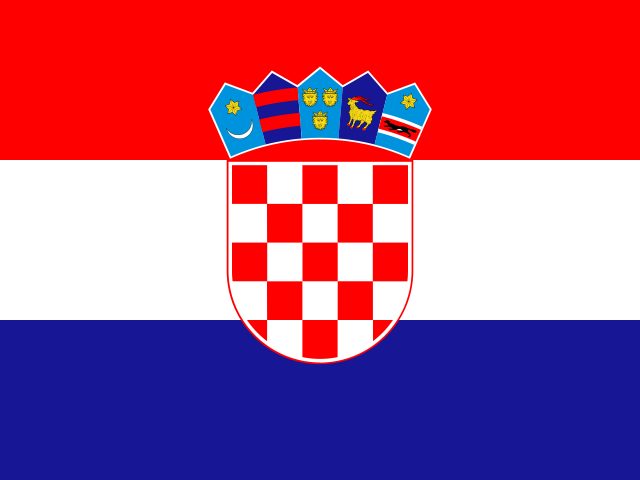


Croatian circulating coins of kuna and lipa had one interesting feature that made them recognizable among numismatists worldwide. Depending on whether they were minted in an odd or even year, the coins bore either Croatian or Latin names of the plants and animals depicted on the reverse.
On coins with odd minting years, the names were written in Croatian, while coins with even years had Latin, i.e., scientific names of the depicted plant and animal species. Thus, on the one-kuna coin, the reverse features an image of a nightingale, along with the Croatian inscription “SLAVUJ” or the Latin “LUSCINIA MEGARHYNCHOS”.
Such a method of designing coin series was a very interesting numismatic detail. The same denomination practically appeared in two language versions of the reverse, and the alternation of Croatian and Latin names was tied to the year of minting.
Error on a one-kuna coin from 1994
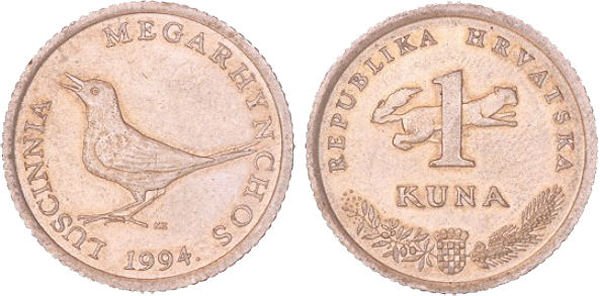
The first one-kuna coins with the Latin inscription bear the year 1994. It was precisely with this issue that one of the most well-known errors on Croatian circulating currency occurred.
Instead of the correct “LUSCINIA MEGARHYNCHOS,” the coin is inscribed with “LUSCINNIA MEGARHYNCHOS.” Therefore, an extra letter “N” appears in the name “Luscinia.”.
It is interesting that the incorrect form can be found even in the official Decision on the basic characteristics of kuna and lipa coins with the Latin names of animals and plants from 1995. In it, for the one kuna coin with the year 1994, the inscription „LUSCINNIA MEGARHYNCHOS” is officially listed.
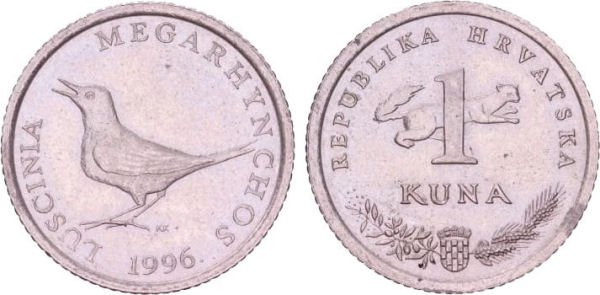
In the next issue, with the minting year 1996, the error was corrected, so the correct form “LUSCINIA MEGARHYNCHOS” appears on the coin. Coins bearing the year 1996 were put into circulation on May 16, 1996.
Thus, right at the beginning, two clearly distinct types of one kuna with a Latin inscription were created:
- 1994. LUSCINNIA MEGARHYNCHOS – wrong inscription, two letters N
- 1996 and later – LUSCINIA MEGARHYNCHOS – corrected inscription, one letter N
This difference has long been known to Croatian numismatists and, in a catalog sense, represents a very clear and easily recognizable variety.
Lesser known change on 2016 and 2018 coins.
It is much less known that another interesting change appears towards the end of the kuna period.
For one-kuna coins with years 2016 and 2018. A modified obverse design can be observed compared to earlier issues with Latin inscriptions. Both years were officially issued as circulating coins bearing the Latin names of animals and plants.
The change is most evident in the appearance of the inscription. In the older issues, the letters of the Latin name are relatively thin and clearly formed. On the 2016 and 2018 specimens, the inscription is noticeably thicker, and the overall obverse strike gives a somewhat rougher impression.
At first glance, one might think this is merely a minor difference resulting from the coining process. However, a comparison of the specimens reveals yet another very characteristic detail.
Connected letters “I” and “N” in the inscription “LUSCINIA”
The easiest way to distinguish this variant is precisely in the inscription “LUSCINIA”.
In older issues with thinner type, the letters "I" and "N" are clearly separated from each other. There is a visible space between them and each letter is individually shaped. On the 2016 and 2018 coins, the thicker elements of the inscription cause the letters "I" and "N" to practically touch, or merge.
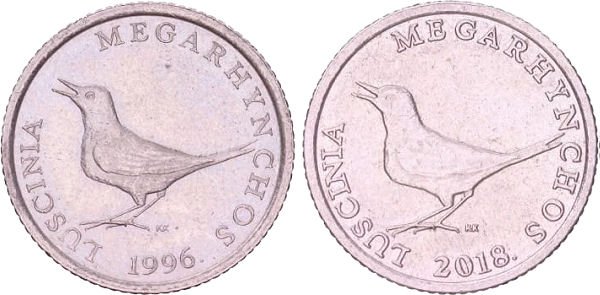
That is precisely a very practical detail for identifying the variety, because it is not necessary to compare the entire relief of the coin. It is enough to carefully look at the part of the inscription “LUSCINIA” where the letters “I” and “N” are located.
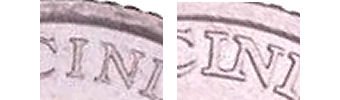
The difference can be simplified as follows:
- earlier editions: thinner letters, “I” and “N” separated
- 2016 and 2018: thicker letters, “I” and “N” connected
It is, therefore, a difference related to the modified mold of the reverse side, and not just an accidental irregularity of a single specimen.
Return to the old look of 2020 and 2022
It is especially interesting that this change was not retained until the end of the minting of the kuna.
With coin years 2020 and 2022. The earlier reverse style with thinner letters reappears. Both years also belong to issues with Latin names of plants and animals.
This means that the variant with the bolded lettering and the characteristic merging of the letters “I” and “N” can be dated very precisely:
- 2012 and earlier: thin inscription, “I” and “N” separated
- 2016.: bold lettering, “I” and “N” connected
- 2018.: bold lettering, “I” and “N” connected
- 2020.: a thin, separate "I" and "N"
- 2022.: thin inscription, “I” and “N” separated
The return to the earlier 2020 design further shows that the coins from 2016 and 2018 form a separate and clearly recognizable group.
New variant for Croatian coin collections
This difference is especially interesting to collectors who do not collect Croatian coins by year, but only by types, subtypes, and variants. Now, alongside other coins with Latin inscriptions, they must also acquire one specimen each from 2016 or 1018.
For the one-kuna coin with a Latin inscription, which is not a commemorative edition, we can therefore single out at least three very interesting versions:
- 1994 – incorrect inscription “LUSCINNIA MEGARHYNCHOS”
- standard type – corrected inscription “LUSCINIA MEGARHYNCHOS” and thin letters
- 2016 and 2018 – “LUSCINIA MEGARHYNCHOS” in bold with connected “I” and “N”
Such minor differences are precisely what makes the detailed study of circulating coinage interesting. A coin that at first glance appears completely ordinary can, upon closer comparison, reveal different dies and characteristics that largely went unnoticed during everyday circulation.
For Croatian numismatists, this also means another interesting item they can add to their collections. It will be especially interesting to those who systematize kuna and lipa coins by types and variants, as the one-kuna specimens from 2016 and 2018 represent a clearly recognizable reverse design between older issues and the return to thinner lettering in 2020 and 2022.
Author: Zlatko Viščević with AI assistance
Photos: Numex – Coins, Banknotes & Militaria Store [www.numex.hr]