Croatian collectors of national paper money often debate which issue of SFR Yugoslavia banknotes was the last one belonging to the Croatian national issue. Was it the banknote series from 1990 or the one from 1991? Arguments vary, and the aim of this paper is to reasonably provide a correct answer to that question from our still recent monetary history, which more or less all of us remember quite well.
„Marković“ convertible dinar

Many readers of these lines still remember the smile of the last Prime Minister of the SFRY, Ante Marković, when at the end of 1989 in the Federal Assembly of the SFRY from the rostrum he waved two banknotes of the „new“ convertible dinar and announced unexpected monetary changes that would take place on January 1, 1990. In that year 1989, inflation in December was surging at a rate higher than 100 % per month, and the exchange rate of the dinar by the end of December reached 69,450 for one German mark. With Ante Marković's program, the dinar was denominated: 10,000 for 1 new, convertible dinar, and the exchange rate was pegged to the German mark at a ratio of 7 dinars for 1 mark. In that year 1990, citizens were able to exchange dinars for foreign currency in banks (which had been unimaginable until then, and would remain so for less than 10 months). A new emission of banknotes immediately followed, dinars without so many confusing zeros.

Figure 1. „Extraordinary“ issue of the „Marković“ dinar: 50 and 200 dinars.
Source: Coins, Banknotes & Militaria Store [www.cbm-store.com].
The National Bank of Yugoslavia first issued two banknotes (Figure 1) from the „for extraordinary needs“ series: 50 and 200 dinars dated January 1, 1990 (better known as „monuments,“ which were withdrawn from circulation quite quickly, between January 3 and March 31, 1991, because due to the urgency of circulation needs they were produced using the flat printing technique, making them easily counterfeit-able). As early as March 11, 1990, the first banknote „for regular circulation needs“ (Figure 2) of 100 dinars appeared, dated March 1, 1990, and produced using the high-quality intaglio printing technique, soon followed by banknotes of 500 dinars (dated March 1, 1990, issued April 27, 1990), 50 dinars (dated June 1, 1990, issued June 10, 1990), 10 dinars (dated September 1, 1990, issued November 26, 1990), and the last in the series, the 1000 dinars banknote (dated November 26, 1990, issued January 30, 1991). (2)

Figure 2. „Regular“ issue of „Marković“ dinar: 10, 50, 100, 500, 1000 dinars.
Source: Coins, Banknotes & Militaria Store [www.cbm-store.com].
Monetary situation in 1991.
Following the tragic historical events in the SFRY in 1991, prior to which the republics of Croatia and Slovenia were excluded from the primary money issue of the National Bank of Yugoslavia by a decision of the monetary authorities in Belgrade (3), the Croatian and Slovenian monetary authorities prepared their own issue with which they would, at a given moment, replace the banknotes of the NB of Yugoslavia in current circulation. At the same time, preparing for such a possible event, the NB of Yugoslavia also prepared a new issue of banknotes in the event that Croatia and Slovenia withdrew the current dinar banknotes from circulation.
During that time, the circulating emission of the dinar was constantly growing, so in the summer of 1991, the daily press in Slovenia reported that freshly printed bundles of 1,000-dinar banknotes (4) were arriving from Belgrade by Yugoslav People's Army helicopters for military payrolls. Naturally, this significantly affected the rise in prices and the „black market“ exchange rate, causing the value of the German mark in exchange offices to jump from 16-17 dinars in May to 20-22 in June, 25-28 in September, 33-36 in October, 42-44 in November, and 48-50 in December of that year, 1991. (5)
Thus, the „Marković“ dinar emission remained in circulation in Croatia until the end of 1991, right up until the definitive, irrevocable monetary independence of the Republic of Croatia on December 23, 1991, and the introduction of the Croatian dinar as the legal tender in our country, with the „Marković“ banknotes ceasing to be legal tender by December 31, 1991. Following the decision on the severance of all state-legal ties with the former state of the SFR Yugoslavia on October 8, 1991, the Republic of Croatia simultaneously carried out its monetary independence by the end of that year. Thus, temporary currency issued by the Ministry of Finance—the Croatian dinar—was put into circulation in the territory under the control of the authorities in Zagreb, and its value was set at 55 Croatian dinars for 1 Deutsche Mark. (6)
Croatian and the new „Yugoslav“ dinar
The exchange took place from December 23, 1991, to December 31, 1991, at a 1:1 ratio. As of the New Year 1992, the new Croatian dinar became the sole legal tender on the territory of the Republic of Croatia.
However, the Croatian dinar was not introduced across the entire territory of Croatia. At that time, a significant part of the country was under the de facto rule of rebellious Serbs (the so-called Republic of Serbian Krajina), and the Dubrovnik region from the border with Montenegro to the west all the way to the surroundings of Ston and almost to the Neretva River, except for the narrowest area of the City of Dubrovnik, was under the military rule of the so-called Yugoslav People's Army, whose units consisted mostly of soldiers from Serbia, Montenegro, Bosnia and Herzegovina, and Macedonia, as well as members of various paramilitary groups predominantly from northern Montenegro and eastern (Serbian) Herzegovina. In those areas, the Croatian dinar could not be put into circulation.
However, the National Bank of Yugoslavia, anticipating an independent Croatian currency emission, prepared a new series of Yugoslav dinar banknotes with which, once Croatia introduced its own currency, it would withdraw „Marković's“ dinars from the territory under its monetary authority (Bosnia and Herzegovina, Serbia, Montenegro, Macedonia) and replace them with this new emission. In that case as well, the exchange ratio was set at 1:1, and it is interesting that the exchange rate of the new „Yugoslav“ dinar (Figure 3) was set at 65 for 1 Deutsche Mark, which is 10 currency units higher than the value of the Croatian dinar estimated by the National Bank of Croatia. (7) The physical exchange was carried out from December 25, 1991, to January 3, 1992, in all territories of the still formally existing SFR Yugoslavia that were under the civil or military, i.e., monetary authority of Belgrade. (8)

Figure 3. Issue of the new „Yugoslav“ dinar: 100, 500, 1000, 5000 dinars.
Source: Bank Note Museum [www.banknote.ws].
The new „Yugoslav“ dinar was issued in banknotes identical to the previous „Marković“ edition with the following changes:
- Primary colors changed,
- „SFR“ was removed from the country name SFR Yugoslavia on the obverse,
- the names of the republics that were printed vertically on the left and right sides of the printed frame of the obverse in the previous issue have been removed,
- the introduction of the 5000 dinar banknote featuring the image of Ivo Andrić,
- The 10 and 50 dinar coins (figure 4) were not issued.
It should also be noted that unissued banknotes of the new „Yugoslav“ dinar in denominations of 10 and 50 dinars have appeared in very limited numbers on the collector's market. The 10-dinar denomination appeared in three variants: without numbering, numbered with the zero series „AA 0000000“, and so far a single seen specimen with regular numbering, specifically of the replacement „ZA“ series. The 50-dinar denomination also appears without numbering, numbered with the zero series „AA 0000000“, and about a dozen specimens with regular numbering of the „AA“ and „AC“ series are known.

Figure 4. Unissued banknotes of the new „Yugoslav“ dinar: 10 and 50 dinars.
Source: Coins, Banknotes & Militaria Store [www.cbm-store.com].
Since the National Bank of Yugoslavia classified the 1991 issue as an „issue for extraordinary needs“ (9) rather than a new regular issue, the issue of dinar banknotes dated 1991 represents an issue of the SFR Yugoslavia that was produced at a time when the SFR Yugoslavia still formally and legally existed, including Croatia and Slovenia, and on the date of issue, from an international law perspective, the SFR Yugoslavia was still a recognized state in its entirety. Therefore, despite the fact that on October 8, 1991, the Republic of Croatia declared the severance of all state and legal ties with the former state of the SFR Yugoslavia, the 1991 issue cannot be considered in any other way than as the final issue of also the Croatian national heritage from the period of the existence of the SFR Yugoslavia.
In reality, the circulation of the Croatian dinar and the new "Yugoslav" dinar did not "overlap" anywhere on the territory of the Republic of Croatia, except in the aforementioned Dubrovnik area, from the border with Montenegro westward to the vicinity of Ston, excluding the immediate area of the City of Dubrovnik. Unlike the self-proclaimed "Republic of Srpska Krajina," where the new "Yugoslav" dinar was introduced, and which was "divided" from the free territory of the Republic of Croatia by the front line, with no communication between the populations, a specific and unique situation existed in the Dubrovnik area: The Dubrovnik hinterland was not "declared" a Serbian statelet but was simply an area under the military administration of Belgrade. In the Dubrovnik suburbs of Mokošica and Zaton, the population largely remained in their homes and did not flee. In Mokošica alone, an estimated 1,500 to 2,000 residents remained. (10) Communication between the populations of Dubrovnik and Mokošica was established by a boat line (which bypassed the front line), thereby enabling a relatively orderly supply of the population that remained under the military authority of the so-called "Yugoslav People's Army." The uniqueness of this case also lies in the fact that the Croatian dinar was introduced as a means of payment in Mokošica, even though it was not under Croatian state authority. This was not done officially, since there were no Croatian authorities there, but spontaneously, with the introduction of Croatian money via the boat connection from free Dubrovnik. At the same time, there was a parallel "influence" of the new "Yugoslav" dinar, for two reasons: first, because soldiers of the so-called JNA put this money into circulation—those who decided to pay for goods in stores rather than simply take them from the shelves, in other words, to steal. And the second reason was population flux, as people—out of practical necessity or, more accurately, for survival—came into possession of certain amounts of the new "Yugoslav" dinar. As a result, these banknotes even appeared, albeit sparingly, in the Dubrovnik area, but they were never accepted there as a means of payment. Thus, the only situation in Croatia was recorded where the Croatian dinar and the new "Yugoslav" dinar circulated simultaneously under these limited conditions, and at the beginning "al pari," which means that 1 new "Yugoslav" dinar was (compulsorily) accepted for 1 Croatian dinar.
Since the monetary policies of Zagreb and Belgrade differed significantly—that is, the emission of the new „Yugoslav“ dinar grew faster than the emission of the Croatian dinar—the „black“ market soon established a new equilibrium between the two currencies. The 1 : 1 ratio lasted for a very short time. Already by mid-January 1992, 100 YUD was calculated as 80 HRD, which was influenced by the fact that on January 15, 1992, the Republic of Croatia received international recognition, making it clear under international law that the so-called JNA was an occupier of Croatian territory and would sooner or later have to withdraw to Bosnia and Herzegovina, Serbia, Montenegro, and Macedonia.
February marked the beginning of a more significant shift in the „strength“ of the two currencies, so in the middle of that month, 100 YUD was valued at 50 HRD. The new „Yugoslav“ dinar suffered a new blow in April: on April 6, Bosnia and Herzegovina and Macedonia declared independence, and as early as April 26, Macedonia introduced its own currency, the denar, and withdrew the banknotes of the new “Yugoslav„ dinar from circulation. (12) In the newly created circumstances, the value of the new “Yugoslav„ dinar plummeted, so at the end of April, 100 YUD was valued at 25 HRD. The beginning of May brought new geostrategic circumstances: the combat pressure of the “Croatian Army„ on what was no longer the “Yugoslav People's Army„ but the “Army of Yugoslavia„ became stronger and stronger, and the end of the occupation was drawing near. Mokošica was liberated on May 25, and that day also marked the end of the short-lived “coexistence„ of the Croatian and the new “Yugoslav" dinar in the Dubrovnik area. (13)
5000 Dinars „Ivo Andrić“: originally a „Marković“ dinar banknote of SFR Yugoslavia?
As stated in the previous chapter, the National Bank of Yugoslavia, in the issue of dinar banknotes dated 1991, put into circulation the previously unissued denomination of 5000 dinars featuring the portrait of the Croatian Nobel laureate Ivo Andrić. The author of this paper rightly and with argument maintains that this banknote was previously planned as part of the „Marković“ dinar emission, but the course of political events during 1991 did not allow this denomination to be issued in its originally planned version. Several elements on this banknote indicate that it was prepared (and possibly even printed in a certain number of copies) in the original version of the „Marković“ dinar, bearing a date around late 1990 or early 1991. These elements on the 5000 dinar banknote of 1991 are:
1. In the country title „YUGOSLAVIA“, it is clearly visible (Figure 5.a) that the Cyrillic and Latin names are not centered one above the other; instead, the Latin name is „shifted“ to the right, which is the result of the subsequent removal of „SFR“ from the title „SFR YUGOSLAVIA“ from the printing plate, which was present on the original, first unissued banknote.

Figure 5.a From the country name on the 5000 dinars banknote of 1991, the removal of „SFR“ is clear.
Source: Coins, Banknotes & Militaria Store [www.cbm-store.com].
Letters positioned in that way are found on all banknotes of the „Marković“ dinar. Incidentally, the National Bank of Yugoslavia corrected this „flaw“ in the issue of the next emission, the emission of the dinar of the FR Yugoslavia (Serbia and Montenegro) in 1992, which were actually modified denominations of the previous emission. In that emission, the Cyrillic and Latin names „YUGOSLAVIA“ were „corrected,“ i.e., centered (Figure 5.b).

Figure 5b Illustrative comparison of the country name on the 5000 dinars banknote of 1991 with the clearly „removed“ „SFR“, and the subsequently centered name on the 1992 FR Yugoslavia banknote. Source: Coins, Banknotes & Militaria Store [www.cbm-store.com].
2. On the obverse, vertically on the left and right (Figure 6), space was left for the printed names of the republics, as on all banknotes of the „Marković“ dinar. This left-over space is clearly visible, especially on the left side, where the drawing of Višegrad is not printed within 3 to 4 mm along the border, i.e., it does not touch the border, because the names of the republics were located in that place on the original, first unissued banknote. Therefore, it is completely certain that this „empty“ space vertically on the left of the obverse of the 1991 issue denomination is a consequence of the subsequent removal of the names of the republics from the printing plate. In that case as well, the National Bank of Yugoslavia corrected this „deficiency“ on the issue of the next emission of the dinar of the Federal Republic of Yugoslavia (Serbia and Montenegro) in 1992, so the drawing of Višegrad was „extended“ all the way to the edge of the printed entire obverse.

Figure 6. The „empty“ space of the left vertical band on the 5000 dinars banknote of 1991 with clearly „removed“ names of the republics, and the „corrected“ drawing of Višegrad on the 5000 dinars banknote of 1992. Source: Coins, Banknotes & Militaria Store [www.cbm-store.com].
3. The nominal value (Figure 7) is printed in all languages of the SFR Yugoslavia, as well as on the previous denominations of the „Marković“ dinar: Serbian, Croatian, Slovenian, and Macedonian. This indicates that the denomination was undoubtedly intended to circulate throughout the entire SFR Yugoslavia, including Slovenia and Croatia. Furthermore, the fact that Slovenian and Croatian were not removed from the 1991 issue indicates that the 1991 issue was actually created at the „last“ moment (due to the expected monetary independence of Slovenia and Croatia) by modifying the current issue of the „Marković“ dinar amidst the still uncertain outcome of the political crisis in the SFR Yugoslavia, and that the printing of this issue began before the outbreak of the war in Slovenia in late June 1991.

Figure 7. Complete obverse of 5000 dinars 1991, nominal value in words in all official languages.
Source: Coins, Banknotes & Militaria Store [www.cbm-store.com].
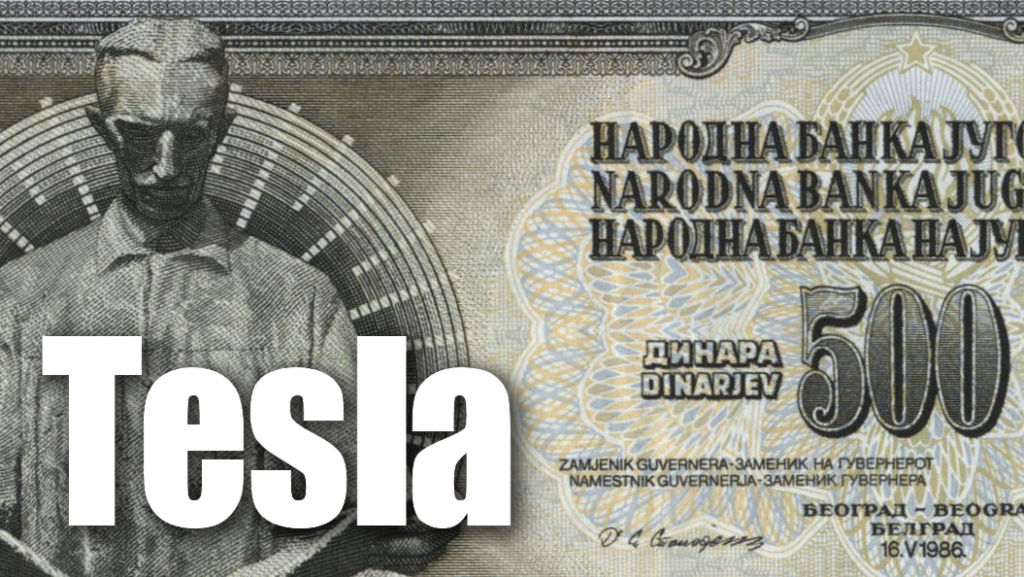
4. The portrait of Ivo Andrić as a Nobel laureate is a logical sequence to the banknote featuring the portrait of Nikola Tesla, also a Nobel laureate, which was printed on the 1000-dinars denomination of the „Marković“ dinar on November 26, 1990, making it likely that the tendency was to present the portraits of our Nobel laureates (Figure 8) in sequence.Editor's note: Nikola Tesla is erroneously stated as a Nobel Prize winner, which is not factually correct.]

Figure 8. A series of Nobel laureates: Nikola Tesla, Ivo Andrić.
Source: Bank Note Museum [www.banknote.ws].
5. In the literature of the NB of Yugoslavia (Serbia), it is stated that the nomenclature number of the issue for the 5000 dinars denomination of 1991 is I-3, and for the 5000 dinars denomination of May 1, 1985 (with the portrait of J. B. Tito) of the same series (type) it is I-1. (14) At the same time, the nomenclature number I-2 is „skipped“ in the overview of issued banknotes in which between these two issues from 1985 and 1991 there were no other types of the 5000 dinars denomination, so it is quite clear that the nomenclature number I-2 belongs to the (unissued) 5000 dinars denomination (of a currently unknown date from late 1990 or early 1991) with the portrait of Ivo Andrić as the last denomination of the „Marković dinar“ emission series. (15)
Two unissued banknotes of the National Bank of Yugoslavia, 1990 emission.
Two banknotes also appear on the collector's market that cannot be said to belong to either the „Marković“ dinar or the new „Yugoslav“ dinar. These are the 100-dinar banknote dated March 1, 1990, in an olive printing color, identical to the color of the later issued 100-dinar denomination of the new „Yugoslav“ dinar from 1991, while in all other elements it is identical to the denomination of the „Marković“ 100 dinars dated March 1, 1990, issued in golden-yellow. The second banknote is the 500-dinar denomination dated March 1, 1990, in an orange printing color, identical to the color of the later issued 500-dinar denomination of the new „Yugoslav“ dinar from 1991, but unlike the 100-dinar note, its elements correspond to the banknote issued in 1991: „SFR“ has been removed from the country's name, and the names of the republics are also absent vertically on the left and right sides of the obverse. These two banknotes are not mentioned in the official literature of the National Bank of Yugoslavia. It can be assumed that in both cases these were proposals for the emission of the new „Yugoslav“ dinar that were rejected in that form, i.e., with such elements, and were additionally „politically“ modified (while retaining only the accepted printing color) and produced in the final version known to us as the 1991 emission.

Image source: Bank Note Museum [www.banknote.ws].
Certainly, these are collector's specialties, currently quite rare on the market, and so far they have appeared exclusively numbered with the zero series „AA 0000000“ or without any numbering at all, which also confirms that they are proofs. It is not excluded, however, that a specimen with regular numbering also exists, but up to the time of writing this paper no such specimen has been discovered.
The aim of this paper was to help collectors in their dilemma of „where“ to draw the line in the emission of dinar banknotes of the former Yugoslavia that also belong to the Croatian national issue. The authors' stance is that Croatian national issues within the Yugoslav community must also encompass the 1991 emission of the dinar, and all available arguments in favor of this are presented here. The final decision must certainly be made by each collector individually. In any case, whatever that decision may be, the primary goal has been fulfilled, which is the promotion of notaphily as a beautiful, interesting, and valuable hobby, as a witness to the time, history, politics, economy, and culture of a historical period.
Documentation and data sources
(1) www.nbs.rs, National Bank of Serbia, archive
(2) J. Hadži-Pešić, „Money in Yugoslavia 1944/92“, NBY, Belgrade, 1996.
(3) www.nbs.rs, National Bank of Serbia, archive
(4) „Slobodna Dalmacija“, daily editions for June 1991.
(5) „Dubrovačka banka“ d.d. Dubrovnik, exchange rates at the beginning of the month
(6) www.hnb.hr, Croatian National Bank, archive
(7) National Bank of Yugoslavia, „Exchange Rate List“ as of December 25, 1991.
(8) J. Hadži-Pešić, „Money in Yugoslavia 1944/92“, NBJ, Belgrade, 1996.
(9) „Official Gazette of the SFRY“, No. 93/91
(10) „Dubrovački vjesnik“, war editions for December 1991.
(11) „Dubrovački vjesnik“, wartime editions for January – May 1992.
(12) www.nbrm.gov.mk, National Bank of Macedonia, archive
(13) To be fair, the VJ remained in the Dubrovnik area from May 26 to October 18, 1992, specifically from Plat and Cavtat to the border with Montenegro, but under conditions where it can no longer be considered that the „Yugoslav“ dinar was in circulation at all, since the remaining population was supplied exclusively through humanitarian aid.
(14) A new, more modern series of SFRY banknotes (following the 1965/74 series) began with a completely new design type, first seen on the 5000 dinar banknote of May 1, 1985, created by the Italian designer T. Cionini, and continued with the production of banknotes of this type in a series of denominations all the way until 2000, when the National Bank of Serbia began issuing a newly designed series. www.nbs.rs, National Bank of Serbia, archive
(15) J. Hadži-Pešić, „Money in Yugoslavia 1944/92.“, NBJ, Belgrade, 1996.
Author: Ivan Škrabo
Source: Numismatic News, issue 63, Zagreb, 2010.
Photos: Coins, Banknotes & Militaria Store (www.cbm-store.com), Bank Note Museum (www.banknote.ws).