

One of the rarest ducats of Maria Theresa appeared at an auction by a German house Münzenhandlung G. Hirsch successor. Gold ducat minted in Prague in 1745, offered as a lot 3168 at the 410 auction held on September 24 and 25, 2026., It was valued at 15,000 euros and sold for as much as 65,000 euros. This resulted in a price that was more than four times the auction estimate. NumisBids
One of the rarest Prague ducats of Maria Theresa
This is a gold ducat of Maria Theresa from 1745, minted in Prague. On the face of the coin is depicted the ruler standing facing to the right, with a scepter in her right hand and a regnal scepter in her left hand. Around the depiction is a legend PR. MAR. THERESIA – D : G : REG : HUNG : BOH :, which, among other things, mentions her titles of Queen of Hungary and of Bohemia.
On the obverse is a crowned, elaborate coat of arms with the crowned central shield of the Czech Republic, while around it is a legend. ARCHID. AUST. DUX. – BURG : COM. TYR : 1745. The coin weighs 3.46 grams.
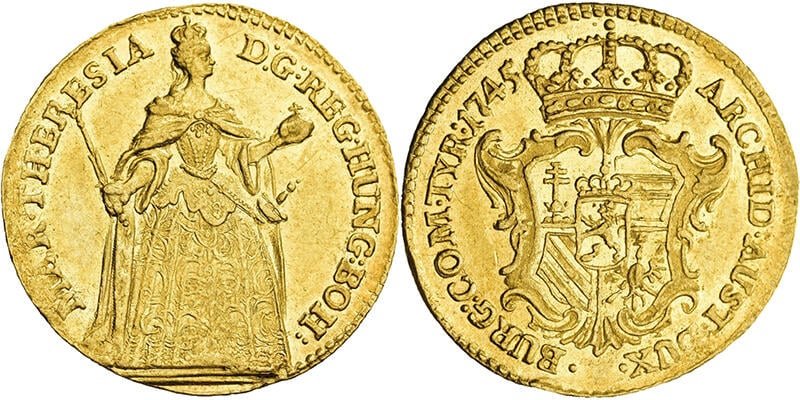
The auction house listed the catalog references Her. 166, Eyp. 11/3, Fr. 417 and Frühwald 821 and assigned it the rarity label. RRRR. In the description, slightly weaker knots along the edge and minor defects on the edge were noted, while the degree of preservation was described as „gutes vz”.
An estimate of 15,000, and a selling price of 65,000 euros
Before the auction, the ducat was valued at 15,000 euros, while the starting bid was 12,000 euros. After the bidding, it was sold for 65,000 euros, which shows how extreme the rarity of a particular type can affect its market value.
The published price represents the auction result, while according to the auction house's terms, the corresponding buyer's commission and any additional costs are calculated on the achieved price, depending on the method of participation and the tax treatment of the lot.
Previously sold for 90,000 euros
Particular attention is drawn to the fact that Münzenhandlung G. Hirsch Nachfolger mentioned in the description of the lot. According to their data from the CoinArchives database, only one earlier example of this edition has been recorded on the market. It appeared in 2019 at the Macho & Chlapovič auction, Auction 21, as lot 3, where it was sold for 90,000 euros.
Data from the auction results archive confirm that this Prague ducat from 1745 was offered on November 22, 2019, and that at that time it was described as extremely rare, with the auction house noting that according to their knowledge, only one example has been recorded on the market.
Such a formulation should nevertheless be distinguished from the claim that there is only one surviving example. It primarily refers to known phenomena in the public numismatic market and in auction databases. With extremely rare coins, individual examples may remain in private or institutional collections for decades without being put up for public sale.
Two exceptional auction successes
The result of 65,000 euros in 2026 is lower than the 90,000 euros achieved in 2019, but with such rare coins, two individual auction sales are not sufficient to draw broader conclusions about the movement of the market value. The final price largely depends on how many serious interested buyers are present at the very moment the coin appears on the market.
This example once again shows how wide a range of values there is within the Marija Terezija coinage. While many of her ducats appear relatively regularly at international auctions, individual issues from specific mints and years belong to a completely different category of rarity. The Prague ducat from 1745 is clearly one of such examples, and its new sale for 65,000 euros represents one of the most notable realizations of Habsburg gold currency on the European auction market in 2026.
Photos: Münzenhandlung G. Hirsch successor / NumisBids, lot 3168.
Source: Münzenhandlung G. Hirsch successor, Auction 410; NumisBids
Did you notice an error in the text or a linguistic inconsistency? Please report it to us via the page for Contact how we could fix it. Thanks in advance!