



For years, claims have been appearing online that the 2002 2-euro Greek coin, which has the letter „S” in one of the stars, is extremely rare and worth several thousand, even tens of thousands of euros. Such information regularly generates great interest, especially among people who are not usually involved in numismatics. Many then start examining their coins in the hope of finding just that allegedly valuable specimen.
However, the letter „S” on this coin is not a printing error, nor is it a rare large-denomination coin. This is a completely standard issue, minted in as many as 70 million copies. Despite this, unfounded claims about its exceptional value continue to spread on social media and online advertisements.
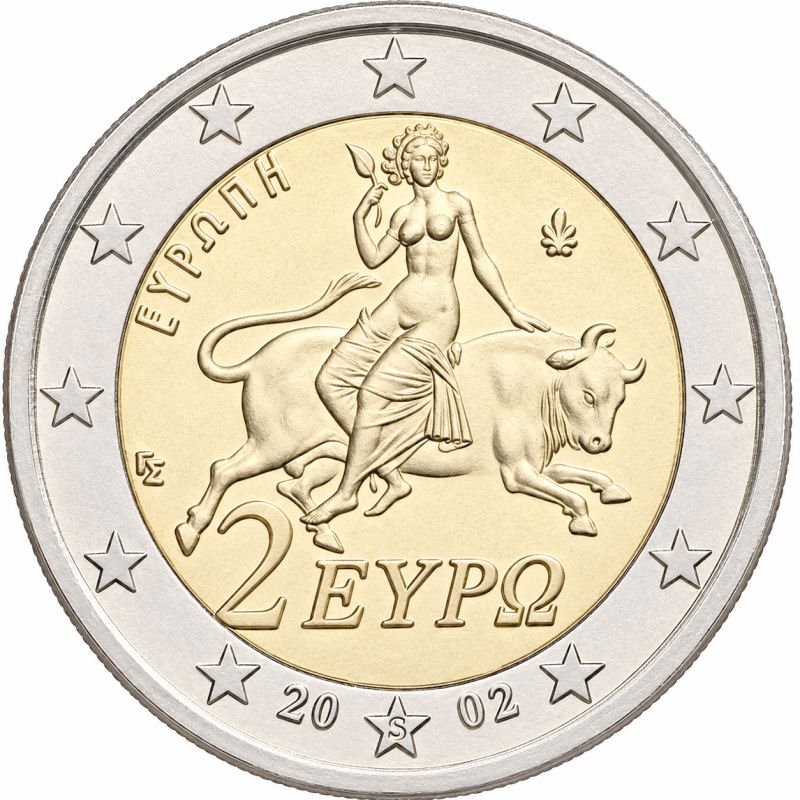
Greek 2-euro coin from 2002
Greece was among the countries that introduced euro banknotes and coins into circulation on January 1st, 2002. For its euro coins, it chose various national motifs, and the scene from Greek mythology is depicted on the 2-euro coin.
On the national side of the coin is Europe being taken by Zeus, transformed into a bull. The motif is taken from an ancient mosaic from Sparta, dating from the 3rd century AD. The author of the coin’s artistic design is the Greek sculptor Georgios Stamatopoulos.
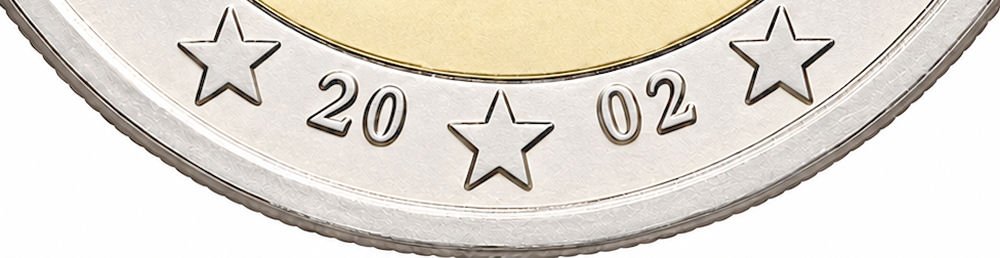
Next to the motif of Europe and the bull is the inscription „ΕΥΡΩΠΗ” (Europa) and the nominal value mark „2 ΕΥΡΩ”. On the outer ring there are twelve stars, and at the bottom of the year of minting „2002”, divided into two groups of digits: „20” and „02”.
It is precisely in the asterisk that separates these two groups of digits in some examples that the letter „S” is found.
What does the letter „S” actually mean?
The explanation is very simple and is related to the organization of the production of euro coins during the introduction of the euro.
The Greek mint did not have sufficient production capacity to independently secure all the necessary quantities of euro coins for the start of their circulation. Therefore, part of the production was entrusted to mints of other European countries.
Minting of Greek euro coins was carried out in Greece, Finland, France and Spain.
The Finnish Mint „Mint of Finland” produced part of the Greek 1 and 2 euro coins. To distinguish these from the coins produced in Greece itself, a „S” mark is placed on them.
The letter „S” stands for „Suomi”, that is, Finland in Finnish.
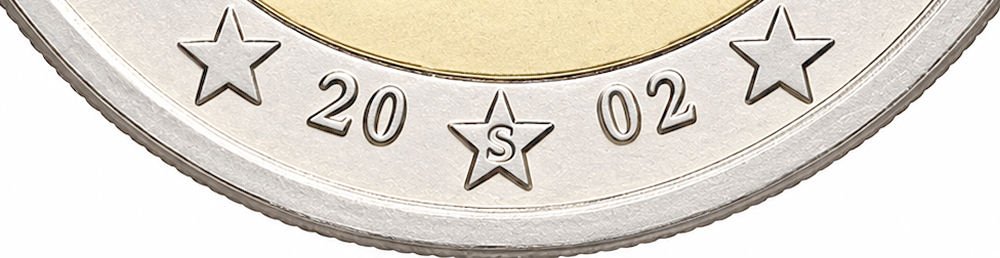
Therefore, it is a mint mark that has been intentionally included in the official design of the coin. It was not created by accident, does not represent a manufacturing error, and does not make the coin particularly rare.
Similar markings are also found on other Greek euro coins from 2002. The 1, 2, 5, 10 and 50 cent coins produced in France have the „F” mark, while the 20 cent pieces produced in Spain have the „E” mark.
How many coins with the letter „S” are struck?
The data on the minted quantity best shows how unfounded the claims about the rarity of this coin are.
According to numismatic catalogs, the 2-euro Greek coin from 2002 exists in two basic variants that differ precisely by the mint mark.
| Variant | Coin factory | Excessive amount |
|---|---|---|
| 2002, without the letter „S” | Greece | 75.400.000 |
| 2002, with the letter „S” | Finland | 70.000.000 |
In total, therefore, more than 145 million Greek 2-euro coins from 2002 have been minted in these two base variants.
Of these, as many as 70 million have the letter „S” in them.
This means that almost every second coin from these two major issues was produced in Finland and bears the mentioned mark.
Although the variant with the letter „S” is slightly less common than the one without it, the difference is negligible for the numismatic market when we talk about tens of millions of minted copies.
A coin minted in 70 million copies cannot be considered rare just because it has the mark of the minting side.
How much is actually worth the Greek 2-euro coin with the word „S”?
The actual market value of this coin is significantly lower than the amount that appears in sensationalist publications.
A coin that has been in regular circulation and has typical signs of use will generally be worth its face value, namely 2 euros.
For specimens in completely unused condition (UNC), without traces of circulation, collectors can pay slightly more. As a guideline range in the numismatic trade is often quoted as approximately 4 to 10 euros, depending on the condition, the offer, and demand. Individual catalogs and dealers may also quote different amounts.
It is important to understand that not every brilliant coin is automatically in UNC condition. A coin can retain a large portion of its original brilliance even after spending some time in circulation. To assess the condition of preservation, it is necessary to examine its surface, relief, and any traces of use.
The letter „S” by itself does not increase the value of the coin by hundreds or thousands of euros.
How did the story of a coin worth 80,000 euros come about?
One of the more famous examples of the spread of this misconception was documented by the numismatic portal „Numismag” in January 2019.
Then a 2-euro Greek coin from 2002 appeared on German eBay, offered for an incredible 80,000 euros.
The seller specifically highlighted the letter „S” in the star as a feature, presenting it as a manufacturing defect. Other alleged irregularities were also mentioned in the description.
At the same time, other ads appeared with similar coins, but with very different asking prices. Some sellers demanded tens of thousands of euros, while others offered the same type of coins for just a few dozen euros.
The problem arises when the amount from such an advertisement begins to be presented as the actual market value of the coin.
It is necessary to clearly distinguish between the „desired price” and the „achieved sales price”.
Anyone can offer a regular 2-euro coin for 10,000, 50,000, or 100,000 euros on an online auction site. However, that does not mean that the coin is worth that much, nor that someone will buy it at that price.
Despite this, it is precisely such ads that often become the source of new sensationalist publications.
Someone finds an unusually high price, posts a photo and presents the coin as a rarity. Others pass on that information without verifying it, and then the same story spreads on social media.
In the end, the impression is created that this is a well-known numismatic fact, although the entire story was created based on one or several unfounded advertisements.
Before you believe in the sensational price…
The story of the 2-euro Greek coin with the letter „S” is a good example of how an entirely ordinary numismatic fact can be turned into a widely spread online misconception.
The coin is interesting because it testifies to the cooperation of European mints in introducing the common currency. In numismatic terms, the „S” mark represents a legitimate and well-documented issue variant from 2002.
But there is a big difference between an interesting variant and a valuable rarity.
Before believing the claim that a certain coin is worth several thousand euros, it is necessary to verify its actual minted quantity, the data in numismatic catalogs, and, what is especially important, the prices at which comparable examples have actually been sold.
In the case of the 2002 2-euro Greek coin with the letter „S”, the facts are clear: 70 million copies have been minted and the ordinary circulation coin is worth 2 euros.
All the stories about thousands and tens of thousands of euros because of that letter are just another internet delusion that keeps repeating itself.
Edited: Zlatko Viščević with AI assistance
Sources: European Central Bank, Numista, CoinsWeekly, Numismag
Did you notice an error in the text or a linguistic inconsistency? Please report it to us via the page for Contact how we could fix it. Thanks in advance!