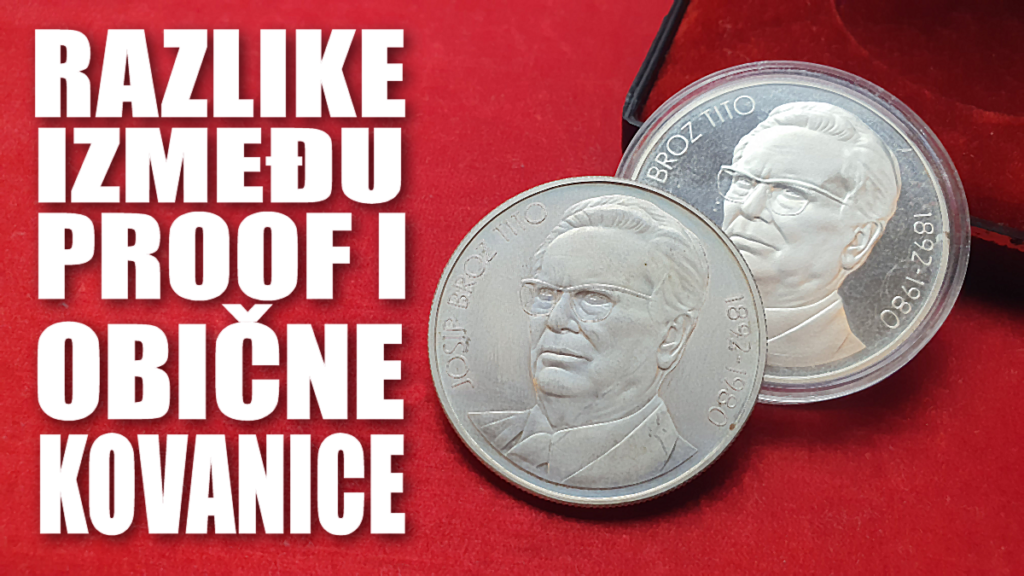



Aside from the obverse and reverse, a coin also has an edge obod (Eng. edge). The edge is the side, most commonly curved surface connecting the obverse and reverse of a coin. The edge is usually smooth or reeded, but can also be more complex in shape. In addition to its decorative role, edge shaping also has an important protective function. Very often, the edge of coins also contains edge lettering.
What is a peripheral inscription?
Peripheral inscription The text is placed on the edge of the coin. Most often it has a decorative role, but historically it was also introduced as an additional protection against counterfeiting, trimming, or scraping (in order to reduce the mass of money, especially in the case of precious metal coins).
In execution, the peripheral inscription can be:
- concave – text is engraved on the rim or
- embossed – the text is raised above the surface of the rim.
In addition to the text itself, the peripheral inscription may also contain decorative elements such as dots, asterisks, dashes, or various other decorations.

Orientation of the peripheral inscription
For coins with edge lettering, it is important for numismatics how is the text oriented in relation to the obverse and reverse coins. Two basic positions are distinguished:
- Legend oriented toward the face or peripheral inscription read from the obverse (abbr. N/A or position A). The inscription is correctly read when heads up, and the text runs along the rim in one direction. If the coin is flipped so that the reverse is up, the inscription will be upside down.
- Reverse-oriented legend or circumscription read from the reverse (abbr. ON/R or Position B). In this case, the inscription is correctly legible when face up, while when turned face up, the inscription is upside down.

Source: Numex – Coins, Banknotes & Militaria Store [www.numex.hr].
Edge lettering on 2 euro coins
New numismatists are often surprised to notice that 2 EUR coins they have a rim inscription that is „normal“ on some specimens and „inverted“ on others. Therefore, it is important to emphasize that It is not about an error, a rare variant, or a special numismatic curiosity. That is a completely common and expected phenomenon. Both variants of the edge inscription are actually – normal.
How are the two variants of the edge inscription created?
The reason lies in itself forging process. For modern bi-metallic 2-euro coins, the edge lettering is created using a special tool that presses the text into the coin's edge. The obverse and reverse, as well as the edge lettering, are struck on blanks (planchets) separately, and so sometimes it happens that the edge inscription is „right-side up“ relative to the obverse, and sometimes it is „upside down“. Depending on which side the coin „falls“ into the machine.
That is why for 2-euro coins in circulation both orientations of the peripheral inscription regularly appear, without any difference in official status, emission, or value.
Therefore, regarding the orientation of the edge lettering, it should be kept in mind that this is a normal and common occurrence, and that it is „nothing special“ when it comes to numismatic value.
Author: Zlatko Viščević
Photos: Numex – Coins, Banknotes & Militaria Store [www.numex.hr]