





In the region of the Latin cities, in the central part of the Apennine Peninsula, the city of Rome was founded (according to tradition in 753 BC). From the initial settlement on the Palatine, the city gradually developed and, following the abolition of the monarchy (around 510 BC), became a republican aristocratic state in which two high officials—consuls, elected every year—wielded supreme civil and military power.
The nobles—patricians were gathered in the Senate, while the commoners—plebeians gradually fought for increasingly greater rights through a long-term struggle. With the consolidation of the republic, Rome began a long and exceptionally tenacious period of conquests, aimed first at expanding its rule at the expense of its immediate neighbors, and then beyond the borders of Italy. In doing so, it gradually established dominance in the Mediterranean and created the largest empire of the ancient world, which extended into parts of Europe, Africa, and Asia.
By the mid-4th century BC, the expansion of Roman rule was limited to long-standing struggles with neighbors—the Latins, Sabines, Etruscans, and Volscians—as well as defense against frequent Gallic incursions into Italy. Only in the second half of the 4th century BC did the Romans begin an offensive toward the southern Italian cities under Greek rule. Through Campania, this also fostered more intensive trade with the culturally and economically more advanced Greek world.
The appearance of the first round Roman coins can also be placed in that period.
Until then, the Romans in their mutual trade, as well as in their exchange with neighbors, did not know real money, but used cattle as a means of payment and exchange. From the Latin word livestock The word (stoka) originated money, which later became the generic name for money in Latin.
Already around 450 BC, in the Laws of the Twelve Tables, along with livestock as a means of payment, crude pieces of copper are also mentioned (AES). The oldest such finds show irregular, unprocessed pieces of metal. This type is called aes rude („raw copper“), while for the mixture of copper and tin the term used is tainted copper („mixed copper“).
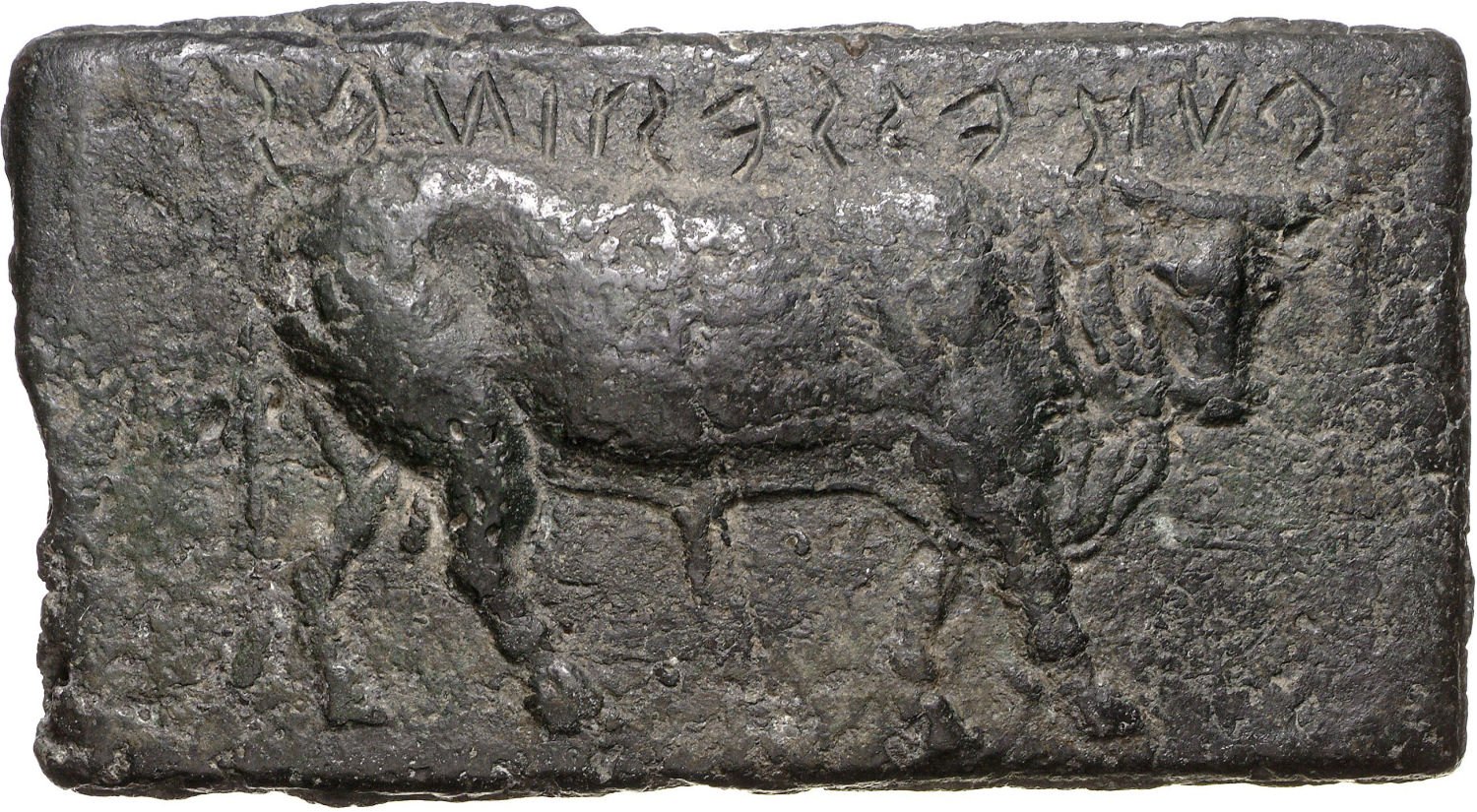
Over time, under the influence of more developed neighbors, copper processing by casting into bars began. They were initially marked with simple, ribbed symbols and later with depictions of animals. Such money is called signed bronze („marked copper“) and has a regular rectangular shape.
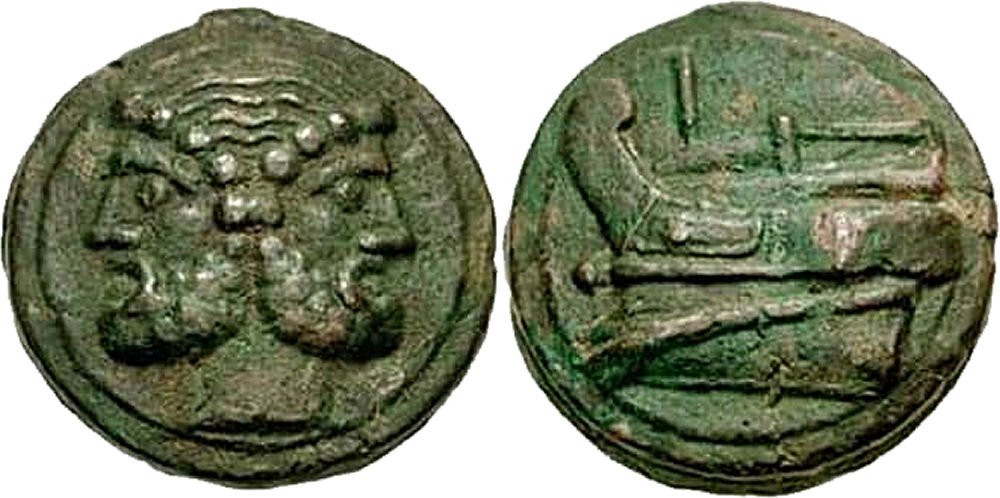
Around 289 BC, following the model of the coinage of the neighboring areas of Latium, Umbria, Etruria, and Picenum, the first round Roman cast copper coin was created. Because of its weight, it was called aes grave („heavy copper“).
To supervise its production, the Roman state established a special board of three officials, later known as tresviri auro argento aere flando feriundo („three men in charge of casting and forging gold, silver, and copper“). This institution would continue to exist even after the fall of the Republic.
The basic unit was as, which was divided into 12 parts – from semisa (1/2 tsp) salt ounces (1/12th). That system is called duodecimal.
After making peace with the Gauls and Samnites (290 BC), Rome directed its military efforts toward the conquest of Greek cities in southern Italy, among which Tarentum particularly stood out. The southern Italian Greeks called upon the Epirote king Pyrrhus for help, but after fierce battles, the Romans expelled him from Italy (275 BC), and in 272 BC Tarentum also fell under Roman rule.
With this, Rome solidified its dominance in southern Italy, leading to the minting of the first Roman silver coins in Campania. Their purpose was first to compete with and then to displace the Greek silver coins that were in circulation there, particularly didrachms, litrai, and half-litrai.
From 269 (268) BC, the development of Roman coinage during the Republic can be divided into six periods:
269 – 222 BC.
(duality of units: Roman didrachm and as – aes grave)
II. 222. – 187. BC.
(appearance of the Roman type on silver coinage – didrachm)
III. 187 – 155 BC.
(introduction of the denarius and sextant standard for copper coinage)
IV. 155. – 91. BC.
(introduction of a new standard for the denarius and the uncial standard for copper coinage)
91 - 79 BC.
(introduction of the semi-uncial standard for copper coins)
6th – 30th BC.
(older denarii and extraordinary coinages during the civil wars)
Period I
Several years before the completion of the unification of the Apennine Peninsula (264 BC), around 269 BC, driven by the needs of trade and political expansion in Sicily and in the conquered cities of southern Italy, Rome introduced new silver coins. These coins entirely followed the Greek type and weight, particularly didrachms, litrae, and half-litrae.
The obverse features depictions of the heads of deities (young Janus, Mars, and Diana), while the reverse initially depicts the forepart of a horse, and later the very widespread motif of the she-wolf with Romulus and Remus.
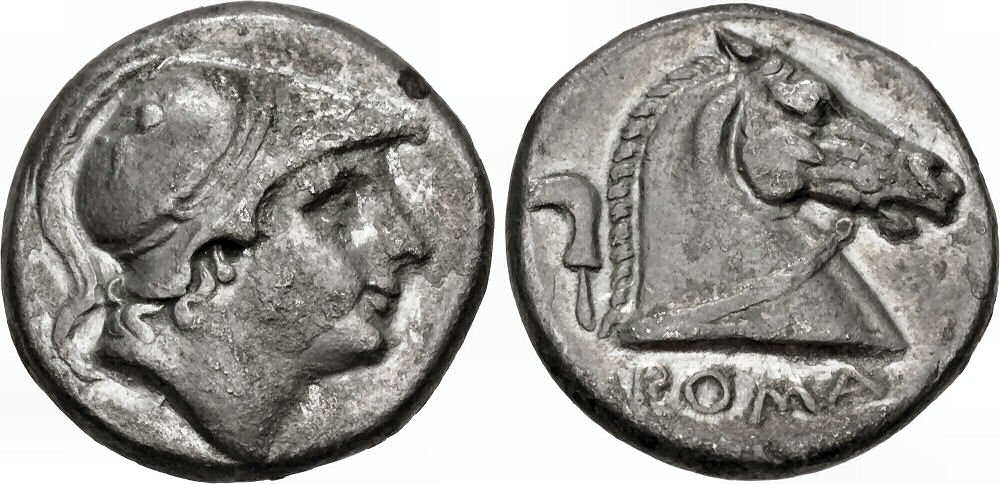
On smaller silver denominations, the heads of deities also appear on the obverse, while the reverse features depictions of animals. As for the inscriptions on the reverse, only ROMA and ROMANOM appear.
On the copper coins of the same period, the obverse features the heads of Janus, Apollo, and Diana, while the reverse depicts Mercury on older specimens, and wheel and horse motifs on younger ones.
Period II
Following great victories over Carthage, with which it waged the First Punic War from 264 to 243 BC, Rome became master not only of all Sicily but also of Sardinia and Corsica, and by the end of that period it also completed the conquest of Cisalpine Gaul (222 BC).
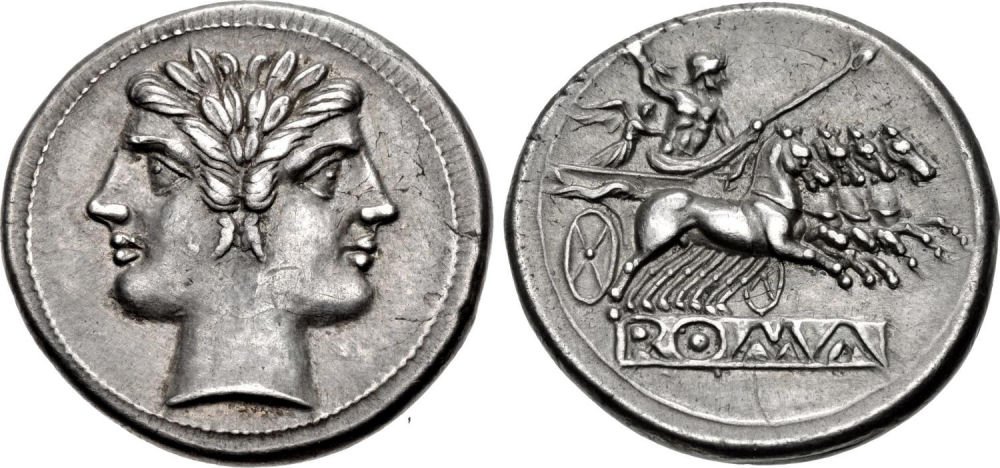
At that time, there was a gradual liberation from Greek artistic influence on silver coins the size of the didrachm and its fractions. While the obverse still depicts the beardless head of the god Janus, a reverse appears featuring a new type, which, according to the depiction of the quadriga (quadrigawas named quadrigatus. That motif will remain very popular in the later period as well, both on the coinage of the Republic and of the Empire.
At the beginning of the Second Punic War with Carthage (218–201 BC), Roman gold coins appeared for the first time, though their Latin name has not been reliably established. In weight, they are based on the Greek stater and half-stater. Their obverse bears the head of a beardless Janus, while the reverse depicts a young man holding a pig, upon which soldiers gathered around him place their hands—a scene interpreted as a symbol of making an alliance.
In 205 BC, a copper coin reform was carried out by introducing the so-called semilibral standard. This marked the beginning of the gradual reduction in the weight of Roman copper coins, which would continue until the end of the Republic through several further reductions.
While earlier copper coins were made by casting, from that time they began to be struck, which also led to a significant improvement in their artistic execution. On the reverse, a motif appears that would remain characteristic of almost all copper currency until the end of the Republic – the prow of a ship, a symbol of Roman naval victories.
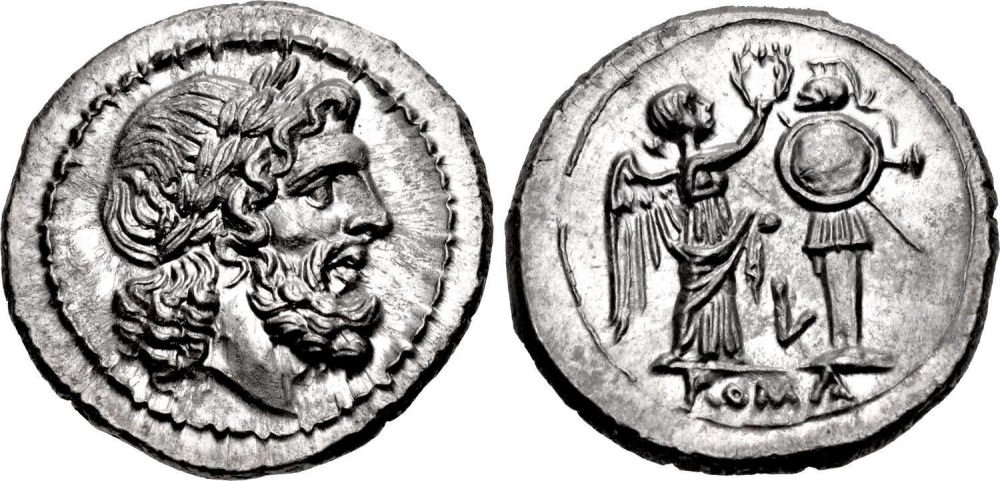
Trade relations between Rome and the regions of northern Greece, Epirus, and Illyricum prompted the introduction of a new type of silver coinage in 205 BC. According to the depiction of the goddess of victory (Victoria) on the reverse, this coin was named victoriatus. Measuring about half the size of the quadrigatus, the victoriatus gradually displaced the quadrigatus from circulation, disappearing completely after the end of the Third Punic War (146 BC).
Period III
After successfully concluding the long war with Carthage in 201 BC, Rome could turn its attention to preparations for a conflict with Macedonia, which posed the main obstacle to the Roman conquest of Greece. The Macedonians found an ally in Antiochus III, the king of Syria, but they paid a heavy price for that alliance following the unfavorable outcome of the war (192–189 BC) and the peace concluded at Magnesia ad Sipylum in Asia Minor.
The consequence of that defeat was that Antiochus III had to cede all his Asian possessions to Rome up to the Taurus mountain range.
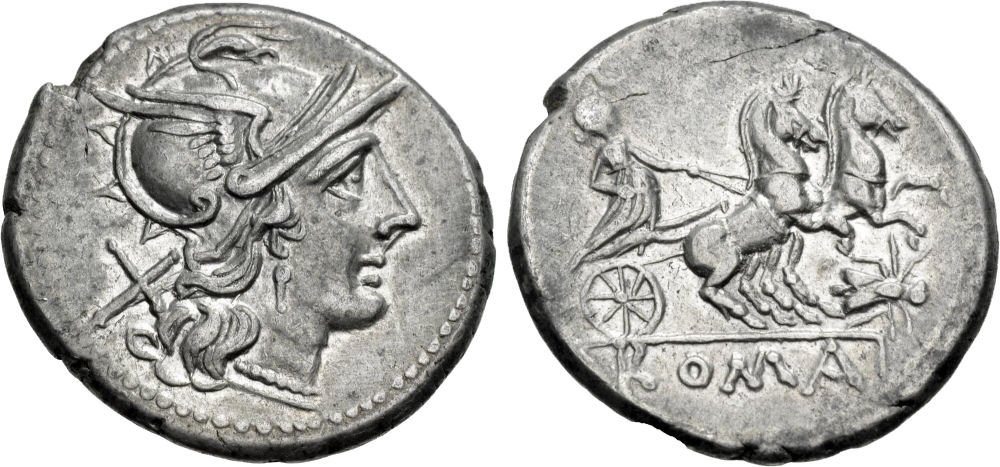
Shortly after the victorious peace of 189 BC, Rome implemented one of the most significant and far-reaching reforms of its monetary system. A new silver monetary unit was introduced – denarius, named after the X (ten) mark on the obverse. Thus, Rome established a monetary system independent of Greek influence, which would survive almost uninterrupted for the next 750 years.
As parts of the denarius were minted quinarius (from five = pet), which represents half a denarius, and the silver sestertius, marked with II.S, which means two and a half asses. While denarii were minted in large quantities, quinarii, and especially sestertii, were issued in significantly smaller series.
In this period, a new issue of gold coins also appears, the Latin name of which is unknown. The obverse bears the head of Mars, while the reverse depicts an eagle holding a thunderbolt in its talons. The numerals IX (60 asses), XXXX (40 asses), and XX (20 asses) appear as value marks.
Toward the end of this period, the depiction of the head of the goddess Roma with a helmet became established on the obverse of denarii, while the Dioscuri on horseback appeared on the reverse. Along with these depictions, moneyers' monograms also appear.
Period IV
Following the collapse of the Macedonian state (165 BC), all of Greece came under Roman rule. As a result of the subsequent economic boom, the Roman state in 155 BC standardized the weight of the denarius and its subdivisions to approximately 4 and 2 grams, respectively.
While the depiction of the head of the goddess Roma still remained until almost the end of this period on the obverse of all silver coins, the figure of the Dioscuri on the reverse was first replaced by the depiction of a biga (biga), and then a four-horse carriage (quadriga), which is driven by the goddess of victory. The weight of the denarius then remained unchanged until the end of the Republic (31 BC).
Around 135 BC, the previous, established depictions on the reverse of silver coins were abandoned. Instead of the quadriga, diverse motifs from daily life, mythology, and the animal kingdom began to appear on denarii.
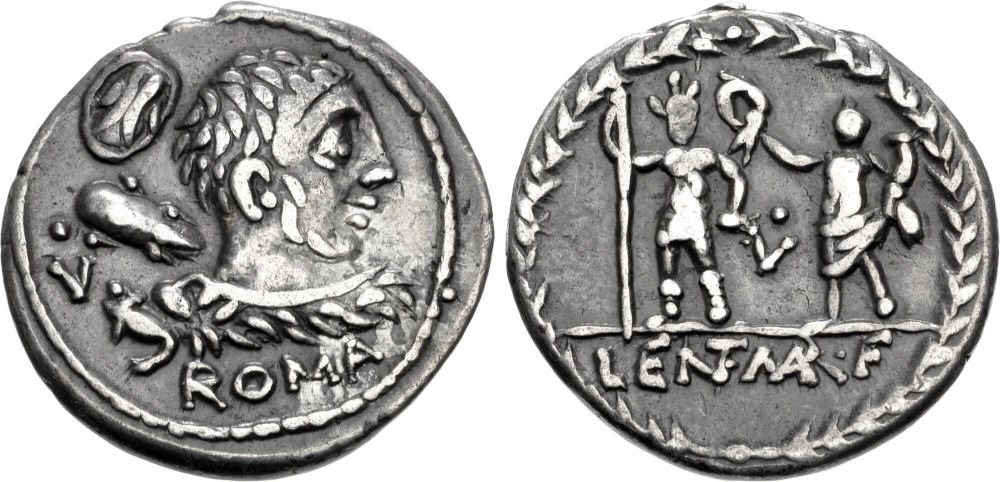
Shortly after, the fully spelled-out names of the moneyers also appear on the coins for the first time. For this reason, older numismatic literature interpreted these issues as coinages of individual Roman families, referring to them as „family coins.“.
Copper coin, due to a further reduction in weight, transitions to the so-called uncial standard (around 135 BC).
Following the victory over Carthage and its destruction in the Third Punic War (149–146 BC), Roman currency also spread to the territories of the former Carthaginian state in Africa. Rome then continued the expansion of its rule through wars in Gaul and Hispania.
Due to the high costs of these wars, mints in southern Italy and Gaul are reopened to pay the army. After the end of the wars, the number of mints was reduced again to two – in Rome and southern Italy.
Period V
In the relatively short period of just thirteen years (91–79 BC), the Roman monetary system underwent a series of significant changes.
During the rebellion of the Italian allies, who sought to free themselves from Roman supremacy, special Italian coinage was minted. These coins were very similar in type and weight to the Roman currency of the time, but the inscriptions were written in the Oscan alphabet, and they particularly stood out for their strong propagandistic symbolism on the reverse. For example, scenes were depicted in which an Italian warrior pierces a Roman she-wolf lying defeated beneath him.
To suppress this dangerous rebellion, Rome was forced to coin large quantities of silver denarii to pay the numerous mobilized soldiers. For this purpose, special military or camp mints were also established in the areas of military operations. The rebellion was finally suppressed after less than three years (91–89 BC).
Following the end of that „civil war,“ Rome faced a severe financial crisis, which led to the final change in the copper coinage system. A special law introduced a new, so-called semi-uncial standard, which remained in force only until 80 BC.
Copper currency, which was increasingly used only in local commerce, gradually lost its importance in a state that had evolved into the greatest power of the ancient world. Therefore, around 80 BC, its minting was definitively suspended.
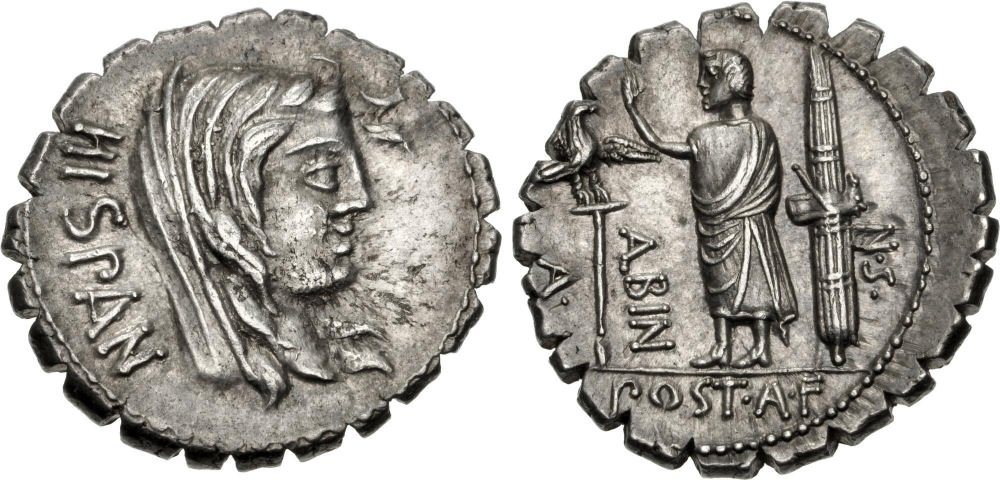
From then until the end of the Republic, alongside occasional issues of gold coins, silver coins were continuously minted, primarily the denarius. In this period, denarii with a serrated edge also appeared, after which they were named Serrati.
Constant civil conflicts between the senatorial (patrician) and popular (plebeian) factions spread to almost all parts of the Roman state. Due to the needs of financing and supplying opposing armies, so-called military coinages of Roman money were minted in military camps, not only in Hispania and Gaul, but also in Greece and Asia Minor. Under these circumstances, the patrician dictator Sulla also had gold coins minted Aureus.
Period VI
In the final period of the Roman Republic (79–31 BC), marked by almost continuous civil wars, the denarius is almost completely dominant in circulation. Standard-type denarii (without a serrated edge) are minted by the Roman mint, serrated denarii (Serrati) Italian mints, while legionary denarii are produced in military mints in active combat zones.
The currency of that period is characterized by a great diversity of imagery, especially on the reverses, which often show a high level of craftsmanship and a pronounced artistic sensibility of the engravers.
Among the gold coins stands out aureus, which is distinguished by its weight (about 10 grams) and the quality of craftsmanship, especially of the portrait. The first such gold coins were minted by Gnaeus Pompey around 60 BC in the East, and after Caesar's death (44 BC), slightly lighter aurei were minted by the members of the Second Triumvirate—Octavian (later Emperor Augustus), Mark Antony, and Lepidus—right up until the collapse of the Republic.
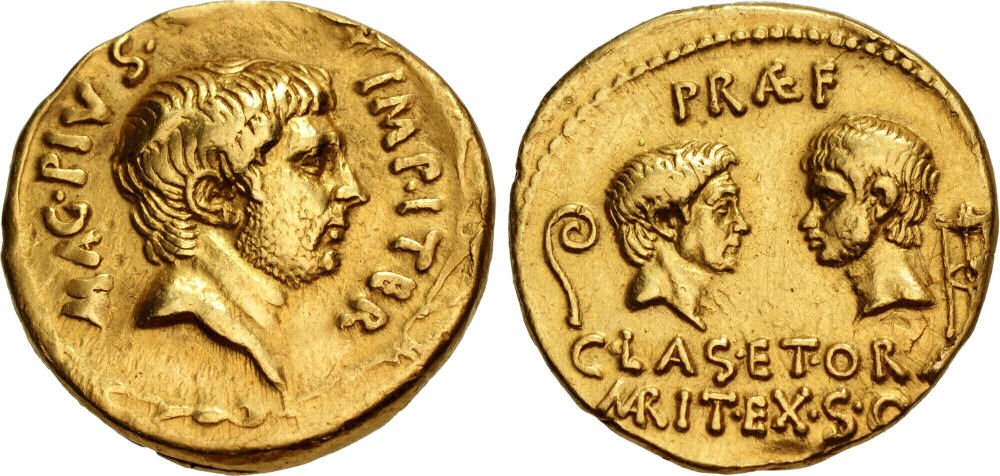
Following the end of the Gallic War (54–51 BC), the First Triumvirate collapsed due to a conflict between Caesar and Pompey (50 BC). Soon after, Caesar was declared dictator, which is also reflected in his coinage (from 49 BC). Following Pompey's death (48 BC) and the defeat of his supporters, Caesar's triumph followed, and then his violent death in 44 BC.
The coinage of that period still retains the fundamental features of republican iconography, but with the transfer of actual power from the Senate to the triumvirs and subordinate structures, new iconographic changes are also introduced. The most significant among them is the frequent appearance of the ruler's portrait on the obverse, which was previously a rare occurrence. Alongside the laurel-wreathed, recognizable head of Julius Caesar, the coinage also features portraits of his supporters and successors, as well as political opponents, such as Brutus and Cassius.
In addition to money minted in Rome, in the period from Caesar's death to the establishment of the Empire (30 BC), a large part of Roman coinage was also produced in provincial mints, from Gaul through Greece to Asia Minor. These coins do not differ in type from those minted in Rome, since they were produced by Roman craftsmen for the needs of generals and provincial governors.
The names of the moneyers are still found on the obverse or reverse of the coins. Julius Caesar increased the number of supervisors of the Roman mint from three to four, but this change was short-lived, as Octavian reduced their number back to three as early as 36 BC.
The denarius retained its dominant role until the end of the Republic, although silver quinarii and sestertii were also occasionally minted alongside it. These coins survived the end of the Republic (31 BC) and continued to be minted into the period of the Roman Empire.
Author: Bartol Zmajić
Source: Bulletin of the Croatian Numismatic Society, year III, number 7, Zagreb, 1965.
Edited: Zlatko Viščević
Photos: Classical Numismatic Group, Coin Cabinet – National Museums in Berlin.
The text was originally written by Bartol Zmajić and published in the HND Bulletin. For the purpose of publication on the NumizmatikaNET portal, the text was adapted to the contemporary linguistic standard and accompanied by images of currency.