



Myanmar, Myanmar, Burma, Bama… is a country of rich history and unique heritage, such as linguistic diversity, Buddhist temples, original food and customs (read, for example, about their personal names…). Unfortunately, since its (re)independence, it has been in a state of constant internal conflict and political instability with no end in sight. Recently, we have read a bit more about it in the media due to the unfortunate earthquake that leveled historical Mandalay; otherwise, the same old story occasionally sneaks through—some kind of political executions, imprisonments—generally, nobody cares, because it has already been 80 years of war, hundreds of thousands dead, and more than a million displaced, but we won't get into politics.
Neither is modern numismatics really all that interesting. The last issue of circulating money was in 1999, and completing the issues of the previous 1952 monetary reform is not much of a problem either. Otherwise, until 1937 it was an integral part of British India, then a special protectorate, and in 1948, as part of the dissolution of colonial Britain, independence was declared. The currency was the Burmese rupee, which replaced the Indian rupee 1:1, which is why all rupee coins from 1949 are physically identical to the Indian ones. After all, this was also the case with other independent currencies that succeeded the Indian rupee (e.g., Pakistan). The traditional names of fractional denominations from the 19th century were retained, so the largest coin, with a denomination of 8 pe, corresponded to half a rupee. A one-rupee coin was never minted. By the way, the word pe itself can be translated as eight. Naturally, because 1 pe = 8 pya (coins).
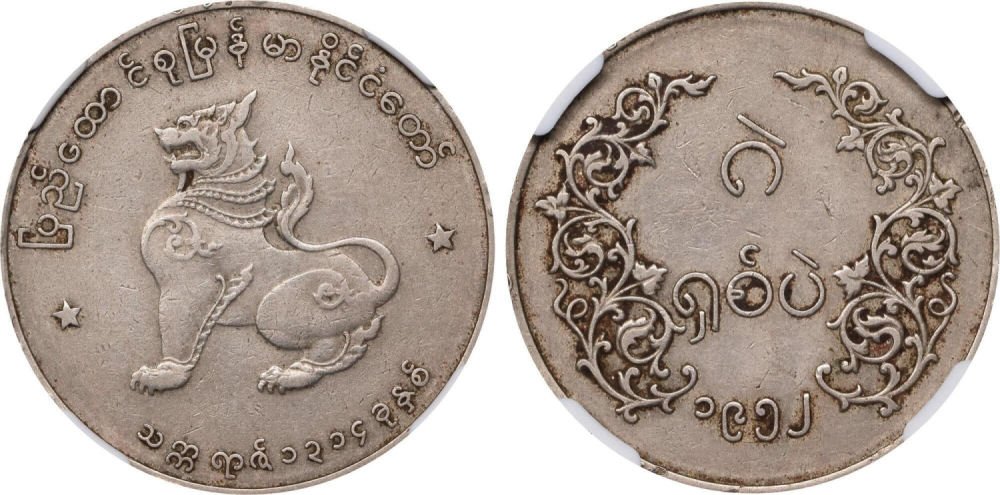
And this brings us to one of the greatest gems of modern Southeast Asian numismatics, yet probably the least known. Because it is Myanmar… In early 1952, 1.642 million pieces of a new 8 pe coin were ordered from Tower Hill, the Royal Mint, with a slightly modified design (an inscription added around the lion: “Union of Burma, Year 1314 BE”, which would become the later standard) and a slightly cheaper material (Cu-Ni) than the previous pure nickel coin. The reverse remained the same, simply “8 Pe, 1952.” within the decoration.
Just a few years prior, due to inflation, the Indian rupee had “fallen” from silver to nickel, and it was clear that amidst the government upheavals during the first four years of modern Myanmar, the local rupee could not remain stable either, so a monetary reform was planned at the same time. That same year, the first parliamentary elections were organized, in which Prime Minister U Nu retained power (many of you certainly know about him), and the chance for peace seemed more likely than ever. On the first day of July, the monetary reform was carried out, so only a small portion of these coins were ever put into circulation; very likely, the entire stated quantity was not even minted, but rather used for new coins of the same composition. The decimal kyat with a very similar design became the new currency of Myanmar, and the old coins were withdrawn.
As for this type, SARC (Stephen Album Rare Coins) states that “astoundingly exceptionally few have survived.” The rough assumption is 30 to 50 pieces excluding proofs (also very rare). Of course, it is possible that new specimens will appear, but the probability decreases with years and very likely the number of known ones will never reach three digits. HA HK (Heritage Auctions Hong Kong) states that known specimens are always “heavily circulated.” It is unknown whether a regular specimen of this coin or only its proof is preserved in the Tower Hill archive, which was sold off in the 1970s, but by searching the PCGS archive I found that there is nevertheless one specimen graded MS62 (never offered publicly), with an image that you can truly enjoy. All others are graded lower, mostly “Cleaned” or “Details,” and in terms of preservation are truly significantly below mint condition.
I have followed, searched for, and dreamed about this type of coin for years. I concluded that it was unrealistic to expect a specimen that meets my criteria – UNC after 1945 or exceptional AU (according to my personal criteria, often ranking NGC MS62). Therefore, for the first and hopefully last time, I compromised on that criterion. After all, so did the colleague who was selling off one of the most complete type collections of 20th-century world numismatics ever assembled, and he acquired this specimen, which he sold to me, only last year at SB HK (Stack’s Bowers Hong Kong). From 1989 until that sale, the specimen was in a private collection from Hong Kong, and it has recently graced my Myanmar section…
Author: Natko Bajic
Photos: Author's collection.