



In the history of money, there are numerous examples of the adaptation of materials and forms to specific living and economic conditions. One of the most unusual and interesting such examples comes from distant Alaska, where in the 19th century monetary vouchers made of parchment, specifically from seal and walrus hide, were in circulation. These vouchers represent a unique combination of numismatics, colonial history, and practical solutions in extreme climatic conditions.
Russian America and the economic monopoly of the Russian-American Company
In the early 19th century, the territory of present-day Alaska was under Russian administration, specifically as part of so-called Russian America. A key role in the governance of this territory was played by the Russian-American Company, established in 1799 by a charter of Tsar Paul I. The company held exclusive rights to exploit natural resources—primarily the lucrative fur trade—as well as complete administrative control over the colony.
Within such a system, the company established its own closed-loop economy. In major centers such as New Archangel, Kodiak, Unalaska, Ross, and the Northern Islands, company stores operated where payment could be made exclusively with their vouchers. At the same time, goods prices were marked up by about 35%, allowing the company to further control the market and generate a profit.
Origin and development of Alaska scrip
The idea of introducing a special colonial currency emerged as early as 1803 on the initiative of Alexander Andreyevich Baranov, one of the company's leading figures. However, the first vouchers in the value of 12,000 rubles did not appear until 1816, specifically in the form of printed cardboard banknotes.
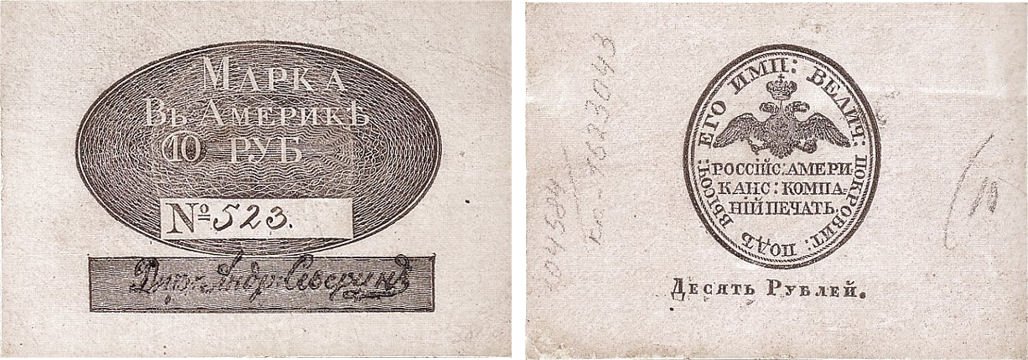
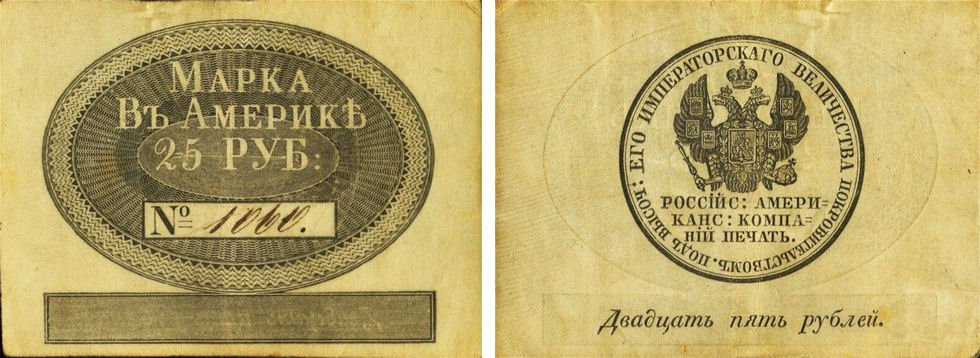
The second emission followed in 1822, also on cardboard. However, the harsh climatic conditions of Alaska, high humidity, and constant exposure to external influences quickly proved that such material was not durable. Because of this, a third emission was introduced in 1826, this time on parchment, a significantly more resistant material. In certain cases, walrus hide was also used, which makes these vouchers particularly interesting and rare.
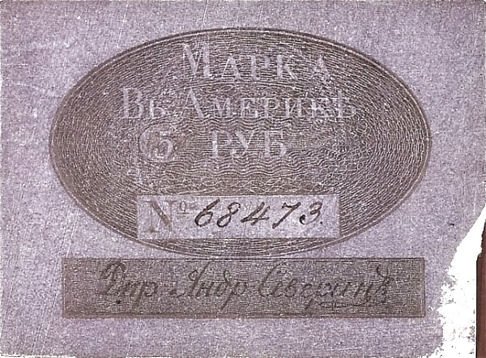
Later issues also brought additional innovations, especially in a visual sense. Higher denomination vouchers were printed on colored parchment, for example blue for 5 rubles and red for 10 rubles. During the 1840s and 1850s, standardized colors were introduced for individual denominations, while the 1852 issue brought changes in the combination of background color and ink.
Support, design, and user customization
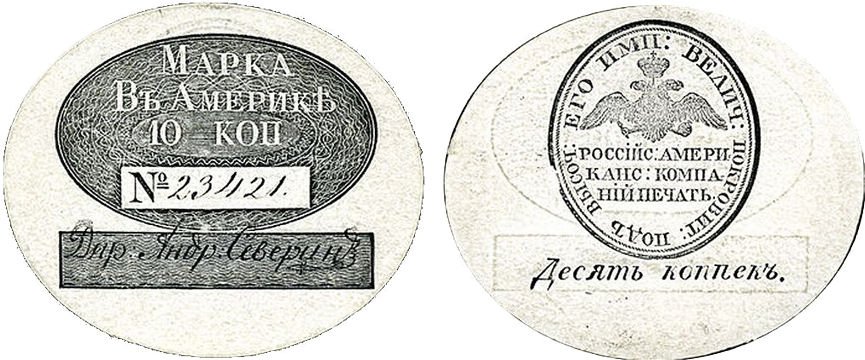
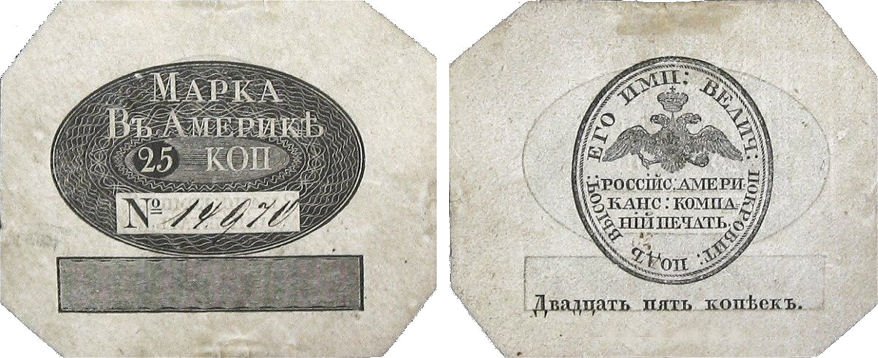
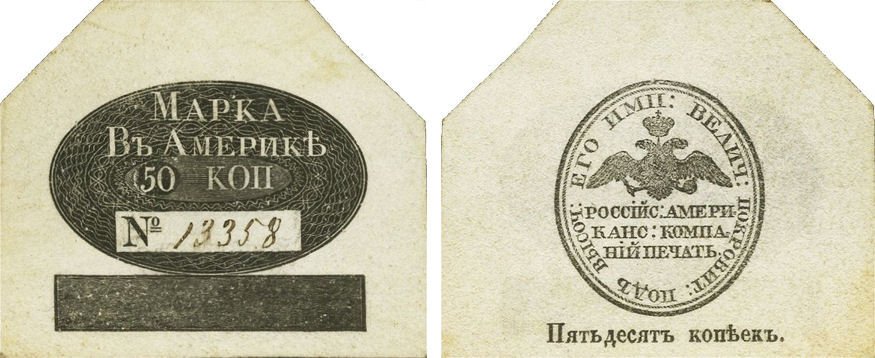
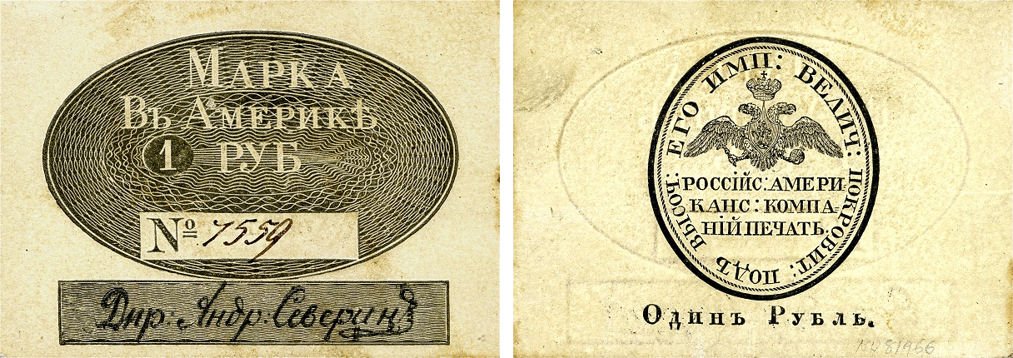
Alaska scrip was issued in denominations of 10, 25, and 50 kopecks, as well as 1, 5, 10, and 25 rubles. A particularly interesting detail relates to the lower denominations, which were adapted for the local, predominantly illiterate population.
To make it easier to distinguish the values, the vouchers have been physically modified:
- A bond of 10 kopecks had two small holes in the upper corners
- The 25-kopeck stamp had all four corners cut off.
- A 50-kopeck bond had its two upper corners cut off.
These solutions represent an extremely interesting example of functional design in numismatics, where visual and tactile recognition is used instead of a written inscription.
Circulation and function in the colonial economy
Tokens served as a medium of exchange within the closed system of the Russian-American Company. Company employees and local native hunters were paid with them, but they could be used exclusively in company stores. In this way, the company maintained complete control over the colony's economy.
Due to intensive use and unfavorable climatic conditions, the vouchers wore out and were damaged quickly, which required the constant issuance of new editions. Precisely for this reason, a very small number of specimens from earlier periods has been preserved today.
| Overview of issued vouchers | |||
| Year: | Amount in rubles: | Material: | Nominal: |
| 1816. | 12.000 | cardboard | 25 and 50 kopecks 1, 5, 10 rubles |
| 1822. | 30.000 | cardboard | |
| 1826. | 30.000 | parchment | 10, 25, 50 kopecks 1, 5, 10 rubles |
| 1834. | parchment | ||
| 1842. | 41.662 | parchment | |
| 1846. | 20.300 | parchment | |
| 1848. | parchment | ||
| 1852. | parchment | ||
| 1858. | 80.000 | parchment | |
Rarity and numismatic significance
According to research, the number of preserved copies of these vouchers is extremely limited. Back in 1982, only 53 copies were known, while in the mid-1990s that number rose to 77 recorded pieces. Today, it is estimated that a total of between 100 and 150 copies exist.
Due to their rarity, unusual material, and historical context, Alaska scrip notes rank among the most attractive and valued items in world numismatics.
We can also see this from some auction results
10 kopecks ND (1820–1860) – PMG 25 – Heritage Auctions – 09.18.2020. – 5,279 EUR
10 kopecks ND (1820-1860) - PMG 40 - Heritage Auctions - 03/07/2024 - 19,176 EUR
10 kopecks ND (1816-1852) – PMG 50 – Heritage Auctions – 01/13/2022 – EUR 23,277
10 kopecks ND (1816-1852) – PMG 50 – Heritage Auctions – June 1, 2022 – 28,331 EUR
10 kopecks ND (1820-1860) – PCGS 63 PPQ – Stack’s Bowers Galleries – 03.26.2015 – 34,482 EUR
25 kopecks ND (1816-1867) – PMG 63 – Heritage Auctions – 09.01.2020. – 27,004 EUR
50 kopecks ND (1816-1867) – PMG 64 EPQ – Heritage Auctions – 09.01.2020. – 49,508 EUR
25 rubles ND (1816-1867) – PMG 55 – Heritage Auctions – January 21, 2021 – 131,519 EUR
Conclusion
Alaskan script tokens made of seal and walrus hide represent a unique blend of adaptation, innovation, and colonial economy. Their emergence testifies to human ability to find functional solutions in extreme conditions, as well as to complex power relations within colonial systems.
For numismatists, these vouchers are not only rare collector's items, but also valuable historical documents that reveal the story of a specific period and place – Russian America in the 19th century.
Edited: Zlatko Viščević
Source: Wikipedia
Photos: Banknote Museum, Heritage Auction.