

The 10,000 dinar banknote of the former Kingdom of Yugoslavia, dated September 6, 1936, is today the rarest seen banknote bearing the name of the National Bank of the Kingdom of Yugoslavia. There are not many who have had the good fortune to have their collections adorned by this extraordinary specimen of national notaphily—national for collectors from all the currently independent states that once comprised the territory of the former Kingdom. Furthermore, it can also be considered a great witness to the history of the disappearance of a state that, in its roughly twenty years of existence, left a magnificent mark from our collecting, or rather notaphilic, perspective.
Characteristics
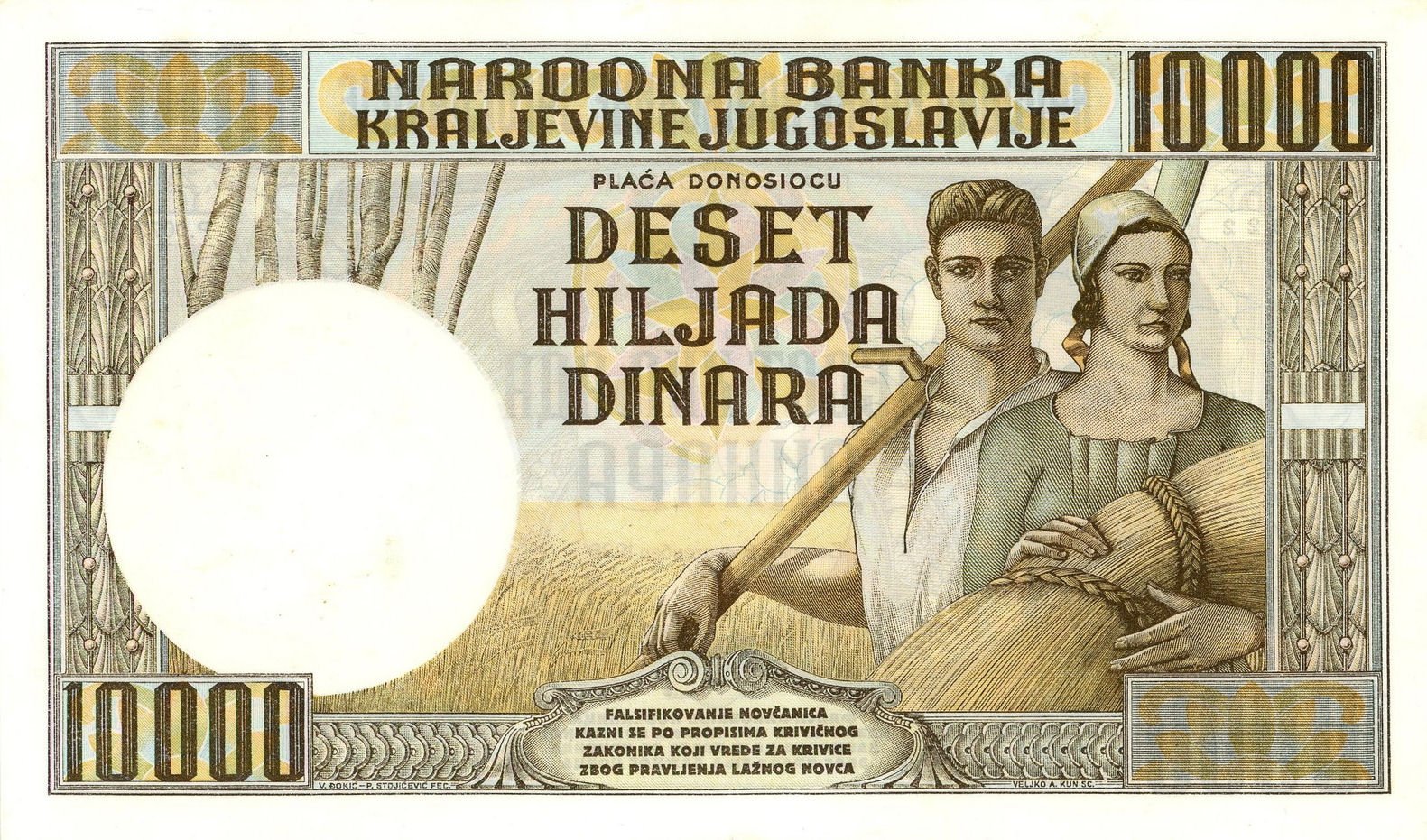
We are talking, therefore, about an extremely attractive banknote that is highly desirable for any collector. It is adorned with attractive motifs: an exceptionally well-rendered graphic portrait of the young Crown Prince Peter II Karađorđević with state and monarchist symbols on the obverse, and a slightly less successful artistic depiction of a young male and female harvester on the reverse. The watermark features the bust of King Peter I Karađorđević. The designers are Vojislav Dokić and Panta Stojićević, and the engraving was created by Veljko A. Kun. The signatories are board member Dr. Ivo Belin and Governor Dr. Milan Radosavljević. It was entirely produced at the Institute for Manufacturing Banknotes in Belgrade.
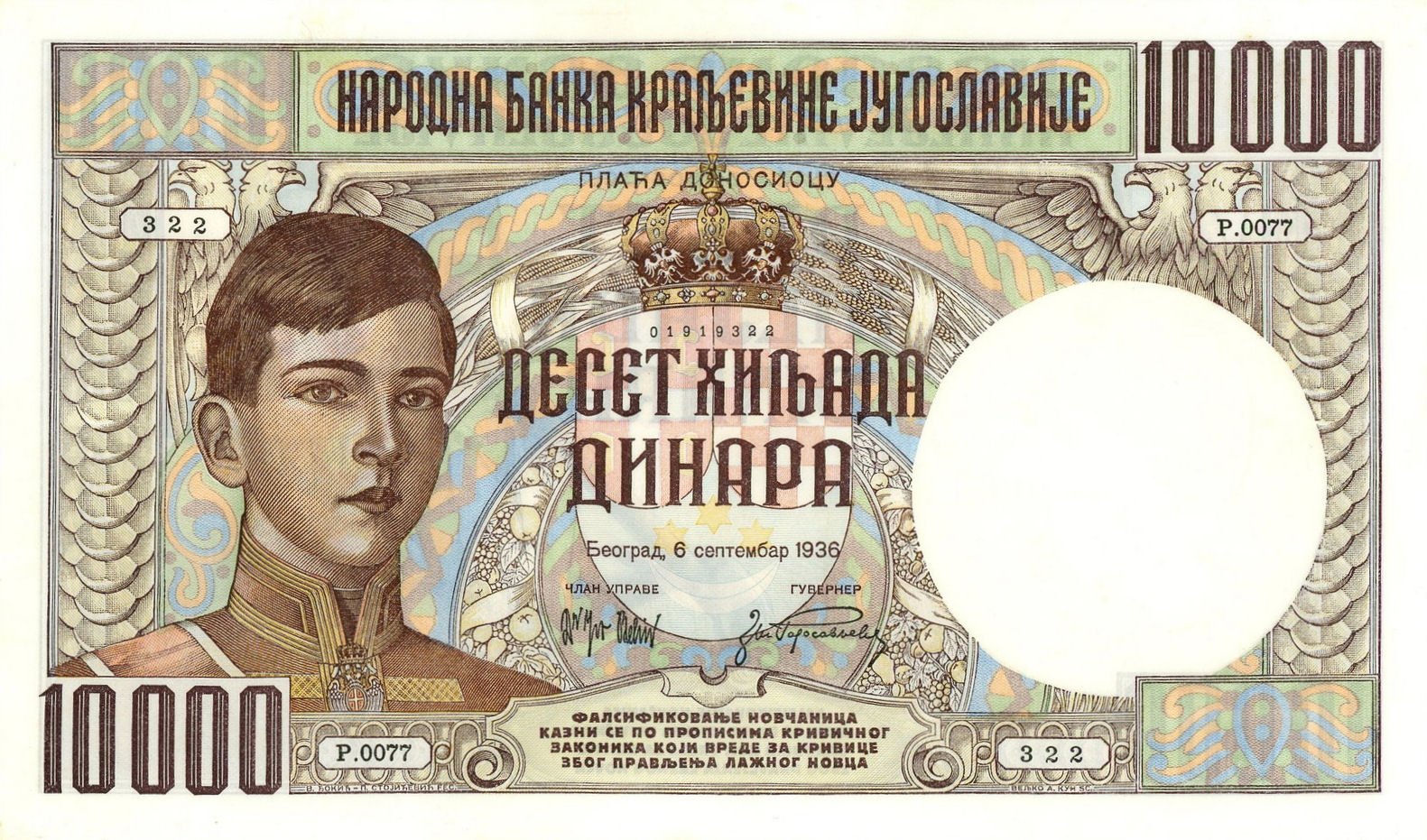
The banknote is of an exceptionally large format, 219 × 131 mm, even for the conditions of the time when the size of the paper on which it was made in a way also symbolized value, at least in the eyes of the people.
As a rule, the 10,000 dinar banknote from September 6, 1936, rarely appears on the collector's market. When it does appear, it achieves a relatively high and steadily growing price within its „national“ territory of the former Kingdom. Given the fact that it is an unissued banknote, it is also interesting that it is not common even in the first (UNC) grade of preservation.
Whether she is objectively just rare or even a rarity can be assessed based on 15 years of tracking her appearances at auctions, fairs, or in private offers, in fact, wherever in the world she appeared, provided it was published.
Banknote fund „for completely extraordinary state needs“
The 10,000 dinar banknote from September 6, 1936, belongs to a special group of banknotes of the National Bank of the Kingdom of Yugoslavia officially named the „Fund for Completely Extraordinary State Needs“.
Namely, in the excellent book Yugoslav currency during World War II, by author Miodrag Ugrčić, states that as early as 1930, the state began creating a reserve of specially produced banknotes intended exclusively for extraordinary wartime needs.
„The State Defense Emergency Fund, as it was named, was set at 6 billion dinars and by the end of 1935 it contained three types of previously unissued banknotes: 50 dinars dated December 1, 1931, 100 dinars dated July 15, 1934, and 1000 dinars dated September 6, 1935, featuring a completely new graphic design.
Upon the completion of filling that planned banknote reserve fund (which otherwise continuously increased until 1941), the creation of a new category was also undertaken – the „Banknote Reserve Fund for Completely Extraordinary State Needs,“ which was to consist of types of banknotes that had not been produced or issued until then: 20 dinars dated September 6, 1936, and 10,000 dinars dated September 6, 1936, in the nominal amount of 26 billion dinars.
By the end of 1939, that fund was also closed according to plan. Of the total amount, 1 billion dinars was minted in 20-dinar banknotes, and 25 billion in 10,000-dinar banknotes.
It should be noted that the 20-dinar banknote continued to be produced and was used to fill the „Fund for Extraordinary State Defense Needs,“ whereas the 10,000-dinar banknote was no longer produced and remained exclusively in the „Fund for Completely Extraordinary State Needs.“.
The 10,000 dinar banknote from September 6, 1936, was therefore produced in 2.5 million copies. According to the serial number, this means that banknotes were produced in the range from the first number A.0001 001 to the last number A.0100 000. The numbering is arranged according to the „French“ method used up to that time: 0001 is the series number (100 series), and each series was produced with 25 selected Cyrillic letters (from A to H) and in 1,000 copies per letter (from 000 to 999).
War and annulment
By the end of 1938, and especially at the beginning of 1939, it became clear in Europe that a larger-scale war would break out. The German-Soviet attack on Poland on September 1, 1939, definitely removed all doubts.
As early as September 22, 1939, the Minister of Finance of the Kingdom of Yugoslavia, upon the proposal of the National Bank, issued Decree No. 442/VIII, according to which the bank could put into circulation banknotes from the „Fund for Extraordinary State Defense Needs“ and the „Fund for Completely Extraordinary State Needs,“ and thereby also the prepared 10,000 dinar banknote.
At that moment, the circulation of banknotes was constantly increasing due to the growing discounting of State Defense Bonds. Yet, although the circulation increased from 6.9 billion dinars in 1938 to 19.7 billion immediately before the attack in 1941, it did not indicate a need to issue a banknote of such high denomination. Until the very last moment, the dinar actually held its value well, despite the large increase in the amount of money (banknotes) in circulation, both on the domestic and foreign exchange markets, as well as in terms of purchasing power.
Well, what could you even buy in early 1941 for 10,000 dinars? Quite a lot. Namely, according to the book The exchange rate of the dinar and the foreign exchange policy of the Kingdom of Yugoslavia, by author Goran Nikolić, in the days leading up to the war, the US dollar was worth 44.75 dinars according to the official quotation including a „premium“ of 28.5% (a stimulating addition to the official value that was calculated after the short-lived convertibility of the dinar into gold ended in 1931), and 55 dinars according to the official so-called „free“ quotation (for a realistic comparison, it is very important not to forget that in 1941 the dollar had a purchasing power even 12 to 15 times greater than today: a gram of gold in 1941 was worth 1.11 $, in mid-2005 12.35 $, and in mid-2006 as much as 21.70 $). The value of the National Bank's gold backing was calculated at a ratio of 60,000 dinars per kilogram of gold. Although prices in the Kingdom had been constantly rising since mid-1939, by as much as about 30% in the first three months of 1941, a worker's daily wage at the beginning of 1941 was around 28 dinars, and a daily newspaper, for example, could be bought for 1 to 2 dinars, depending on quality. Therefore, 10,000 dinars represented a very large amount that most citizens never saw all at once in their lives.
Even if there was an intention to put the 10,000 dinar banknote into circulation, it was ultimately dismissed due to the speed of events following April 6, 1941—the day Germany, Italy, and their allies attacked the Kingdom of Yugoslavia. Already in the first days of the war, it became clear that the end was near: on April 8, 1941, the Ban of Slovenia issued a proclamation regarding Slovenia's desire „to separate from the Kingdom of Yugoslavia and form an independent state,“ and on April 10, 1941, the Independent State of Croatia was proclaimed in Zagreb. The army began to disintegrate, and there was virtually no organized resistance.
Realizing that total defeat was a matter of days, the Minister of Finance issued a decision on April 9, 1941, to cancel the monetary reserve: among other things, all 2.5 million copies of the 10,000 dinar banknote, strategically located at the time in Užice, Serbia, had to be destroyed by burning.
The incineration was carried out on April 10, 1941, in the afternoon, in the village of Turica near Užice. The banknotes, packed in 50 crates, were transported by military trucks to a meadow designated for this operation, the crates were smashed with axes and doused with oil, and soldiers, under the supervision of National Bank experts, set everything on fire. According to the official record, the burning and incineration was completed the same day by 7 PM.
What is left?
Luckily for us today, or rather luckily for all collectors of „national“ paper money from the time of the Kingdom, all those minutes, soldiers, experts, commissions... were not reliable enough mechanisms for the ordered burning job to be carried out completely. Luckily for us, someone happened to be on that meadow at the time who took a certain number of banknote specimens in time, partly out of collecting and financial calculation, and partly as a keepsake. Who knows...
It can be said with a high degree of probability that the „saved“ specimens were taken before the burning rather than after, since specimens with traces of fire do not appear. It seems that a smaller number of banknotes were simply removed from the crates just before the burning, when the crates had already been smashed with axes and were ready to be burned. Whatever was set on fire—burned. It can also be clearly concluded that this was not done by just one man, but by several. Namely, some specimens are ideally preserved, thus taken selectively, which suggests that they were taken by someone who knew their collector value, probably an official of the National Bank. On the other hand, some specimens—and there are more of those—are crumpled and dirty, as if they had been hastily stuffed into pockets without any regard for preserving the appearance of the banknote—probably taken by one or more soldiers, unversed in collecting. Such specimens evidently remained in houses for years, folded and stored in various books, containers, metal or wooden boxes among other documents, etc.
In any case, as we see today, little has been saved. How little? It is very difficult to speak with certainty about the number of preserved banknotes. However, over the 15 years of this banknote's appearance, it can be said that they appear in only 4 series and within a relatively narrow range of numbers:
from D.0067 657 to D.0067 675 (18 possible copies)
from H.0077 664 to H.0077 758 (94 possible copies)
from U.0079 101 to U.0079 123 (22 possible copies)
A.0099 004 (1 copy)
The number of sighted specimens and the quality of preservation vary significantly across those series.
In the D.0067 series, banknotes appear that are generally undamaged and can be classified as UNC or the first grade of preservation, while only a few specimens have minor damage or soiling and could be classified as XF or the second grade of preservation. Out of the 18 possible specimens, not all of them appeared in the observed period, but it is very likely that the best-preserved specimens ended up in collections that are rarely sold off, so their frequent appearance is not expected.
b/ Series H.0077 appears in the highest number of specimens, however none are in UNC condition, meaning without damage. All specimens in this series exhibit more pronounced paper damage, soiling, and missing parts. They are most commonly classified in the third grade or VF, although there are also heavily damaged specimens in the lowest categories. Out of 94 possible specimens in the observed period, fewer than 50 appeared. Nevertheless, this series leaves the most room for potential new discoveries.
For series code U.0079, the smallest number of copies appears, and exclusively in UNC quality, which is the first grade of preservation. Of the 22 possible copies, not all have appeared, but it can be assumed that due to their high quality they are already in collections and will appear individually and at very long intervals.
Only one specimen of series code A.0099 appeared, and that in the third or VF grade of preservation.
It is not ruled out that there are other numbers of the listed series, nor that only those four series have been preserved. However, the fact is that over the past 15 years, only specimens within the specified ranges have appeared on the market. A specimen from the book is also mentioned Banknotes of the Kingdom of Yugoslavia 1918–1941. by author Jovana Hadži-Pešić, series L.0065 number 900, but with a red „specimen“ overprint, so it is not counted among the „rescued“ copies as a sample.
Overall, in the last 15 years, a maximum of about 120 specimens have appeared:
in 20U UNC quality,
up to 30 in XF quality,
do 50 in VF and F quality,
and several in very bad condition.
Collector value
(This article was originally published in 2006, so it reflects the market conditions of that time. Today, 20 years later, the market conditions are different. Editor's note.)
Na kolekcionarskom tržištu cijene koje postiže ova novčanica vrlo su različite i nepredvidive. Najnovija informacija govori da UNC primjerak gotovo nije dostigao katalošku cijenu (cjenik objavljen 2005. u časopisu „dinar“) od 1500 EUR.
Primjerak UNC kvalitete D.0067 670 prodan je 2006. godine na aukciji kuće „Barac-Pervan“ u Zagrebu za 1425 EUR (uključujući aukcijsku proviziju). Nepunih pet godina ranije, u časopisu „dinar“ br. 17, u pregledu rezultata aukcije SND 2001., naveden je podatak da je primjerak UNC kvalitete D.0067 657 prodan za 1325 EUR (uključujući aukcijsku proviziju).
Spomenimo i to da na najpoznatijoj internetskoj aukciji eBay, u 15 godina nije ponuđen nijedan jedini primjerak u UNC kvaliteti. Nudili su se primjerci u prosječnom VF kvalitetu, i to serije H.0077, a cijene su tijekom 2005. bile od 350 do 500 EUR, ovisno o trgovcu.
Nije nevažno ni reći kako primjerci UNC kvalitete, kao i oni s neznatnim manama koji bi se mogli svrstati u AU ili XF kvalitetu, odmah i bez problema nalaze kupca. Nasuprot tome, primjerci slabije očuvanosti, bez obzira na rijetkost novčanice, mnogo se teže prodaju. Prema tome, za očekivati je da će razlika u cijeni između primjeraka u UNC i onih u lošijim kvalitetama biti sve veća, odnosno, vrijednost primjeraka u UNC kvaliteti mnogo će brže rasti od vrijednosti novčanica slabije očuvanosti.
Conclusion
Objektivno, u ovom trenutku stupanj rijetkosti novčanice Kraljevine Jugoslavije od 10.000 dinara od 6. rujna 1936. mora se promatrati odvojeno, ovisno o kvaliteti očuvanosti.
Primjerci UNC kvalitete mogu se bez zadrške proglasiti raritetom vrlo visoke razine s „ljubiteljskom“ cijenom, s obzirom na to da ih je otkriveno iznimno malo u netaknutom stupnju očuvanosti. Realnost je da je cijena na tržištu danas, koliko god se 1425 EUR za UNC činilo puno, za tako rijetku novčanicu zapravo mala, jer je ta cijena ograničena niskim standardom prosječnog kolekcionara na cijeloj „nacionalnoj“ teritoriji nekadašnje Kraljevine (iako će cijena postignuta u Sloveniji zasigurno biti veća od one postignute u Bosni i Hercegovini). Da je riječ o novčanici neke zapadnoeuropske države ili možda Sjedinjenih Američkih Država, njezina bi vrijednost s obzirom na toliku rijetkost bila barem deset puta veća.
Primjerci s manjim ili većim oštećenjima također se moraju smatrati vrlo rijetkima, ali ne i raritetima, jer se ipak pojavljuju u ciklusima, pa bi im i cijena trebala biti stvar „ukusa“ kolekcionara, odnosno onoga što želi vidjeti u svom albumu u okvirima koliko može platiti.
Na kraju, posve je sigurno kako je ova novčanica dobra investicija i s financijskog gledišta: prije desetak godina primjerak u UNC kvaliteti mogao se uz malo pregovaračke vještine dobiti i za 500 EUR, a ove godine, eto, prodan je za 1425 EUR. To je rast od 185% u 10 godina ili 11% godišnje. Toliku kamatu ne nudi nijedna sigurna banka… a sigurno je i da će s rastom životnog standarda u svim „zainteresiranim“ državama, odnosno na „nacionalnoj“ teritoriji nekadašnje Kraljevine, rasti i spremnost za izdvajanje sve više novca za pravi primjerak. Dok se još može naći…
Poznati serijski brojevi
Ova tablica nije izvorni dio članka već je dio istraživanja koji je objavljen na forumu “Croatian numismatics”.
Osim ovih brojeva u tablici, navedeni su još neki u komentarima.
Serijski broj: | Očuvanost: | Komentar: |
Л.0065 900 | UNC | SPECIMEN |
Л.0065 991 | UNC | SPECIMEN |
Б.0069 142 | VF | • www.kupujemprodajem.com; siječanj 2014. |
Б.0069 226 | UNC | • www.ebay.com; početna cijena 3999.99 USD |
Б.0069 702 | • www.kupindo.com; srpanj 2012. – ponuđena cijena 75.000 RSD ili 646 EUR. | |
Б.0069 770 | F | |
Д.0067 470 | • Zlatko Viščević: The Guide to Coins and Banknotes of Yugoslavia, Slovenia, Croatia, Bosnia and Herzegovina, Serbia, Montenegro and Macedonia, Kastav, 2007. | |
Д.0067 658 | UNC | • SND Aukcija 5, Lot broj 502, Beograd 13.05.2001. prodana za 1250 DEM. |
Д.0067 670 | UNC | • Barac-Pervan, II Aukcija (3.6.2006.). Početna cijena 1000 EUR. |
Д.0067 671 | UNC | • Željko Stojanović, Papirni novac Srbije i Jugoslavije, Beograd, 1996. |
Д.0067 688 | AUNC | • Aukcija Stack’s Bowers, siječanj 2016 , AUNC , prodano za 3,172.50 $ + provizija. |
P.0077 042 | VF | • Numizmatički časopis “Dinar” br. 29, str. 40. |
P.0077 306 | AUNC | • SFK 26. aukcija, 07.05.2006. Beograd: Lot br. 1565. Prodano za 600 EUR. |
P.0077 322 | UNC | • Barac-Pervan, IX Aukcija, Lot broj 173. Prodano za 1300 EUR. |
P.0077 346 | UNC | • Aukcija Stack’s Bowers (2012) – prodano za 3450 USD. |
P.0077 348 | UNC | • Sasa Stojmenovic Web site. |
P.0077 390 | XF / repair | • Ponuđena na ebay.com u rujnu 2015 za 2300 $; bila bi u XF stanju da nema popravka u kutu novčanice. |
P.0077 395 | AUNC | • www.limundo.com – Početna cijena 854 EUR – povučena iz prodaje.. |
P.0077 502 | UNC | • Privatna zbirka V., Beograd. |
P.0077 516 | UNC | • SND Aukcija 8, Lot broj. 276, Beograd 12.12.2004. Prodana za 1170 EUR. |
P.0077 597 | VF | • www.kupindo.com lot broj: 24131249. Početna cijena 139.990 RSD (1160 EUR) |
P.0077 606 | VF | • 60. međunarodni susret numizmatičara SND. Ponuđeno za 2000 EUR – nije prodana. |
P.0077 725 | F | • Privatna zbirka M. Đ. – konzervirana u NMB. |
X.0077 458 | VF | |
X.0077 473 | VF | • Zmago Jelinčić, Katalog novčanica Jugoslovenskih zemalja, 1. dio – redovna izdanja; Ljubljana 1988. |
X.0077 485 | F | • SFK, 17. Aukcija, Beograd 2003. Prodana 200 EUR. |
X.0077 673 | VF | • www.aukcije.hr, lot broj 213313. Početna ciijena 7000 kuna – nije prodana. |
X.0077 740 | VF/XF | • http://www.papermoney-world.com/, svibanj 2016, VF/XF, u ponudi za prodajnu cijenu 2800 EUR. |
X.0077 748 | • Ron Wise’s Banknoteworld. | |
X.0077 813 | F | • njuškalo.hr – ožujak 2016. |
X.0077 889 | F | • Prodana na kupindo.com, F kvaliteta, 2015. godina. |
X.0077 975 | VF | |
X.0079 673 | VF | • www.aukcije.hr, lot broj 213313. Početna cijena 7000 kuna – nije prodana. |
У.0079 104 | UNC | • Irislav Dolenc, Hrvatska numizmatika. Zagreb 1991. |
У.0079 114 | AUNC | • Privatna prodaja, cjena 4000 EUR, AUNC , svibanj 2016. |
У.0079 117 | UNC | • http://www.sammlerecke.at/shared/showimg.php?path=/bank/images&img=jug34 |
У.0079 145 | UNC | • Privatna zbirka M.Đ. |
У.0079 151 | AUNC | • www.limundo.com; Septembar 2009. Početna cijena 2360 EUR, nije prodana. |
У.0079 161 | UNC | • Auction Fruhwald: 77. International Papermoney Auction 27-28 April 2007. Salzburg, Austria: Lot br. 924. Prodano za 1300 EUR. |
У.0079 170 | UNC | • Borna Barac: Banknotes of the States of the Former Yugoslavia 1767-2002, Zagreb 2002. |
У.0079 701 | • www.limundo.com – aukcija broj 4785480 |
Author: Ivan Škrabo
Photos: Katz Auction