






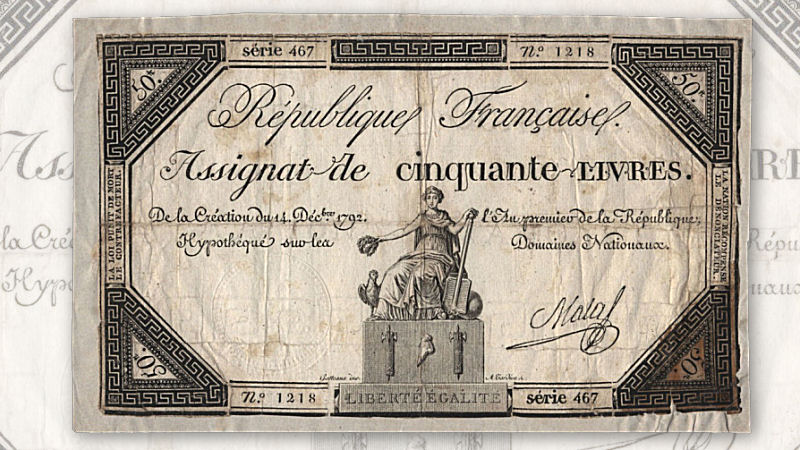

The French Revolution, which began in 1789, not only changed the political landscape of France, but also left a strong mark on the country's economy. One of the most significant aspects of that economic change was the introduction of paper money called “assignats.” These banknotes became a key element in financing military campaigns and state needs, but at the same time they led to hyperinflation and poverty among wide strata of the population.
Before the revolution began, France was already facing enormous national debts. Payments were difficult, and coin money carried a 2% premium. To settle the debts, it was decided to seize noble and church property for the benefit of the state and sell it. However, a lack of buyers still left the state without money. To solve this problem, the French government put into circulation mortgage state bonds known as assignats. These banknotes initially came in large denominations: from 50 to 2000 livres, and the property confiscated from the nobility and the church served as a guarantee for their value.
Although it was originally planned for this measure to be temporary, the needs of the state and especially the army required new and large expenditures. Therefore, the assignats were not withdrawn from circulation as promised, but were massively printed and released into circulation in large quantities, often in nominal values below 50 livres.
This massive issuance of paper money led to a rapid fall in its value. According to reports, in 1796 there were assignats worth 46 billion livres in circulation. The exchange rate of the assignats continuously fell, from 77% in 1791 to just 0.33% in 1796.
When the French army began achieving major victories in surrounding European countries in 1796, contributions from foreign states enabled France to start minting its own money again. Assignats were abandoned without any compensation, and broad strata of the population were left poor and impoverished.
The hyperinflation caused by the assignats had long-term negative consequences for the French economy. Prices rose rapidly, wealth disappeared, and poverty affected an increasing number of people. The assignats became a symbol of the financial chaos that accompanied the French Revolution.
Ultimately, the French assignats are remembered as an example of a failed attempt to resolve state financial problems through the mass emission of paper money. Their use brought temporary relief, but in the long run led to catastrophic economic consequences for France and its citizens.
Edited by: Zlatko Viščević
Image: Coins, Banknotes & Militaria Store [www.cbm-store.com]