
During archaeological research at the site of the former St. Nicholas monastery complex in Zadar from 2014 to 2016 (during Italian rule, it housed a military hospital and the „Tommaseo Gulli“ Royal Navy barracks), a specimen of the Kingdom of Italy coinage from the 1943 R – XXI emission was found. In Dalmatia, this is the first such find, and most likely one of the few found outside mainland Italy. It is a 20 centesimi coin from 1943 – XXI, bearing the mark of the 21st year of the Fascist era and the mint mark of Rome (R). Since the coins of this emission minted in 1943 could not have arrived in Dalmatia as regular coin issues of the Roman State Mint due to the fall of fascism on July 25, 1943, or the capitulation of Italy on September 8, 1943, I believe this would be the first verifiable specimen of the Kingdom of Italy 20 centesimi coin from 1943 R – XXI, identically, i.e., subsequently minted from July 26, 1944, at the provisional mint of the Italian Social Republic in Aosta using transferred, utilized minting machinery of the Roman State Mint for the 1943 R – XXI series. This money must have arrived in Zadar—under the nominal control of the Government of the Italian Social Republic, but under actual German occupation (Deutsche Besetzung Zara)—between July 26 and October 30, 1944, which is by the day the city was captured by the units of the People's Liberation Army of Yugoslavia (NOVJ). Considering the historical circumstances, as well as the physical isolation of Zadar from the rest of Italy during late 1943/1944, I think this coin most likely arrived specially by air route with a certain official of Mussolini's Government or the Fascist Federation from northern Italy to the area of the St. Nicholas military complex, mere months before the end of German rule in Zadar.
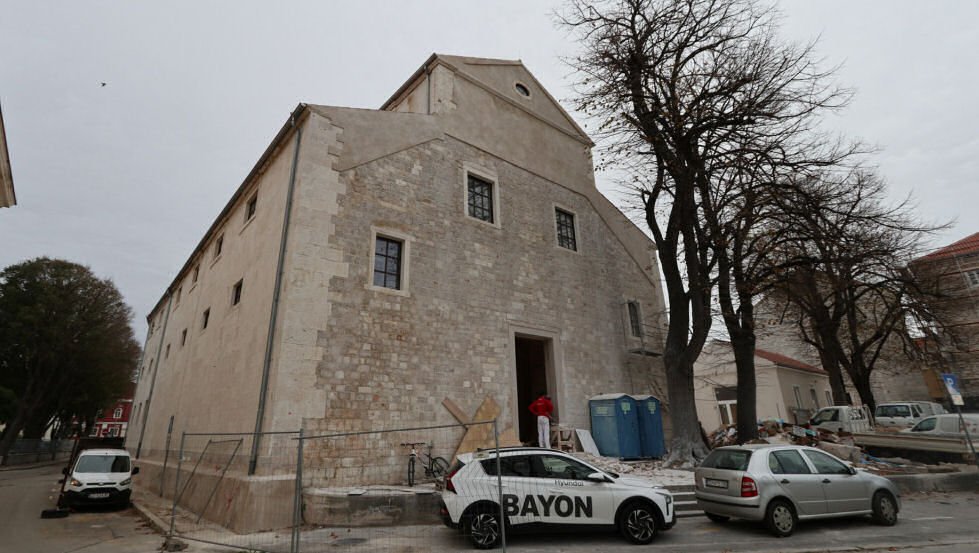
During archaeological excavations at the site of the former church and monastery of St. Nicholas in Zadar, a large quantity of numismatic material dating to the Middle Ages and the early modern period was discovered. In addition to these numismatic finds, further excavations in 2016 in trench I (in the channel inside the cistern beneath the monastery) also yielded numerous coins from the late 19th and the first half of the 20th century. During the clearance of surface debris in the cistern beneath the monastery (trench I), a large quantity of coins was found, mostly gathered in one place within the drainage channel, so it is possible that this is a hoarded find of coins that was deposited or discarded at a single moment. A total of 186 coins from the cistern were cleaned.[1] It is evident that coins from the late 19th century until the mid-20th century, specifically from 1861 to 1943, fell into the cistern drain beneath the monastery (sounding I). Judging by the frequency, coins from the 19th and early 20th century rarely fell into the drain, but a large group of coins clearly ended up there in 1943. An important find for this is the Vittorio Emanuele III type coin, 20 Centesimi, Impero, minted in 1943 (marked XXI), which never officially came to the city as a medium of exchange due to events surrounding the eve and aftermath of Italy's capitulation in early September 1943.
Any find of coins of the Kingdom of Italy from both series of 1943, Rome – XXI, in all territories occupied by Italy in the Second World War represents a unique find in an archaeological sense. The reason for this lies in the fact that the regular currency minted that year in Rome was not put into circulation due to a series of war events related to the capitulation of Italy in early September of that year. In accordance with historical events, the monetary shipment of this series never even reached the Governorate of Dalmatia. On the other hand, the 20 and 50 centesimi coins, subsequently minted at the mint in Aosta in northern Italy, were put into circulation in late July 1944 in relatively small quantities and only in the area controlled by the Government of the Italian Social Republic. The Zadar Prefecture nominally belonged to such an area as well. However, even this subsequently minted money was never officially sent to Zadar. This article discusses the find of a Kingdom of Italy coin of 20 centesimi 1943 R – XXI, minted from the dies of engraver Giuseppe Romagnoli for the regular series of 20 centesimi 1943 R – XXI, transferred in April 1944 from the Roman state mint to the temporary mint of Aosta. Such a specimen was found during archaeological research at the site of St. Nicholas in Zadar.[2] A specimen of this money had to arrive in Zadar between the activation of the mint on July 26, 1944, and before the order of the Ministry of the Interior on the evacuation of the Prefecture from Zadar on October 30, 1944, up to and including the entry of the units of the NOVJ into the city the following day. Given that Zadar, as part of the RSI, was largely physically cut off from the rest of northern Italy, and since this money, much like the regular money minted in Rome before the fall of Fascism on July 25, 1943, did not arrive in Dalmatia as legal tender of the Italian monetary system, and considering that the last government aircraft officially landed in Zadar in late March 1944.[3],This specimen should be viewed as a curiosity that obviously arrived as private money with some government or Fascist Federation official specially dispatched via some communication to Zadar between late July 1944 and late October 1944. Therefore, given the closed context of the find and the elements of specific historical circumstances in Zadar in late 1944, this money, as one of the rare ones, would have to be connected with certainty to the activity of the mint in Aosta, although physically it does not differ in any way from the specimens minted in Rome. This realization could pave the way for further research into possible specific deviations in distinguishing these two types of identical money.
The sequence of historical events that forced Italy to exit World War II unfolded on the late Sunday afternoon of September 8, 1943. That day, at 6:30 PM Central European Time, Radio Algiers announced in its regular broadcast the news that the Italian government had unconditionally surrendered to the Allies.[4] The sudden news of the capitulation quickly spread across all areas held by Italy under occupation in the Mediterranean and, in the following couple of days, chaotically dissolved the Italian army. This also happened to the command of the 158th Infantry Division „Zara“ in Zadar and the 15th Infantry Division „Bergamo“ in Split. Disinformation, hesitation, doubt as to whether the Germans should be resisted or not, the failure of radio communications, i.e., the inability to establish communication with central commands from Rome, the German expectation of capitulation, and finally the collapse of the command and communication system led to this army, with individual instances of resistance, being captured and disarmed and mostly interned in various camps in the territory of the Reich.[5] The capitulation of Italy was the logical consequence of a sequence of related events that followed the Allied landing on Sicily on July 10, 1943. Two days later, at night, about 3,500 American B-17 bombers, darkening the sky over Rome, carried out the first Allied attack on the city. About a month later, Rome was granted the status of an open city, open city.[6] The collapse of Fascism began abruptly. The Allied advance in southern Italy during July called the Duce's authority into question. Things began to develop at lightning speed after United States troops entered Naples on July 21, 1943, as a result of which the Grand Council of Fascism withdrew its confidence in Prime Minister Mussolini five days later. With this, the fascist regime formally fell as well. The king entrusted the mandate to form a government to Marshal Pietro Badoglio.[7] The new Government, while promising the Germans to fulfill all contractual obligations from the Tripartite Pact, simultaneously began secret negotiations with the Allies regarding the surrender of arms and possible entry on their side. Armistice, namely the armistice of Cassibile signed on September 3, entered into force on September 8, 1943 at 6 PM. Half an hour later, in the evening news, Radio London broke the news to all its listeners that Italy had finally capitulated.
Following the fall of Fascism back in July, an entire series of Impero-type coins in denominations of 5, 10, 20, 50 centesimi and 1 and 2 lire from 1943 R – XXI remained minted at the state mint in Rome. This money was supposed to be put into circulation at the end of year XXI and the beginning of the new XXII. Years of the Fascist Era were counted from the March on Rome on the night of October 28/29, 1922. Accordingly, year XXI began on the night of October 28/29, 1942 and lasted until the transition from October 28 to 29, 1943. Since, due to the fall of fascism and all previous war events, as well as the Allied advance toward the Gustav Line, it was not possible to put the freshly minted 1943-XXI series coins into circulation at the end of October, that entire series, of which only from the coin mold of 20 centesimi 1943 R – XXI 57,000,000 pieces were struck[8] It was never put into circulation, and thus it never reached the territory of the Governorate of Dalmatia. However, a single specimen of the Kingdom of Italy 20 centesimi coin from 1943 R – XXI was nevertheless found in Zadar in the area of St. Nicholas. Since, due to war events following the fall of fascism, the coin from the mintage of 57 million pieces struck in Rome was never put into circulation, this Zadar find must be part of the series of slightly more than 2 million pieces subsequently struck from the mint dies transferred from Rome to northern Italy in April 1944 for the 1943 – XXI series of Kingdom of Italy coins,[9] with nominal mint mark (R)[10] in the provisional mint of Aosta. The transfer of the coin striking dies to a safe place is the direct result of the frontline approaching Rome in April 1944. Finally, American troops entered the city on June 6. Therefore, the dies and material (acmonital) were transferred from Rome[11]) and the technical staff from the State Mint in Aosta.[12] Within three months, the Autonomous Mint Section in Aosta was equipped to operate in full shifts. It was established by a decision of the Ministry of Finance dated May 1, 1944, number 422.,[13] published in the Official Gazette (Official Gazette) of the Government No. 171, dated July 24, 1944, with the order to mint coins of 50, 20, and 10 centesimi (Lire 0.50, L. 0.20, L. 0.10) therein. It began operations on July 26, 1944, and until June 4, 1945, that is, until the suspension of operations, it minted 2,053,000 pieces of 20 centesimi coins of 1943 R. – XXI.[14] Although due to the high inflation rate that small change in circulation could not have any significant role, it nevertheless entered the monetary turmoil that ruled Italy from 1943 to 1947. After the capitulation and the establishment of the RSI government in northern Italy, banknotes from 10 to 1000 lire were issued. These banknotes were emitted by the Bank of Italy and also used the designation of the Kingdom of Italy. In the south, in the area under Allied control, the military administration, Allied Military Group It issued AMG lire, which replaced the previous currency of the Kingdom of Italy from circulation. In 1944, these lire were replaced in the liberated territories by the currency of the Provisional Government of Italy, although all three types of currency remained in circulation in Italy until 1950.[15]


The context of the find of 20 centesimi from 1943 – XXI. in archaeological research at the site of St. Nicholas in Zadar speaks of a historical situation in which within the „Tommaseo Gulli“ naval barracks, although bombed several times during air raids, ever since the end of 1943, a certain military organization was maintained throughout 1944. It was urgently evacuated from the Zadar peninsula, in whatever form it had functioned up to that point, on the morning of October 30, 1944, following a collective order from the Ministry of the Interior of the republican Government on the evacuation of state personnel from Zadar. The situation in which the deposition of the 20 centesimi specimen from 1943 occurred in Zadar can be linked to a very narrow time period from when the minting of this coin began at the mint in Aosta on July 26, 1944, until the evacuation of the German army from Zadar on October 30/31, 1944, which is theoretically just over 3 months.
The find of Kingdom of Italy currency from the 1943 series – XXI/R is currently a unique phenomenon and should be studied within the context of the very complex economic and historical circumstances in which Zadar found itself just before and after the capitulation of Italy in early September 1943.
Notes
[1] Luka Bekić, St. Nicholas in Zadar, Post-Medieval and Contemporary Numismatic Finds Recovered at Zadar’s St Nicholas Church, Zadar, 2017, p. 170
[2]Luka Bekić, Post-Medieval and Contemporary Numismatic Finds Recovered at Zadar’s St Nicholas Church, pp. 91, 167
[3] Dalmatia – a chronicle for history (1943 – 1944), vol. 5, p. 1406, at the end of March 1944, the Bank of Italy paid 3 million lire in Zadar to the German military.
[4] Odone Talpo, Dalmatia. A Chronicle for History 1943-1944, Rome, 1994, p. 7
[5] Odone Talpo, Dalmatia. A Chronicle for History 1943-1944, Rome, 1994, p. 8
[6] Odone Talpo, Dalmatia. A chronicle for history 1943-1944, Rome, 1994, p. 10
[7] Odone Talpo, Dalmatia. A Chronicle for History 1943-1944, Rome, 1994, pp. 5 – 6
[8] Numismatica, periodical of numismatic culture and information, year II, no. 1, 1961, pp. 12-14
[9] Numismatica, periodical of numismatic culture and information, year II, no. 1, 1961, pp. 12-14
[10] Numismatica, periodical of numismatic culture and information, year II, no. 1, 1961, pp. 12-14
[11] Numismatica, periodical of numismatic culture and information, year II, no. 1, 1961, pp. 12-14
[12] Numismatica, magazine of numismatic culture and information, year II, no. 1, 1961, p. 14
[13] See in Gigante, 2017, 193: Ministerial Decree 422/1944 of the Italian Social Republic ordered the minting in Aosta of 50 and 20 centesimi acmonital coins, which were previously minted in Rome. However, only 2,053,000 pieces of 20 centesimi were issued—which, moreover, cannot be distinguished from those issued in Rome for the Kingdom of Italy—out of a total of 6,000,000 blanks prepared by the Cogne Company for the Aosta mint. In fact, the Material Register of the Engraving Material Warehouse of the Rome mint shows that on April 13, 1944, the matrices and punches for the 50 centesimi, 20 centesimi, and 10 centesimi acmonital coins were delivered to Captain Pietro Martinelli (who 20 days later became the police commissioner of Aosta); said material was never returned to the Rome mint. It is not known whether, in addition to the aforementioned 20 centesimi, the 50 centesimi coins were also minted, which, moreover, would not be distinguishable from the analogous coins struck for the Kingdom of Italy.
[14] Numismatica, periodical of numismatic culture and information, Year II, No. 1, 1961, p. 15
[15] Luka Bekić, St. Nicholas in Zadar, Zadar, 2017, pp. 191-196
Author: Dejan Filipčić