


Numismatics is a science that deals with the study of ancient coins and medals. The word is of Greek origin, deriving from the word “nomē,” which originally means pasture and fodder, and later developed the meaning of distribution and something given in exchange. A similar Greek word “nomos” also has various meanings, including district, place of residence, custom, habit, and finally regulation or law.
From the word “nomos” the word “nomisma” is derived, which refers to coins. Coins are shaped pieces of metal that are made by minting or casting. They serve as a medium of general exchange and a means of circulating value, that is, money. However, for coins to fully fulfill their purpose, they need to have a guarantee in terms of content and weight. This means that coins should be created under the supervision of the elder, the ruler of the community, the state, and similar authorities.

Source: Classical Numismatic Group [https://www.cngcoins.com]
Numismatics has always been a science that deals with coins, recognizing their importance as objects of historical, cultural, and artistic significance. Its main goal was to determine the place and time of a coin's origin, and to identify the ruler who ordered its minting (given that the right to mint was the exclusive right of the sovereign). Also, numismatics has the role of interpreting the inscriptions and images depicted on coins and monitoring the development of engraving art and minting methods among different nations.
Numismatics and the science of money were once significantly different. The science of money encompassed a part of the national economy, and coins were treated solely as money that served as a measure of value and determined value relations. However, both sciences complement each other in many areas and serve as auxiliary scientific branches to one another. Numismatics, therefore, is not only a way of arranging collections and answering the question of what coins depict; it also has the task of answering questions about their purpose and value.
Closely related to numismatics is the art of medal making. It is particularly important when it comes to medals of Roman rulers, which cannot be viewed separately from Roman currency. This relationship remains for later periods as well, even though most medals were not minted and issued by the state. Despite the fact that medals have no monetary value, they are of great importance for numismatics because not only are they similar to coin currency, but as witnesses to minor sculpture, or rather art, they play an exceptionally important historical and artistic role.
Numismatics has often provided important help in various situations when history is being falsified or when the processing of certain historical periods has reached a standstill. In such cases, numismatics has contributed to the clarification of purely historical facts, such as the sequence of rulers in antiquity and the determination of the time periods of various important events.

Source: Leu Numismatik [https://www.leunumismatik.com]
Ancient coins are a rich source of information about old languages and written symbols whose forms changed over the centuries. They show us images of gods and heroes, temples and animals, household and worship objects, weapons, and other artifacts. On many Roman coins, we find artistically and aesthetically expressed vivid portraits of rulers with indications of their names. Thanks to numismatic finds, archaeologists can very reliably identify portraits of rulers for whom it was previously not possible to say with certainty to whom they belong.
Coins provide us with insight into the level of education, as well as the political and religious state of a people during a given period. Through coins, we can trace the beginning, flourishing, and decline of the level of art. Furthermore, those same coins, acting as currency, allow us to observe the development of trade and the degree of development and wealth of a nation.
Numismatics (and history) are divided into three main groups. The first group encompasses coins of the ancient world or antiquity. The second group encompasses medieval coins, while the third group includes modern coins.
Numismatics has become a significant scientific discipline that studies numismatic material as a source for political and economic history, epigraphy, chronology, linguistics, heraldry, and art history. From a technical standpoint, it deals with researching the value of money, its purchasing power, and the legal regulations related to coinage among various peoples and in different time periods.
It is true that numismatics is not a recent phenomenon. Unfortunately, it is not possible to fully ascertain whether the ancient Greeks and Romans engaged in collecting and studying money, since there are not enough sources to confirm this. However, we can state with certainty that in the Middle Ages, Italy was the country where a sense for the study of ancient money and for its collection and preservation developed. One of the first known collectors was the Renaissance poet Francesco Petrarca, who collected Roman coins.
Already in the 15th century, many rulers and wealthy individuals had their own numismatic collections. Among them were Leonello d’Este, Cosimo de' Medici, Alfonso of Naples, Emperors Maximilian I, Ferdinand I, and others. These collectors contributed to the development of numismatics as a scientific discipline that studies money as a historical source.

Sources: Wikipedia [https://www.wikipedia.orgRoyal Collection Trusthttps://www.rct.uk]
Scientific interest in ancient coins began in the late 15th century. At that time, in 1489, the humanist Angelus Politianus printed and published his work “Miscellanea,” which is considered the first and oldest numismatic work.
In the 17th century, the first money collectors also began to appear in Croatia. Among them were Counts Nikola I and Nikola II Drašković, and bans Nikola and Petar Zrinski.
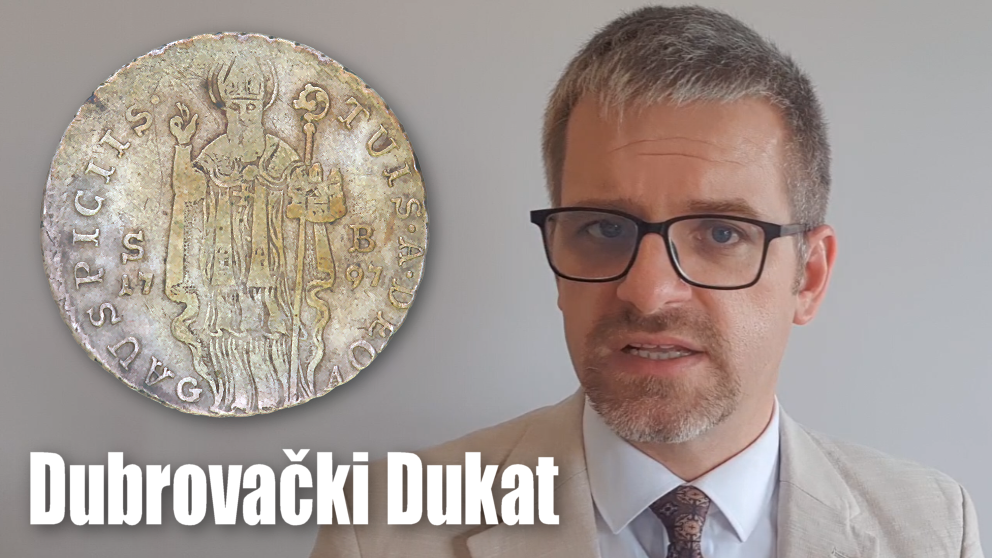
During the 18th century, the number of collectors and scientific workers in the world, including in our region, increased significantly. Our fellow citizen from Dubrovnik, Anselmo Banduri, who worked as a scientist in Paris, wrote two important numismatic works that are still often relevant today.
One of his works is “Numismata imperatorum Romanorum a Traiano Decio ad Palaeologos Augustos”, published in Paris in 1718. In this work, he described the lives of Roman emperors and rulers from the Egyptian Ptolemaic dynasty. In his second work entitled “Bibliotheca numaria”, Banduri presented the history of numismatics up to his time, and it is considered the first such work of its kind in the world.
At the end of the century, our Friar Matija Katančić also published two numismatic works: “Tentamen publicum ex numismatica veteri” in Buda in 1797 and “Elementa Numismatica” in Buda in 1798. It is interesting that Katančić was one of the first professors of numismatics in Europe at the University of Buda. His works and contribution to the science of numismatics remain important and appreciated even today.
During the 19th century, the field of numismatics experienced a rapid expansion. Research was no longer focused solely on the coinage of ancient Greece and Rome, but medieval coins were also increasingly investigated. A significant contribution to this development was made by Professor Josip Mader from the University of Prague, who published his extensive work “Kritische Beiträge zur Münzkunde des Mittelalters” in Prague between 1803 and 1809. This work increased interest in the study of the Middle Ages, which resulted in a sharp rise in the number of collectors.
In the 19th century, the first numismatic journals also began to be established. The first such journal began publication in 1832 in the Netherlands, followed by similar publications in 1834 in Germany and England. The influence of these journals encouraged the establishment of numismatic societies. The first and oldest “Numismatic Society” was founded in London in 1836, around 1840 a numismatic society was established in Berlin, and in 1869 in Vienna. Following these initial initiatives, numismatic societies were founded in other countries as well.
The first numismatic society in the territory of the former Yugoslavia was founded in 1928 in Zagreb.
Numerous prominent scientists have made a great contribution to the spread of numismatic knowledge in our region. Professor Šime Ljubić's work “Opis jugoslavenskih novaca” (Description of Yugoslav Coins), published in Zagreb in 1875, represented an important foundation. Furthermore, Professor Milan Rešetar's work “Dubrovačka numizmatika” (Dubrovnik Numismatics), published in Zemun in 1925, and “Slavonski banovci” (Slavonian Banovci) by Dr. Ćiro Truhelka from Sarajevo in 1897, also contributed to the further development of numismatics in our country.
Professor Ivan Rengjeo set high standards in numismatic research with his numerous works, especially with the work “Corpus der mittelalterlichen Münzen von Kroatien, Slavonien, Dalmatien und Bosnien”.
Today, major numismatic auction houses play an important role in spreading numismatic knowledge by publishing extensive and thoroughly prepared sales catalogs with exceptional images. Also, numerous editions of numismatic societies around the world contribute to explaining and shedding light on many details that may have been insufficiently addressed by earlier prominent scholars in the numismatic community. All these initiatives together contribute to the progress and richness of numismatic science.
Edited: Zlatko Viščević
Source: Numizmatika.Antikviteti.net (no longer active)
Photos: Christie's [https://www.christies.com], Classical Numismatic Group [https://www.cngcoins.com], Leu Numismatik [https://www.leunumismatik.com], Royal Collection Trust [https://www.rct.uk], Wikipedia [https://www.wikipedia.org]