





The National Bank of the Federal People's Republic of Yugoslavia had produced, but never put into circulation, as many as 16 types of paper banknotes, which today are a great rarity and a true treat in the collecting world. The banknotes, about which there is not a single piece of data in official literature other than images, can be observed in four separate groups: three groups relate to specimens of regular issues, and one group relates to specimens of extraordinary issues, or issues for extraordinary needs (as this type of money is referred to in publications of the former National Bank of Yugoslavia).
Individual specimens of those banknotes occasionally appear on the collector market in very small numbers, and some do not appear at all. This paper analyzes recorded specimens that have appeared at auctions over the past fifteen years and specimens from private collections personally studied by the author, in order to attempt, due to the inaccessibility and a certain embargo on information from the issuing institution, to consolidate all possible data in one place to some extent. This should also be done because the aforementioned unissued banknotes certainly belong to the Croatian numismatic history of a not-so-distant, yet very interesting and somewhat neglected period.
Unissued banknotes of the FPR (Federal People's Republic) of Yugoslavia, especially those printed after 1945, have regularly been accompanied to this day by a series of half-information, and even complete disinformation or guesswork regarding their circulation, printing technology, and production time, and above all, the purpose of their production. The reason for this is certainly the secrecy surrounding such specimens in their parent institution of production, the National Bank of Yugoslavia (today Serbia) in Belgrade, from which it was not possible, nor is it possible today, to obtain any information, even the smallest amount. Such a practice was common during socialism, when almost everything was a secret, but today, especially after the dissolution of the state, there are no obstacles to publishing at least some official data about these „secret“ banknotes.
Meanwhile, since such data are collectible „treats,“ one must rely on the existing very scarce literature and very rare findings as the best witnesses of that time in an economic, political-ideological, and historical sense.
The author of these lines managed to gather all available data and record the appearance of all types of the mentioned banknotes over the past 15 years at all auctions in the countries of the former Yugoslavia, Europe, and the United States, as well as to document many specimens held in private collections of prominent individuals from the region, especially over the last four years, since, by all accounts, the last preserved specimens appeared on the collecting market. In this way, the first concrete picture of that chapter has been created, and this data is being published for the very first time precisely in this magazine.
Four years ago in the numismatic literature of Serbia, the subject of unissued banknotes of Yugoslavia was approached from the perspective of a division into two issues, regular and extraordinary. Today, with significantly better and richer knowledge, and after collecting additional data, it can be stated that between 1949 and 1951, four separate projects of new paper banknotes that were never put into circulation were created. In total, this refers to as many as 16 different banknotes.
Project 1.
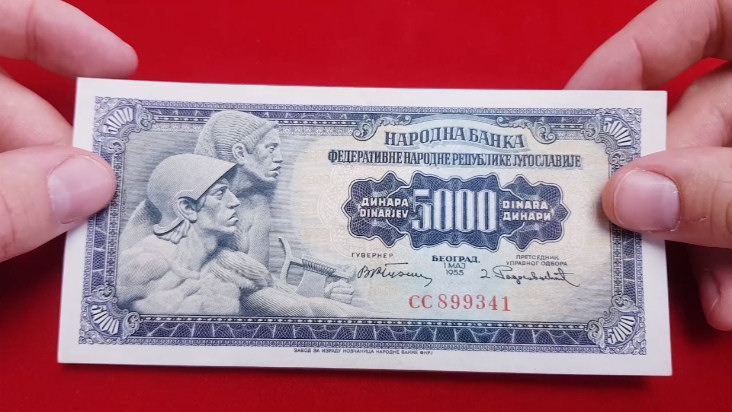
Only a single specimen belongs to the first group of unissued banknotes. This is a regular issue banknote, or an issue for regular circulation purposes, of 5,000 dinars, dated November 1, 1950. (2) This banknote belongs to the continuation of the regular banknote issue dated May 1, 1946 (denominations of 50, 100, 500, and 1,000 dinars), made on the same type of yellowish paper, without a security thread, fully permeated by the watermark. It was signed by the Governor of the National Bank of the FPRY, Marijan Dermastija. The banknote is the work of already well-known experts from the Institute for Banknote Printing in Belgrade, and only their last names are printed on the banknote: Zlamalik and Krnjajić as the authors of the obverse, and Kocmut as the author of the reverse. (3)
At the time that banknote was produced, which was 1951, an economic reform with a measured market component took place in Yugoslavia (to put an end to major shortages of goods in a market of strictly regulated prices and an unrealistic exchange rate), along with a drastic devaluation of the dinar exchange rate from 50.00 to 300.00 dinars per 1 US dollar (4) and the introduction of a system of a „stimulative“ or „tourist“ exchange rate, which was set at a higher level than the official exchange rate. At the same time, a general increase („readjustment“) of prices was carried out in accordance with measured market guidelines, so in practice the value of the dinar fell by 5 to 6 times compared to the previous year. Consequently, the existing largest circulating banknote, the 1,000-dinar note dated May 1, 1946, certainly no longer met the needs of circulation, and a 5,000-dinar denomination was urgently needed.

Figure 1. National Bank of the FPR Yugoslavia, 5000 Dinars, November 1, 1950.
Source: Heritage Auctions, Inc.http://coins.ha.com]
On the collector's market, that banknote appears very rarely, mostly without a regular serial number (a single specimen of the series BG 092607 has also been seen, which indicates that most of the preserved specimens belong to a printed sheet that remained unfinished, i.e., unnumbered, and was preserved as such and subsequently cut. The mintage of the banknote cannot be discussed precisely, but based on the only seen serial number, it turns out that at least 23,092,607 specimens were produced.(5)
It is important to note that this banknote (mostly folded) also appears with a fake serial number, all with the obvious aim of defrauding naive and uninformed collectors (since the numbered specimen, due to greater rarity, can fetch twice the price of the unnumbered one). However, this is a subsequently added numbering, with irregular digits of varying heights that deviate from the line by as much as 2 mm, and high serial prefixes that, according to the logic of the actually required print run, could not have existed. (6)
There is no official data on why that banknote was not issued. However, it is most likely that the production technology did not offer a satisfactory level of protection against counterfeiting. As early as the beginning of 1952, the printing of banknotes on somewhat better paper, with a built-in security thread, began (7), and at the end of 1953, the Banknote Printing Office in Belgrade acquired intaglio printing machines (8), on which a new 5000 dinar banknote was produced shortly thereafter, using the most advanced technology of the time and a significantly more modern design.
Project 2.
By all accounts, simultaneously with the 5000 dinar banknote of the regular issue dated November 1, 1950, the National Bank also produced a series of 10 banknotes in denominations of 1, 2, 5, 10, 20, 50, 100, 500, 1000, and 5000 dinars, all bearing the year 1950. Unfortunately, there is no official data whatsoever about this series anywhere in the literature, nor can any information about them be obtained from the printing house or the National Bank. However, it is certain that this was a reserve banknote emission, or an emission for extraordinary needs, usually wartime. Banknotes for extraordinary needs are the concept of the Swiss National Bank, which during the Second World War printed a parallel series of banknotes to instantly replace the circulating banknotes of the regular issue in the event of a monetary intrusion by a foreign power into its monetary system.(9)
All banknotes of the 1950 series have manufacturing elements identical to those of the previously described regular issue 5000 dinars banknote of November 1, 1950, meaning they were produced without a security thread and on the same type of yellowish paper completely permeated by a watermark. They were signed by the Governor of the National Bank of the FPRY, Marijan Dermastija, but none of them have the authors„ names printed on them. The reason for this is likely a “state secret.".

Figure 2. National Bank of the FPR Yugoslavia, 20 and 50 dinars, 1950.
Source: Katz Coins Notes & Supplies Corp. [https://www.katzauction.com]
That series was created primarily for political reasons. Namely, in 1951, the history of Yugoslavia marked two very dangerous crises. The first, the so-called „Cominform Resolution,“ which began back in 1948 with the split between Tito and Stalin, was a constant threat of open military intervention by the Warsaw Pact countries against Yugoslavia. The second, the so-called „Trieste Crisis,“ culminated in 1952 and until 1954, just like the first crisis, threatened the outbreak of war over Trieste and Istria, this time with Italy and the powers of the Western political-military bloc. In such circumstances, the authorities in Yugoslavia perhaps justifiably expected a possible monetary strike, making the creation of a reserve issue of banknotes understandable, which would be used to immediately intervene and replace the existing paper money in circulation.
Denominations from 1 to 50 dinars were printed without the intended numbering because at that time they were of small face value. Consequently, it is not even possible to estimate what their print runs would have been. Denominations from 100 to 5000 dinars were numbered. However, most specimens appear largely without numbering, which again indicates that the majority of the printed and numbered circulation was destroyed, and the specimens that have been preserved are those that were left behind in the printing press and had not yet been numbered, and judging by errors and cutting irregularities, most likely in sheets. On the 100-dinars banknote, the highest numbering recorded so far is VO 917334, which corresponds to a print run of 54,917,334 printed specimens. The highest observed numbering for the 500-dinars banknote is AT 804227, which corresponds to a print run of 18,804,227 specimens. The 1000-dinars banknote did not appear with a numbering higher than AA 000712, meaning only 712 specimens, and the 5000-dinars banknote has been recorded with the highest numbering AK 002982, which corresponds to a print run of 10,002,982 specimens.
Certainly, the recorded numbers are not final and, in fact, the actual circulation of copies cannot be determined until the National Bank in Belgrade decides to make that information available.

Figure 3. National Bank of the FPR of Yugoslavia, 1000 and 5000 dinars, 1950.
Source: Auction House Christoph Gärtner [http://www.auktionen-gaertner.de]

Figure 3.a. Example of original numbering on 500 dinars, 1950, and Figure 3.b. Example of original numbering on 5000 dinars, 1950.
Project 3.
The third group of banknotes is actually a technically more advanced regular banknote emission by which the banknotes of the May 1, 1946 emission were supposed to be withdrawn from circulation. This group includes the following banknotes: 50 dinars, May 1, 1950; 100 dinars, May 1, 1949; and 1000 dinars, May 1, 1949. The year 1953 should be taken as the time of their creation for the 50 and 100 dinar banknotes, and no earlier than 1954 for the 1000 dinar banknote, because in those years the Institute for Banknote Manufacturing in Belgrade adopted (already mentioned in the description of the 5000 dinar banknote of November 1, 1950) the two essential elements in banknote production: the production of domestic banknote paper and the adoption of intaglio printing technology.

Figure 4. National Bank of the FPR Yugoslavia, 50 Dinars, May 1, 1950 and 100 Dinars, May 1, 1949.
Source: Bank Note Museum [www.banknote.ws]
It is certain that the decision (decree) to produce a completely new issue for regular circulation was made much earlier (dates from 1949 and 1950) than the banknotes were actually manufactured, and it can be assumed that priority was given to the production of the 10 banknotes of the 1950 reserve issue instead, which, considering the technology and capacities of that time, was certainly being produced throughout the entire year of 1952.
Certainly, the 50 and 100 dinar banknotes, with exceptionally beautiful graphics, were printed on high-quality paper, and the 100 dinar denomination also has a built-in security thread. They were signed by Governor Marijan Dermastija and the authors Kocmut, Mujadžić, and Krnjajić. (10) According to available data based on the recording of all available preserved specimens, which are otherwise extremely few, the highest observed numbering on the 50 dinar banknote bears the series 0182 (11), which corresponds to a circulation of 4,550,000 produced specimens, and this is certainly not the final figure. However, the 100 dinar banknote is numbered with a classic numbering machine, and the highest observed is VS 447187, which corresponds to a circulation of 57,448,187 specimens, again, not final.

Figure 5. National Bank of the FPR Yugoslavia, 1000 Dinars, May 1, 1949.
Source: Auction House Christoph Gärtner [http://www.auktionen-gaertner.de]
The most interesting, or better yet, the most controversial is the 1000 dinar banknote of May 1, 1949, because it was produced on premium paper that the Belgrade Banknote Printing Office simply did not possess at that time. Such paper is closest in appearance to the paper of the 1960 series German mark, and is identical to the paper of the dinar banknotes that was first used in the production of the 1000 dinar banknote of December 19, 1974. Therefore, it is exceptionally difficult to say where and when that banknote was even produced. In any case, it was also signed by Governor Marijan Dermastija and authors Kocmut, Mujadžić, and Krnjajić. It has not appeared on the collector's market for five years, and the highest recorded serial number prefix is series 0153 (also of the French type, just like on the 50 dinar banknote of May 1, 1950), which corresponds to a print run of 3,825,000 produced copies, but in this case as well, the question of the entire print run remains open.
Project 4.
Two banknotes belong to the fourth project, 10 and 20 dinars, bearing the printed year 1951. They belong to the regular issue of banknotes produced on identical paper and using identical technology as the 100 to 5000 dinar banknotes dated May 1, 1955, put into circulation on April 25, 1957 (14), and accordingly it can be determined that they were created no earlier than the end of 1954, that is, when the new printing presses at the Institute for Banknote Manufacturing were put into operation. These two banknotes, like the previous unissued ones, bear the signature of Governor Marijan Dermastija, and the graphic design is signed by Miodrag Petrović (15).

Figure 6. National Bank of the FPR Yugoslavia, 10 and 20 dinars, 1951.
Source: Bank Note Museum [www.banknote.ws]
Those banknotes are not part of the regular issue to which the previously mentioned banknotes of Projects 1 and 3 belong. Namely, it is certain that those banknotes were intended to withdraw from circulation the then still current banknotes of the 1944 Democratic Federation of Yugoslavia issue of 10 and 20 dinars, which had been put into circulation in several variations starting as early as April 20, 1945, and were both design-wise and politically anachronistic. However, by 1955 those nominal values were almost rendered worthless by inflation (16), so it can be assumed that putting them into circulation was nevertheless abandoned, and the production and issuance of those denominations in coins was undertaken instead (17).
Supporting the claim that these were banknotes of almost marginal nominal values at the time is the fact that numbering was not even provided for the 10 dinar banknote, whereas it was for the 20 dinar banknote. The highest numbering recorded so far among the specimens that have appeared in recent decades is GA 082663, which corresponds to a print run of 60,082,663 manufactured specimens. Interestingly, this specimen has appeared, uniquely among unissued banknotes, with the „first“ numerator as well, specifically AB 000001, AG 000001, AD 000001, BA 000001, BB 000001, BG 000001, and BD 000001. It is not out of the question that new serial prefixes of the „first“ numerator will also appear. Banknotes with regular serial numbers rarely or never appear, with only the occasional specimen without numbering showing up from time to time at auctions in the successor states of the former SFRY.
Finally, it is worth noting that only the 100 dinar banknote of May 1, 1949, was, so to speak, conditionally issued with modifications, subsequently printed using the more modern intaglio printing technique, and bearing the date May 1, 1953, with Vojin Guzina as the signing governor.(18) Also, the basic design of the unissued 10 and 20 dinar banknotes of 1951 was modified and essentially used for printing the regular emission of 100, 500, 1000, and 5000 dinars on May 1, 1955.(19)
Regarding the collecting aspect of Croatian numismatics, specifically notaphily, all anachronistic prejudices that justifiably arose among our people in the recent, tragic past of the early 90s toward anything bearing the name and prefix of Belgrade should be discarded, and Yugoslav banknotes should be accepted as an integral part of Croatian monetary history and the history of Croatia in general. There is not a single reason why a Croatian collector should not also collect Yugoslav banknotes, i.e., why Yugoslav banknotes should not be included in future numismatic literature dealing with Croatian numismatics.
Notes
(1) „Dinar“, No. 24, publisher Serbian Numismatic Society, Belgrade, 2005.
(2) „World Paper Money“ Standard Catalog, General Issues, 11th Edition, publisher Krause Publications, Iola, 2005.
(3) Data based on personal inspection of the original copy.
(4) „Annual Report of the National Bank of the FPRY 1951“, publisher National Bank of the FPRY, Belgrade, 1952.
(5) Serial prefixes from AA to AH yield 20,000,000 copies, and from BA to BG another 3,092,607 copies. The series letter designations are according to the Cyrillic alphabet because Yugoslav banknotes were numbered exclusively in Cyrillic until 1953.
(6) One such falsely numbered banknote of the SA series was even published in the Krause catalog (10th edition), but the image was removed in the 11th edition and replaced with an unnumbered banknote. Had the SA series been produced, it would have corresponded to a number of 380,000,000 specimens produced up to that point, which is completely irrational. To illustrate, the first produced and issued banknote of the FPRY 5,000 Dinars of May 1, 1955, was printed in 64,585,000 specimens.
(7) Thus, starting from 1952, circulation banknotes of 50, 100, 500, and 1000 dinars dated May 1, 1946, were produced on new, higher-quality paper with an embedded security thread, which can be considered the second variant of that issue.
(8) „The Monetary System of Yugoslavia“, published by the National Bank of Yugoslavia, author M. Ugričić, Belgrade, 1967.
(9) Swiss National Bank, www.snb.ch 4th series of CHF banknotes.
(10) Data based on personal inspection of the original copy.
(11) This is a French type of numbering machine used during the time of the Kingdom of Yugoslavia, where one series of banknotes has 25,000 copies, of which every thousand copies bears one of the 25 letters of the Cyrillic alphabet (at that time, exclusively the Cyrillic alphabet and not the Latin alphabet was used in numbering the issues).
(12) The 2 January 1960 issue, in denominations from 5 to 1000 DM, was produced without modifications up to and including the issue dated 2 January 1980, but in reality was printed until the early 1990s. Source: Deutsche Bundesbank, www.bundesbank.de
(13) Data based on personal inspection of the original copy.
(14) „Currency of Yugoslavia 1944-1992“, published by the National Bank of Yugoslavia, author J. H. Pešić, Belgrade, 1996.
(15) Data based on personal inspection of the original copy.
(16) For example, the official „tourist,“ i.e., incentive exchange rate of the US dollar on the National Bank of Yugoslavia's exchange rate list reached 400 dinars in 1955 (at the same time, the official regular exchange rate was 300 dinars), and the price of daily newspapers, such as „Vjesnik,“ was already 30 dinars.
(17) Issue of coins of the FPRY of 10, 20 and 50 Dinars 1955, in circulation from April 25, 1957, by the Decision of the National Bank of the FPRY No. 33/55.
(18) „Official Gazette of the SFRY“, No. 17/54 of April 26, 1954.
(19) „Official Gazette of the SFRY“, No. 17/57 of April 25, 1957.
Author: Ivan Škrabo
Source: Numizmatičke vijesti, number 62, Zagreb, 2009.
Images: Christoph Gärtner Auction Househttp://www.auktionen-gaertner.de], Bank Note Museum [www.banknote.ws], Heritage Auctions, Inc.http://coins.ha.com], Katz Coins Notes & Supplies Corp. [https://www.katzauction.com]