In the immediate period after the Second World War, a unique numismatic phenomenon emerged in the territory of the then-FPR Yugoslavia. It was a proprietary currency of a foreign refugee community within a sovereign state. This currency is known as the Buljkes dinar and was used between 1945 and 1949 in the Greek municipality in the village of Buljkes, today's Maglić near Bački Petrovac in Vojvodina.
This closed and specific community, often called the „Greek Republic,“ functioned as a sort of autonomous commune. Greek legal regulations applied within it, and its own banknotes were recognized by the Yugoslav authorities. Such a situation, in which a parallel monetary system with its own money exists within a single state, represents an exceptional and rare example in modern history.
Historical context of the community's emergence
The emergence of this community is connected to the political and military circumstances in Greece after the end of the Second World War. Following the withdrawal of German forces in 1944, the Greek People's Liberation Army, known as ELAS, controlled a large part of the country. At the same time, there were other armed groups and a government-in-exile, which led to tensions and conflicts.
Attempts at political unification failed. When the new government demanded the disarmament of ELAS, it was refused, which led to open clashes with other resistance movements, particularly with the EDES organization. The clashes were complex and often involved multiple parties, including German forces in the final stage of the war.
The Varkiza Peace Agreement of February 1945 was supposed to calm the situation, but it led to new divisions. Some members of ELAS decided to continue the fight in the form of guerrilla warfare, while a large number of people emigrated. Yugoslavia, where refugee groups already existed, emerged as one of the main destinations.
Formation of the Greek municipality in Vojvodina
Yugoslav authorities organized the reception of refugees in camps, primarily in the territory of Macedonia. One of the more important camps was located in Kumanovo. From there, on May 25, 1945, a group of 1,454 people was transferred to Vojvodina.
That group, along with later settlers, formed the core of the Greek municipality in Buljkes. The community was relatively closed. Entry and exit were restricted, and internal life was organized according to its own rules and needs.
Buljkes dinar as a means of payment
Due to isolation and specific economic circumstances, the municipal administration decided to introduce its own currency. Thus, the Buljkes dinar was created, which was printed in a local printing office in Buljkes and used as legal tender within the community.
The total amount of issued money was 9,253,255 dinars. By the end of 1948, 7,173,735 dinars had been issued, while an additional 2,079,520 dinars were emitted during 1949. The amount of money was aligned with the total sum of salaries of all employees in the municipality.
This issue served as a sort of reserve currency within the village, primarily for purchasing goods in local stores. However, the banknotes had no value outside of Buljkes.
The introduction of their own currency also had a control function. Workers received their salaries in the Buljkes dinar, which forced them to spend all their money within the community. Goods were often sold at high prices, allowing the administration to maintain control over economic flows. In this way, the municipality accumulated significant funds in its bank account.
Economic difficulties and limitations
Despite attempts to integrate Buljkes into Yugoslavia's planned economy and make it a self-sufficient community, these goals were not achieved. Agricultural production and the workshops were not sufficient for stable functioning.
The workshops operated under the supervision of the Vojvodina authorities, but did not settle their tax obligations. For example, for the year 1948, unpaid taxes amounted to 5 million dinars. Consequently, the supply of food, clothing, and other necessities was difficult and took place with the help of the Yugoslav Army, the Red Cross, and other sources.
Banknotes in circulation
Officially, banknotes in denominations of 1, 5, 10, 20, 50, 100, and 500 dinars were in circulation. The number of preserved specimens today is very small, which further increases their numismatic value. To date, the existence of a 1-dinar banknote has not been recorded.
The main characteristics of individual denominations are as follows:
1 DINAR
The obverse and reverse are light orange with red borders and inscriptions.
5 DINARS
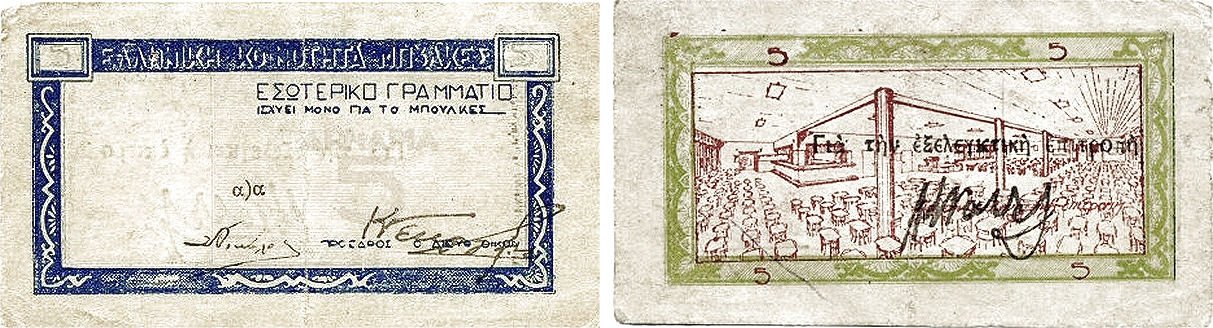
Dimensions 83 x 46 mm. The front is blue, and the back is brown with a green border. A canteen is depicted on the back.
10 DINARS
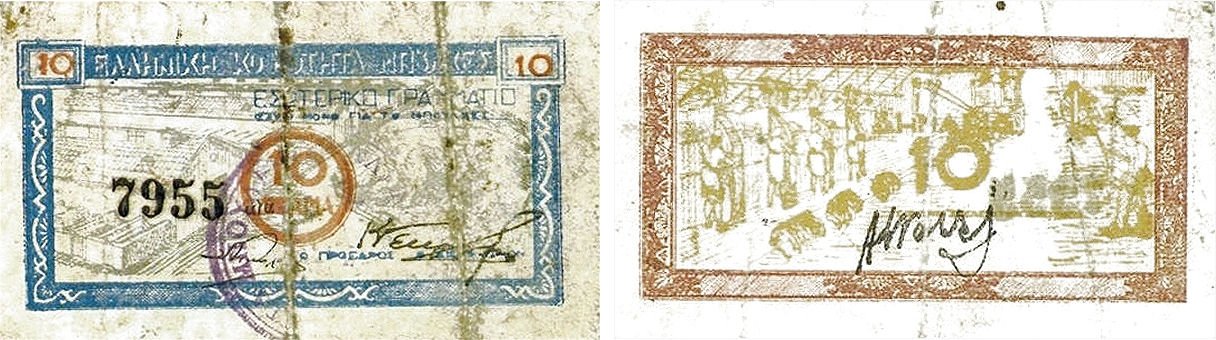
Dimensions 92 x 53 mm. The obverse is blue with brown denomination markings. The reverse is yellow with a red border. Factory motif.
20 DINARS
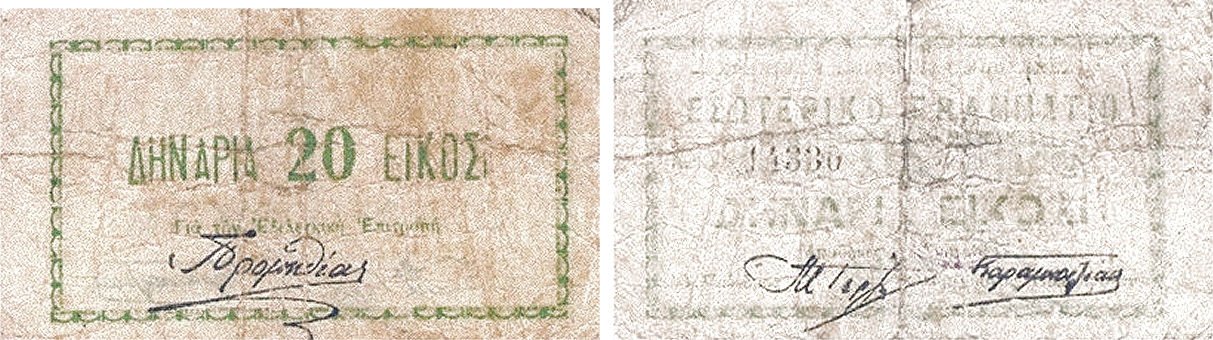
Dimensions 103 x 60 mm. The obverse and reverse are light orange with green borders and inscriptions.
50 DINARS
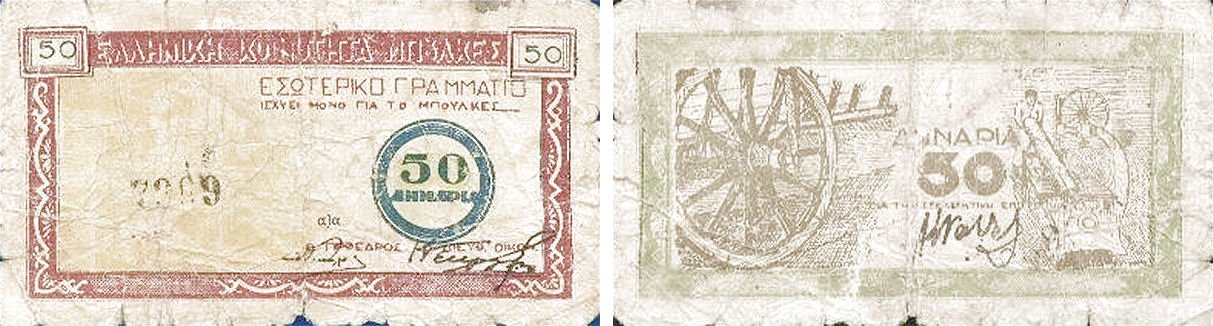
Dimensions 115 x 60 mm. The obverse is olive-yellow, and the reverse is light brown. The obverse features bricklayers, and the reverse a sawmill.
100 DINARS
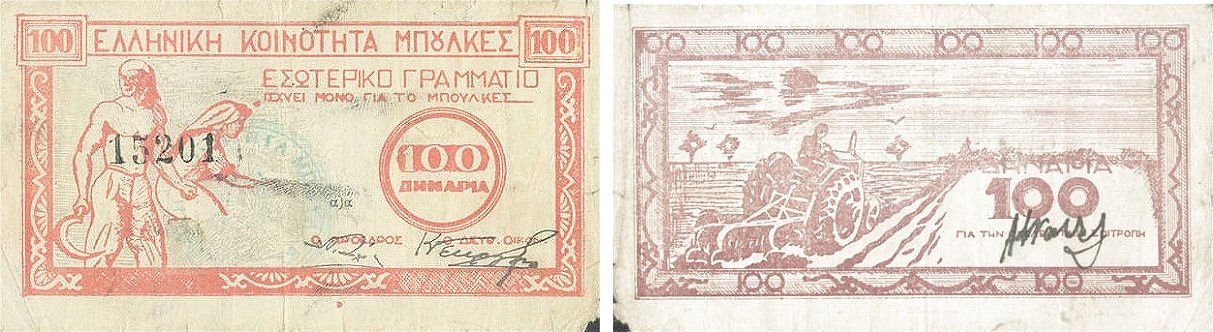
Dimensions 118 x 63 mm. The obverse is red-brown and the reverse is brown. The obverse depicts a harvest, and the reverse depicts a tractor in a field.
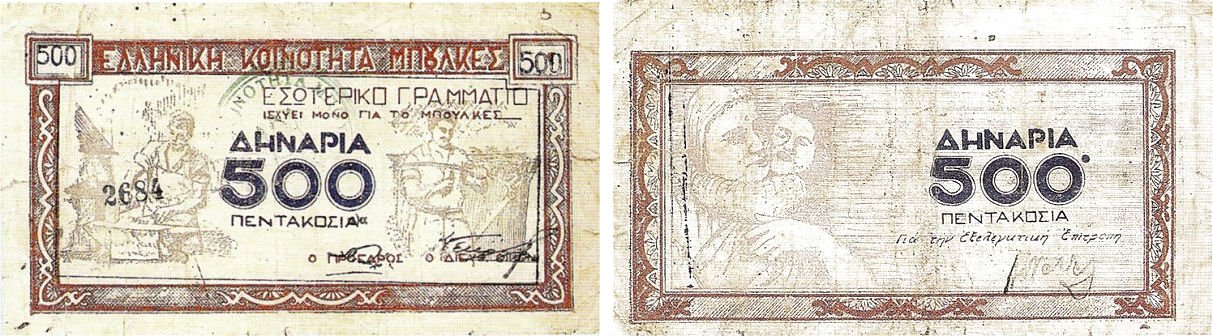
500 DINARS
Dimensions 133 x 31 mm. The obverse and reverse are purple. The obverse depicts a blacksmith and a scythe-man, and the reverse depicts a mother with a child.
Design and inscriptions
Two basic types of banknotes are known. The first group consists of the 1 and 20 dinar denominations marked „Buljkes 1947“. They differ in the color of the text, which is green on the 1 dinar denomination and red on the 20 dinar denomination. These banknotes bear the signatures of President M. Terzis (Μ. Τερζης) and Chief Cashier Karafilias (Καραφιλια).
The second group consists of denominations of 5, 10, 50, 100, and 500 dinars. They do not have a marked year of issue and feature different motifs. They bear the hard-to-read signatures of the governor and the director of the economy.
All banknotes feature the same text in Greek:
GREEK COMMUNITY OF BULJKES – Grčka zajednica Buljkes
INTERNAL VOUCHER – Internal money
VALID ONLY FOR BULJKES – Vrijedi samo u Buljkesu
These inscriptions clearly indicate that it is an internal currency valid exclusively within Buljkes.
Completion and numismatic significance
The Buljkes dinar was in circulation until 1949, when the Greek municipality in Vojvodina was abolished. This also ended the need for this specific currency.
Today, these banknotes represent extremely interesting and rare numismatic material. They are not only a means of payment, but also a testimony to an unusual political and social experiment. Their rarity, historical context, and limited circulation make them particularly valuable in a collecting and numismatic sense.
Source: Wikipedia
Photos: Banknote Museum, NuMex