

The author presents his opinion on the newly discovered Slavonian banovac minted during the time of Duke Stephen Anjou. In the paper, he also provides his review of the theories on this denar put forward by Szilveszter Gerlovics and Ferenc Soós in the work Anjou István herceg szlavón pénzei.
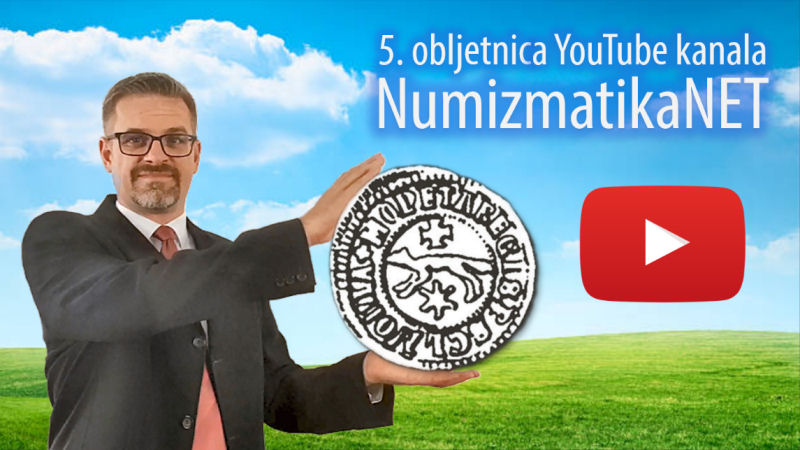
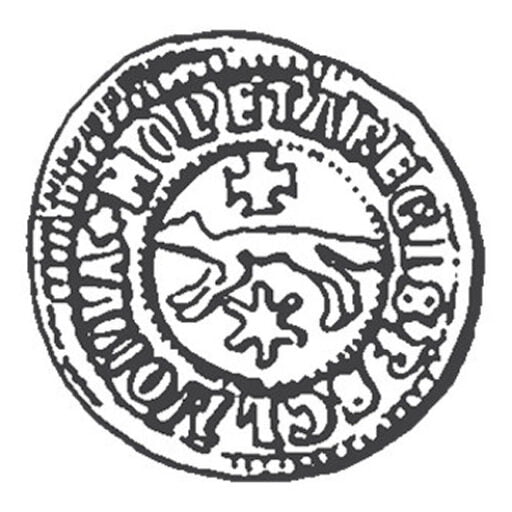
A few years ago, about ten kilometers north of Sremska Mitrovica, a previously unknown specimen of the Slavonian banovac denar was found. The general public was first introduced to this discovery in a paper published in Numismatic Bulletin, 106-107 (2009–2010), and the authors of the paper are Szilveszter Gerlovics and Ferenc Soós. Except for the mint mark, the reverse of this denar is identical to the denar minted for Duke Stephen of Anjou (1350, 1353–1354), which is attributed to Ban Nikola Banfi (1353–1356). The only known specimen of this denar found so far was discovered near Klisa and is kept in the collection of the Museum of Slavonia in Osijek. The reverses of both denars show a crowned helmet facing left, adorned with an ostrich head holding a horseshoe in its beak, with an ostrich feather on each side. This is the coat of arms of the Angevins, an identical depiction of which can be seen on Hungarian coinage as early as the reign of Charles Robert (1301–1342).1 On the specimen from the Museum of Slavonia, next to the helmet, there are the sigla nI-BA, which we read as: Nicolaus Banus, and on the newly discovered specimen, to the left and right of the helmet, are the initials P-E.
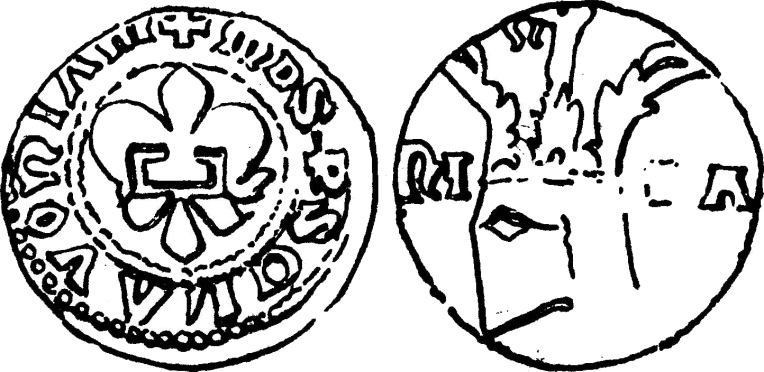
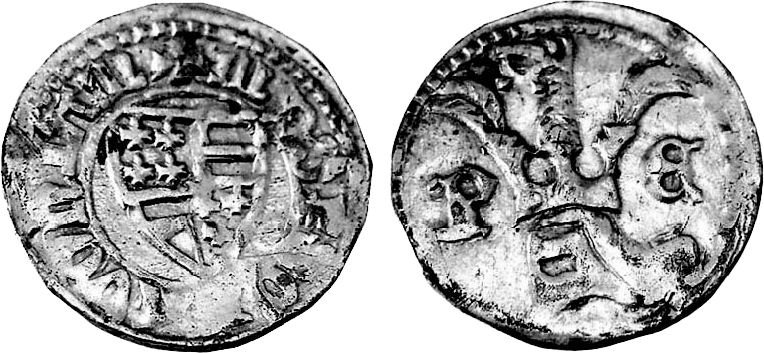
The legend on the face of that denarius undoubtedly confirms that it is a Slavonian banovac. It is also identical to the legend on the previously known specimen, which reads: M DS P SCLAVONIAM, which should be read as: Coinage of Duke Stephen for Slavonia – Duke Stjepan's coin for Slavonia.2
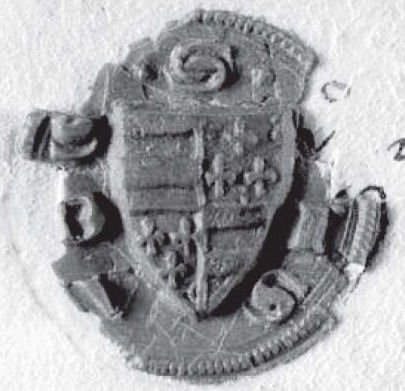
In the central field of the first denar there is a lily, a frequent symbol of the Angevins, while on the „new“ denar the central field is occupied by a coat of arms in the shape of a heart-shaped shield, divided into four fields. The upper left field of the shield is filled with four fleurs-de-lis, the lower right field with three fleurs-de-lis, and in the upper right and lower left fields are horizontal stripes representing the Hungarian coat of arms of the Arpads. The aforementioned authors identified this coat of arms as that of Duke Stjepan, and they did so on the basis of the wax seal of his charter dated August 12, 1350,3 which is kept in the county archive in Sopron. On the mentioned seal, the fields inside the shield are shown mirrored, or reversed.
The denarius has a diameter of 15 mm, which matches the denarius from the Museum of Slavonia, its weight is 0.59 g, and its silver fineness is about 800/1000.4
Since Duke Stephen appointed Nikola Banfi as the Ban of all Slavonia and Croatia in 1353, the denarius with the initials nI-BA must have been minted in that year, or at the latest in the following one. Assuming that the operation of the Slavonian mint did not change from its establishment until the time when Nikola minted his denarii—which implies that the mint operated from Martinmas (November 11) to the end of the year—we can date the aforementioned denarius quite precisely to 1353, since Duke Stephen died on September 9, 1354. Between the month of September and Martinmas, the die-makers had enough time to change the dies for the new denarii. Interestingly, we have proof of this practice, specifically regarding the minting period, from a contract in which Ban Nikola himself, during his first term as Ban (1343–1346), leases the Zagreb mint to Master Jakov for the period of one year.5 It should also be mentioned that this contract was concluded precisely on Martinmas, November 11, 1344.
To determine and date that newly discovered denarius, the mentioned authors proposed four theories.
According to the first theory, the authors date this coin to 1350, during the time of Ban Pavao Ugal, so the initials P-E would denote: initial P – Ban Pavao, and initial E – Elizabeth, the mother of Duke Stjepan and King Louis.
According to a second theory, the authors maintain that due to their exceptional rarity, both of Stjepan's denars were minted as commemorative coins on the occasion of his assumption of ducal authority. The third theory proceeds from the premise that Duke Stjepan, following the example of the monetary reforms of his brother Louis I, attempted to introduce a new monetary system in Slavonia. The final theory puts forward the assumption that the denar was minted starting in 1353, so the mint marks would represent: P – the mint master Petar Ligerius and E – Endre Kempelini, the chamber count of the Buda-Esztergom chamber.
At this point, I would first refer to the theories of the aforementioned authors that I personally consider less likely.
None of these denars has any specific details that would classify them as commemorative coins. None of them glorifies the title of archduke; on the contrary, it is only hinted at in the legend, where it appears as an abbreviation, and as such it remained unrecognized and unconnected to Archduke Stephen for a long time. The reverse of these denars is a common reverse also found on Hungarian denars. The obverse of Nicholas's denar, with the large fleur-de-lis in the central field, already appears on the denars of Charles Robert. The obverse of the newly discovered denar, with its heart-shaped shield, is also common on many Hungarian denars both before and after. Its distinctiveness stems solely from the specific nature of the coat of arms itself, or rather, the combination of its ornaments. The rarity of these specimens alone does not necessarily mean anything special. A future find could completely change this situation. Their rarity, as is the case with all other Slavonian ban's denars from the time of King Louis I, may be related to something that has no direct connection to the number of specimens minted, namely the situation in the kingdom and new monetary practices. Ludovik certainly needed money, due to the numerous wars he participated in, and across Europe at that. However, he was neither the first nor the last king to find himself in such a situation, nor was he the only one to resort to monetary reform at that time. As the absolute ruler of monetary policy, he could very easily take measures to generate greater revenue, which increased taxes; These included increasing the number of mints, which in turn generated greater profit; reducing the internal value, or quality, of the currency; increasing the exchange rate during the annual swap of old currency for new; and the like. Most of these measures were implemented through his reform. As always, such measures also provoked a wave of opposition, but he managed to impose most of the reforms in Hungary. The situation in Slavonia, however, was different. In 1350, Louis appointed Stephen as duke of all of Slavonia, Croatia, and Dalmatia. Herzeg Stephen remained in Buda because Louis was away. Stephen abandoned his hercogial duties that same year for another post, and did not return until 1353, when, once again as herzeg, he settled in Zagreb.6 The following year, in 1351, Louis issued a decree containing this provision in Article 12: „The chamber profit of our nobles between the rivers Drava and Sava, as well as the counties of Požega and Vukovo, are obliged to pay together with the other nobles of our realm. Therefore, they must not be disturbed from now on and in the future regarding the tax of marten blood, commonly called the ban's tax, but rather they are completely free from the collection of any other taxes that were hitherto paid, like our other nobles in other parts.“7
From the decree it is evident that Louis's intention was to abolish all banovac dues in Slavonia, namely the marten tax, which at the time amounted to 12 denars, and the seven-denar tax, which totaled 19 denars annually, and to replace them with the tax of the Royal Chamber (mint), which amounted to 18 denars annually. Naturally, this reform implied the abolition of the ban's or duke's chamber and mint. This would have led to a tax reduction, but that did not happen, as we can see from a document dated July 25, 1364. In it, the king asks Stephen, the Bishop of Zagreb and also the vicar general of all Slavonia, to mediate on his behalf so that the unified royal currency would be accepted in Slavonia.8 That he did not succeed is proven by the decree of Queen Mary, who only in 1384 abolished the Slavonian banovac denars and had royal coins minted in the Zagreb mint under the supervision of Master Simun de Talentis and the Frenchman Aczom.9
It is obvious that during those 20 years some money had to be in circulation within Slavonia, and undoubtedly it was the Slavonian banovac denar, but today not a single such specimen is known to us. All of the above leads to the conclusion that something in monetary policy changed. From the composition of all previous hoards of Slavonian banovac denars, with the exception of the find of denars attributed to Nikola Omodejev, we see that different types of denars were represented, often with a difference in age of up to twenty years. In Hungary, the mandatory replacement of old money with newly minted money was prescribed by law, while in Slavonia the so-called seven-denar tax was in effect, which brought income to the chamber without the need for a constant reduction in the quality of money (silver purity) in order to profit from the currency change. Thus, in Slavonia it was not necessary to change money every year, so the money remained in use longer, and this indirectly preserved confidence in the currency.
Therefore, multi-year types appear in the coin hoards of Slavonian banovci because they were in circulation on an equal footing. It is difficult to say whether some of Louis's monetary reforms led to a change in this practice, such as the abolition of the seven-denar tax, or, as we have already mentioned, the leasing of mints to guild masters, who then encouraged the compulsory exchange of money every year in order to obtain „cheap“ raw material for minting new coins. By doing so, we have also expressed our opinion on the third theory of the aforementioned work, in which the authors assume that these denars could have been trial strikes of Duke Stephen, with which he monitored the monetary reform of his brother Louis and wanted to introduce a new monetary system in Slavonia. As we have seen, an attempt at monetary reform in Slavonia had not been implemented even a decade later.
I think the authors are on the right track with the remaining two theories. Since the Zagreb mint had been leased out for about a decade by that time, it can be assumed that, following the Hungarian example, some of the chamber counts and masters of the mint placed their initials as mintmarks on the denars they struck. This should not be viewed as self-promotion, but rather as an obligation imposed by the ruler, since mintmarks can be compared to the signatures of responsible persons who must guarantee the strictly specified quality and quantity of the coin. It is necessary to examine whether these are indeed the individuals named by the authors.
Of all the mentioned theories, I think the one with the firmest foundation is the theory that the newly discovered type of denar was minted by Ban Pavao Ugal. In 1350, King Louis, by appointing his brother Stephen as duke, re-established the institution of the Slavonian ducat. In the same year, Duke Stephen appointed Pavao Ugal, his loyal protonotary and judge of the royal court, as Ban of Slavonia and Croatia.10 That Stjepan had trust in Ban Pavao can be seen from the document of August 22, 1350, in which the ban, at the king's court, carries out the assessment of the authenticity of a certain document in a lawsuit.11 His diplomatic service is certainly the reason why there are few of his ban's documents. We have already mentioned that the seal of Duke Stjepan from 1350 features a coat of arms identical to the one shown on the obverse of the newly discovered Slavonian ban's denar, unlike the denar minted for Ban Nikola, which in a way dates that denar closer to 1350. It is worth noting that this would in a way also preserve the tradition according to which the denarii bore the initials of the ban for whom the money was minted, in this case Ban Pavao Ugal. The initial E, which according to that theory would represent Elizabeth, the mother of Duke Stjepan, also makes sense, since both Stjepan and Ludovik were absent at that time. In any case, the answer to the question of who minted this newly found type of denar – which after a long time definitely increases the collection of Croatian numismatics – requires further research.
The author thanks Mr. Szilveszter Gerlovics for providing the photograph and granting permission to publish it in this paper.
Notes
1. Truhelka, Ćiro, Slavonski banovci, p. 86.
2 Ć. Truhelka misinterpreted this as: Moneta DuciS Per Sclavoniam, Slavonski banovci, p. 85.
3 Gerlovics, Szilveszter / Soós, Ferenc, Slavonian Coins of Duke Stephen Anjou, nos. 2–3.
4 Ibid., p. 6.
5 The contract was extended for the following years as well, see: Truhelka, Ćiro, Slavonski banovci, pp. 21–22, 156.
6 Horvat, Rudolf, “History of Croatia: Book I: From the Oldest Times to the Year 1657”, Zagreb, 1924, p. 115.
7 Klaić, Vjekoslav, History of Croats, vol. 3, pp. 32–33.
8 Truhelka, Ćiro, Slavonski banovci, p. 23.
9 Ibid., p. 24.
10 Codex Diplomaticus of the Kingdom of Croatia, Dalmatia and Slavonia: vol. 11, doc. 490, pp. 592-594, see also: Hálasz, Éva B., Diplomatička analiza isprava slavonskih banova u razdoblju od 1323. do 1381. godine, Zbornik OPZ HAZU, 27 (2009), p. 47.
11 Ista, p. 55.
Literature and sources
Diplomatic Collection of the Kingdom of Croatia, Dalmatia and Slavonia / Codex diplomaticus Regni Croatiae, Dalmatiae et Slavoniae, vol. 11, Zagreb, 1913.
Dolenec, Irislav, Croatian numismatics from the beginning to the present day, Zagreb.
Gerlovics, Szilveszter / Soós, Ferenc, The Slavonian Coins of Duke Stephen of Anjou, Numizmatikai Közlöny, CVI-CVII, Budapest, (2009-2010).
Answer, Éva B., Diplomatic analysis of the charters of the Bans of Slavonia in the period from 1323 to 1381, Proceedings of the Department of Historical and Social Sciences of the Croatian Academy of Sciences and Arts, No. 27, Zagreb (2009).
Horvat, Rudolf, History of Croatia: Book I: From the Earliest Times to the Year 1657, Zagreb, 1924. Klaić, Nada, History of Croats in the Middle Ages, Zagreb, 1990.
Klaić, Vjekoslav, History of Croats, Vol. 3, Zagreb, 1981. Rengjeo, Ivan, Corpus of Medieval Coins of Croatia, Slavonia, Dalmatia, and Bosnia, Graz, 1959.
Székely, György V., Slavonian banate coinage, Dissertationes archaeologicae, Ser. II No. 8., Budapest, 1980.
Truhelka, Ćiro, Slavonian Banovci, Herald of the State Museum, Sarajevo, 1897.
Author: Robert Smajlagić
Source: Numismatic News, issue 65, Zagreb, 2012.
The article was published in Numismatic News as an original scientific paper and is reproduced here with the author's permission, for which we thank him.