One of the beauties of engaging in numismatics is that it broadens our horizons, not only in terms of knowing the coins (and banknotes) themselves, but also through learning about the history, geography, and culture of various parts of the world. A numismatist very quickly realizes that money is not just a medium of exchange, but also a sort of historical document.
In numismatic and especially collector circles, so-called exotic countries—meaning states and political entities that the general public has often never even heard of—are particularly interesting. Such environments frequently hide very interesting and visually attractive coins. One such example is the Federation of Rhodesia and Nyasaland.
A brief overview of the Federation of Rhodesia and Nyasaland
The Federation of Rhodesia and Nyasaland was a colonial entity in Africa that existed from 1953 to 1963. It consisted of three British territories: Southern Rhodesia (today's Zimbabwe), Northern Rhodesia (today's Zambia), and Nyasaland (today's Malawi). The idea of connecting these areas was based on their economic interconnectedness and the desire for joint development.
The Federation was officially established on August 1, 1953, and had a joint federal government, although individual territories retained a certain degree of autonomy. Initially, the project was economically successful, thanks in particular to mineral wealth, such as copper in Northern Rhodesia.
However, political tensions soon came to the fore. The main problem was the relationship between the white minority, which held political power, and the majority African population, which was demanding greater rights and self-government. During the 1950s, African nationalism and demands for independence grew stronger, and this also affected the stability of this African federation.
Under the pressure of internal unrest and the international community, the federation began to dissolve in the early 1960s. Nyasaland and Northern Rhodesia were granted the right to secede, and the federation officially ceased to exist on December 31, 1963. Shortly thereafter, the independent states of Malawi and Zambia were created, while Southern Rhodesia embarked on its own, significantly more complex political path.
Despite its short duration, this federation left an interesting mark in numismatics through its own currency, which is today a subject of interest for numismatists and collectors.
In this article, we present three coins, the three smallest denominations from this country.
1/2 penny 1958
The 1958 half-penny coin is one of the more recognizable bronze small denominations of the Federation of Rhodesia and Nyasaland. It is made of bronze, with a weight of 2.92 grams, a diameter of 21 mm, and a thickness of 1.25 mm. It is round in shape, featuring a round hole in the center, and is machine-struck, with a smooth edge and in medal alignment. It was minted at the Royal Mint in Tower Hill, London.
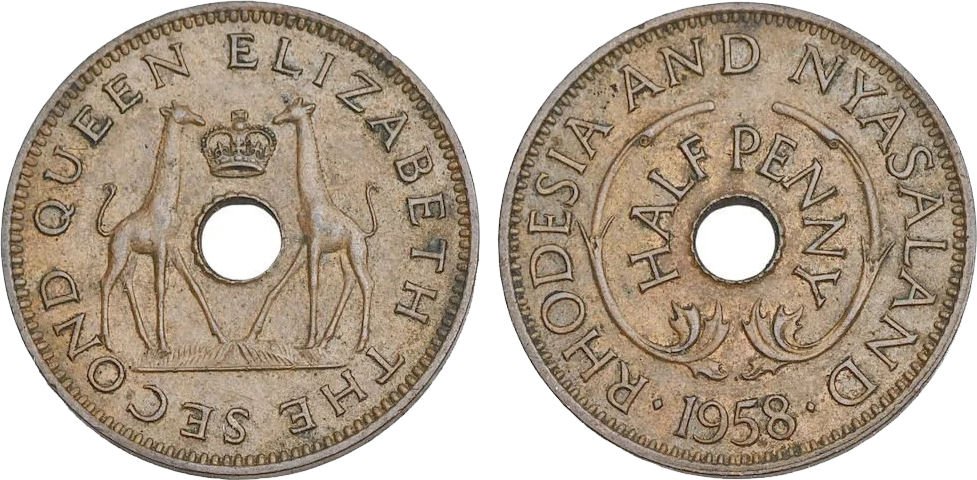
The face of the coin depicts two giraffes facing each other. There is a hole in the middle, and a crown is located above the hole. Along the edge, the inscription „QUEEN ELIZABETH THE SECOND“ is written.
On the reverse side is the country name „RHODESIA AND NYASALAND“, while the inner part, around the hole, bears the denomination „HALF PENNY“. The composition is complemented by floral ornaments, and at the bottom is the year 1958. The design is very harmonious and decorative, and the opening in the center gives the coin an extra uniqueness and ease of recognition.
The author of the artistic design for the obverse and reverse was Bernard Sindall.
For the year 1958, a mintage of 2,400,000 pieces for regular circulation was recorded. Precisely because of its relatively high mintage, this type is not rare, but it is of interest among collectors due to its attractive depiction of giraffes and its characteristic colonial African motif. This coin is a good example of how even the smallest denominations in this country had a very appealing and symbolic design.
1 penny 1957
A 1957 one-penny coin belongs to the basic bronze circulation coins of the Federation of Rhodesia and Nyasaland. The coin is made of bronze, with a mass of 6.48 grams, a diameter of 27 mm, and a thickness of 1.68 mm. Like the halfpenny, this coin is also round with a hole in the center, featuring a plain edge and coin alignment. It was also minted at the Royal Mint in Tower Hill, London.
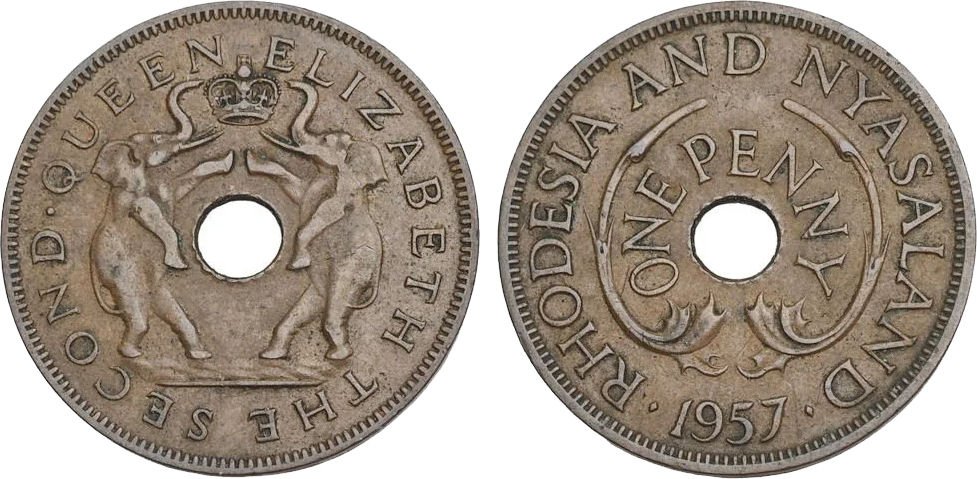
On the obverse are depicted two elephants rearing up on their hind legs, facing each other, with a hole between them. The elephants are holding a royal crown with their tusks and trunks. Along the rim is the inscription „QUEEN ELIZABETH THE SECOND“. The motif of the elephants is very striking and fits well with the African identity of this short-lived federation.
On the reverse, along the outer edge, is the name of the country „RHODESIA AND NYASALAND“, while the inscription „ONE PENNY“ is located around the central hole. Around the denomination are floral decorations, and at the bottom is the year 1957.
The designer of both the obverse and reverse was Bernard Sindall, so the coin clearly displays a unified and harmonious artistic approach, just like the ½ penny.
For the year 1957, the one-penny coin was issued in a large mintage of 7,200,000 pieces, making it one of the more common years of this type. Interestingly, two obverse variants, or two die types, are known for this denomination, which may be of additional interest to specialized collectors. Although not rare, this coin is very attractive due to the strong motif of elephants and the characteristic holed design for which the bronze denominations of this federation are particularly famous.
3 pence 1956
The three-pence coin from 1956 differs from the previous two in both its material and its overall artistic design. It is made of cupronickel, with a mass of 1.41 grams, a diameter of 16.3 mm, and a thickness of 0.92 mm. It is round in shape, without a central hole, with a smooth edge and in medal alignment. It was also minted at the Royal Mint, Tower Hill, London.
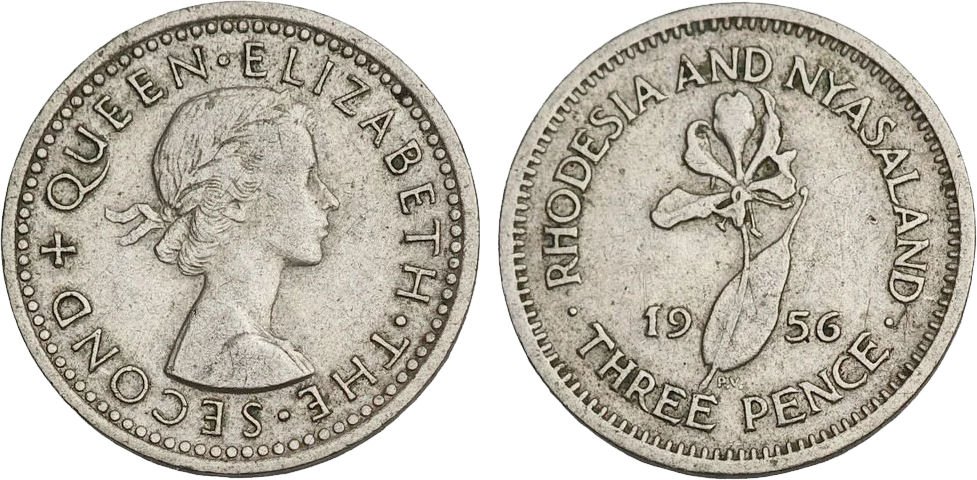
On the obverse is a portrait of the young Queen Elizabeth II facing right, along with the inscription „QUEEN ELIZABETH THE SECOND“. The author of the portrait and the obverse of the coin is the renowned British medallist Mary Gillick. This is the first portrait of Elizabeth II that appeared on numerous Commonwealth coins in the 1950s.
The reverse depicts a Flame Lily, which shares the year of minting, so the digits 19 and 56 are located to the left and right of the motif. Above is the inscription of the country name „RHODESIA AND NYASALAND“, and below is the denomination „THREE PENCE“. Also next to the motif are the initials P.V., which indicate the author of the reverse, the sculptor and medallist Paul Vincze.
For 1956, this coin was minted in a mintage of 3,200,000 pieces for regular circulation. Although not rare, it is very interesting because it features an elegant portrait of the queen on a smaller format and a very nice floral motif on the reverse. Unlike the bronze coins with a hole, this denomination looks more classical and formal, yet still carries the recognizable identity of the country.
Conclusion
Coins of the Federation of Rhodesia and Nyasaland are a fine example of how numismatics brings together art, history, and geography. Although the federation itself existed for only ten years, it left behind a series of very interesting and visually appealing coins.
For numismatists and collectors, especially those who enjoy thematic collecting or exotic countries, these coins represent an excellent blend of accessibility and attractiveness. Such specimens are often the best reminder that behind every coin lies a story—sometimes short, but always worth exploring.
Author: Zlatko Viščević
Photos: Numex.hr