



The paper examines the variants of the new vižlin from 1751, which is the first year of minting this type of coin. A total of nine coins are examined, six of them for the first time.
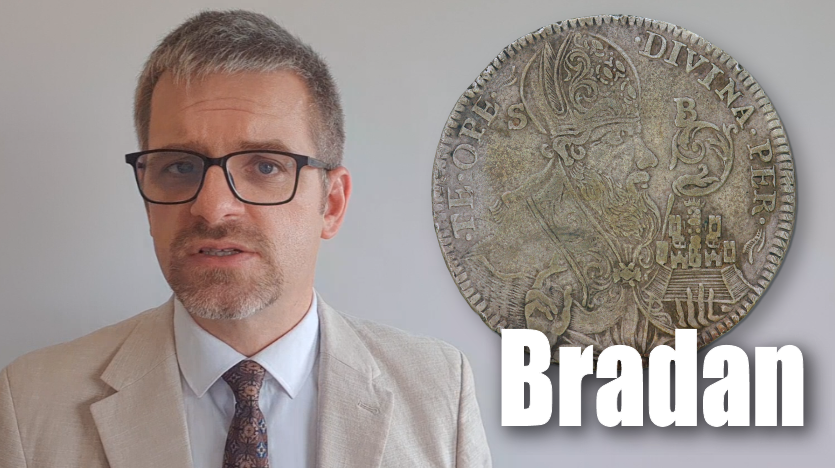
It is not precisely known by which decision the Senate of the Republic of Ragusa decided to mint thalers. A decision dated May 14, 1725, states that the minting of „the new thaler coin in the manner, with the shape, and for the time that will be stated hereafter“ should be continued. Those first Ragusan thalers were bradans. The first known bradan is the one from 1725. They were also minted in 1730, 1731, 1733, 1734, 1735, 1736, 1738, and 1743. Whether the bradan was minted even before 1725 is not known for now, and since the decision states „that it be continued to mint...„, it is not impossible either.
By a decision of the Senate on April 2, 1743, the type of the Ragusan taler was changed, where on the obverse, instead of the figure of St. Blaise, an imaginary figure of the rector appears, and the inscription is changed. By this decision, the mint masters mint talers „with the known new type and inscription,“ with the same alloy and weight as the taler last minted (the bradan from 1743), and they may mint as many as requested of them. From this, it is evident that this new taler, the old vižlin, was not minted for the state account, but for private individuals and merchants who would bring silver to the mint. The old vižlin was minted every year from 1743 to 1748. In the middle of 1748, the mint no longer made a profit from minting talers, and the value and exchange rate of the taler fell. Because of this, the Senate, by an order of July 19, 1748, abolished the minting of the old vižlin.
After conditions improved, by a decision of June 10, 1750, it was ordered that new money—the new vižlin—be minted from 100 liters of pure silver. However, it seems that nothing was minted in 1750, and minting began in 1751. The new vižlin was minted every year from 1751 to 1779.
The new vizlin from 1751 is an extremely rare coin. It was minted in two variants.
1. Variant:
Obverse: the Rector's bust to the left under a large wig falling onto his shoulders, draped in a ducal mantle and with a wide ducal sash descending from his left shoulder down his chest. Around, the inscription: RECTOR•REIP• – RHACVSIN •
Back the coat of arms of Dubrovnik, as it appears on old *vižlini* (small Venetian coins), beneath the ducal crown where the ducal cap is clearly visible above the closed rim, and as adornment above the rim five flowers, with a spike between each bearing two vertically placed pearls. Around it the inscription: DVCAT•ET•SEM• – •REIP•RHAC•1751
2. Variant:
Obverse: exactly the same as in the 1st variant
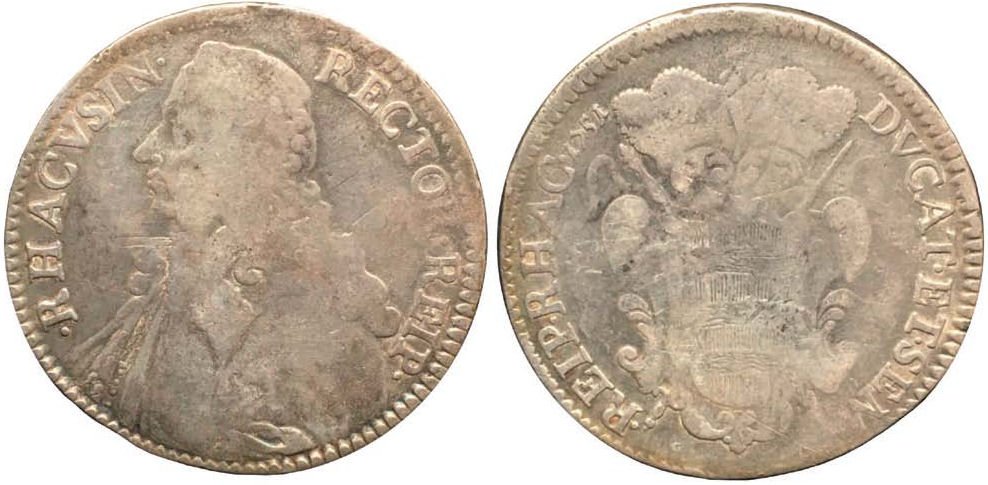
Back exactly the same as the first variant, except that a ribbon hangs down from the crown to the left and right along the coat of arms, and under the coat of arms is the die-cutter's signature G – B (Giovanni Bettinelli)
Rešetar discusses only two copies of the first variant and one copy of the second variant. All other recent authors generally do not bring anything new. My collection contains six copies of the first variant and three copies of the second variant, and I considered it worthwhile to publish this.
Rešetar, p. 448
1.1. Obverse: bust of the rector to the left under a large wig falling onto his shoulders, draped in a ducal mantle and with a wide ducal sash descending from his left shoulder down his chest. Around, the inscription: RECTO•REIP• – •RHACVSIN •
Back Dubrovnik coat of arms, as it is also on old vislins, and under the ducal crown where the ducal cap is clearly visible above the closed rim, and as an ornament above the rim five flowers, and between them one spike each with two vertically placed pearls. Around it the inscription: DVCAT•ET•SEM• – •REIP•RHAG•1751
Rešetar, on the obverse RECTO, and not RECTOR as in all other known specimens
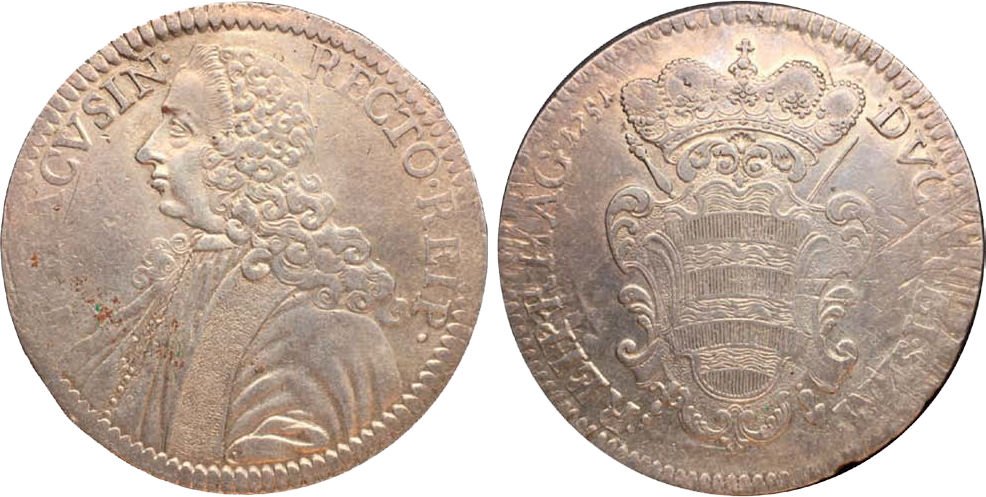
1.2. Obverse: Bust of the Rector to the left, wearing a large wig falling onto his shoulders, draped in a ducal mantle with a wide ducal sash descending from his left shoulder down his chest. Around, the inscription: RECTOR•REI• – •RHACVSIN •
Back Dubrovnik coat of arms, as it is also on old vislins, and under the ducal crown where the ducal cap is clearly visible above the closed rim, and as an ornament above the rim five flowers, and between them one spike each with two vertically placed pearls. Around it the inscription: DVCAT•ET•SEM• – •REIP•RHAG•1751
Rešetar 2684
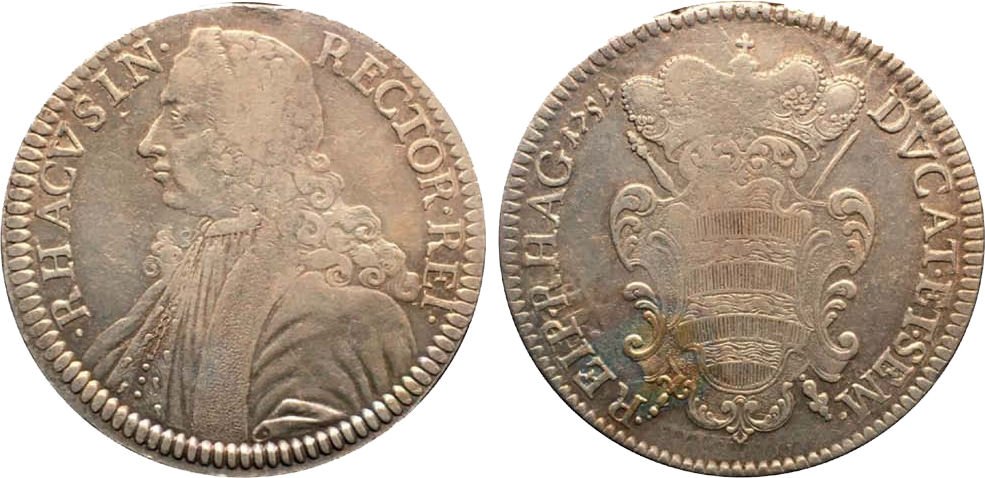
1.3. Obverse: the Rector's bust to the left under a large wig falling onto his shoulders, draped in a ducal mantle and with a wide ducal sash descending from his left shoulder down his chest. Around, the inscription: RECTOR•REIP• – RHACVSIN •
Back Dubrovnik coat of arms, as it is also on old vislins, and under the ducal crown where the ducal cap is clearly visible above the closed rim, and as an ornament above the rim five flowers, and between them one spike each with two vertically placed pearls. Around it the inscription: DVCAT•ET•SEM• – •REIP•RHAG•1751
Reshetar 2685
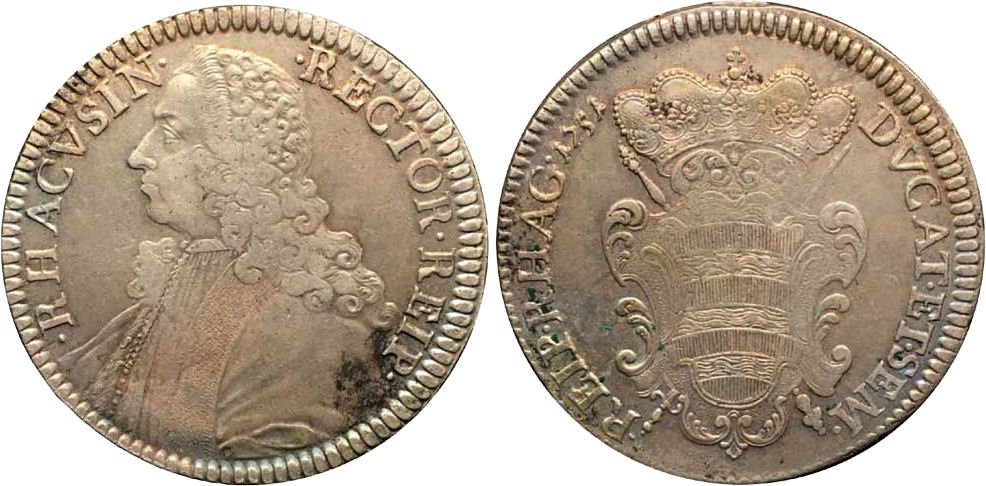
1.4. Obverse: bust of the rector to the left under a large wig falling onto his shoulders, draped in a ducal mantle and with a wide ducal sash descending from his left shoulder down his chest. Around, the inscription: RECTO•REIP• – •RHACVSIN •
Back the coat of arms of Dubrovnik, as it appears on old *vižlini* (small Venetian coins), beneath the ducal crown where the ducal cap is clearly visible above the closed rim, and as adornment above the rim five flowers, with a spike between each bearing two vertically placed pearls. Around it the inscription: DVCAT•ET•SEM• – •REIP•RHAC•1751
Rešetar, obverse a different die than the previous two, on the reverse RHAC and not RHAG as in the previous two.
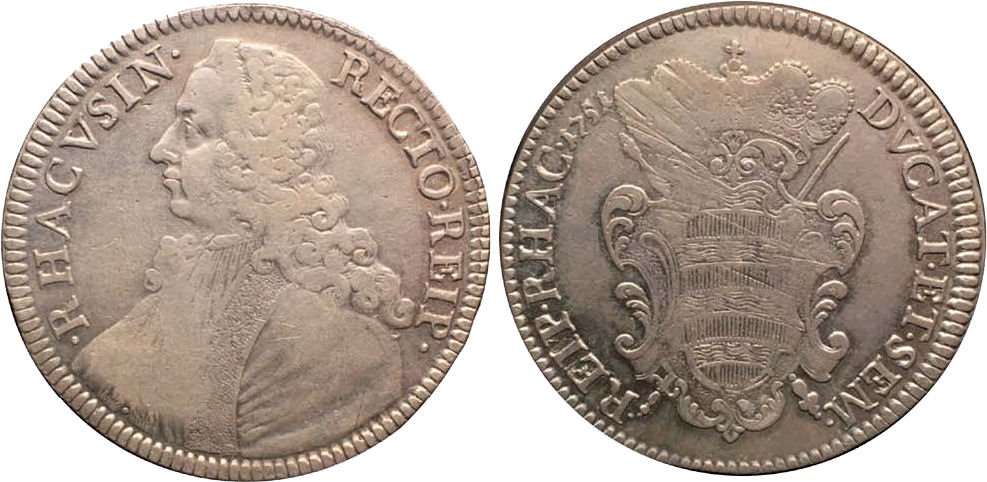
1.5. Obverse: bust of the Rector to the left, wearing a large wig falling to his shoulders, draped in a ducal mantle and with a wide ducal sash descending from his left shoulder down his chest. Around, the inscription: RECTOR•REIP• – •RHACVSIN •
Back the coat of arms of Dubrovnik, as it appears on old *vižlini* (small Venetian coins), beneath the ducal crown where the ducal cap is clearly visible above the closed rim, and as adornment above the rim five flowers, with a spike between each bearing two vertically placed pearls. Around it the inscription: DVCAT•ET•SEM• – •REIP•RHAC•1751
Rešetar, obverse different from 1.3 and 1.4; on the reverse, the year 1751 is significantly larger than on other specimens.
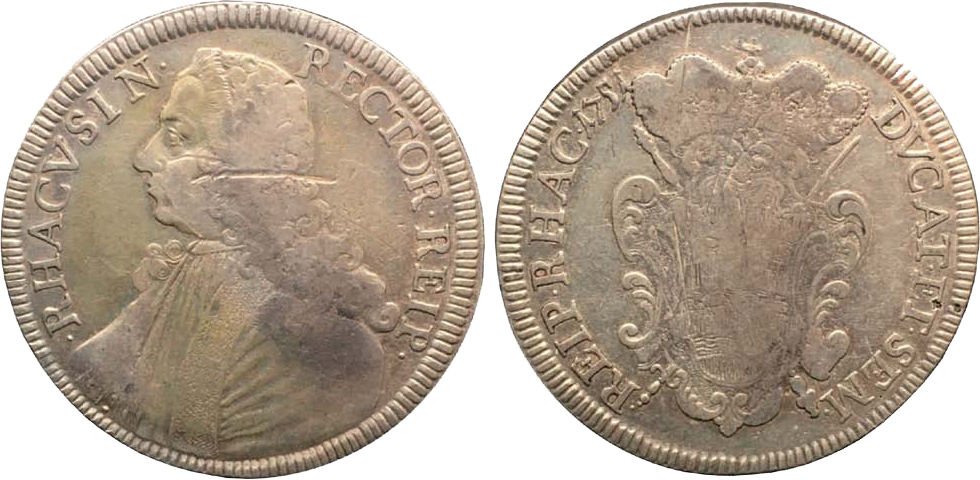
1.6. Obverse: bust of the Rector to the left, wearing a large wig falling to his shoulders, draped in a ducal mantle and with a wide ducal sash descending from his left shoulder down his chest. Around, the inscription: RECTOR•REIP• – •RHACVSIN •
Back Dubrovnik coat of arms, as found on old vislins [small gold coins], under a ducal crown where the ducal cap is clearly visible above the closed rim, and as ornamentation above the rim five flowers, each separated by a spike with two vertically placed pearl grains. Around the inscription: DVCAT•ET SEM• – •REIP•RHAC•1751
Rešetar, obverse different from 1.3-1.5; on the reverse there is no dot between ET and SEM
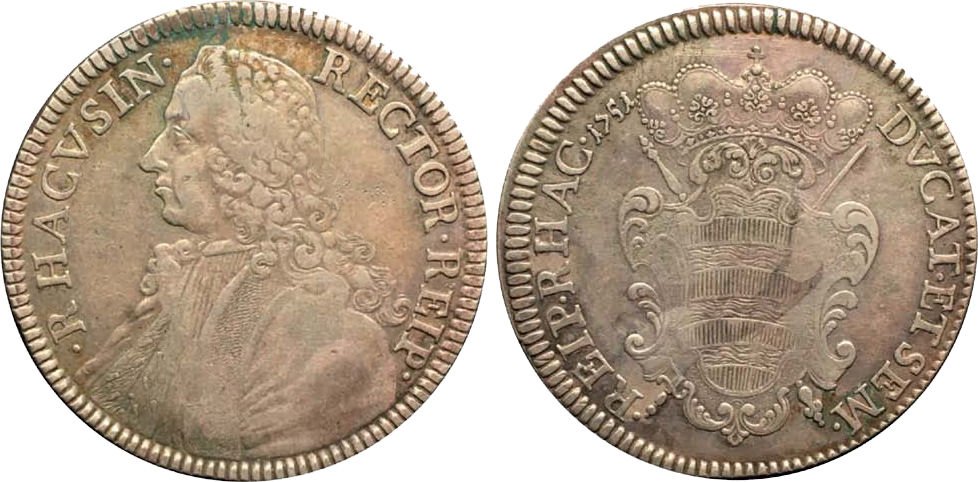
2.1. Obverse: bust of the rector to the left under a large wig falling onto his shoulders, draped in a ducal mantle and with a wide ducal sash descending from his left shoulder down his chest. Around, the inscription: RECTO•REIP• – •RHACVSIN •
Back the coat of arms of Dubrovnik, as it is also on old vislins, and under the ducal crown where above the closed rim the ducal cap is clearly visible, and as an ornament above the rim five flowers, and between each a spike with two vertically positioned pearl grains. From the crown, to the left and right, a ribbon descends down each side of the coat of arms. Below the coat of arms is the signature of the mold maker G – B. Around the inscription: DVCAT•ET SEM• – •REIP•RHAC•1751 G B
Reshetar, obverse same die as 1.4.
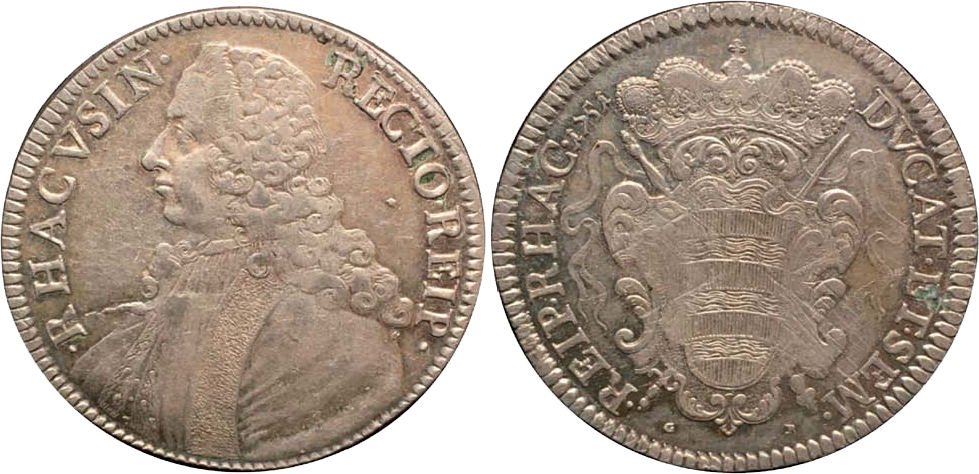
2.2. Obverse: bust of the Rector to the left, wearing a large wig falling to his shoulders, draped in a ducal mantle and with a wide ducal sash descending from his left shoulder down his chest. Around, the inscription: RECTOR•REIP• – •RHACVSIN •
Back Dubrovnik coat of arms, as it is on old vizlins, and under the ducal crown above whose closed rim the ducal cap is clearly visible, and as an ornament above the rim five flowers, and between each a spike with two vertically positioned pearl beads. From the crown, left and right, a ribbon descends down the coat of arms on each side. Below the coat of arms is the mold maker's signature G – B. Around the inscription: DVCAT•ET SEM• – •REIP•RHAC•1751 G B
Rešetar 2686
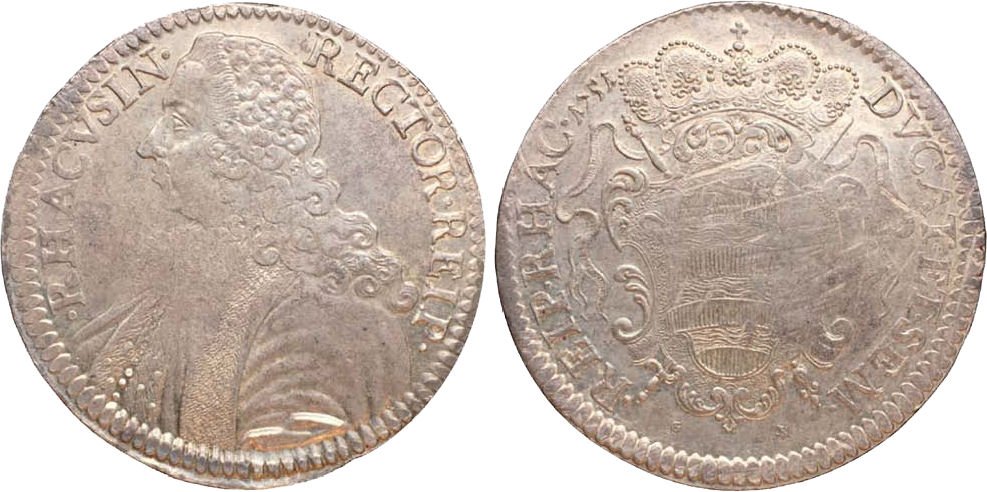
2.3. Obverse: bust of the Rector to the left, wearing a large wig falling to his shoulders, draped in a ducal mantle and with a wide ducal sash descending from his left shoulder down his chest. Around, the inscription: RECTOR•REIP• – •RHACVSIN •
Back Dubrovnik coat of arms, as it is on old vizlins, and under the ducal crown above whose closed rim the ducal cap is clearly visible, and as an ornament above the rim five flowers, and between each a spike with two vertically positioned pearl beads. From the crown, left and right, a ribbon descends down the coat of arms on each side. Below the coat of arms is the mold maker's signature G – B. Around the inscription: DVCAT•ET SEM• – •REIP•RHAC•1751 G B
Rešetar, obverse different die than 2.2, reverse same die as 2.2.
Literature:
Barac, Borna, Reference Catalogue Coins and Medals of Ragusa, Zagreb, 2015.
Dolenec, Irislav, Croatian Numismatics, Zagreb, 1993.
Mimica, Bože, Numismatic History of Dubrovnik, Rijeka, 1994.
Pierucci, Paola, The Gateway to the East, Dubrovnik, 2001.
Rešetar, Milan, Dubrovnik Numismatics I, II; Sremski Karlovci – Zemun, 1924–1925.
Viščević, Zlatko, The Coinage of the Republic of Dubrovnik, Kastav, 2018.
Author: Marko Šarinić
Source: Numizmatičke vijesti, number 75, Zagreb, 2022.
The article was published in Numismatic News as a professional paper and is reprinted here with the author's permission, for which we thank him.