



Are there 5,440 unissued copies of the 500 dinar banknote dated May 6, 1939?
More than 67 years have passed since the creation and disappearance of the greatest enigma of Yugoslav paper money history: the 500 dinar banknote of the National Bank of the Kingdom of Yugoslavia dated May 6, 1939. To this day, despite many stories, there is talk of only one known specimen of this banknote, which is in the collection of an owner whose name, for understandable reasons, will not be mentioned. Apart from that specimen, whose existence is known for a fact, no one has found any other „surviving“ specimen of this exceptionally beautiful banknote, the existence of which was swept away by the whirlwind of war like no other in the history of not only monarchist, but also communist Yugoslavia.
The banknote was created just before the end of the existence of the Kingdom of Yugoslavia, at a time when unity, in a state fraught with economic, political, and interethnic problems and already quite eroded, was necessary for its survival in the dangerous times of war that had already deeply engulfed Europe.
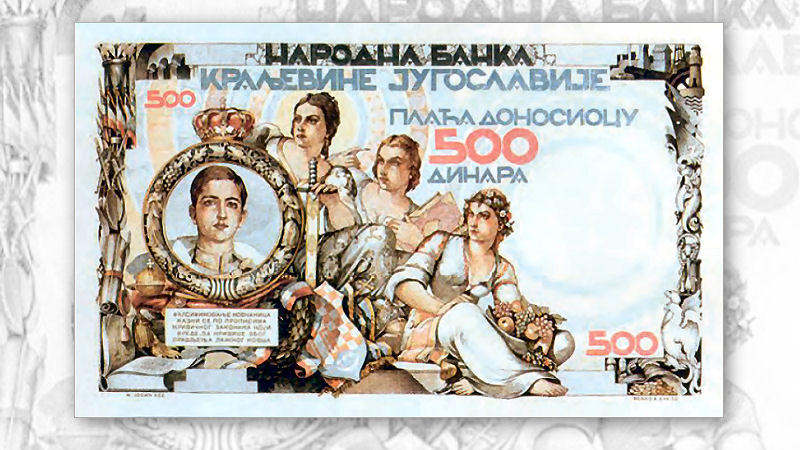
It was created with obvious great symbolism, i.e., the aspiration toward the unity of the key nations of Yugoslavia: Serbs, Croats, and Slovenes. Monarchical and state-building motifs are emphasized (the figure of the king, state flags, and coats of arms), along with the figures of three idealized young girls who, as “SHS" symbols of a Serb woman, a Croat woman, and a Slovene woman, benevolently observe the (artistically quite successfully rendered) figure of King Peter II. It is dated May 6, 1939, and signed by Governor Dr. Ivo Belin and Board Member Dr. Dragutin K. Protić. The authors of the graphic, that is, the engravers, are M. Jošić and Veljko A. Kun, who, without exaggeration, excelled with this banknote in their already refined and proven high-quality work. It is also worth noting that in international collecting circles, the beauty of this banknote is very often mentioned.
Here is what this beautiful banknote looked like (finished print, but without date, signatures, and numbering).
Its existence, however, became known relatively quickly, but not during the Kingdom of Yugoslavia, but only after the establishment of independent Serbia as an administrative unit under German military administration. It appeared in circulation, but as a provisional banknote of 1000 Serbian dinars dated May 1, 1941, issued by the Serbian National Bank.
So what actually happened? There is no answer to this question anywhere in the available literature. However, from the sequence of historical events and the available information about the first days of operation of the Serbian National Bank, a picture of the events can be formed. Therefore, we should start from the summer of 1941, and only then go back to sometime in the summer of 1940.
Thus, shortly after the establishment of military rule in Serbia, Germany also installed a domestic civil administration loyal to it. Money and monetary circulation, as the basis of control over any society, were among the first steps taken by the new authorities.
Thus, as early as April 30, 1941, exactly 12 days after the capitulation and the de facto “abolition„ of the Kingdom of Yugoslavia, the governor and the German military commander for Serbia of the legally still non-existent Serbian National Bank made a decision “that, for the purpose of exchanging Yugoslav banknotes for SNB banknotes in the territory of the German military commander for Serbia, the production of SNB banknotes in denominations of 1000, 100, and 10 dinars shall commence...„ (from the book “Money of Yugoslavia during World War II" by Miodrag Ugričić), primarily because a certain quantity of pre-war Yugoslav banknotes was held in stock at the State Printing Office (ZIN), both finished ones and those in various stages of production. From this stock, the provisional 100 Serbian dinars banknote was created first (by a black overprint on both sides of the fully manufactured 100 dinars banknote of December 1, 1929), followed by the provisional 10 Serbian dinars banknote (by a black overprint on the fully manufactured reverse of the 10 dinars of September 22, 1939, while the obverse was unmanufactured, i.e., blank paper, and was thus printed in the original colors with a new motif).

A different solution had to be found for the provisional 1000 Serbian dinar banknote, because the 1000 dinar notes of December 1, 1931, or September 6, 1935 (the unissued stock of both mentioned editions was mostly burned in the Trebjesa cave near Nikšić in Montenegro) were not available. However, a certain quantity of the fully manufactured 500 dinar banknote of May 6, 1939, was found immediately before the war, which had neither been issued nor managed to be evacuated in time from outside Belgrade with the other banknotes of the National Bank of the Kingdom of Yugoslavia. And so, by simply black overprinting on the 500 dinars of May 6, 1939, the 1000 Serbian dinar banknote of May 1, 1941, was created, put into circulation on June 4, 1941, which indicates that the work on finalizing the provisional issue took only one month.
It can be said with a high degree of certainty that the 500-dinar banknote is the last in the series of so-called „reserve“ banknotes planned and produced during the time of the Kingdom. Every circulating denomination (let us not forget that until the beginning of the war only 3 denominations were in circulation, namely 100, 500, and 1000 dinars) had its own „reserve“ denomination, so the 100-dinar circulating banknote from December 1, 1929, had a „reserve“ dated July 15, 1934, and the 1000-dinar one from December 1, 1931, had a „reserve“ dated September 6, 1935, so it is logical that a „reserve“ was also planned for the 500-dinar circulating banknote of September 6, 1935.
Of the other „reserve“ banknotes for the 500-dinar enigma of May 6, 1939, the only significant one is the 10-dinar banknote issued on April 8, 1941 – why was that one issued and not the 500-dinar one, considering the 10-dinar note bears a later date? A logical answer could be this: the 10-dinar banknote of September 22, 1939, was produced „in a hurry“ (which is evident from the rather simple design, as well as the thick and lower-quality paper, but primarily from the urgent need for such a small denomination to withdraw the 20- and 50-dinar silver coins minted in 1938 from circulation), whereas the 500-dinar banknote of May 6, 1939, was produced on high-quality paper with high-quality graphics, which took time.
Thus, the following facts can be established with a very high degree of certainty:
- The decision to draft it was made in 1939, perhaps even on that date, May 6;
- The final graphic layout was accepted no earlier than the summer/autumn of 1940;
- The engraving matrix was made no earlier than the beginning of 1941;
- Production began at least a month before the start of the war.;
- By the outbreak of the war, a certain amount of banknotes had been completely produced, bearing the date, signature, and numbering.
The final claim, that a certain quantity had been manufactured by the beginning of the war, can be made with a clear conscience and absolute certainty. The next major question is how many pieces had been produced by then? Although this is officially not known, nor is it known how many pieces were converted per month (from April 30, 1941, to June 4, 1941) into 1,000 Serbian dinars on May 1, 1941, from data on the circulation structure of this now provisional 1,000 Serbian dinar banknote on October 20, 1944, when Belgrade was captured by the partisans, it is known that a total of 6,019,560 copies were in circulation on that day. This data also corresponds to the factual situation, because banknote findings today show serial numbers no higher than series 0241 as the highest the author has observed so far.
However, this raises a major and crucial question: if 241 series were produced, meaning from series 0001 to series 0241 (each series contains 25,000 copies marked with 25 Cyrillic letters, and each letter contains 1,000 copies), that is a total of 6,025,000 copies, provided that the last 241st series was also produced in all 25 letters, with each letter having 1,000 copies. This would mean that there is a difference between the number of produced copies and the number of overprinted copies of 5,440 pieces!!! 6,019,560 pieces were overprinted, and 6,025,000 pieces were produced.
Does that difference of 5,440 copies exist, and where is it located, has it been saved, is it hidden at the home of the heir of some former ZIN official without them even knowing it? There are many questions, and not a single answer.
From the available data on other produced banknotes, it can be stated that the series for most specimens are not „completed,“ i.e., the last series was not produced down to the last specimen, and likewise, the data in the available literature are often incomplete and inaccurate. For example, for the 1000 dinar banknote of December 1931, literature states that 10 to 11,000,000 pieces were produced (from the book „Money of the Kingdom of Yugoslavia“ by J. Hadži-Pešić, which the author based on the quantity of paper procured for the production of that banknote, but the data is obviously incomplete), which is half the actual quantity produced: in practice, the author of this text has even observed series 0841, which corresponds to a print run of 21,025,000 specimens!
No, let's go back to the 500 dinars. Under the watchful eye of a German soldier, was it possible for a worker at ZIN to save even a single unoverprinted specimen? On the other hand, if the 241st series was produced in its entirety of 25,000 specimens, why weren't those „missing“ pieces overprinted as well? Or perhaps those 5,440 pieces were also overprinted, and the difference in the print run between the one found on October 20, 1944, and the theoretical one according to the produced 241st series comes down to 5,440 possibly withdrawn banknotes, perhaps damaged during nearly 4 years of circulation, or were those 5,440 pieces perhaps separated and eliminated from the printed quantity while the banknote was still being produced, as failed specimens, those with errors that the printing press crumpled, misprinted, smeared, and the like?
And another equally important thing: why did the Institute for Manufacturing Banknotes and Coins (ZIN) not continue producing this banknote (that is, the 500 converted into 1000) any further? There can be only one answer: the plates were removed, destroyed, or hidden from the Germans. It is most logical that the plates were taken from ZIN along with the other plates for both regular and reserve banknotes of the National Bank, and the printed quantity of banknotes was left at ZIN because it had not been transferred to Užice in the previous months like the other reserve and as-yet-unissued circulation banknotes, given that production had probably begun only a month before the war. Thus, the Germans found the quantity produced up to that point, but not the plate, nor the paper with which production could have been continued. For this reason, what was found was overprinted, and a new 500-dinars banknote was urgently produced on November 1, 1941, as a „replacement“ for the insufficient number of 1000-dinars denominations. All the more so since the paper on which the 500-dinars banknote of May 6, 1939, was produced does not appear again with any other SNB banknote! There is no other explanation.
It is true, however, that to this day only a single unprinted copy is mentioned in a private collection, far from the public eye. In collector circles, the case of the alleged appearance of a copy in Prague in the late 1980s is also mentioned, but this information is unreliable and at the level of rumor.
Be that as it may, it remains for all of us to hope that at least some of these unresolved specimens, bearing dates, numbering, and signatures, will be found sooner or later, which would certainly make many collectors very happy. Who knows...
Author: Ivan Škrabo