





Replacement banknotes represent a special and often insufficiently known segment of notaphily, which in an interesting way connects the technical process of money printing with collecting practice. Although at first glance they do not differ from regular specimens, their role in the monetary system and the way they are marked make them particularly interesting to researchers and experienced collectors. This article provides an overview of the origin of replacement banknotes, the ways of identifying them, and their meaning and value within the numismatic world.
Printing of replacement banknotes
During the banknote printing process, a portion of the pieces is rejected due to various errors: improper print alignment, paper damage, impurities, incorrect colors, various waste sheets, or other technical defects. Since central banks and printing houses predetermine the exact number of banknotes in each emission, the defective pieces must somehow be quantitatively replaced.
Replacement banknotes are printed precisely for this purpose. They serve as a direct replacement for specimens that, for some reason, failed quality control, thereby ensuring that the total amount of money in circulation or in the planned emission remains unchanged. It is important to emphasize that replacement banknotes are not printed due to circulation damage, but exclusively because of errors occurring in the production phase.

Labels and recognition method
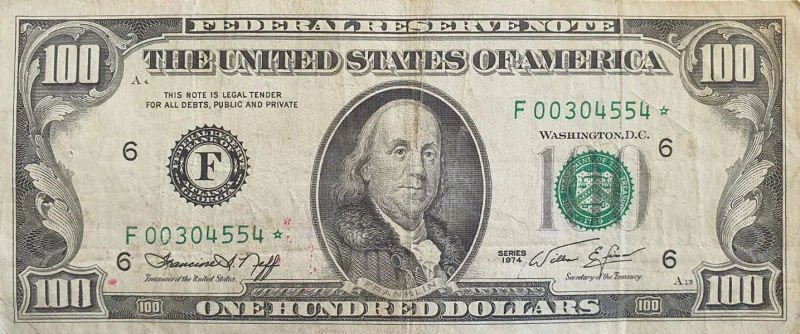
One of the key characteristics of replacement banknotes is that there is no universally accepted method for marking them. While some countries use clearly recognizable symbols, others rely on subtle differences in serial numbers, and some countries do not implement a replacement banknote system at all.
The most common method of identification is the use of special prefixes or suffixes in the serial number. In some systems, this may be an asterisk, an additional letter, or an unusual sequence of characters that does not follow standard numbering. In other cases, replacement banknotes occupy a specific range of serial numbers that does not fit into the regular series.
Due to the lack of a universal standard, the identification of replacement banknotes often requires the use of numismatic literature, catalogs, and research papers. Today, it is normal for numismatic catalogs to provide information on the existence and characteristics of replacement banknotes for the region or country they cover.
Cataloging and market value
In numismatic catalogs, replacement banknotes are listed as separate variants, and information on how they can be identified is usually provided. Namely, they do not differ in appearance from regular specimens in terms of design, dimensions, or security features, but exclusively by their serial number, which is how they are identified.
Catalog values for replacement banknotes are generally higher compared to the values for normal, regular banknotes. In some cases, they are slightly higher, while sometimes replacement banknotes are rare, making their catalog value far greater compared to regular specimens.
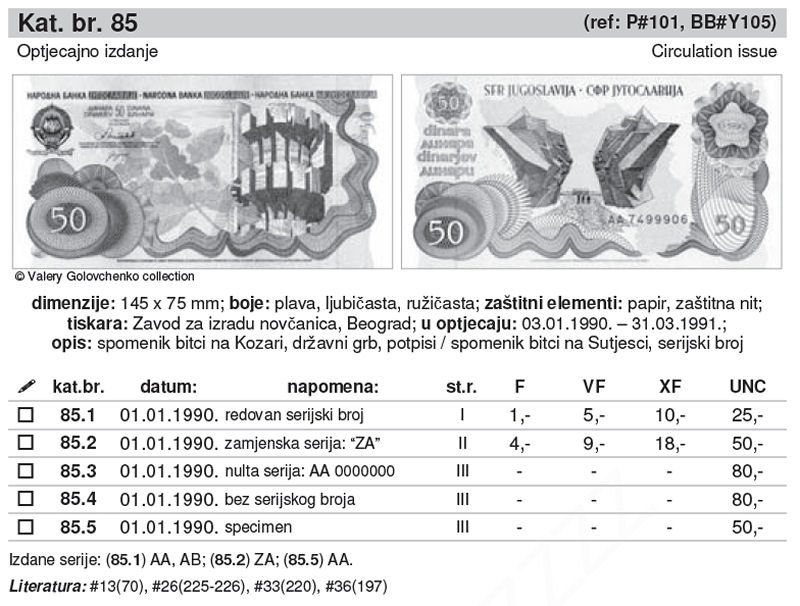
Replacement banknotes in Yugoslavia and the countries of the former Yugoslavia
On the banknotes of the Kingdom of SCS and the Kingdom of Yugoslavia with the French type of numbering, replacement series were most commonly marked with the letter X (Cyrillic letter H). Post-war issues, up until the 1970s, had various methods of marking replacement banknotes, during which it not infrequently happened that banknotes initially used as replacements were later put into circulation as regular series. From the 1970s onwards, prefixes starting with the letter „Z“ (ZA, ZB, ZC) gradually became established, becoming a standard feature of replacement issues.
In the successor states of the former Yugoslavia, the practice of using prefixes containing the letter „Z“ (ZA, ZB, ZC) generally continues. This particularly applies to banknotes printed at the Institute for Manufacturing Banknotes in Belgrade, including Serbian banknotes, as well as wartime issues used in areas under Serb control in Bosnia and Herzegovina and Croatia.
For Slovenia, the prefixes „ZA“ and „AZ“ were recorded, while the wartime issues of Bosnia and Herzegovina use the prefix „RE“. For Macedonian banknotes, we currently do not have reliable data on the prefixes used for replacement banknotes.
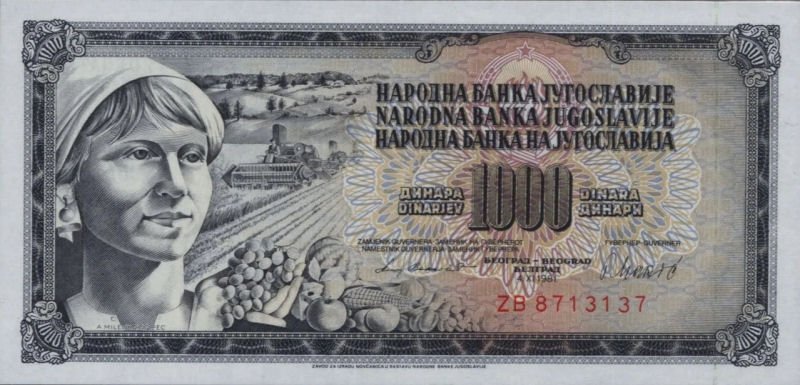
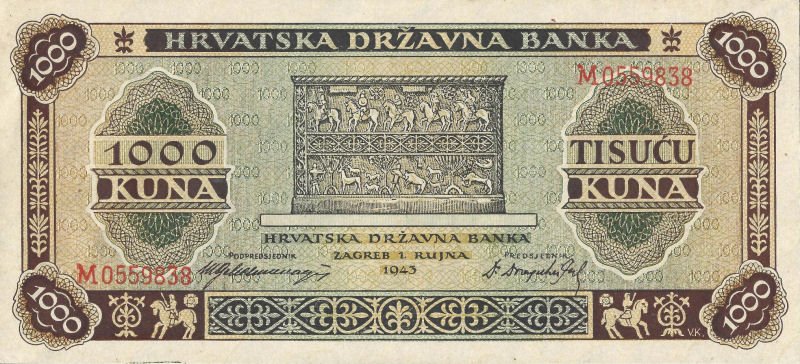
Croatian replacement banknotes
Croatian kuna
For some issues of the Independent State of Croatia kuna, the existence of replacement banknotes is known. They do not have a special letter designation, but differ from regular issues in the way the serial number is printed, which was done using a manual rather than a mechanical numbering machine. Such banknotes can be identified solely on the basis of the specific characteristics of manual numbering.
A detailed and systematic overview of these banknotes is provided by Vedran Krušelj in his book „Banknotes of the NDH: Untold Stories“.
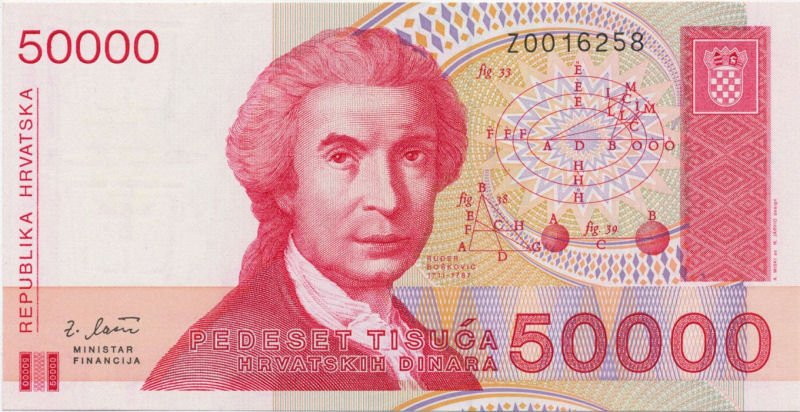
Croatian dinars
In the case of Croatian dinar banknotes, replacement issues are known to be marked with the prefix „Z“, but exclusively for denominations greater than 100 Croatian dinars. These are the banknotes in denominations of 100, 500, and 1,000 Croatian dinars from 1991; 2,000, 5,000, and 10,000 Croatian dinars from 1992; and 50,000 and 100,000 Croatian dinars from 1993.
Republic of Croatia Street
In practice, numismatists often encounter the misconception that every Croatian kuna banknote with the letter series designation „AZ“, „BZ“, or „CZ“ is also a replacement banknote. Such an interpretation is not entirely correct. Replacement banknotes make up a significantly smaller share of the total issue of a given denomination, estimated at a mere 0.2 – 0.4 %, which is why they are in reality rarer than commonly assumed.
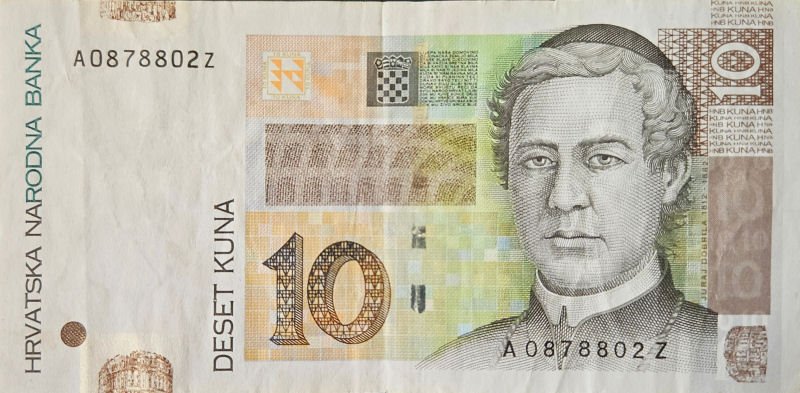
Replacement banknotes from 1993
On all kuna banknotes of the 1993 issue, the series „AZ“ was used as a replacement series. Numbering in this series was carried out only up to a certain number on each of those banknotes.
Replacement banknotes from 2001 and 2002
On all banknotes from 2001 and 2002, the numbering in the „AZ“ series continued with the numbers where the 1993 ones left off, with the exception of the 10-kuna banknote, where the numbering in that series continued with the number where the banknote of that denomination from 1995 left off.
On the 5, 10, 20, and 50 kuna banknotes, the „AZ“ series continued to be used as replacement notes, while on the 100 and 200 kuna banknotes, that role was taken over by the „BZ“ letter series.
There is a possibility that some 5, 10, and 20 kuna banknotes from the „AZ“ series with higher numbers were put into circulation as regular banknotes.
Banknotes of 50, 100, and 200 kuna were printed in the „AZ“ series (starting from the number where numbering previously left off) until the end of that series, i.e., up to the number 9999999. Replacement banknotes of 50 kuna were only those with low numbers in the „AZ“ series, while the entire remainder of the banknotes numbered with that series letter code was put into circulation as regular banknotes.
On the 100 and 200 kuna banknotes, the „AZ“ series was regular. The role of replacement banknotes was played by those in the series with the letter designation „BZ“, exclusively with low numbers. The greater part of the banknotes printed in that series, approximately up to the middle of that series, was put into circulation as regular banknotes.
Replacement banknotes from 2012
On the 10 and 20 kuna banknotes from 2012, the „AZ“ series continued to be used to designate replacement banknotes. The numbering in this series continued from the numbers where it previously left off, but some of the banknotes with higher serial numbers were put into circulation as regular ones.
On the 50-kuna banknote from the same emission, the replacement series was „BZ“, but only the one with low numbers. The rest of the banknotes numbered with this series letter were put into circulation as regular banknotes.
On the 100 and 200 kuna banknotes from the same year, the numbering continued in the „BZ“ series with the numbers where the previous banknote emission had left off. That series was regular. Replacement banknotes were those with low numbers in the „CZ“ letter-code series, while the greater part of the banknotes from the same series was put into circulation as regular ones
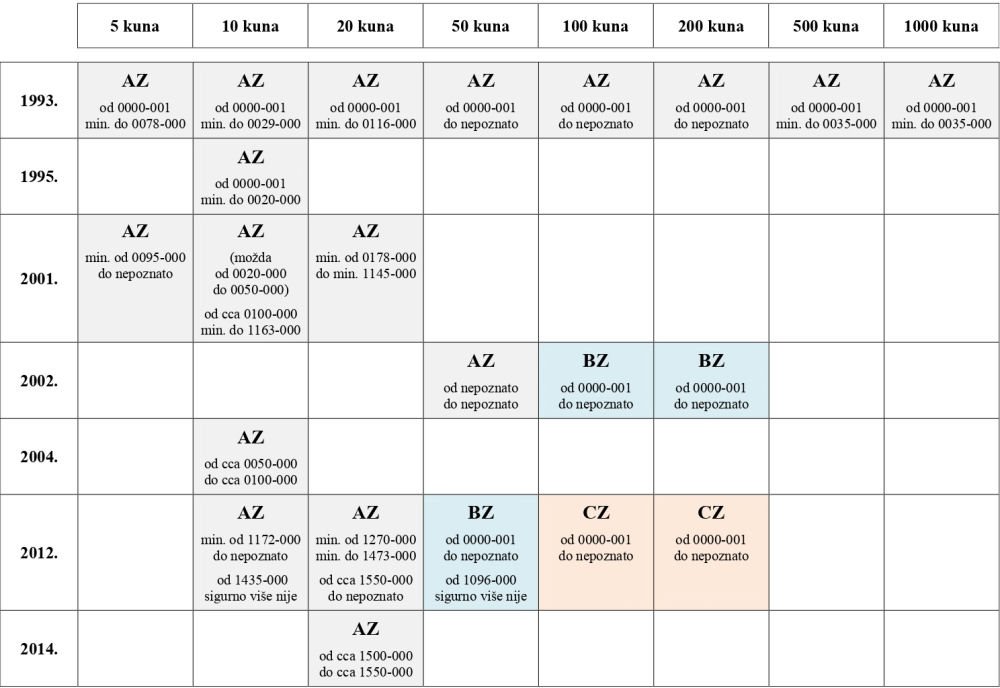
In practice, it is difficult to determine with absolute certainty up to which exact serial number individual banknotes served as replacement notes, or from which point they were used as regular ones. It can be stated with certainty that all banknotes from the 1993 issue numbered in the „AZ“ series are replacement notes, as well as banknotes with that letter series designation for the 10 kuna from 1995 and 2004, and the 20 kuna from 2014.
The presented conclusions are based on years of research by Vedran Krušelj and the analysis of available material, with certain fellow collectors also participating in data collection. Any additional information that could contribute to a more precise understanding of this topic is welcome.
Authors: Zlatko Viščević i Vedran Krušelj (about replacement banknotes of the Croatian kuna)
Photos: Numex – Coins, Banknotes & Militaria Store [www.numex.hr]