



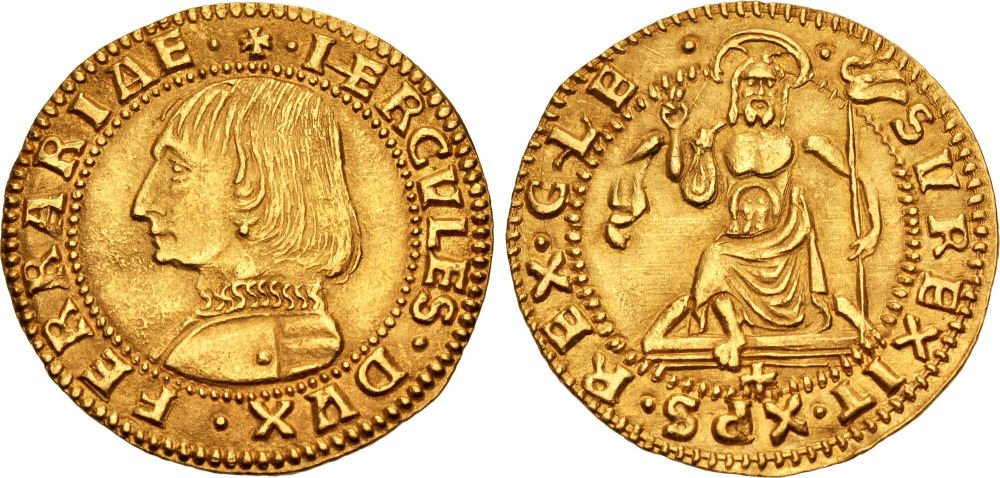
The depiction of the Resurrection of Christ is one of the most powerful and recognizable motifs in Christian iconography. Yet, despite its theological importance, this scene very rarely appears on currency. Precisely for this reason, the gold ducat from Ferrara, minted during the time of Ercole I d'Este in the late 15th century, represents an exceptional blend of religious message and numismatic art.
During the Renaissance, money had a multiple function. In addition to serving as a medium of exchange, it was also a bearer of political legitimation and visual communication. Through coins, rulers presented their own image as well as the values they wished to emphasize. In this context, the choice of the motif of the Resurrection of Christ on the reverse of a gold coin was not accidental. It carried a clear message about the victory of life over death, as well as about divine protection and the legitimacy of the ruler's power.
On the ducat of Ercole I d’Este, this scene is depicted with exceptional clarity and symbolism. Christ emerges from the tomb, with one hand raised in a gesture of blessing while holding a banner in the other, a traditional symbol of resurrection and victory. The composition is simple yet powerful. The figure of Christ dominates the depiction, emphasizing the moment of triumph over death. Such an iconographic choice clearly reflects the fundamental Christian message of Easter.
It is particularly interesting that this depiction most likely did not originate in isolation, but was inspired by contemporary visual art. As early as the beginning of the 20th century, it was suggested that the motif originates from a 15th-century fresco in Ferrara, attributed to Pisanello's circle. Thus, this ducat becomes an excellent example of the transfer of artistic ideas from a sacred space into an everyday object like currency. The boundary between art and numismatics in this case almost disappears.
Unlike common religious symbols on currency, such as the cross, saints, or coats of arms with Christian elements, the Resurrection scene represents a narrative depiction. It does not merely symbolize faith, but directly portrays a key event of Christian theology. Precisely for this reason, such motifs remain rare and particularly valued in numismatics.
The ducat of Ferrara is thus not only a gold coin of high artistic value, but also a testimony to a time when religion, politics, and art were deeply intertwined. The depiction of the Resurrection of Christ upon it reminds us that money, apart from its economic function, has throughout history often carried strong spiritual and ideological messages. In that sense, this gold coin represents an exceptional example of how numismatics can be a source for understanding the broader cultural and religious context of an era.
Edited: Zlatko Viščević
Photos: Classical Numismatic Group