It is known that the banknotes of the Kingdom of Serbs, Croats and Slovenes and the Kingdom of Yugoslavia are the product of the „French school“ of banknote printing. The first issues of royal Yugoslav banknotes (with the exception of the 10-dinar banknote of November 1, 1920, which was produced by the American Bank Note Co., New York) were designed and produced in France at the Banque de France. They were signed, at that time and still today, by an elite group of French artists, the famous Clément Serveau, who also created many banknotes for the Banque de France, as well as L. Deloche and G. Fraipont.
Later editions, hand-drawn by local artists of the time in a style under obvious French influence, were produced at the Institute for Manufacturing Banknotes in Belgrade.
Knowing how French banknotes are surely the most beautifully crafted in the world, it is no wonder that many „Royal Yugoslav“ banknote issues also rank exceptionally well aesthetically among the world of paper money enthusiasts.
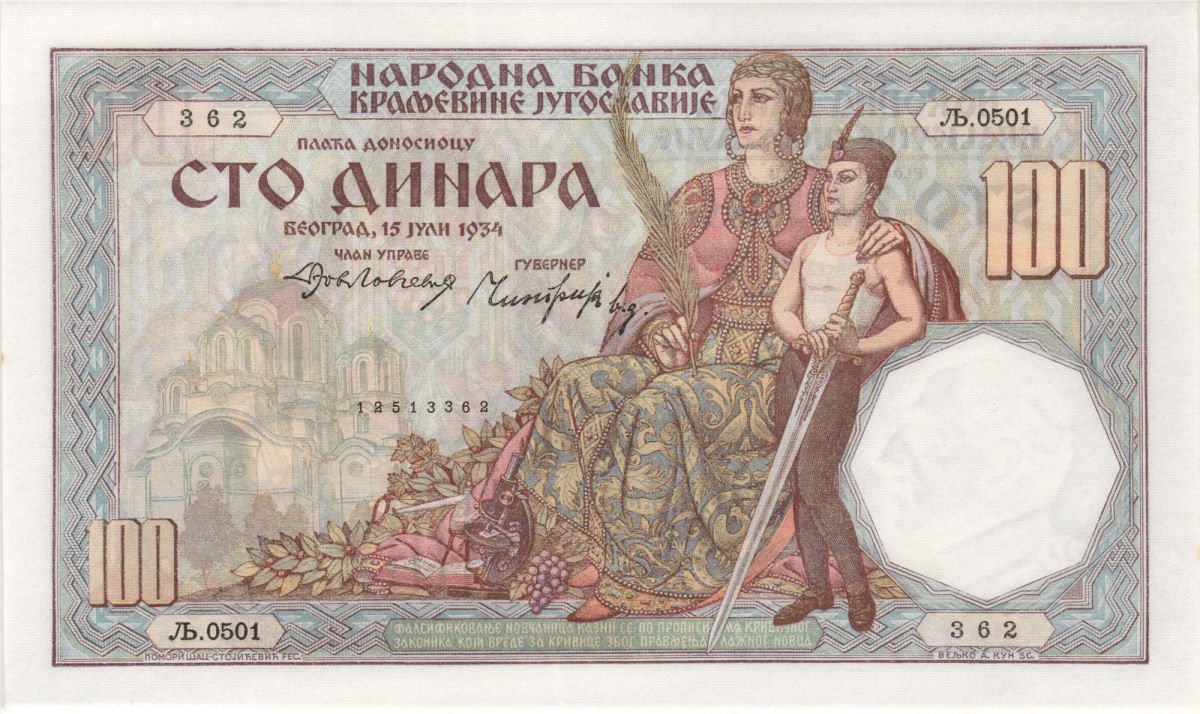
Although it would be very difficult to decide which banknote of the Kingdom of Serbs, Croats and Slovenes or the Kingdom of Yugoslavia is the „most beautiful,“ many will agree that the 100 dinar banknote of July 15, 1934, featuring the motif of Dubrovnik, is right at the top of the competition.
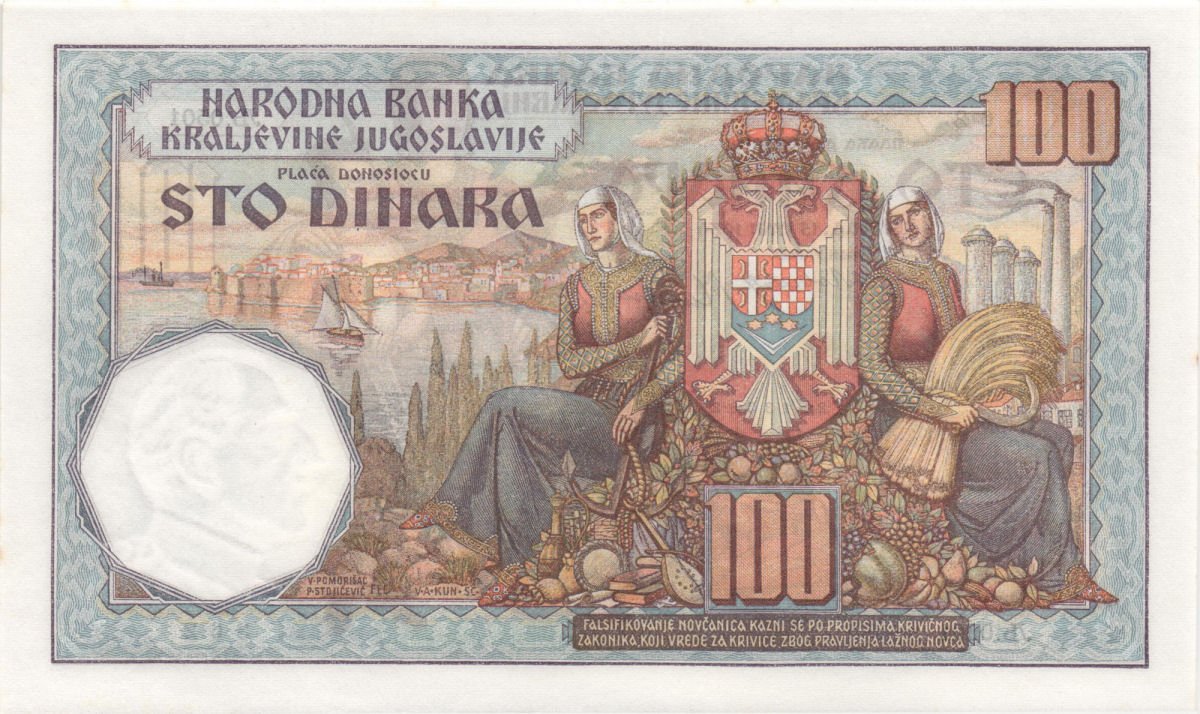
The disappearance of the state, however, did not allow many people to ever see this banknote and pay for something with it. Although it was officially put into circulation on April 8, 1941, as part of an emergency issue for wartime needs, in practice very few of these banknotes actually found their way into regular circulation. Here is why:
The beginning, journey, and end of the 100-dinar banknote dated July 15, 1934, can be observed in fragments even in the numismatically exceptionally good book „Money in Yugoslavia During the Second World War“ by author Miodrag Ugrčić, but unfortunately, not systematically, only in the explanations for all other banknotes of the National Bank of the Kingdom of Yugoslavia. However, through a somewhat more thorough study of the data scattered throughout the text regarding this banknote, and based on clear and logical conclusions drawn from them, it is possible to describe its entire „lifespan“ as well. But let's go in order.
Creation and wartime path
Data from the National Bank of the Kingdom of Yugoslavia as of March 31, 1941, indicate that by that date, 24,565,000 pieces of the 100-dinar banknote dated July 15, 1934, had been produced. Of that amount, 24,515,000 pieces were set aside for so-called „completely extraordinary state needs,“ and 50,000 pieces were intended for regular circulation. By the start of the war on April 6, 1941, this banknote, along with others from the treasury of the National Bank in Belgrade, was transferred to the National Bank branch in Užice.
However, as the war began, so did the unusual journey of this banknote. First, 5,850,000 copies (along with other banknotes, though this text exclusively tracks the 100 dinar banknote dated July 15, 1934) were dispatched by rail from Užice to Sarajevo on April 10/11, 1941, while 18,970,000 copies remained in Užice. The sum of these figures indicates a total of 24,820,000 produced copies, which is 255,000 more than according to the status as of March 31, 1941, published in the official data of the National Bank, according to Ugrčić's book. The difference was, therefore, produced at the Institute in Topčider between March 31 and April 6, 1941, and thus dispatched „to a safer place,“ to Užice.
Secondly mentioned, the larger quantity of banknotes in Užice, after April 6, 1941, was not significantly moved anymore, and there it awaited the German occupation, after which it was transferred back to where it had started from—Belgrade. This means that, according to current findings, the 100-dinar banknote from the July 15, 1934 Užice contingent was only slightly used, briefly, until the withdrawal and issuance of the occupation banknotes of the Serbian National Bank. Slightly, but it nonetheless was, because it was officially withdrawn in the territory of occupied Serbia.
The first, smaller quantity shipped to Sarajevo had a much more interesting fate. When the rail transport carrying banknotes from Užice arrived in Sarajevo on April 11, 1941, it actually arrived amidst complete chaos and an uncertain future. The Germans had not yet arrived, the Kingdom had begun to collapse, and the Independent State of Croatia was proclaimed in Zagreb, which also came to include Sarajevo... In all that turmoil, the services of the Kingdom's National Bank found a somewhat already scattered army to destroy the banknotes. The army waited for the opportune moment on April 14–15, 1941, because the banknotes needed to be transported from the National Bank branch to the railway station, but due to the continuous and constant bombardment of the station, it could not be accessed, and the task was not accomplished. The German Wehrmacht finally captured Sarajevo on April 15, 1941, and the banknotes were confiscated (along with about 1,100 kg of gold and other valuables).
As soon as the German authorities stabilized, an order arrived from the German commander for Serbia, sent from Belgrade to Sarajevo on April 23, 1941, to withdraw the banknotes and gold from Sarajevo and return them to Belgrade. The meticulous German forces immediately carried out the order, and the loading began the same day, but due to the large amount of cargo, it could not be completed in a single day.
However, as early as April 24, 1941, in Sarajevo, where Croatian state authorities had already been established by that time, a delegation of the Croatian State Bank arrived, sent personally by the Poglavnik, Dr. Ante Pavelić, with the intention of keeping the banknotes and gold as the property of the Independent State of Croatia. In accordance with an agreement between Zagreb and Berlin, Germany suspended the preparations already underway for the return of the banknotes and gold to Belgrade, and finally, on April 27, 1941, everything was irrevocably handed over to the Croatian authorities and dispatched to Zagreb.
Thus, 5,850,000 pieces of the 100-dinar banknote ended up in Zagreb on July 15, 1934. Given that the payment using old Yugoslav dinars in the territory of the NDH lasted slightly longer than in the territory of Serbia—meaning that kunas appeared even a month later than Serbian dinars—a slightly larger quantity of the banknote in question entered circulation in the NDH than from the quota that ended up in Belgrade. According to official data from the State Bank of Croatia, this banknote was also among those withdrawn from circulation.
Finally circulation – Sarajevo first?
The most important piece of information that can be drawn from all of the above is the following:
- Undoubtedly, exactly 24,820,000 pieces of the banknote were produced, a piece of information that has not been published anywhere until now.
- Although they were officially put into circulation on April 8, 1941, throughout the Kingdom of Yugoslavia, due to historical circumstances, not a single banknote could appear in circulation at that time.
- Banknotes were in circulation exclusively in Croatia and Serbia, and perhaps also in Montenegro (Z. Jelinčić's catalog mentions the existence of „verificato“ overprinted banknotes, but without an image). They certainly never reached either Macedonia or Slovenia.
- The time of circulation in Croatia and Serbia is certainly after May 15, 1941, by no means before that. In Serbia, because on April 24, 1941, the German Commander for Serbia ordered these banknotes from the branch of the National Bank of the Kingdom of Yugoslavia in Užice to be returned to Belgrade, so by the time the banknotes were loaded, returned, and prepared for circulation, at least a few days must have passed. In Croatia, even later, and certainly after July 27, 1941, when the banknotes were taken over and dispatched to Zagreb, and a smaller part of them left in Sarajevo. There too, it took a few days for delivery and preparation for putting into circulation, so there too we can speak of the same date as for Serbia.
- It may be cautiously noted that it is possible, however, that the first actual appearance of the banknote among the population took place in Sarajevo, because a smaller portion of the banknotes (out of a total of 5.85 million copies) was left in the branch of the Croatian State Bank in Sarajevo, and therefore there is a possibility of actual issuance perhaps a few days earlier.
And a little more for the note file
For the banknote, besides the number of printed copies, equally important would be the data on the serial numbers of the banknotes. The 24.82 million printed copies were divided into 993 series of 25,000 pieces each, according to the classic French-type banknote numbering system (25 letters x 1 series x 1,000 copies).
So, for clarification: the serial number looks like this A.0001 000. The batch number is 0001, the letter A is the batch prefix (25 Cyrillic letters of the prefix have been selected), and 000 is the banknote number (from 000 to 999).
Specifically: the 100 dinar banknote dated July 15, 1934, was produced in a series range from 0001 to 0992. Therefore, the first serial number of this banknote is A.0001 000, and the last is R.0993 999.
The price in the banknote collecting market has experienced a significant decline in recent years. While up until 10 years ago it reached as high as €60 (120 German Marks at the time), today it is €30 to €35 for a specimen in the top grade of preservation. (This article was originally published in 2006, so it reflects the market conditions of that time. Today, 20 years later, the market conditions are different. Ed. note)
Finally, as an interesting point, it should be emphasized that among the first-quality specimens, in 90% of cases, those with the series 0483 appear, while other series appear very rarely. Specimens with traces of handling (circulation), which are not very common, appear in various series. From this, it can also be concluded that the competent services of the State Bank of Croatia and the National Bank of Serbia, during their existence, nevertheless properly destroyed most of the withdrawn banknotes of this type.
Author: Ivan Škrabo
Photos: Katz Auction