



The history of the exchange rate of the Yugoslav dinar from the end of the Second World War to 1990 reflects profound changes in monetary policy, the economic system, and the country's international position. In the numismatic sense, understanding exchange rate relations is crucial for the proper interpretation of the timing of the issuance of certain denominations of banknotes and coins, especially during periods of denominations.
The immediate post-war period (1945–1946)
Following the post-war monetary reform, the new dinar was introduced into circulation as legal tender in the Democratic Federal Yugoslavia. In that initial period, there was exclusively an official exchange rate of the US dollar, which was the reference point for foreign trade settlements.
Exchange rates for other currencies were determined by internal circulars of the competent institutions. It was only from the end of 1946 that the application of international rules began in accordance with the rules of the International Monetary Fund (IMF), thereby formally aligning the system with international monetary standards.
Multiple exchange rates and „coefficients“ (1947–1965)
During the period of the planned economy and the administratively managed foreign exchange system (1945–1965), the official exchange rate often did not reflect actual transactional relations.
The actual settlement rates were increased by so-called coefficients, ranging from 50% to as much as 400%, depending on the export sector. In this way, the state selectively encouraged certain economic branches and directed foreign exchange flows.
Of particular importance is the so-called „tourist exchange rate“, which was applied during:
- purchase of foreign currency from tourism companies
- conversion of expatriate remittances and gifts from abroad
- sale of dinars to foreign citizens
Examples of the relationship with the US dollar:
- 01.01.1956. – official exchange rate × 1.33 → 1 USD = 400 din.
- February 15, 1961 – official exchange rate × 2 → 1 USD = 600 din.
- 01.01.1962. – official exchange rate × 2.5 → 1 USD = 750 din.
- 01.07.1965. – official exchange rate × 3.33 → 1 USD = 1000 din.
This kind of multiple exchange rate system represented a typical feature of the socialist economies of that period, where the exchange rate was an instrument of economic policy rather than a market indicator.
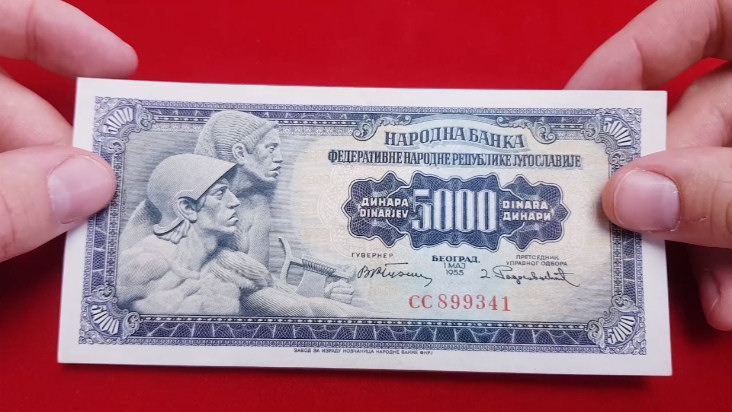
For numismatists, it is important to note that the face values on banknotes from the 1950s and 1960s do not reflect real purchasing power internationally without knowing the applied coefficient.
Denomination on January 1, 1966 (1:100)
On January 1, 1966, a denomination was carried out at a ratio of:
1 new dinar = 100 old dinars
This reform had a primarily technical and psychological character – the goal was to simplify calculations and stabilize the monetary system after a period of high inflation and nominal growth.
In a numismatic sense, this denomination clearly delineated:
- so-called „old dinar“ (1945–1965)
- „new dinar“ (1966–1989)
When analyzing catalogue values and historical data, it is always necessary to take into account which dinar is involved.
Liberalization and gradual depreciation (1966–1989)
Following the 1966 reform, the monetary system became more flexible, and the exchange rate gradually adjusted to market trends. However, during the 1970s, and particularly in the 1980s, accelerated inflation, growth in foreign debt, and a decline in the real value of the dinar occurred.
The exchange rate of the US dollar against the dinar records a continuous depreciation of the domestic currency, which in numismatic terms has resulted in increasingly higher banknote denominations. Issues from the 1980s, with high denominations, are today an important segment of collecting interest precisely as testimony to the monetary instability of that period.
Denomination of January 1, 1990 (1:10,000)
The second major denomination was carried out on January 1, 1990, at the ratio of:
1 new dinar (1990) = 10,000 dinars from 1989.
This measure was a direct consequence of strong inflationary trends in the late 1980s. In practice, the denomination only temporarily eased nominal amounts, while the structural problems of the economy soon led to further monetary disruptions in the 1990s.
For collectors, it is crucial to distinguish:
- issues prior to denomination (with face values in thousands and tens of thousands of dinars),
- issues after January 1, 1990, which are nominally „reduced“ (deflenated/redenominated), but in circulation for a very short time.

The exchange rate of the Yugoslav dinar against other foreign currencies (1945–1990)
Here are the middle exchange rates of the National Bank of Yugoslavia at the end of the current year, i.e., on December 31 of each stated year,
The table shows how many Yugoslav dinars were needed for 1 unit of foreign currency (the only exception is the Italian lira, where the ratio is against 100 lire).
Year: | 1 USD | 1 CHF | 1 GBP | 1 DEM | 1 ATS | 100 ITL |
1945. | 50,00 | – | – | – | – | – |
1946. | 50,00 | 11,63 | 201,50 | 0,60 | 3,00 | 15,00 |
1947. | 50,00 | 11,63 | 201,50 | 2,00 | 2,00 | 15,00 |
1948. | 50,00 | 11,63 | 201,50 | 15,00 | 5,00 | 10,00 |
1949. | 50,00 | 11,43 | 140,00 | 11,90 | 5,00 | 10,00 |
1950. | 50,00 | 11,43 | 140,00 | 11,90 | 1,92 | 10,00 |
1951. | 50,00 | 11,43 | 140,00 | 11,90 | 1,92 | 10,00 |
1952. | 300,00 | 68,61 | 840,00 | 71,43 | 11,54 | 48,00 |
1953. | 300,00 | 68,61 | 840,00 | 71,43 | 11,54 | 48,00 |
1954. | 300,00 | 68,61 | 840,00 | 71,43 | 11,54 | 48,00 |
1955. | 300,00 | 68,61 | 840,00 | 71,43 | 11,54 | 48,00 |
1956. | 300,00 | 68,61 | 840,00 | 71,43 | 11,54 | 48,00 |
1957. | 300,00 | 68,61 | 840,00 | 71,43 | 11,54 | 48,00 |
1958. | 300,00 | 68,61 | 840,00 | 71,43 | 11,54 | 48,00 |
1959. | 300,00 | 68,61 | 840,00 | 71,43 | 11,54 | 48,00 |
1960. | 300,00 | 68,61 | 840,00 | 71,43 | 11,54 | 48,00 |
1961. | 300,00 | 68,61 | 840,00 | 75,00 | 11,54 | 48,00 |
1962. | 300,00 | 68,61 | 840,00 | 75,00 | 11,54 | 48,00 |
1963. | 300,00 | 68,61 | 840,00 | 75,00 | 11,54 | 48,00 |
1964. | 300,00 | 68,61 | 840,00 | 75,00 | 11,54 | 48,00 |
1965. | 1.250,00 | 285,86 | 3.500,00 | 312,50 | 48,08 | 200,00 |
1966. | 12,50 | 2,86 | 35,00 | 3,13 | 0,48 | 2,00 |
1967. | 12,50 | 2,86 | 30,00 | 3,13 | 0,48 | 2,00 |
1968. | 12,50 | 2,86 | 30,00 | 3,13 | 0,48 | 2,00 |
1969. | 12,50 | 2,86 | 30,00 | 3,42 | 0,48 | 2,00 |
1970. | 12,50 | 2,86 | 30,00 | 3,42 | 0,48 | 2,00 |
1971. | 15,65 | 4,01 | 39,63 | 4,76 | 0,65 | 2,61 |
1972. | 16,75 | 4,41 | 39,00 | 5,25 | 0,73 | 2,86 |
1973. | 15,58 | 4,87 | 36,30 | 5,91 | 0,80 | 2,48 |
1974. | 17,08 | 6,41 | 39,63 | 6,89 | 0,95 | 2,57 |
1975. | 18,00 | 6,82 | 36,89 | 6,95 | 0,98 | 2,65 |
1976. | 18,29 | 7,49 | 30,70 | 7,63 | 1,07 | 2,11 |
1977. | 18,39 | 8,78 | 33,81 | 8,49 | 1,18 | 2,09 |
1978. | 18,72 | 11,00 | 37,02 | 9,70 | 1,35 | 2,23 |
1979. | 19,12 | 11,95 | 42,18 | 11,02 | 1,53 | 2,36 |
1980. | 29,17 | 16,83 | 69,51 | 15,12 | 2,14 | 3,20 |
1981. | 40,13 | 22,14 | 76,37 | 17,79 | 2,53 | 3,33 |
1982. | 62,43 | 30,42 | 101,17 | 25,80 | 3,67 | 4,47 |
1983. | 125,35 | 57,09 | 179,53 | 45,65 | 6,48 | 7,54 |
1984. | 203,32 | 79,60 | 241,74 | 65,74 | 9,35 | 10,65 |
1985. | 305,18 | 145,30 | 442,12 | 121,73 | 17,30 | 17,88 |
1986. | 452,16 | 271,62 | 650,26 | 227,29 | 32,28 | 32,76 |
1987. | 1.263,90 | 950,17 | 2.310,21 | 773,70 | 109,90 | 104,86 |
1988. | 4.795,05 | 3.238,29 | 8.743,57 | 2.728,55 | 387,82 | 369,79 |
1989. | 107.003,43 | 68.546,12 | 171.351,86 | 61.795,92 | 8.771,72 | 8.315,38 |
1990. | 10,52 | 8,19 | 20,15 | 7,00 | 1,00 | 0,93 |
The period from 1945 to 1990 was marked by:
- administratively set official exchange rate
- parallel system of increased coefficients
- in two major denominations (1966 and 1990)
- by the long-term depreciation of the dinar
For numismatic analysis, exchange rate data are not just economic statistics, but the key to understanding the real value of individual issues, the context of high-denomination releases, and the relationship between nominal and actual purchasing power.
The middle exchange rates of the National Bank of Yugoslavia at the end of individual periods therefore represent a valuable source for the precise interpretation of monetary history and the proper valuation of Yugoslav paper money.
Source: KunaLipa.com