





The 500 dinar banknote of the Kingdom of Yugoslavia from 1935 represents one of the most artistically successful and iconographically complete issues of interwar Yugoslav notaphily. The entire composition is rendered in a subtle palette of green, olive, and brown tones, with discrete pink transitions in the background, which gives it a refined, almost painterly softness.
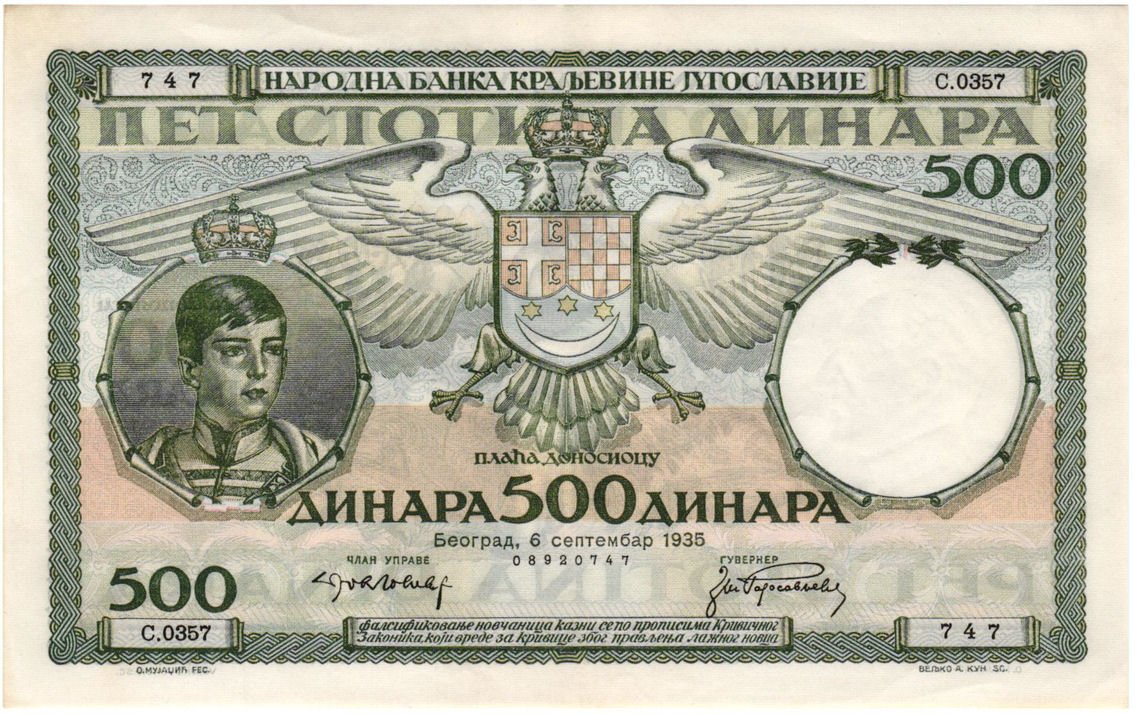
Lice It is conceived in a strictly symmetrical manner. The center is dominated by the coat of arms of the Kingdom of Yugoslavia – a monumental double-headed eagle with outstretched wings, crowned with the royal crown. On the chest shield is a complex heraldic representation of national symbols, executed with precise engraving technique in a dense linear network. The eagle's wings extend across almost the entire width of the banknote, forming a protective visual canopy over the other elements of the composition.
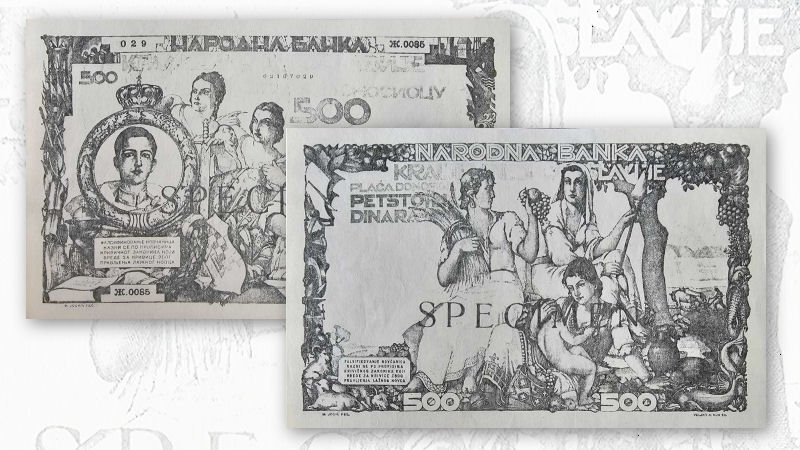
On the left is an oval medallion with a portrait of the young King Peter II, depicted with an idealized, calm expression. The portrait is modeled with subtle tonal transitions, achieving a sense of volume and psychological characterization. Above the portrait is the royal crown. On the right is a circular area for a watermark. Both medallions are bordered by decorative motifs in the form of paper scrolls that bring balance to the entire composition.
The typography is monumental and authoritative: the inscription „НАРОДНА БАНКА КРАЉЕВИНЕ ЈУГОСЛАВИЈЕ“ and the denomination designation „ПЕТ СТОТИНА ДИНАРА“ are formed in a strong, classical script. It is repeated below the depiction of the eagle in the form of „ДИНАРА 500 ДИНАРА“. The numerical designation „500“ is also placed in the corners—bottom left and top right. Below the denomination designation is the place name and date of issue (Belgrade, September 6, 1935), along with the signatures of the responsible persons at the National Bank. The rich ornamental frame, inspired by interlace and geometric patterns, also has a protective function, as the complex linear structure makes counterfeiting difficult.
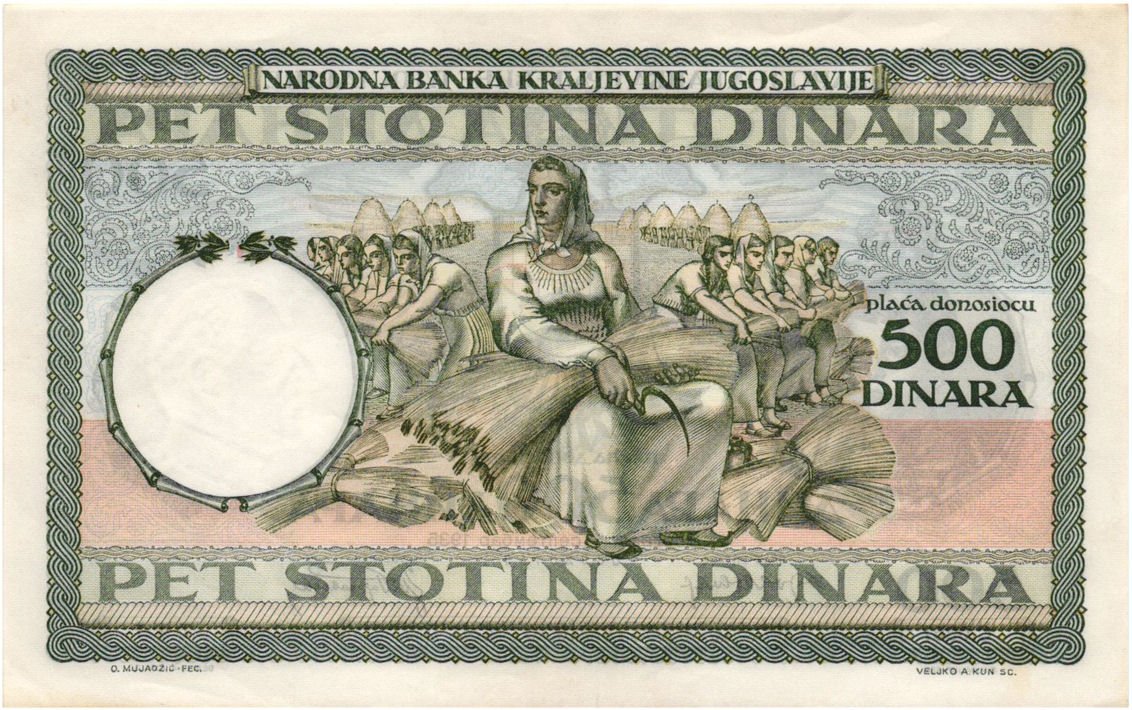
The reverse side features an allegorical composition with pronounced socio-agrarian symbolism. In the center sits a monumental female figure, the personification of fertility, labor, and national unity. In her hands, she holds sheaves of wheat, a symbol of agrarian strength and the economic foundation of the state. In the background, a group of peasant women is depicted in a rhythmic sequence, creating a dynamic and a sense of collective effort. The composition is horizontally developed, with a gentle depth of space, while the ornamental background subtly connects the figural scene with the decorative frame.
The banknote drawing was made by a painter Omer Mujadžić (1903–1991), an academically trained artist who worked within the modernist art movement of the interwar period. His style is characterized by a blend of classical figuration and subtle idealization, which is visible on this banknote in the harmonious modeling of the portrait and the monumentally stylized allegorical figure on the reverse. Mujadžić's ability to adapt academic painting discipline to the demands of banknote design resulted in a composition that possesses both artistic value and clear symbolic legibility.
The printing matrices were engraved by Veljko Andrejević Kun (1877–1948), one of the most significant printmakers and engravers of his time. His engraving precision is evident in the exceptionally fine line screen, the rich texturing of the eagle and ornamental frames, and the tonal development of the portrait. Kuno's technical virtuosity allowed Mujadžić's drawing to be transferred into intaglio printing with a high level of detail and security reliability.

This banknote represents a harmonious synthesis of fine art and technical engraving excellence. The obverse highlights heraldic symbolism and monarchical authority, while the reverse emphasizes the agrarian ideal and collective labor as the foundation of state stability. Thanks to the collaboration of Omer Mujadžić and Veljko Andrejević Kun, the 500 dinar banknote from 1935 transcends its monetary function to become a representative cultural-historical document and a supreme achievement of Yugoslav banknote graphics of the interwar period.
Photos: Numex – Coins, Banknotes & Militaria Store [www.numex.hr]