



Most people who are involved in numismatics in some way are not clear on the procedure for producing, that is, printing banknotes. In this article, you have the opportunity to get a better idea of that, and also to get acquainted with the numbering scheme for the 1941 1000-kuna banknotes of the Independent State of Croatia.
Initial print runs
First print run
The production of 1,000-kuna banknotes with an issue date of May 26, 1941, as well as the initial quantity of 2,000,000 pieces, was defined by the contract of May 9, 1941, between the NDH, represented by the head of the State Finance Department, Dr. Vladimir Franolić, and the company Giesecke & Devrient d.d. in Leipzig, represented by Mr. Ludwig Devrient. However, as early as June 23, 1941, another contract was signed by the same signatories (Contract II), which, among other things, redefined the production quantity of banknotes of this denomination to 8,000,000 pieces. Based on both mentioned contracts, the NDH agreed to accept a potential excess delivery of banknotes of about % compared to the ordered quantity. Consequently, the Independent State of Croatia was delivered 8,925,000 banknotes of this denomination by Giesecke & Devrient based on these two contracts. Given that banknotes of this denomination were produced on several more occasions, this initial quantity of 8,925,000 pieces can be characterized as banknotes from the first printing run.
That first print run included the series:
A from 0000-001 to 1000-000
B from 0000-001 to 1000-000
C from 0000-001 to 1000-000
D from 0000-001 to 1000-000
E from 0000-001 to 1000-000
F from 0000-001 to 1000-000
G from 0000-001 to 1000-000
H from 0000-001 to 1000-000
J from 0000-001 to 0925-000
When producing these banknotes, 30 printing plates were used, arranged in 5 columns and 6 rows. Consequently, there were just as many banknotes on a single sheet, positioned in the same way (Figure 1).

The initial position on the sheet was at the bottom left, and the direction of movement of the series during numbering moved vertically upwards, from left to right. The final position on the sheet was at the top right (Figure 2).

The position on the sheet during numbering was made up of a letter series and the first 4 digits. The last 3 digits in the serial numbers on one sheet were the same in all positions, and on each subsequent sheet they decreased by 1, starting from (1)000, then 999, 998... all the way to 001. After reaching 001, the sheet changed with the following series, i.e., the first 4 digits in each position. The last 3 digits on that next sheet of serial numbers once again started from the highest number towards the lowest. A schematic representation of the initial sheet of series during numbering can be seen in Figure 3.

The letter series followed one another during numbering. Thus, after the numbering of one letter series was completely finished, the numbering of the next letter series was continued on the same sheet of serial numbers (Figure 4).

There are certain numbering irregularities during the first printing round, which occurred due to occasional position skips during numbering. As a result, all banknotes at that skipped position on all sheets when numbered with the same press sheet of certain series remained unnumbered. After cutting the banknotes from those sheets, a bundle of 1,000 unnumbered banknotes consequently remained. From these banknotes, replacement banknotes were later created individually as needed, in such a way that the targeted serial number was printed on them using a manual (or hand-held) numbering machine, identical to the one on the banknote that needed to be replaced for a certain reason. There were a total of 11 such empty positions, or numbering skips, in the first printing round (1 skip somewhere between C 0015 and C 0066, 1 skip somewhere between C 0838 and C 0853, 3 probably consecutive skips somewhere between E 0714 and E 0771, 5 probably consecutive skips somewhere between H 0988 and J 0001, 1 skip somewhere between J 0182 and J 0228).
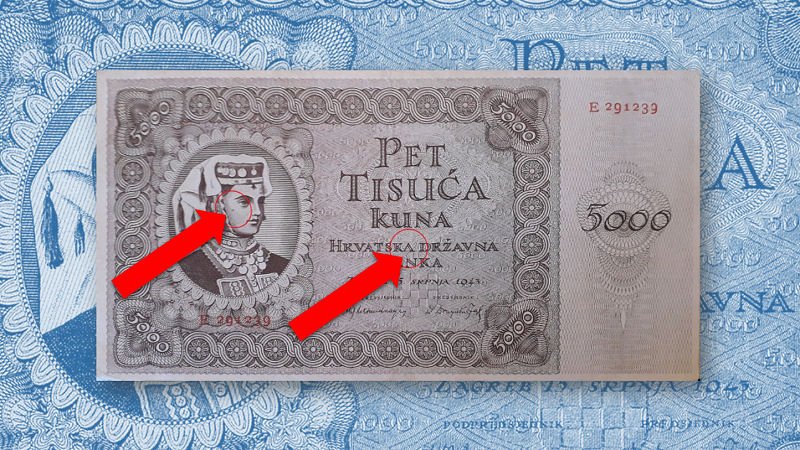
Banknotes produced in the first round have their own specific characteristics compared to banknotes from later printing rounds. These specifics are mostly manifested in a series of errors that appear on all banknotes printed in specific positions, while these same errors are no longer found on banknotes printed in the subsequent round. Out of 30 banknotes originating from the same sheet, at least 13 exhibit a characteristic anomaly for the position on the sheet where they were located. Some of these errors are interesting and worth mentioning, but for the most part, they are minor details that may not be interesting in a numismatic-collectible sense, but have served exceptionally well in determining the numbering scheme of these banknotes.
Second round of printing
The production of the next quantity of 8,000,000 banknotes of this denomination was defined by the contract dated July 31, 1942, between the State Treasury in Zagreb, represented by Minister Dr. Aleksandar Hondl, and the company Giesecke & Devrient d.d. in Leipzig, represented by Director Franz Helmberger. Based on the aforementioned contract, as well as the clause on consenting to accept up to about 10% more than the ordered quantity, 8,925,000 banknotes of this denomination were delivered, which is therefore identical in quantity to the earlier delivery. The banknotes produced and delivered based on this contract can be characterized as banknotes from the second printing round.
This second round of printing included the series:
J from 0925-001 to 1000-000
K from 0000-001 to 1000-000
L from 0000-001 to 1000-000
M from 0000-001 to 1000-000
N from 0000-001 to 1000-000
O from 0000-001 to 1000-000
P from 0000-001 to 1000-000
Q from 0000-001 to 1000-000
R from 0000-001 to 1000-000
S from 0000-001 to 0850-000
For the production of banknotes in this round, the same printing plate with 30 clichés, evenly distributed (5 columns and 6 rows), was used, meaning there were consequently just as many banknotes on a single sheet.
During the second printing run, there were also certain irregularities in the numbering, caused by occasional position skips during the numbering process, due to the need for the subsequent production of replacement banknotes. The number of such empty positions in this printing run was a minimum of 4 (1 skip somewhere between M 0374 and M 0411, 1 skip somewhere between O 0149 and O 0238, 1 skip somewhere between O 0926 and P 0009, 1 skip somewhere between Q 0930 and Q 0937).
Although produced with the same plates, the banknotes from the second round do not have a single one of the errors created and personally detected on the banknotes from the first printing round. However, they still have their own specific features compared to all other rounds. These specific features are also manifested in a large number of repeating anomalies, mostly minor, characteristic of individual positions on the sheet. Out of 30 banknotes originating from the same sheet in this printing round, as many as 20 of them exhibit a characteristic error related to the position they occupied during production. In the image below (Figure 5), you have the opportunity to see one of the aforementioned anomalies, characteristic of position number 29 on the sheet.

Other rounds of printing
There were a total of 7 printing rounds. A common characteristic of the banknotes resulting from the remaining 5 rounds is that they were produced on a new printing plate containing 42 clichés, arranged in 6 columns and 7 rows (Figure 6).

The direction of movement of the series during numbering also moved vertically across the columns, from left to right. Although it has not yet been confirmed at this time whether this vertical movement of the series was also from bottom to top, it is realistic to expect that the printing house that produced and thus numbered these banknotes remained faithful to its earlier production practice. From this, it follows that the starting position on the sheet during numbering was most likely also in the bottom-left corner, and that the final position was in the top-right corner (Figure 7).

An additional common characteristic of the banknotes originating from the remaining 5 rounds is the existence of a larger number of individual identical errors, created during the production of the banknotes in most of the remaining printing rounds, or even in all of them. Thus, a minimum of 14 different anomalies can be observed on the banknotes originating from the 3rd printing round, and continuing all the way to the 7th round.
The production of the next quantity of 20,000,000 banknotes of this denomination was defined by the contract of January 27, 1943, between the State Treasury in Zagreb, represented by Minister Dr. Aleksandar Hondl, and the company Giesecke & Devrient d.d. in Leipzig, represented by Consul Ludwig Devrient. Given that the stated quantity does not correspond to the quantity of all subsequently manufactured and delivered banknotes (at least another 34,942,000 pieces), there initially had to be at least one more contract in which an agreement was reached on the production of an additional quantity of banknotes of this denomination, or an annex to the contract in which the previously ordered quantity was redefined. However, the exact content of that disputed legal act, as well as its existence, are unfortunately unknown to me.
Third round of printing
The third round of printing included the series:
S from 0850-001 to 1000-000
T from 0000-001 to 1000-000
U from 0000-001 to 1000-000
V from 0000-001 to 1000-000
W from 0000-001 to 1000-000
X from 0000-001 to 1000-000
Y from 0000-001 to 1000-000
Z from 0000-001 to 1000-000
From the above, it follows that a total of 7,150,000 banknotes of the 1000 kuna denomination were printed in this round. It remains unknown why there was a temporary suspension in further production, given the ordered quantity of 20,000,000 pieces, but most likely due to the fact that the same printing house was entrusted with the production of banknotes of other denominations of the NDH, and the content of the agreement regarding the delivery schedule of individual ones is unknown.
Regarding the numbering irregularities present in this round, there is only one position skip, somewhere between X 0029 and X 0067.
Fourth printing round
The fourth round of printing included the series:
A from 1000-001 to 2000-000
B from 1000-001 to 2000-000
C from 1000-001 to 2000-000
D from 1000-001 to 2000-000
E from 1000-001 to 2000-000
F from 1000-001 to 2000-000
G from 1000-001 to 2000-000
H from 1000-001 to 2000-000
In this round, a total of 8,000,000 banknotes of this denomination were printed. Here, too, there is only one position jump during numbering, somewhere between B 1046 and B 1057.
Fifth round of printing
The fifth round of printing included the series:
J from 1000-001 to 2000-000
K from 1000-001 to 2000-000
L from 1000-001 to 2000-000
M from 1000-001 to 2000-000
N from 1000-001 to 2000-000
O from 1000-001 to 2000-000
P from 1000-001 to 2000-000
Q from 1000-001 to 2000-000
In this round, the total quantity of manufactured banknotes is also 8,000,000 pieces. There were no position skips during numbering.
The total quantity of banknotes printed in the 3rd, 4th, and 5th rounds is 23,500,000 pieces, which could correspond to the ordered quantity of 20,000,000 pieces based on the contract of January 27, 1943, increased by a manipulative percentage for possible manufacturing surplus of about 10%, which the ordering party had agreed to with their signature.
Sixth round of printing
The sixth print run included the series:
R from 1000-001 to 2000-000
S from 1000-001 to 2000-000
T from 1000-001 to 2000-000
U from 1000-001 to 2000-000
V from 1000-001 to 2000-000
W from 1000-001 to 2000-000
X from 1000-001 to 2000-000
Y from 1000-001 to 2000-000
Z from 1000-001 to 2000-000
A total of 9,000,000 banknotes were printed in this round. There is only one position skip during numbering, somewhere between S 1885 and T 1078.
Seventh round of printing
The final, seventh round of printing included the series:
And from 2000-001 to 3000-000
B from 2000-001 to 3000-000
C from 2000-001 to at least 2792-000
In this round, the total quantity of manufactured banknotes is a minimum of 2,792,000 pieces. There were no skipped positions during numbering.
Following all the previously stated data regarding the quantity of manufactured banknotes in individual printing rounds, we ultimately arrive at a total quantity of at least 52,792,000 banknotes of this denomination (Figure 8).

Author: Vedran Krušelj