



In phaleristics, an auxiliary historical science that deals with the study of decorations, medals, orders, commemorative plaques, military insignia, and related items, the term miniature It has a very clear meaning. Miniatures are reduced versions of decorations, made to look like the original, full-sized decoration, but in a smaller format. They are not a replacement in the sense of a regular ribbon or bar (ribbon bar), but rather represent a formal, reduced version of the decoration itself.
Miniatures are most commonly made as small decorations on a ribbon, chain, or clasp, and are worn on occasions when the full decoration would be impractical or inappropriate to wear. This applies especially to formal civilian attire, diplomatic receptions, evening events, uniforms for special ceremonies, or events where the wearing of miniatures is prescribed.
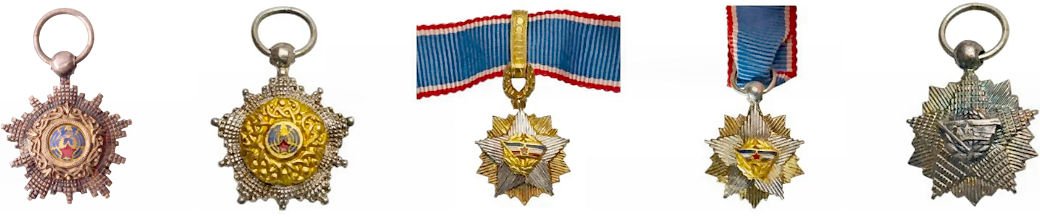
Scaled-down version of the original decoration
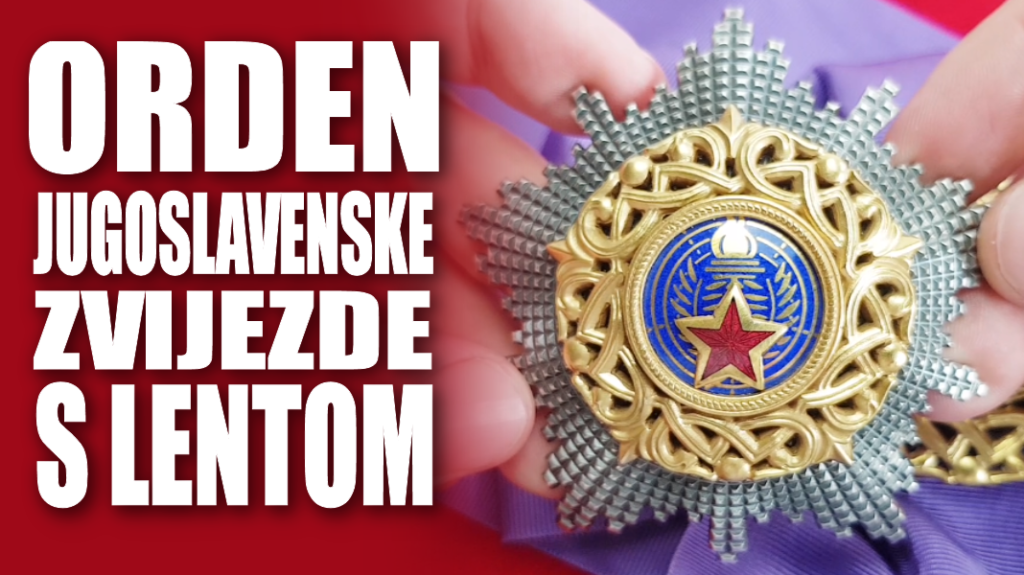
The main feature of a miniature is that it follows the original decoration in shape, motif, and colors. If it is an order in the shape of a cross, star, medallion, or other insignia, the miniature will as a rule repeat the same artistic concept, but on a smaller scale. In higher-quality specimens, the same details as on the full decoration can be seen: enamel, inscriptions, heraldic elements, royal monograms, crowns, swords, laurel wreaths, or other symbols.
Miniatures can be made in various levels of quality. Some are very precise and made of precious metals and more expensive materials, while others are of simpler design intended exclusively for practical wear. In the case of older decorations, miniatures were often privately commissioned from goldsmiths or specialized decoration manufacturers, so they can differ in dimensions, manufacturing quality, and individual details.
Precisely for this reason, miniatures also hold a special collector's value. They are not merely an accessory to the main decoration, but also separate phaleristic items that testify to the rules of-wearing, the social status of the decorated person, and the customs of a given era.
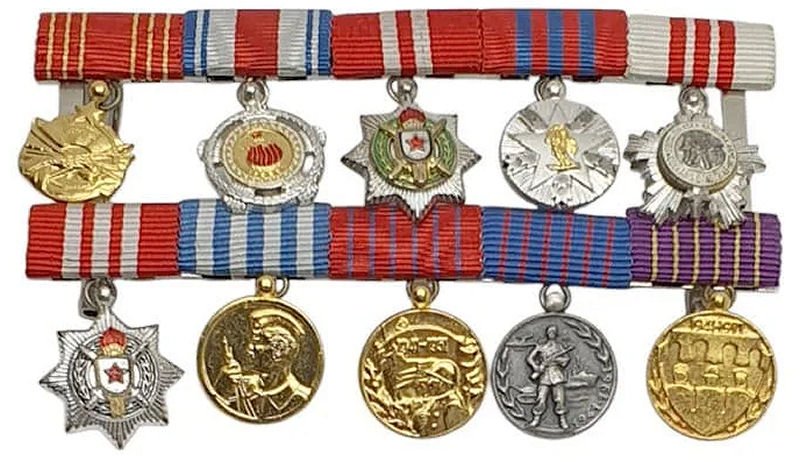
When were miniatures worn?
Full-sized decorations were often relatively large, especially when several were worn at once. On a formal uniform this was not a problem, but on civilian attire, tailcoats, or tuxedos, large decorations could be impractical. Therefore, miniatures were used, which allowed a person to display their decorations in a dignified yet more discreet manner.
For individuals who had a larger number of decorations, miniatures were often arranged side by side on a shared clasp or chain. The order of wearing was not accidental. Usually, the prescribed order of precedence was followed, with higher and more important decorations taking precedence over lower or less important ones.
Such miniature groups are often found among military personnel, diplomats, government officials, nobles, high-ranking civil servants, and other individuals who have received multiple decorations during their lifetime. For people engaged in phaleristics, they are particularly interesting when they can be linked to a specific person, their service, or a historical event.
Miniatures and pronouns are not the same
In phaleristics, it is important to distinguish miniatures from pronoun. Although both terms refer to insignia worn instead of a full decoration on certain occasions, they are not the same thing.
Miniature It is a scaled-down version of the decoration itself. It most commonly takes the form of a small cross, medal, star, or insignia of an order. Therefore, the miniature visually represents the decoration itself, just in a reduced form. If the full decoration is made as a cross with enamel, the miniature will most likely also be a small cross with the same or similar elements.
Pronoun, on the other hand, is not a reduced decoration. A ribbon bar is an insignia that replaces the decoration for everyday or official wear. It most commonly consists of a small rectangular ribbon in the colors of the decoration, and may also feature attachments such as small metal insignia, stars, swords, rosettes, or other symbols indicating the grade, special merit, or type of recognition.
In other words, the miniature shows a decoration in a small format, doc the pronoun only displays its ribbon or official wear insignia.
For example, if a person has a decoration consisting of a cross on a red-and-white ribbon, the miniature would be a small cross on a small ribbon. The ribbon bar would be just a small rectangular red-and-white ribbon, without the cross itself. That is the basic and most important difference.
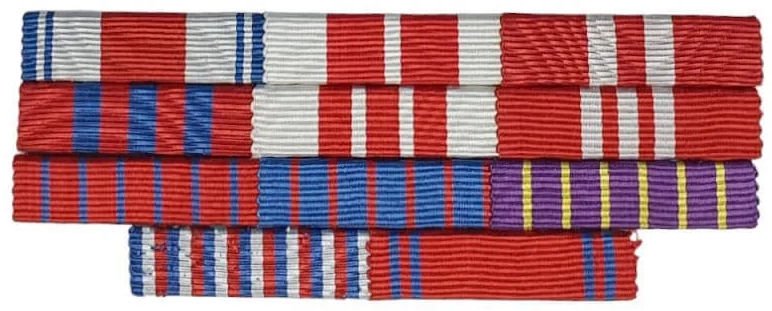
Practical difference in wear
Miniatures are mostly associated with formal occasions. They are more elegant, more decorative, and closer to a full-size decoration. They are worn when one wants to display the complete symbolism of an award, but in a smaller and more convenient form.
Ribbons are more practical and are used more frequently on uniforms in daily service. Their purpose is to show which decorations a person has, but without wearing the actual decorations themselves. Therefore, ribbons are especially common in military and police systems, where constantly wearing full decorations would be impractical.
In the case of ribbon bars, great importance is attached to the colors of the ribbon and additional insignia. An experienced phaleristics expert can recognize, based on the ribbon bar, which decoration it is, which grade it belongs to, and whether it is associated with civil service, wartime merits, or a specific anniversary.
Collector value of miniatures
Miniatures are interesting in collecting for several reasons. First, they often accompany original decorations and can be part of the personal phaleristic collection of the decorated individual. Second, due to their small dimensions and fine craftsmanship, they are often very attractive. Third, some miniatures are rarer than the decorations themselves, especially if they were made in smaller quantities or privately commissioned.
The value of the miniature depends on several factors. Important elements are the type of decoration, grade, period of creation, material, craftsmanship, preservation, manufacturer, and connection to a specific person. Miniatures that come together with the full decoration, original box, diploma, photograph, or other documents can hold special value.
When making an assessment, one must be cautious because miniatures, like other decorations, can be subsequently manufactured, repaired, or combined with inappropriate ribbons. Therefore, it is important to compare dimensions, manufacturing techniques, materials, and the historical context.
Miniatures are small but very important items in phaleristics. They connect the official symbolism of decorations with practical rules of wear and the culture of ceremonial presentation of merits. Unlike ribbon bars, which are simple ribbon insignia, miniatures remain a reduced representation of the decoration itself and therefore occupy a special place in phaleristic collections.
Author: Zlatko Viščević
Photos: Numex – Coins, Banknotes & Militaria Store [www.numex.hr]