


The German colonial empire was created relatively late compared to the colonial empires of Great Britain, France, Portugal, Spain, or the Netherlands. The German Empire, unified in 1871, only became more actively involved in colonial expansion in the second half of the 19th century. German colonies were located in Africa, Oceania, and China, among which the most well-known were German South-West Africa, Cameroon, Togo, and German East Africa.
German East Africa, or Deutsch-Ostafrika, encompassed the territories of present-day Tanzania, Rwanda, and Burundi. It was a large colony on the east coast of Africa, nearly three times the size of the German Empire at the time. Its development began through the activities of the German East Africa Company, and later the region came under the more direct administration of the German Empire. The colony existed until the end of World War I, after which German rule there was abolished, and the territory was divided between Great Britain, Belgium, and Portugal.
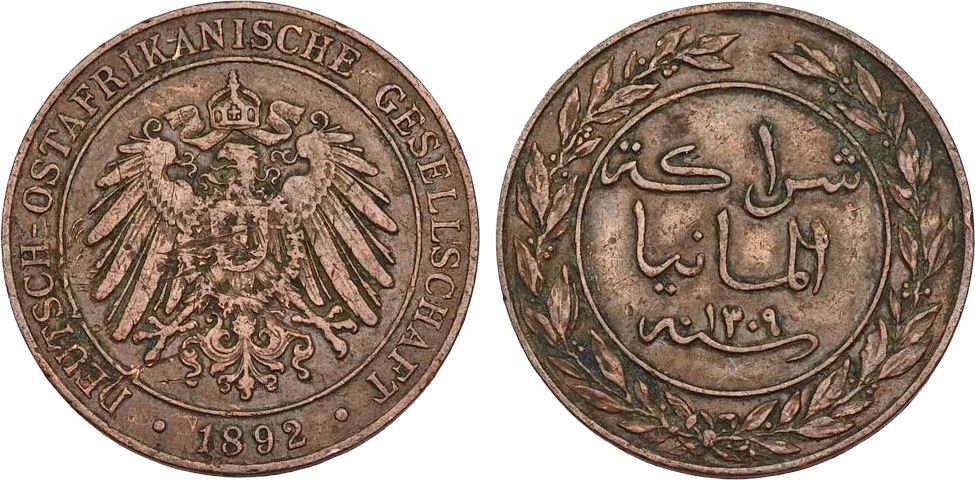
1 peso coin from 1892
One of the more interesting early colonial coins of German East Africa is the copper coin of 1 peso from 1892. It was issued during the time of Emperor Wilhelm II, who ruled the German Empire from 1888 to 1918. The coin belongs to the first standard circulation issues of German East Africa and is linked to a monetary system in which the main currency was the East African rupiah.
The 1-peso denomination was a small unit of account. Its value was one-sixty-fourth of a rupee, which clearly shows that it was intended for everyday small-scale circulation. Such coins were particularly important in local trade, in markets, and in everyday transactions where smaller values were used.
The coin is made of goat, I am now from 6.21 g, diameter 25.2 mm and a thickness of about 1.5 mm. It is circular in shape, machine-forged, with medallic rotation. The rim is smooth.
Coin description
The obverse of the coin depicts German imperial eagle with a crown, surrounded by the inscription:
GERMAN EAST AFRICA COMPANY
In translation, the inscription means German East Africa Company. Beneath the image is the year according to the Gregorian calendar, in the case of this coin. 1892.
The reverse side is particularly interesting because it features an inscription in the Arabic script. In the middle is the Arabic text with the year according to the Islamic, i.e., Hijri calendar. For the year 1892, the Hijri year is stated 1309. The inscription is located within a wreath, which is a classic artistic solution for small circulation coins of that period.
Particularly interesting is the linguistic note related to the Arabic inscription. According to the interpretation, the inscription could be translated as „German partnership” or „German community,” but it was probably intended to convey the meaning „German company.” This points to a possible linguistic or orthographic awkwardness in the Arabic text, making this coin additionally interesting for numismatists, historians, and collectors of colonial currency.
Years of forging and emissions
The 1 peso coin was minted in the period from from 1890 to 1892, or in Hijri years 1307 to 1309. All coins were minted in Berlin.
The following years and shows are known:
- 1307 / 1890.: 1,000,000 copies
- 1308 / 1891.12,551,000 copies
- 1309 / 1892.27,541,000 copies
The year 1892 has the largest mintage in this short series. Because of this, that very year is relatively accessible to collectors today, especially in lower and middle grades of preservation. However, nicely preserved specimens, especially those with pronounced details of the eagle, wreath, and Arabic inscription, command much better prices on the market.
Historical and numismatic context
German East Africa coins are interesting because they represent a blend of European colonial rule and local monetary, commercial, and cultural circumstances. German authorities in that area had to create a monetary system that would be understandable and acceptable in local commerce. Because of this, these coins feature German imperial symbols, Latin inscriptions, the Arabic script, and the Islamic calendar.
Such a combination is not accidental. The East African coast had been connected for centuries with the Arab, Indian, and Eastern trading worlds. Various currencies were in circulation, and trade connections across the Indian Ocean were very strong. The use of the Arabic script on the coin was a practical and political message. The coin was meant to be recognizable to the local population and traders, while at the same time clearly showing who the issuer was and who held authority over the monetary system.
Precisely for this reason, the one-pesa coin is not just a small copper coin. It is a small historical document that testifies to the colonial administration, trade relations, linguistic adaptations, and political symbolism of the German Empire in Africa.
German East African rupee
The monetary system of German East Africa was based on the rupee, reflecting the influence of the Indian monetary space and East Africa's trade connections with the Indian Ocean. From 1890 to 1904, the rupee was in use, divided into smaller units, including the pesa.
The 1-pesa coin belongs precisely to that early period. Later issues of German East Africa also include the better-known denominations in hellers and rupees, especially from the World War I era. However, the early pesas from the 1890s hold special significance because they mark the beginning of systematic colonial coinage for that area.
Collector value
The collector value of the 1892 one-peso coin depends primarily on its state of preservation. Since it is copper circulating currency, many surviving specimens show traces of long-term use, bumps, scratches, surface darkening, or corrosion. In copper coins, natural, undamaged patina and the absence of cleaning are particularly valued.
Specimens in poorer condition are not rare and are available to most collectors. However, specimens in very fine condition, with clear details and an attractive surface, are significantly more valued. Uncirculated or nearly uncirculated specimens represent higher quality collector material, especially if they have a nice copper color and a well-preserved relief.
Significance of the coin
German East Africa's 1 pesa from 1892 is a good example of how the broader history of colonialism, trade, and monetary policy can be observed through a single small copper coin. On it meet the German imperial eagle, the name of the German East Africa Company, the Arabic script, the Hijri year, and the local monetary tradition.
It is precisely this combination that makes it appealing not only to collectors of German colonial coins, but also to anyone interested in the history of Africa, colonial currency, Arabic coin inscriptions, and 19th-century monetary systems. Although it is a small denomination, its historical significance is far greater than the nominal value it had in circulation.
Author: Zlatko Viščević with AI assistance
Photos: Numex – Coins, Banknotes & Militaria Store [www.numex.hr]