



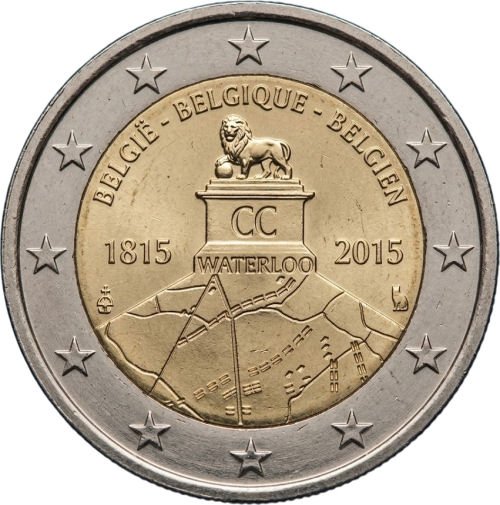
Numismatics often reflects history, identity, and collective memory, yet it rarely causes open political conflict between nations. That is exactly what happened in 2015 when Belgium planned to issue a commemorative 2-euro coin to mark 200th anniversary of the Battle of Waterloo. Instead of a routine numismatic issue, the entire project escalated into an international controversy, in which France played a key role.
French veto: A “negative symbol” of Europe
Belgian coin proposal featuring the motif of the famous battle in which he was defeated Napoleon Bonaparte, he encountered strong resistance from France. In an official objection, the French authorities pointed out that Waterloo represents a “negative symbol” in France's collective memory, and that its commemoration on a European coin could undermine the unity of the eurozone.
Since all eurozone member states must approve the design of the common 2-euro coins, France threatened a blockade through European institutions. Faced with political pressure, Belgium was forced to withdraw the issue.
180,000 destroyed coins
The decision to withdraw came too late. Belgium had already minted around 180,000 pieces of the planned 2-euro coin. The entire batch had to be destroyed, resulting in a significant financial loss, estimated in the millions of euros.
This move shows how sensitive the approval process for joint European coins is to political interpretations of history, even when dealing with events from two centuries ago.
Belgian response: legal “loophole” and the 2.50 euro coin
Belgium, however, did not give up on marking the anniversary. Instead, it found an elegant solution using the eurozone's regulatory framework. Specifically, the rules allow the issuance of coins with unusual denominations that are not standard circulating values.
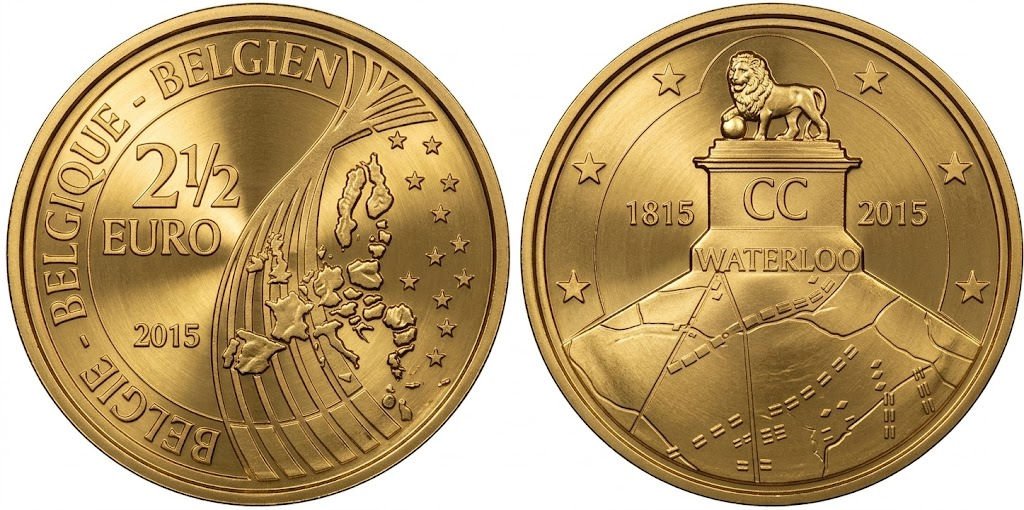
Thus, in June 2015, a commemorative 2.50 euro coin was issued – the first of its kind in Belgium. The series was limited to 70,000 pieces, and the coins were distributed primarily to collectors in special packaging.
The motif remained the same: the Lion's Mound and a stylized representation of the troop deployment at the battlefield of Waterloo.
Historical context and symbolism
The Battle of Waterloo, fought on June 18, 1815, near present-day Brussels, marked the final defeat of Napoleon and the end of his imperial ambitions. Allied forces led by the Duke of Wellington and Prussian forces achieved a decisive victory.
For Belgium, on whose territory the battle took place, this is an important historical site and part of the national heritage. For France, however, that event carries a completely different symbolism.
A precedent in European numismatics
This case raised an interesting question: where is the line between historical commemoration and political provocation? Interestingly, other countries have commemorated military victories in the past without international objections. Examples include French coins dedicated to the Normandy landings or Polish issues related to the Battle of Grunwald.
With this move, Belgium has shown that numismatics can also be a space for the creative “circumvention” of political restrictions. Although formally defeated in the first phase, it ultimately succeeded in realizing its issue.
Numismatic significance
A 2.50 euro coin from 2015 holds a special status among collectors today:
- it is the first Belgian issue of that denomination
- It arose as a result of a political dispute
- It has limited emission
- represents a unique example of how politics influences numismatics
Such circumstances often increase the interest of collectors, as coins acquire an additional “story” that goes beyond their nominal and aesthetic aspects.
Author: Zlatko Viščević with AI assistance