





Bimetallic coins, or coins made of two different metals, are an important part of many monetary systems today. As a rule, they consist of a central insert (core) and an outer ring made of different metal alloys that are permanently joined together into a single unit during coining.
Such a construction enables easier recognition of the denomination, increases resistance to counterfeiting, and gives the coin a recognizable visual identity. Although bimetallic coins are often considered a modern invention, the idea of combining different metals in a single coin or medal has a significantly longer history dating back to antiquity.
Earliest examples in antiquity
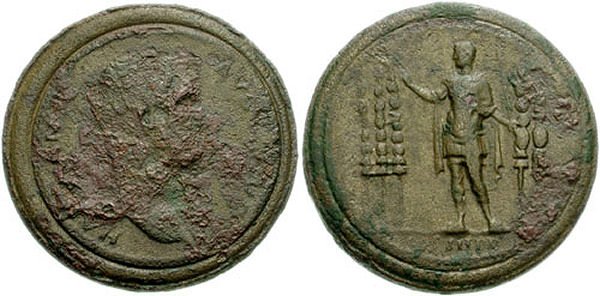
Some of the earliest known examples of bimetallic objects originate from the Roman Empire. As early as the period of Emperor Hadrian (117–138), large special commemorative medals were produced that had a central part made of bronze or copper, while the outer ring was made of orichalcum, a type of brass frequently used in Roman minting production.
Such medallions were intended primarily for gifting and ceremonial use, rather than everyday circulation. Nevertheless, they represent one of the earliest known examples of the deliberate combination of two metals in a single numismatic object.
Early modern examples
Genuine bimetallic coins intended for circulation appear only much later, in the early modern period.
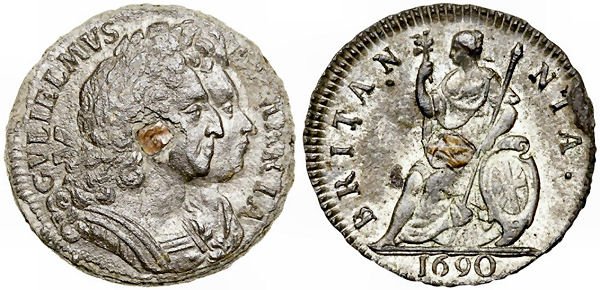
One of the more famous examples comes from late 17th-century England. Between 1684 and 1693, farthing coins made of tin with a small central copper insert were minted. The copper insert had an important function because it was meant to confirm the value of the coin and make counterfeiting more difficult, given that tin was a relatively cheap metal.
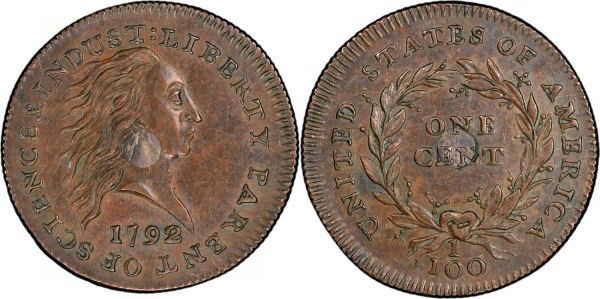
A similar idea appears in the early monetary history of the United States. In 1792, a famous pattern coin known as the „Silver Center Cent“ was produced. This coin featured a copper planchet with a small silver insert in the center to achieve the proper weight and metal value relative to its face value. Although it was an interesting experiment, the coin never entered regular circulation.
19th-century bimetallic tokens
In the first half of the 19th century, new attempts to apply bimetallic construction in monetary production appeared. Particularly interesting is the project of the British medallist Joseph Moore, who during the 1830s and 1840s produced large quantities of bimetallic tokens known as the „Penny Model“ and less frequently the „Halfpenny Model“.
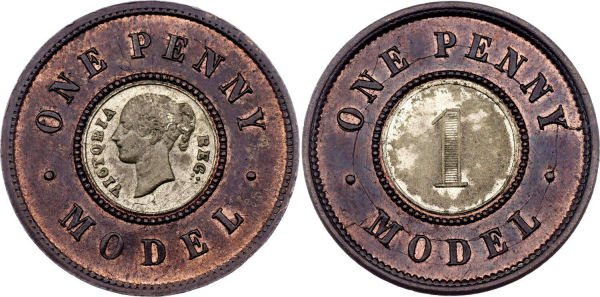
These tokens were conceived as a proposal for the reform of British fractional currency. Moore believed that the large and heavy copper penny and halfpenny should be replaced by smaller, bi-metallic coins that would be lighter yet still clearly recognizable.
Although these tokens were not an official legal tender, in practice they were very widespread in circulation. Many merchants accepted them at face value, which shows that the idea of a bimetallic coin already had practical appeal at that time.
Despite the popularity of these tokens, the Royal Mint rejected Moore's proposal. The size of British copper coins remained unchanged until the decimalization of the British monetary system in 1971, when new denominations of smaller dimensions were introduced.
Development of modern forging technology
Although earlier examples showed an interest in bimetallic structures, it was only the industrial development of minting technology in the 20th century that enabled their reliable and economical production.
A key breakthrough occurred in the field of precision metal plate machining, metal joining techniques, and high-pressure forging. This made it possible to permanently join the metal core and ring without the risk of them separating during circulation.

The Italian 500 lire as the beginning of the modern era
The first widely accepted modern bimetallic coin was the Italian 500-lira coin introduced in 1982.
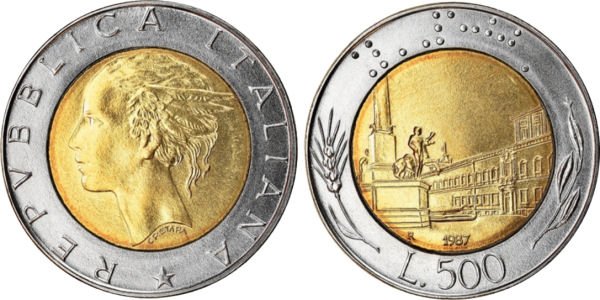
The coin consisted of a central part made of an aluminum-bronze alloy and an outer ring of stainless steel. In addition to technological innovation, the coin was also visually very distinctive.
This 500 Italian lira coin quickly became an example of the successful application of bimetallic construction, particularly due to its resistance to counterfeiting.
Global expansion of bimetallic coins
Following the success of the Italian edition, many countries began introducing similar denominations. During the 1980s and especially the 1990s, bimetallic coins became increasingly widespread worldwide.
Among the better-known examples are:
- 10 French francs from 1988
- 20 Mexican pesos from 1993
- 2 British pounds introduced in 1997
- 1 and 2 euros introduced in 2002
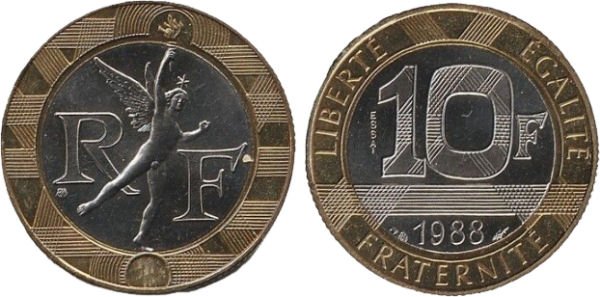
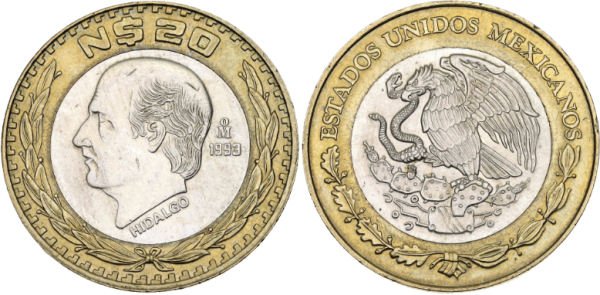
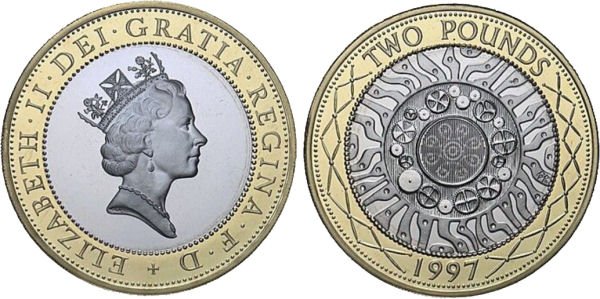
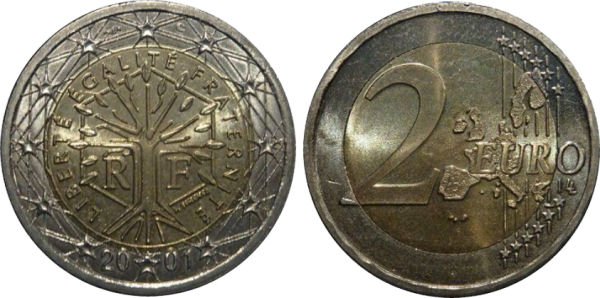
The 2-euro coins, which are among the best-known and most widespread bimetallic coins in circulation today, are particularly significant.
Croatian 25-kuna coins
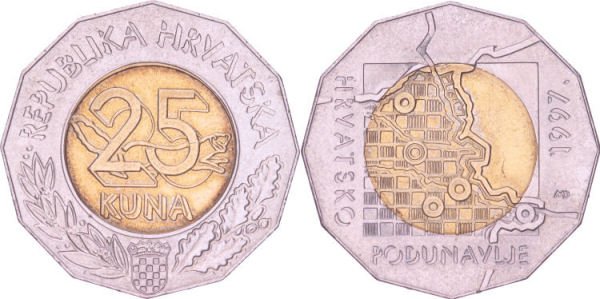
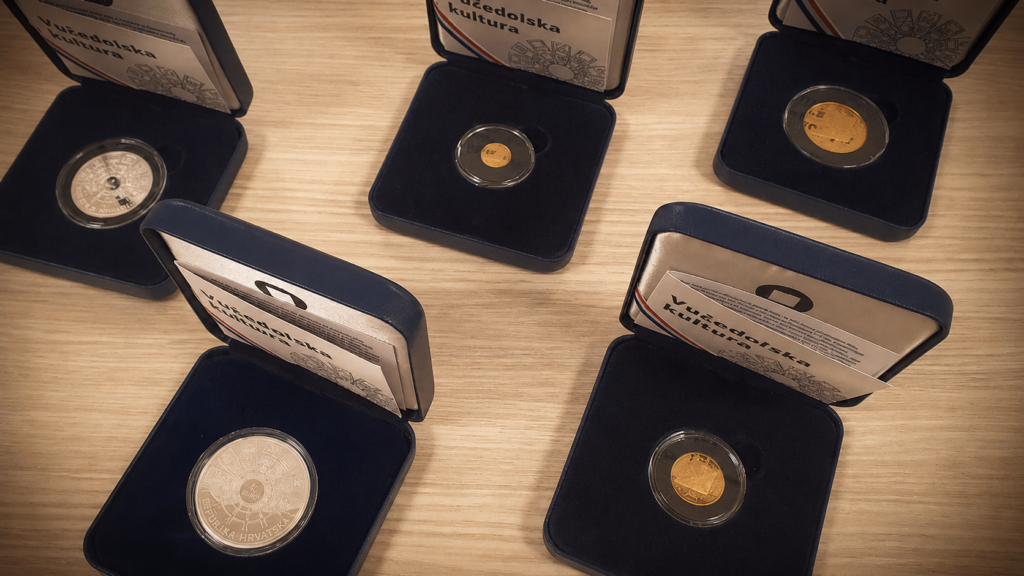
Croatia also used a bimetallic construction for the polygonal coin of 25 kuna, which was issued as a commemorative circulation coin. The first such coin was issued in 1997 on the occasion of the peaceful reintegration of the Croatian Danube region, and then over the following years, other commemorative variants with different motifs were also issued. The coin has cupronickel outer ring i brass central part, which gives it a characteristic two-tone appearance. Although they were formally intended for circulation, 25-kuna coins mostly ended up in numismatic collections due to their commemorative nature and relatively limited issues.
Manufacturing technology
The production of bimetallic coins requires very precise technology.
The process usually involves several steps. First, the metal core and outer ring are manufactured. Then, these parts are mechanically joined into a single plate. This is followed by final high-pressure forging.

During forging, the metal parts are permanently „locked“ into each other, creating a very strong and stable structure.
Bimetallic coins today
Today, bimetallic coins are an integral part of the monetary systems of numerous countries. They are most commonly used for higher denominations where additional security and a recognizable appearance play a particularly important role.
Aside from regular circulation coins, bimetallic construction is also frequently used for commemorative and collector issues because it allows for interesting design contrasts between the two metals.
From Roman medallions to early modern experimental coins and contemporary European denominations, the development of bimetallic coins shows how the idea of combining metals gradually evolved over the centuries until technological progress enabled its widespread application in modern monetary production.
Author: Zlatko Viščević
Photos: Classical Numismatic Group, Heritage Auctions, Katz Auction, Numex – Coins, Banknotes & Militaria Store, Numista.