



Among the numerous coins from the Roman Republic period, a special place is occupied by the silver denarius of Julius Caesar depicting an elephant crushing a snake or a dragon. This coin, minted in the year 49 BC, at the beginning of the civil war between Caesar and Pompey, represents one of the most recognizable examples of political propaganda on ancient coinage. Although it is a relatively common Roman Republican coin, the meaning of its motifs is still not fully clear even today.
Historical context: Caesar, Pompey and the civil war
The year 49 BC marked one of the most important turning points in Roman history. Gaius Julius Caesar, after successful military campaigns and conquests in Gaul, found himself in open political conflict with the Senate and his former ally, Gnaeus Pompeius Magnus.
In January 49 BC, Caesar crossed the Rubicon River with his army, which marked the border between his provincial jurisdiction and Italy. This act represented an open challenge to the authority of the Senate and the beginning of a new civil war.
Pompeii and a large portion of the senators left Rome, while Caesar advanced towards the capital. Soon he took control of a significant part of Italy and secured the resources needed to continue the military operations.
In ancient sources, Caesar’s attempt to obtain funds from the state treasury, located in Saturn’s temple in Rome, is also mentioned, where he clashed with the popular tribune Lucius Cecilia Metellus, who tried to oppose this procedure.
Conducting large military operations required extraordinary financial resources. It was necessary to pay soldiers, procure equipment, ensure supplies, and fund numerous other costs.
In such circumstances, Caesar began issuing his own money, among which the money with the elephant holds a special place.
The forging of Caesar's denarius with a lion
The Caesar money with the elephant belongs to the Roman Republican money from the period of the civil wars, which in numismatic literature is often also referred to as the imperial period.
This is the first large silver coin issue issued directly under Caesar's name.
The coin is usually dated to the 49th year of BC, although some numismatic catalogs list a broader period from 49 to 48 BC. The Classical Numismatic Group (CNG) auction house places its minting more precisely between April and August 49 BC.
The exact location of the minting is not reliably established. The prevailing opinion is that the money was produced by a mobile military mint that accompanied Caesar's army. The literature most commonly mentions northern Italy, while some researchers consider the possibility of minting in Gaul and Hispania.
Such military mints enabled the production of money close to military units, thereby facilitating the financing of military expeditions.
Technical data
- Country: Roman Republic
- Publisher: Gaius Julius Caesar
- Nominal: money (denarius)
- Metal Silver (AR)
- Molding time: 49 BC, according to some catalogs 49/48 BC.
- Mint a mobile military mint that accompanied Caesar's army
- Diameter: approximately 17 to 19 mm
- Table: approximately 3.8 to 4.0 g, with variations among individual specimens
- Rub: smooth
- Catalogues: Crawford 443/1; Sydenham 1006; RSC 49; Sear CRI 9; Sear 1399
A sample from archives of the Classical Numismatic Group auction house, The dial used to illustrate this article has a mass of 3.80 g, a diameter of 18 mm, and a 3-hour dial position.
The face of a denar
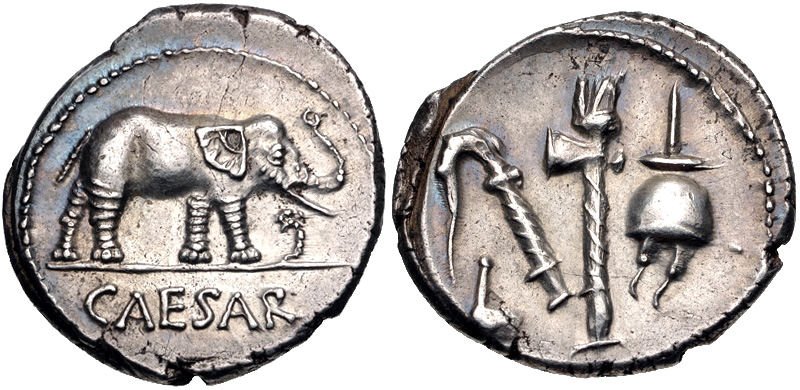
The face of the coin depicts an elephant walking to the right, with its trunk raised. Beneath its feet is an elongated animal that is traditionally described as a snake or a dragon, although there are also other interpretations.
The elephant is depicted with a powerful and pronounced body, with large ears, tusks, and a characteristic snout. On different examples, the details of its body can vary significantly, depending on the skill of the engraver and the molds used.
In the lower part of the display, below the horizontal line, is the inscription: CAESAR
The inscription is made in large Latin letters and represents the name of the issuer.
Beside the edge of the coin is a dot-shaped circle, a common decorative element of Roman Republican coinage.
The peculiarity of this side is not only the depiction of the elephant but also the direct highlighting of Caesar's name. It represented a clear political message about who is behind the issuance of the money.
The back of the banknote
The obverse of the coin depicts four objects related to Roman religious rituals and priestly duties.
The objects are arranged one next to the other, without any additional inscriptions.
Viewed from left to right, they are shown:
Simpulum, A ceremonial vessel or pitcher with a long handle. It was used to pour wine or other liquids during religious ceremonies. In some catalog descriptions, this object is also called „culullus”.
Aspergillum, A ritual spray used to spray water during purification rituals.
Securis, The ritual axe intended for sacrificial ceremonies. It is located in the central part of the composition in the depiction.
Apex, A characteristic clerical cap with a pointed tip. It was associated with certain Roman clerical ranks, especially the flamines.
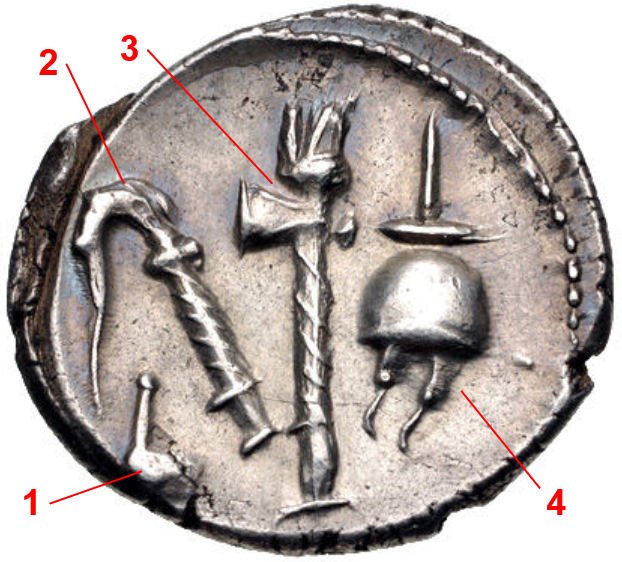
All four objects together create a clearly recognizable religious composition.
It is traditionally associated with Caesar's position as supreme priest of the Roman state, namely the „pontifex maximus”.
Caesar was elected to this position in the year 63 BC and held it until his death in the year 44 BC.
What does the elephant on Caesar's money represent?
In the ancient world, the elephant was an animal strongly associated with military power, royal authority, great conquests and victories.
The Romans came into contact with elephants during wars with the Hellenistic states and Carthage. Their size and strength made them a suitable symbol of superiority.
However, the meaning of the elephant on Caesar's denarius is not completely clear.
One of the most widespread interpretations is that the elephant symbolizes Caesar himself, his army, or the Roman state, while the animal under his feet represents the enemy.
In such a case, the overall result would represent a victory over the opponents.
Another interpretation links the elephant to Caesar's victories in Gaul. The depiction would thus resemble his earlier military successes and represent a kind of confirmation of his military abilities.
There is also the possibility that the elephant symbolically refers to Alexander the Great, whose military achievements and conquering glory were an important model for later military leaders.
Is there any connection between the elephant and Cezar's name?
An interesting interpretation links the depiction of the elephant with the origin of the name Caesar itself.
The late antique work „Historia Augusta” reports a tradition according to which one of Caesar’s ancestors acquired that name after killing an elephant in battle. According to this tradition, the word „caesai” referred to an elephant in one of the North African languages.
If this tradition had a historical basis, the depiction of the elephant and the inscription CAESAR could together represent a kind of visual play on words related to Caesar's family name.
However, the reliability of this etymology has not been confirmed. Since this is a much later literary source, it cannot be asserted with certainty that such a meaning was the intention of the coin's issuer.
Snake, dragon or Gallic battle drum?
An even more heated debate among numismatists is caused by an object or an animal that an elephant tames.
In traditional catalog descriptions, the snake, dragon, or horned snake is most often mentioned.
According to one interpretation, the elephant that bites the snake represents the victory of good over evil, or the overcoming of the enemy.
Michael H. Crawford associated the portrayal with the general idea of good defeating evil.
Other researchers link the motif with ancient traditions of hostility between elephants and large snakes.
Pliny the Elder describes in his work „Naturalis Historia” the conflicts between elephants and giant snakes. According to these traditions, the snakes attacked the elephants and wrapped themselves around their bodies, while the elephants tried to crush or strangle them.
Such descriptions confirm that the motive for the conflict between the elephant and the snake existed in the ancient worldview. However, Pliny's work was written after the coinage of Caesar's denarius, so it cannot be considered direct evidence of the meaning of the depiction.
Is it a Gaulish carnyx?
A particularly interesting theory is that the object under the elephant's feet is not a living animal at all, but a „carnyx”, a Celtic war horn.
The Carnyx was a long metal wind instrument characteristic of Celtic warriors, especially during the last centuries before Christ.
Its end often took the form of an animal's head with open mouth, and the instrument was used to give signals and to intimidate enemies.
If the Carnyx was indeed depicted on Caesar's coin, the symbolism would be much more concrete.
In that case, the elephant would represent Caesar or the Roman military force, while the muffled Gallic battle drum would symbolize his conquest of Gaul.
This would be particularly understandable at the time of issuing the money, immediately after the end of the great Gallic invasions.
However, there is no generally accepted evidence that this is indeed a carnyx. Some researchers believe that the depiction resembles a snake or a dragon, and that its interpretation as a battle horn is overblown.
It is also possible that the motive was deliberately ambiguous, so that it conveyed different political messages to different observers.
Religious symbols and Caesar's religious authority
Unlike the depiction of the elephant, the meaning of the ceremonial objects on the other side of the coin is traditionally considered much clearer.
Caesar was not only a military leader and politician. As the „pontifex maximus”, he played an extremely important role in the Roman state’s religious life.
This position was one of the most prestigious in the Republic and it brought great social and political influence.
The display of priestly objects could have reminded the public that Caesar, in addition to military power, possessed legitimacy derived from his religious position.
During the time of the civil war, such a message was of particular importance. Caesar sought to present his actions as a defense of the Republic and its institutions, rather than as their destruction.
A more recent interpretation of the priestly cap
However, the meaning of all the objects on the ceiling is not beyond the scientific debate either.
American historian Meghan J. DiLuzio in her work „Caesar as Salius: A Reconsideration of the Apex on Caesar’s Elephant Denarius (RRC 443/1)” published in 2018, questioned the conventional association of the depicted cap with Caesar’s position as supreme priest.
According to her interpretation, the apex could refer to Caesar's connection with the „Salii” priestly group, that is, the Salii, priests associated with the cult of the god Mars.
Such an interpretation would further link the religious iconography of the coin to the warrior symbols.
This is an important alternative interpretation that shows that even seemingly clearly recognizable motifs on ancient money can have multiple meanings.
Tsar's money as a means of political propaganda
Coins in the ancient world were not just a means of payment; they were also one of the most important ways of conveying political and religious messages.
The money passed through the hands of soldiers, merchants and the population on a daily basis, so the motives on it could reach a very wide circle of people.
Tsar's money with the elephant is particularly interesting because there is no portrait of him on it.
Instead, on one side is depicted a symbolic motif of military power, while on the other are found objects related to Roman religion.
The inscription CAESAR connects both messages to one person.
In this way, military power, religious authority, and personal political identity are combined on a small silver coin.
Such a method of coin design was an important step towards the later Roman imperial and imperial numismatics, in which the figure and name of the ruler would become central elements of iconography.
In the year 44 BC, just before his death, Caesar would also receive his own portrait on Roman coinage, further strengthening his personal position within the state.
Variations, issue and numismatic importance
Cesar's money with the elephant was produced in a very large quantity.
Michael H. Crawford estimated that approximately 750 molds were used for this coin and 833 for the other side of the coin.
Such a large number of molds indicates extensive production, which corresponds to the financing needs of Caesar's military forces during the civil war.
Due to the large emission, a significant number of preserved specimens are known.
However, the quality of their production is not uniform.
In some specimens, the elephant is drawn very carefully, with relatively correct anatomical proportions, while in others it is depicted simplified, with an unusual shape of the head, body or legs.
There are also differences in the design of the CAESAR inscriptions, the arrangement of the individual elements, and the appearance of the animal under the elephant's feet.
Such differences mainly result from the use of different molds and the manual forging technology itself.
Especially interesting are the examples with well-preserved reliefs, complete inscriptions, and clearly visible details of the priestly objects.
The numismatic value of an individual specimen depends on its preservation, the quality of the minting, the centering of the depiction, the surface, authenticity, and any special features.
Does our content help you?
Help others learn about numismatics and collecting for free. Your donation helps create new content and share knowledge.
By donating, you support the non-profit association NumizmatikaNET.
 Donate
Auction results of Caesar's denarius with a lion from 2021 to 2026
The Caesar money with the elephant regularly appears at international numismatic auctions. Although it is a relatively common type of Roman Republican money, its historical importance and direct connection with Julius Caesar ensure its enduring interest among collectors.
Below we present a selection of auction results that illustrate the different degrees of preservation and the prices achieved.
All prices listed are expressed in euros and represent the auction prices achieved, excluding the auction commission and other costs for the buyer. The countervalue in euros of the results originally obtained in other currencies has been adopted and displayed in the submitted database.
| Auction house, date of auction | Conservation | Price in EUR / status |
|---|---|---|
| Classical Numismatic Group, 15.09.2026. | VF+ | 2.598 EUR |
| Heritage Auctions, 08.09.2026. | NGC Ch AU | 11.186 EUR |
| Heritage Auctions, 01.09.2026. | NGC Ch XF | 3.620 EUR |
| Gerhard Hirsch successor, 06.05.2026. | VF+ | 800 EUR |
| Heritage Auctions, April 29, 2026. | NGC XF | 1.540 EUR |
| The Coin Cabinet, 23.04.2026. | VF | 518 EUR |
| Jesús Vico, 05.03.2026. | VF+ | 1.150 EUR |
| Gerhard Hirsch successor, 11.02.2026. | XF | 2.000 EUR |
| Heritage Auctions, 06.11.2025. | NGC Ch AU | 9.958 EUR |
| Stack’s Bowers Galleries, September 17, 2025. | NGC Ch AU | 1.861 EUR |
| Heritage Auctions, 03.08.2025. | NGC Ch XF | 820 EUR |
| Heritage Auctions, 03.08.2025. | NGC XF | 1.208 EUR |
| Heritage Auctions, 03.08.2025. | NGC AU | 2.675 EUR |
| Tauler & Fau Subastas, 21.04.2025. | F | 270 EUR |
| Concordia Numismatic, 23.01.2025. | VF | 550 EUR |
| Heritage Auctions, 01.12.2024. | NGC VF | 910 EUR |
| Heritage Auctions, 04.08.2024. | NGC XF | 2.750 EUR |
| Fritz Rudolf Künker, 21.05.2024. | F | 330 EUR |
| Heritage Auctions, 05.05.2024. | NGC MS | 16.731 EUR |
| Roma Numismatics Limited, April 24, 2024. | XF+ | 698 EUR |
| Fritz Rudolf Künker, March 14, 2024. | XF | 1.200 EUR |
| Harlan J. Berk, February 13, 2024. | F | 1.681 EUR |
| Heritage Auctions, November 1, 2023. | NGC VF | 1.086 EUR |
| Heritage Auctions, August 17, 2023. | NGC XF | 1.471 EUR |
| Roma Numismatics Limited, 03.08.2023. | VF- | 279 EUR |
| Heritage Europe, 22.05.2023. | VF | 550 EUR |
| Stack’s Bowers Galleries, 16.05.2023. | NGC AU | 2.393 EUR |
| Heritage Auctions, April 19, 2023. | NGC XF | 776 EUR |
| Heritage Auctions, January 17, 2023. | NGC MS | 11.120 EUR |
| Classical Numismatic Group, 14.12.2022. | F | 562 EUR |
| Tauler & Fau Subastas, 22.11.2022. | VF | 850 EUR |
| Classical Numismatic Group, 11.05.2022. | VF | 5.232 EUR |
| Bertolami Fine Arts, 13.03.2022. | F+ | 260 EUR |
| Auktionshaus Christoph Gärtner, 15.02.2022. | VF | 1.250 EUR |
| Heritage Auctions, January 18, 2022. | NGC XF | 1.633 EUR |
| Heritage Auctions, January 18, 2022. | NGC AU | 2.736 EUR |
| Heritage Auctions, 22.12.2021. | NGC VF | 971 EUR |
| Roma Numismatics Limited, 16.12.2021. | XF+ | 1.293 EUR |
| Harlan J. Berk, November 30, 2021. | VF | 530 EUR |
| Rhenumis by Felzmann & Fischer, 24.11.2021. | XF | 1.700 EUR |
| Soler y Llach, 26.10.2021. | UNC | 3.400 EUR |
| Heritage Auctions, August 19, 2021. | NGC Ch MS | 11.133 EUR |
| Bertolami Fine Arts, 09.01.2021. | F+ | 288 EUR |
In the certified specimens, the labels of the certification houses have been retained. The abbreviation „Ch” stands for „Choice”, that is, the higher level within the specified category of preservation.
The evolution of auction prices from 2021 to 2026
For the purposes of this article, an analysis was conducted of 1,488 auction results with recorded price achieved, which shows that Cezar’s elephant money is sold across a very wide price range.
The total average price in the analyzed period amounts to 991 EUR, while the arithmetic mean is approximately 1.322 EUR.
The difference between the median and the average is the result of, among other things, individual extremely high results that raise the average value.
The annual average prices were:
- 2021.: 1.080 EUR, based on 179 records with a price.
- 2022.: 1.055 EUR, based on 274 records.
- 2023.: 931 EUR, based on 319 records.
- 2024.: 915 EUR, based on 285 records.
- 2025.: 974 EUR, based on 260 records.
- 2026.: 1.200 EUR, based on 171 records as of October.
According to these data, the median price was lowest in 2024, followed by an increase in 2025 and 2026.
However, such data should not be automatically interpreted as evidence of overall growth in market value. The results of individual years are significantly influenced by the composition of the offered material, the levels of preservation, the number of certified specimens, auction houses, and currency conversions.
The impact of preservation on the price
One of the most important factors influencing the value of this currency is its preservation.
Less-well-preserved specimens can be obtained at auctions for a few hundred euros, while better-preserved specimens are regularly sold for amounts exceeding a thousand euros.
Examples in the XF collection, especially those with well-centered images, high-quality relief and an attractive surface, often achieve significantly higher prices.
Examples that are certified by internationally recognized certification houses can have additional value, especially when it comes to high levels of preservation such as NGC AU or NGC MS.
However, certification alone does not guarantee a high price. The quality of the workmanship, the condition of the surface, traces of cleaning, damage, patina, and the overall visual appeal of the piece also play a significant role.
Highest auction results
Particular attention is drawn to the best-preserved specimens, which reach prices several times higher than the median value.
The highest recorded result in the analyzed database was achieved May 5, 2024, When the money certified by the NGC MS grading mark was sold at the Heritage Auctions auction, it was sold for approximately 16.731 EUR.
High results were recorded in other years as well.
At the Heritage Auctions auction on August 19, 2021, the NGC Choice MS label version achieved approximately 11.133 EUR, while on January 17, 2023, the second NGC MS label version achieved approximately 11.120 EUR.
Among the more recent results is the sale at Heritage Auctions on September 8, 2026, when a specimen certified as NGC Choice AU achieved approximately 11.186 EUR.
Such prices show how collectors value the superbly preserved specimens of one of the most historically important Roman denarii.
At the same time, it should not be ignored that specimens that are less well preserved or damaged can be sold at much lower prices.
Especially low results should therefore be viewed in conjunction with data on mass, damage and authenticity, and not as the usual lower market limit.
What do the auction results tell us?
The large number of recorded sales shows that Caesar's denarius with the lion is not a particularly rare coin in numismatic terms.
Its importance stems primarily from its historical context and the fact that it is associated with one of the most famous figures in ancient history.
For this reason, it attracts different groups of collectors: collectors of Roman Republican coins, imperial issues, and money associated with great historical figures, but also collectors who want to own one representative coin of Julius Caesar.
On the other hand, the high results of the best-preserved specimens confirm that quality can be more important than the frequency of occurrence of a particular type itself.
It is precisely this combination of historical importance, recognizable iconography, and relatively high availability that makes Caesar's Denarius with the elephant one of the more interesting types of ancient coinage on the modern numismatic market.
Historical importance of Caesar's denarius with a lion
Although at first glance it represents only one of numerous Roman Republican denarii, Caesar's obelisk coin is linked to events that ultimately led to the disappearance of the Roman Republic.
It arose at a time when Caesar was striving to establish political and military supremacy over his opponents, and its motives testify to the way in which power was presented to the Roman population and army.
At the same time, it raises a series of questions about ancient symbolism.
Did the elephant depict Caesar himself? Did the animal under his feet represent Pompey, the Gallic enemies, or the general victory over evil? Or was it a deliberate play on symbols that contemporaries understood in more than one way?
There is still no definitive answer to these questions.
Precisely because of this, Caesar's money with the elephant remains an extremely interesting subject of numismatic study, in which we encounter political history, Roman religion, ancient art, and symbolism.
Sources and literature
- Crawford, Michael H. „Roman Republican Coinage”. Cambridge University Press, 1974. Catalog number 443/1.
- Classical Numismatic Group. „The Caesarians. Julius Caesar. AR Denarius. Military mint traveling with Caesar”. Example no. 506876.
- Macquarie University, Australian Centre for Ancient Numismatic Studies. „Crossing the Rubicon: The Coins of 49 BC”.
- Australian National University, Classics Museum. „Denarius of Julius Caesar”, catalog number 2007.01.
- British Museum. „Roman Republican Coin, Julius Caesar”, museum number 1985.0421.18.
- DiLuzio, Meghan J. „Caesar as Salius: A Reconsideration of the Apex on Caesar’s Elephant Denarius (RRC 443/1)”. American Journal of Philology, 139/2, 2018., pp. 249–276.
- Pliny the Elder. „Naturalis Historia”, book VIII, chapters 11–12.
- „Historia Augusta”, Vita Aelii, 2.3.
- Coin Talk. „Caesar’s Elephant and Snake: What Do They Mean?!?”, a numismatic discussion about the symbolism of the denarius.
Edited: Zlatko Viščević with AI assistance
Photos: Classical Numismatic Group (CNG)
Did you notice an error in the text or a linguistic inconsistency? Please report it to us via the page for Contact how we could fix it. Thanks in advance!
Was this article useful to you?
Help others learn about numismatics and collecting for free. Your donation helps create new content and share knowledge.
By donating, you support the non-profit association NumizmatikaNET.
Donate