
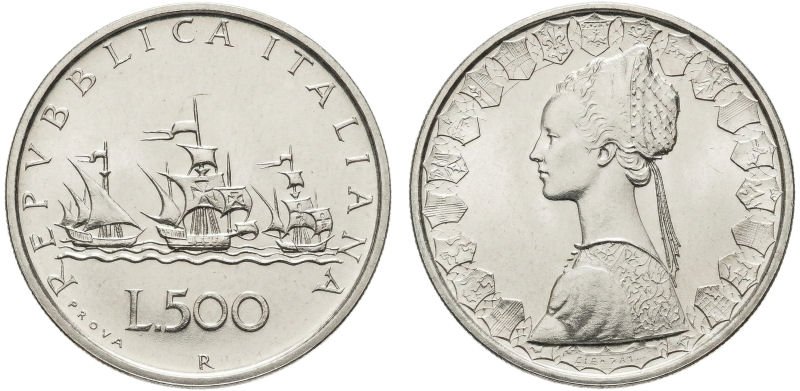
The 500 lira silver coin, issued in the late 1950s, represents one of the most famous and intriguing emissions of modern Italian numismatics. It was created during a period of favorable economic conditions, when Italy, following the devastation of war and post-war reconstruction, was gradually returning to stability and prosperity. At the same time, there was a need to align with other European countries that, after a wartime hiatus, had resumed minting silver circulating coins.
Under those circumstances, Parliament approved the issuance of a 500-lira circulating silver coin. The then Minister of Finance, Giuseppe Medici, commissioned the chief engraver of the Italian Mint, Pietro Giampaolo, to design the first silver coin of post-war Italy.

The search for the symbol of the Republic
All originally proposed designs for the reverse side were imbued with the symbolism of the young Italian Republic. Motifs appeared of a woman's bust or head in the Renaissance spirit, a bareheaded female head or one wearing a Phrygian cap decorated with ears of wheat. On the obverse, motifs alternated between roses, carnations, lilies, Verrocchio's David, as well as a peasant with a plow and a pair of oxen.
Minister Medici strongly supported the idea that the obverse must bear a clear message of national renewal. The choice fell on a Renaissance female figure surrounded by 19 coats of arms. This was intended to emphasize that Italy, following the sufferings of war and the efforts of reconstruction, is entering a new era, a sort of modern Renaissance.
It is interesting that Giampaoli adopted the motif from a medal he had made himself in 1947. On it, he depicted his wife Letizia Savonitto in Renaissance clothing and at a youthful age. The medal was made on the occasion of the tenth anniversary of their marriage, and the reverse depicted their four children. It was exhibited in 1949 at the Numismatic Exhibition in Paris, where the distinguished expert Babelon praised it as the best exhibit of the show.
Nineteen coats of arms as a symbol of state unity
Around the female figure on the reverse side are 19 coats of arms of Italian cities or regions. Starting from the bottom left, they are: Genoa, Turin, Aosta, Milan, Trento, Venice, Trieste and Udine, Bologna, Florence, Ancona, Perugia, Rome, L'Aquila, Naples, Bari, Potenza, Catanzaro, Sicily, and Cagliari. The last two coats of arms are partially obscured by the bust.
Although the artistic value of the coin was almost unanimously praised, a section of the expert public pointed out heraldic inconsistencies: the coats of arms did not represent the regions, but their administrative centers.
Three caravels and „problematic“ flags
The artistic designs that Giampaoli initially proposed for the obverse did not prove sufficiently aligned with the Renaissance symbolism of the reverse. Therefore, the sculptor and medalist Guido Veroi proposed the motif of Columbus's three caravels as a strong symbol of Italy's exploratory spirit and historical greatness.
It was precisely these caravels that caused the biggest controversy. Namely, in the original version, the three flags at the tops of the masts were turned to the left, that is, against the direction of the wind. Some experts considered this an obvious mistake, claiming that flags never flutter against the wind. Others, however, defended the solution as a depiction of sailing close-hauled, with the wind almost opposite to the direction of travel. However, in such a case, the sails would have to be depicted narrow, like thin crescent moons seen in profile, rather than wide and inflated as they were on the coin.
The Commission ultimately decided to adopt a simpler solution that is more understandable to the general public: the flags are facing to the right. It was considered more appropriate to avoid interpretations understandable only to a narrow circle of sailing experts, since this is a circulation coin intended for everyday use.
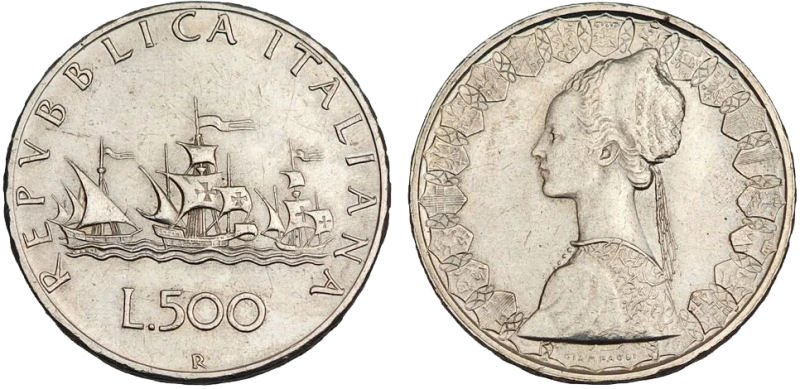
1957 Caravelle trial.
Before the modification, 1004 trial pieces with the flags turned „incorrectly” and with the year 1957 in relief on the rim had already been minted. These specimens were distributed to deputies, senators, and high-ranking state officials. Subsequent investigations by the Financial Police, conducted on trials and projects from the Kingdom and Republic periods, showed that the number of minted trial pieces was greater than 2200.
A new minting die was made for the sake of correction. The differences between the trial piece and the regular coin are clearly visible:
- flag direction (left for rehearsal, right for regular broadcast),
- absence of the PROOF inscription on a regular coin,
- on the rim of the 1957 trial piece, there is the letter „U” in the word REPUBBLICA (modern spelling), and the stars before and after the date are completely in relief (filled),
- regular coins from 1958 onwards have the shape REPVBBLICA, according to the older, Latin spelling, and the stars are only outlined in relief (not filled),
- on the trial coin, the engraver's name VEROI does not appear among the sea waves on the left,
- There are also minor differences in the drawing and letter details.
The most famous silver coin
The silver 500 lira coin featuring the caravel motif is an exceptional blend of artistic ambition, national symbolism, and technical controversy. Its aesthetic value was almost unquestionable, but the details (especially the direction of the flags) entered numismatic history as an example of how even the smallest design element can spark debate among experts and the general public.
Today, the 1957 pattern coin holds a special place in collections, while the regular coin from 1958 and subsequent years remains one of the most recognizable Italian silver coins and an enduring symbol of post-war recovery and a new national revival.
More about the „Caravel“
A more detailed article on the history and creation of this famous Italian coin is featured on the website of Italian numismatist Umberto Moruzzi. The article was translated into Croatian using Google Translate. The first part of the article is here, and the second part here.
Edited: Zlatko Viščević
Photos: Numex – Coins, Banknotes & Militaria Store [www.numex.hr]