


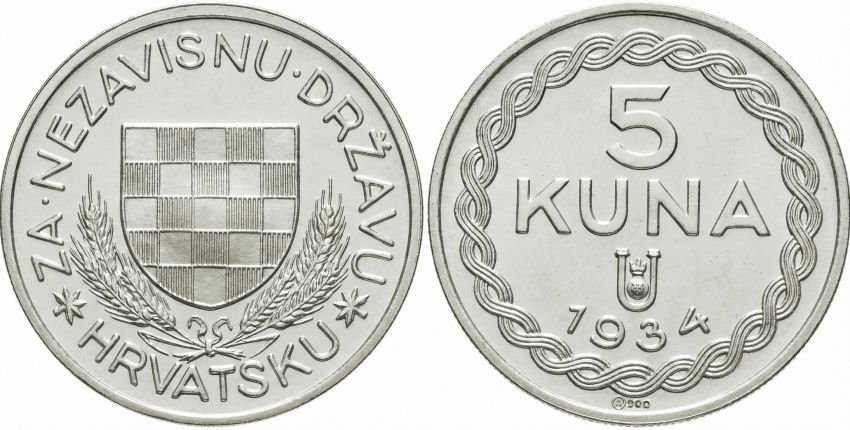
The 5-kuna silver coin minted in 1934 has been written about on several occasions, and several, sometimes contradictory, conclusions have been reached regarding it. Original documents from Belgrade, available in microfilm form at the Croatian State Archives, shed light on many details about the activities of the Ustasha movement in Italy, whose goal was the introduction of the currency unit „kuna” (which was to be divided into 100 banicas). Regulations of the Main Ustasha Headquarters published in 1934 discuss the reasons for introducing the aforementioned names, describe the 5-kuna coins, provide an exchange rate against the major world currencies of the time, and precisely determine the salaries in kunas to be received by officials, chaplains, and military and administrative officers. It is concluded that the coins were indeed issued in 1934, not as a commemoration of the assassination of King Alexander, but as the first step toward introducing a new currency, first within the ranks of the Ustasha movement and later, in a then-undefined future, in Croatia. The documents, on the other hand, confirm that no buying and selling was conducted with this money, regardless of the detailed instructions, and salaries were not truly paid in kunas; instead, the coins were purchased by members of the Ustasha movement as a keepsake. Further production of kunas and banicas was prevented by the reaction of Italy, which, following the assassination of King Alexander, interned Ante Pavelić and later disabled the operation of the entire Ustasha organization.
Over the past decades, several authors have casually or in detail described the 5-kuna coin from 1934 issued by the Croatian emigrant organization officially named “Ustaša – Croatian Revolutionary Organization”, commonly referred to as the Ustaša Movement. This money was written about, among others, by Broz(1), Gvozdanović(2), and Krasnov(3), while in more recent times it has been discussed by Prebeg(4). All correctly conclude that this was not money in the true sense of the word, either because at that time there was no state to officially issue the coins, because of the opinion that these were trial pieces, or because this money did not actually have purchasing power in Italy. Krasnov further expresses the opinion that the aforementioned coins were made as a remembrance of the successful assassination of King Alexander in Marseille in 1934, which was jointly organized by the Ustaša Movement and the Macedonian organization VMRO.(5)
Ante Pavelić, the leader of the Ustasha movement, says in his book Doživljaji that the idea for the name „kuna" for the currency unit is his, and continues:
„KUNA. The name I gave to that monetary unit was reminiscent of the historical name of the marten fur, which in the distant past was a medium of exchange in our homeland, especially in the Danube region, and was considered the soundest medium of exchange.“ (6)
Regarding the widespread use of the 5-kuna currency, Pavelić is probably exaggerating because he says this about it:
„This five-kuna silver coin, which we minted within the activities of our Ustaše Movement, very quickly spread throughout the homeland. The silver for minting came from the homeland. For this purpose, many families sent us their silver items and quantities of buttons, as well as other jewelry from rich women's and men's national costumes. To the hundredth part of this coin, we gave the name BANICA, which corresponded to the old name of the coin minted by the Croatian bans. The value of the minted five kunas was 1.25 Swiss francs. The demand for these five kunas was high, and people paid as much as 200 dinars for them.“ (7)
However, it is evident from documents in the Croatian State Archives(8) that plans for the introduction of the kuna as the official currency were far-reaching and worked out in considerable detail. On March 30, 1934, the Main Ustasha Headquarters (a type of command or headquarters that directed the work of the Ustasha movement) issued Decree No. 23a/34 on the establishment and minting of Croatian currency; unfortunately, this decree is not to be found in the archive, and we learn about it indirectly through Decree No. 50/34 on the management of Croatian minted currency dated September 13, 1934.9 Already from these dates it is clear that the thesis about the minting of the currency as a commemoration of the assassination of King Alexander does not hold up, because that assassination took place on October 9, 1934.
However, as early as March 30, 1934, the Main Ustasha Headquarters issued Decree No. 24/34 on Ustasha pay and allowances.(10) According to this Decree, „service in the Ustasha ranks is as a rule honorary, and is not associated with any right to pay or allowances,“ but in cases where a member of the Ustasha movement was forced to leave their profession due to the performance of their duty, the Main Ustasha Headquarters was authorized to grant such a member a salary (so-called pay – for non-commissioned officers and soldiers, or allowances – for officers) as long as the need for it existed. The decree built upon Decree No. 2/34 on the Ustasha officer corps, which defined the ranks of all branches of the Ustasha movement and divided the members of the movement into:
a) the officer corps of the “Ustaše” – the Croatian revolutionary organization,
b) administrative officers and non-commissioned officers of the Croatian Ustasha Army,
c) military officers and non-commissioned officers of the Croatian Ustaše army.(11)
The officer corps of the Ustaše movement included Poglavnik's *doglavniks*, *pobočniks*, and envoys, as well as Ustaše commissioners. Administrative officers and non-commissioned officers were (ranked from highest to lowest): administrative commander, deputy administrative commander, assistant administrative commander, departmental manager, adjutant to the administrative commander, deputy departmental manager, assistant departmental manager (these formed the administrative officers), supervisor, senior overseer, overseer, and assistant overseer (these formed the administrative non-commissioned officers). Military officers were divided into highest military officers (*ratovođa*, *nadvojskovođa*, and *vojskovođa*), senior military officers (*krilnik*, colonel, and *četnik*), junior military officers (captain, first lieutenant, and lieutenant), officer candidates (ensign and officer candidate second class), senior military non-commissioned officers (sergeant), and junior military non-commissioned officers (corporal, squad leader, assistant squad leader).(12)
According to the Decree on Ustaše Rations and Allowances, the basic ration for an Ustaše without rank was 10 banica per day, and it was supposed to be paid for every 10 days in arrears. For Ustaše military and administrative NCOs, the ration was:
- for the road worker and the overseer, 12 and a half banitsa a day,
- for the rector and the supervisor 15 banicas per day,
- for the driver and the overseer 17 and a half bani daily,
- For the guide and the supervisor, 20 banica per day.
Officers (military and administrative) received allowances that were supposed to be paid every month:
- for the lieutenant and adjutant of the departmental manager 50 kuna per month,
- for senior lieutenant and deputy departmental manager 75 kuna per month,
- for the captain and the adjutant of the administrative commander 100 kuna per month,
- 150 kunas per month for a Chetnik and a departmental manager,
- for the colonel and the deputy administrative commander 175 kuna per month,
- for the adjutant and deputy of the administrative commander 200 kuna per month,
- for the military leader and administrative commander 250 kuna per month,
- for the archduke 275 kuna a month,
- for the war leader 300 kuna per month. (13)
According to the Poglavnik's decree, the Main Ustaše Headquarters was to determine regular allowances and the family allowance „according to local and official needs,“ and it could also authorize administrative commands to independently determine regular allowances for administrative and military officers and non-commissioned officers in their area, but up to a maximum of tenfold the amount of the base salary and up to a maximum of threefold the amount of the base allowances. (14)
The regulation did not set any salary for the deputy leaders, but it stipulated that allowances could be granted to the leader’s adjutants, envoys, and commissioners who were „permanently appointed to certain places for the exclusive performance of Ustaše service“ according to „local conditions and needs.“ Likewise, it was stipulated that members of the Ustaše Movement who became unable to work due to the performance of their duties, or the families of those killed, would be granted a temporary or permanent pension „within the limits of possibilities.“ (15)
At the very end, in Article VIII, the provision once again emphasized that the Croatian currency is called the "kuna" and is divided into one hundred "banke.".
On April 20, 1934, Decree No. 30/34 on Ustaše chaplains was issued, which provided for the introduction of military chaplains within the military units of the Ustaše Movement: an Ustaše spiritual shepherd who was supposed to stand „at the head of the spiritual flock of all Ustaše mobile forces,“ Ustaše parish priests who were supposed to be „at the head of the spiritual flock of individual areas, i.e., armies,“ and Ustaše chaplains whom the Main Ustaše Headquarters, upon the proposal of the Ustaše spiritual shepherd, was to assign to individual military units. The following allowances were determined for them:
a. Ustasha spiritual shepherd – 250 kuna per month,
b. Ustaše priest – 150 kuna per month,
c. Ustasha priest – 100 kuna per month. (16)
The Main Ustaše Headquarters could also determine allowances for them up to a maximum of triple the amount of the salary. Pursuant to the aforementioned Decree on the Management of Croatian Coinage of September 13, 1934, the „Treasury of the Main Ustaše Headquarters“ was established within the framework of the Main Ustaše Headquarters, headed by a „Treasury Commission“ consisting of the treasurer of the M.U.H. and two members appointed by the *Poglavnik*. In handling the coinage, the treasury was required to adhere to the following rules:
1) All minted money shall be initially deposited in the treasury of the Pjeneznica, and issued from it as needed, with the approval of the Main Ustaše Headquarters.
2) The cashier shall enter into the primary ledger of the Mint, in chronological order and accurately, every quantity of minted coin by pieces and nominal value, as soon as it is minted and delivered to the Mint's treasury.
3) Upon the entry of coins, the corresponding gold value and the value in Swiss francs at the time of entry into the cash book shall also be indicated, which value is determined on the basis of the ratio established by the aforementioned Decree of the Main Office for State Accounting on the establishment and minting of Croatian currency.
4) The Treasury of the Main Ustaše Headquarters shall issue minted currency only upon prior payment of the corresponding equivalent value in various currencies, which it must immediately convert into Swiss currency and invest with high security, so that every issued piece of minted currency is backed by Swiss francs at its nominal value.
5) The minted coins were to be put into circulation within the Ustasha organization upon prior payment of the equivalent value, so that they would be distributed proportionally among individual organizations and individuals.
6) To every bearer or returner of original coinage, the nominal equivalent in Swiss francs must be paid upon request, based on the value ratio of the day on which the coinage in question was entered as a type in the ledger of the Mint (Pjeneznica).
Alongside the Decree on the Management with Croatian Minted Money, there is a rather long „Note” on a separate page explaining the reasons for introducing the names „kuna” and „banica,” describing the 5-kuna coin, and featuring an exchange rate list showing the value of the coin. The explanation regarding the name „kuna” is already known, but it is nonetheless worth quoting the official reasons as presented in the Decree:
The name money comes from the name of ancient Croatian currency. At the time when the independent Croatian state was founded over a thousand years ago, marten fur was used as a medium of exchange, therefore as money, among the Croatian people. As is well known, marten fur is good, expensive, and always of unchanging value, so it could be used to make payments for various other goods, just as it is done today in the world with valid money that has a valid gold backing. Fur, especially from certain animals, always has a constant and lasting value just like gold metal.
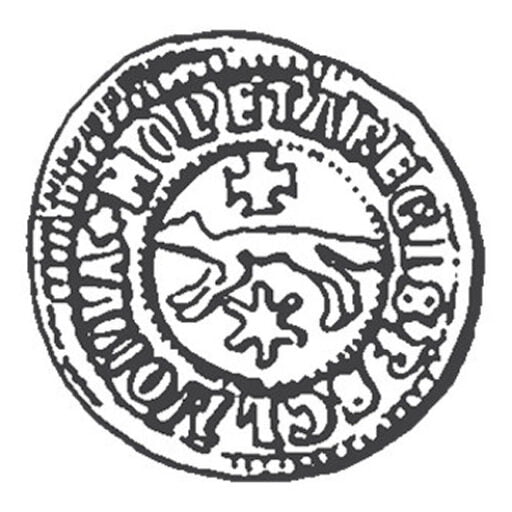
In the Croatian lands there were quite a few martens, especially in Slavonia, whereas in other lands they were not abundant, and that was also one of the reasons why marten fur was used as a means of payment in Croatia, because other nations gladly accepted this means of payment from Croatia in exchange for other goods and commodities. Slavonia was particularly abundant in martens, which is why the marten is also found in the Slavonian coat of arms (running on a blue field between two silver stripes, which represent the two Croatian rivers, the Sava and the Drava, between which Slavonia lies).(18)
The name „banica” is briefly explained as follows: it is money „minted by Croatian bans, and it is still mentioned among the people today.”(19)
Furthermore, the Note points out that the 5-kuna silver coin has already been minted and that the money is in the „Pjeneznica” and will be immediately put into circulation within the Ustasha organization. The Note also provides a description of the 5-kuna coin (the description does not match the exact appearance of the coin):
The 5-kuna coin is very fine and tasteful, of heavy silver content. On one side is the Croatian coat of arms, wreathed with ears of wheat and surrounded by the inscription: “For a free and independent state of Croatia”. On the other side, “5 kuna” is written in the middle, below that the Ustaše symbol and the year 1934, all framed in a wreath made of interlace, as the oldest Croatian ornamentation. (20)
At the end of the Note, an exchange rate list is published showing the value of the 5-kuna coin against 13 world currencies (the table is reproduced without changes). (21)
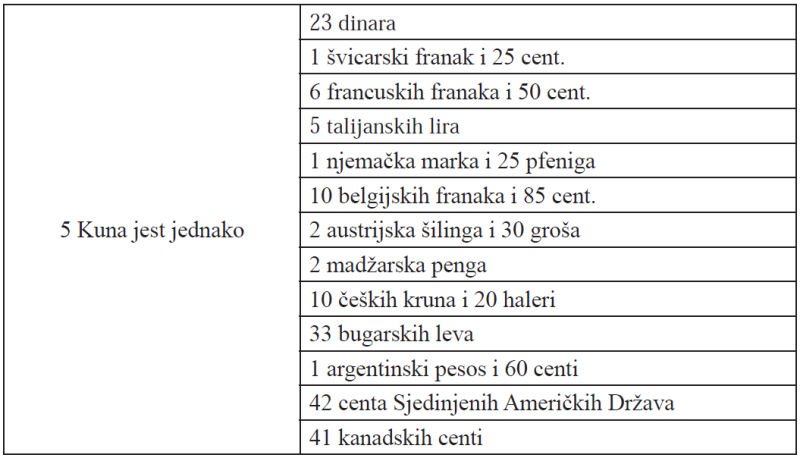
Coins („silver five-kuna pieces”, as the Note calls them) were issued to Ustaše organizations and individuals at the exchange rate specified in the table.
There is no doubt that the minting of the kuna in other denominations would have continued in the future had it not been for Italy's reaction to the assassination of the Yugoslav King Alexander on October 9, 1934. Ante Pavelić was arrested, and the members of the Ustasha organization were first interned on the Lipari Islands, and after the signing of the agreement between Italy and Yugoslavia in 1937, they were dispersed to several locations in southern Italy and Sardinia and placed under heightened surveillance. All plans for minting money were thus halted, and the 5-kuna silver coins are a great rarity today.
Documents from the Croatian State Archives prove that the silver coins were indeed minted in 1934 and entered a form of limited circulation (where it is indeed most likely that members of the Ustasha movement purchased them as souvenirs), that there were well-developed plans and regulations regarding the handling of minted currency, and that, given multiple provisions concerning the salaries of movement members in kunas and banicas, the minting of other denominations and the introduction of kunas and banicas into broader use were planned. Nevertheless, it is evident that no commercial transactions were carried out with the 5-kuna silver coins, nor were salaries paid in this currency (for which there was no longer even time). Unfortunately, it was not possible to conclude from the documents how many coins were minted.
References
- Broz, Petar: The Coinage of the so-called Independent State of Croatia during the Occupation of Yugoslavia from 1941-1945, Numizmatičke vijesti, no. 25, Zagreb, 1967, pp. 31-40.
- Gvozdanović, Nenad: On the Coins of the Independent State of Croatia, Numismatic Bulletin, no. 1, Split, 1980.
- Croatian State Archives, microfilm D-2250 (ZM 53B/130) (MF : 130) (181). The numbering of individual documents can be seen in the text.
- Krasnov, Đuro: Problems of the Coinage of the Independent State of Croatia (1941–1945), Numizmatičke vijesti, no. 41, Zagreb, 1987, pp. 71–87.
- Pavelić, Ante: Doživljaji – Kako sam osnovao NDH (Experiences – How I Founded the NDH), Despot Infinitus, Zagreb, 2015. Prebeg, Darko: Probni kovani novac NDH (Trial Coins of the NDH), http://povijest.net/v5/pepeze/2007/probni-kovaninovac-ndh/, accessed September 25, 2014.
Notes
1. Broz, Petar: The Coins of the so-called Independent State of Croatia during the Occupation of Yugoslavia from 1941–1945, Numizmatičke vijesti, no. 25, Zagreb, 1967, pp. 31–40.
2. Gvozdanović, Nenad: On the Coins of the Independent State of Croatia, Numizmatički vjesnik, no. 1, Split, 1980.
3. Krasnov, Đuro: Problems of the Coinage of the Independent State of Croatia (1941–1945), Numizmatičke vijesti, no. 41, Zagreb, 1987, pp. 71–87.
4. Prebeg, Darko: Trial coins of the NDH, http://povijest.net/v5/pepeze/2007/probni-kovaninovac-ndh/, accessed September 25, 2014.
5. Krasnov, n. d.
6. Pavelić, Ante: Experiences – How I Founded the NDH, Despot Infinitus, Zagreb, 2015, p. 85.
7. Ibid.
8. These are microfilms of original documents kept in the former Archive of the Military History Institute in Belgrade. Further in the notes, the numbering of the microfilms from the Croatian State Archives and the numbering according to the Archive of the Military History Institute (AVII) are provided.
9. Croatian State Archives (HDA), D-2250 (ZM 53B/130) (MF: 130) (181), numbering according to AVII: box 85f, 12/6-28.
10. Croatian State Archives (HDA), D-2250 (ZM 53B/130) (MF: 130) (181), numbering according to AVII: box 85f, 12/6-27.
11. Croatian State Archives (HDA), D-2250 (ZM 53B/130) (MF: 130) (181), numbering according to AVII: box 85f, 12/6-12.
12. Ibid.
13. Croatian State Archives (HDA), D-2250 (ZM 53B/130) (MF: 130) (181), numbering according to AVII: box 85f, 12/6-27.
14. Ibid.
15. Ibid.
16. Croatian State Archives (HDA), D-2250 (ZM 53B/130) (MF: 130) (181), numbering according to AVII: box 85f, 12/6-22.
17. Croatian State Archives (HDA), D-2250 (ZM 53B/130) (MF: 130) (181), numbering according to AVII: box 85f, 12/6-28.
18. Croatian State Archives (HDA), D-2250 (ZM 53B/130) (MF: 130) (181), numbering according to AVII: box 85f, 12/6-29.
19. Ibid.
20. Ibid.
21. Ibid.
Author: Krunoslav Mikulan
Source: Numismatic News, issue 68, Zagreb, 2015.
The article was published in Numismatic News as an original scientific paper and is reproduced here with the author's permission, for which we thank him.