



In 2025, the Royal Monetary Authority of Bhutan issued a series of commemorative circulation banknotes made of polymer. The series is dedicated to the 70th birth anniversary of the Fourth Druk Gyalpa (the Dragon King), King Jigme Singye Wangchuck, one of the most important figures in Bhutan's modern history. The banknotes were issued in denominations of 100, 500, and 1000 ngultrum, and are interesting not only because of their commemorative nature, but also because of the polymer material and rich iconographic display that connects the Bhutanese monarchy, Buddhist symbolism, and state tradition.
The ngultrum has been the national currency of Bhutan since 1974, and these issues belong to the category of commemorative circulation banknotes. This means they are not intended exclusively for collectors, but are also intended for regular circulation. According to available data, the paper banknotes and polymer banknotes issued so far will continue to circulate concurrently until further notice.
Edition event
The occasion for the release is the 70th birthday of King Jigme Singye Wangchuck, the Fourth Druk Gyalpo. Born in 1955, he ascended to the throne in 1972 and ruled until his abdication in 2006. In the Bhutanese and international public, he is particularly well known for the concept Gross National Happiness, a development model in which a country's progress is measured not exclusively by economic indicators, but also by the preservation of culture, environmental protection, good governance, and the general well-being of the population.
During his reign, Bhutan went through a period of gradual modernization. The health system, education, transport, and other infrastructure were developed, while at the same time efforts were made to preserve the country's strong Buddhist and cultural distinctiveness. Jigme Singye Wangchuck also played a key role in Bhutan's political transformation. By gradually transferring powers to elected bodies, he prepared the country for the transition from an absolute to a constitutional monarchy, which was formally achieved in 2008, following his abdication.
Precisely for this reason, this series of banknotes has a strong symbolic dimension. It is not only a numismatic commemoration of the ruler's birthday, but also a sort of depiction of the continuity of the Wangchuck dynasty, from the founder of the monarchy to the current king.
Polymer as a modern material
All three banknotes are made of polymer. In a numismatic sense, this is important information because polymer banknotes generally offer greater durability in circulation, resistance to moisture and dirt, and the possibility of incorporating advanced security features. In this Bhutanese series, the emphasis is placed on a combination of traditional motifs and modern security features.
The banknotes were printed by the company De La Rue from London, one of the world's most renowned printers of banknotes and security documents. All three banknotes bear texts in the Latin alphabet and the Tibetan script, further emphasizing Bhutan's cultural identity.
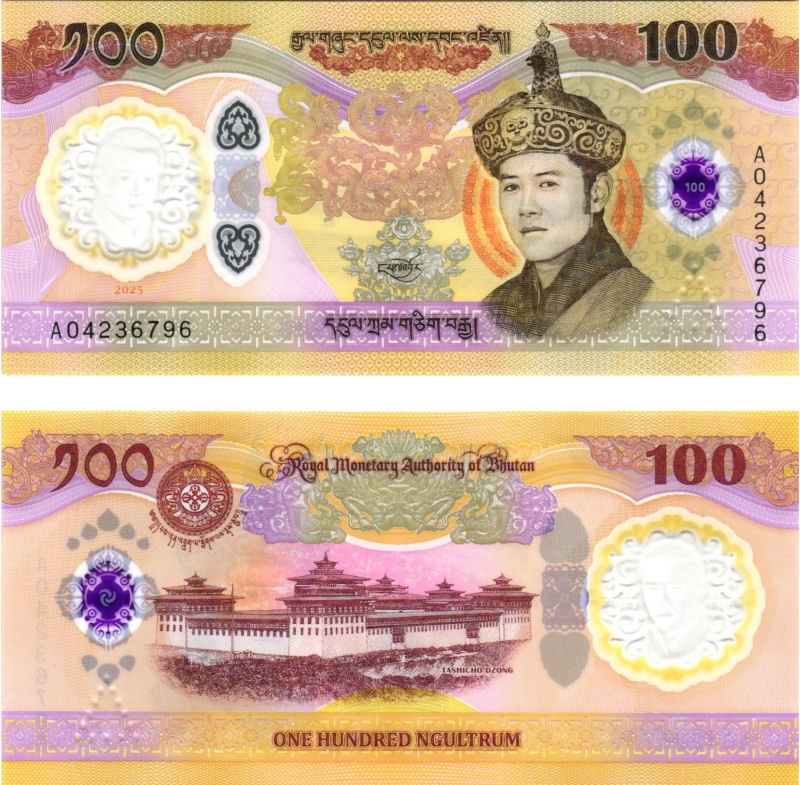
100 ngultrum 2025.
The lowest denomination in the polymer series is the banknote of 100 ngultrum. Its dimensions are 145 × 69 mm, and according to the catalog data in The Banknote Book It is listed under the number TBB#225.
The front of the banknote depicts King Jigme Khesar Namgyel Wangchuck, the Fifth Druk Gyalpo and current King of Bhutan. He is depicted wearing the traditional Raven Crown, one of the most recognizable symbols of the Bhutanese monarchy. In the background is a rich composition featuring a cosmic mandala and dragons, strongly grounding the banknote in Buddhist and state symbolism.
The reverse shows Tashichho Dzong, the monumental fortress and monastery complex in Thimphu, which holds an important state and administrative role as it serves as the seat of the Royal Government of Bhutan. Above Tashichho Dzong, there is a depiction of the mythical Garuda bird, and the national seal is also present on the banknote.
The text on the back reads:
ROYAL MONETARY AUTHORITY OF BHUTAN
ONE HUNDRED NGULTRUM
Among the security elements, a watermark depicting King Jigme Khesar Namgyel Wangchuck in the form of a shadow image is mentioned. Although the series is dedicated to the Fourth Druk Gyalpo, this denomination highlights the current king, thereby symbolically connecting the commemorative issue with the current period of the Bhutanese monarchy.
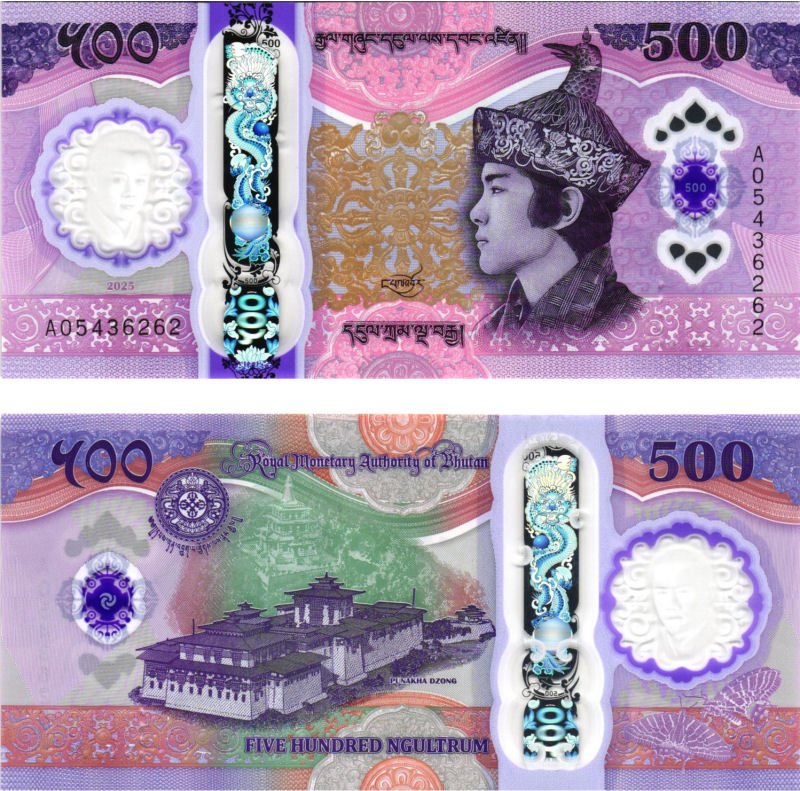
500 ngultrum in 2025.
The central denomination of the series is the banknote of 500 ngultrum. Dimensions are 151 × 72 mm, and you The Banknote Book It is recorded under the catalog number TBB#226.
This banknote is most directly connected to the occasion of issue because its obverse features a portrait King Jigme Singye Wangchuck from younger days. Because of this, the 500 ngultrum denomination carries the main memorial emphasis of the series. Next to the portrait is cross-bracing, an ancient Buddhist symbol associated with indestructibility, stability, and spiritual strength. This motif fits well with the interpretation of the reign of the Fourth Druk Gyalpa as a period of gradual yet firmly directed modernization.
The reverse side shows Punakha Dzong, one of the most significant and beautiful temples in Bhutan. It is a historically and religiously extremely important complex, associated with state ceremonies and Bhutanese tradition. The reverse side also features the state seal and two butterflies of a species known as Bhutanese glory (Bhutanitis lidderdalii), which further emphasizes the country's natural heritage.
The inscription on the banknote reads:
ROYAL MONETARY AUTHORITY OF BHUTAN
FIVE HUNDRED NGULTRUM
As with the other denominations, the watermark depicts King Jigme Khesar Namgyel Wangchuck. Security features also include a foil strip featuring a dragon holding a jewel in its claws. Iconographically, the 500 ngultrum banknote is likely to be the most interesting to collectors who view the series as a direct commemorative issue dedicated to Jigme Singye Wangchuck.
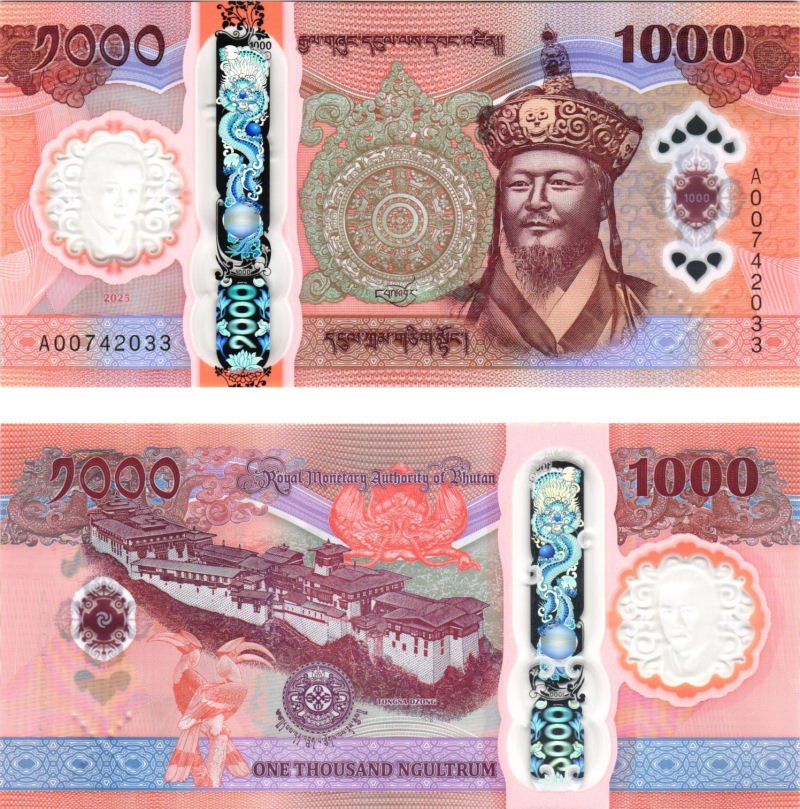
1000 ngultrum 2025.
The highest denomination of the series is the banknote of 1000 ngultrum. Its dimensions are 155 × 75 mm, and you The Banknote Book It is registered under the number TBB#227.
On the face of the banknote is a portrait King Ugyen Wangchuck, the first King of Bhutan and founder of the Wangchuck dynasty. He is depicted wearing the Raven Crown, while in the background is Wheel of the universal ruler. The selection of Ugyen Wangchuck for the highest denomination is no coincidence: this links the series to the beginning of the modern Bhutanese monarchy and the dynastic continuity that persists to this day.
The reverse shows Trongsa Dzong, namely Trongsa Dzong, the historical seat of the Wangchuck dynasty and a place associated with the position of the Tongsa Penlop, an important title in Bhutanese history. The composition is complemented by dragons, a Garuda above the temple, two large hornbills on a branch, and the state seal. This is an exceptionally rich reverse side that combines monarchical, mythological, natural, and architectural symbolism.
The text on the banknote refers to the issuer and the denomination:
ROYAL MONETARY AUTHORITY OF BHUTAN
ONE THOUSAND NGULTRUM
Security features include a watermark depicting King Jigme Khesar Namgyel Wangchuck. Issue texts also mention a foil stripe featuring a dragon holding jewels as one of the visible security features of higher denominations. As the highest denomination of the series, the 1000 ngultrum banknote has a particularly representative character and numismatically rounds off the story of the Wangchuck dynasty from its founder to contemporary Bhutan.
Numismatic significance of the issue
The Bhutanese polymer series from 2025 is interesting for several reasons. First of all, it is a commemorative circulation issue, which means the banknotes have a dual function: everyday payment and commemorative. Second, the use of polymer gives them a contemporary technical character and ranks them among the most modern banknotes in the world with advanced security features. Third, the iconography is very carefully chosen and does not depict only individual rulers, but a broader story about Bhutanese national identity.
The 100 ngultrum banknote emphasizes the current king and the modern state, the 500 ngultrum banknote directly commemorates the Fourth Druk Gyalpo, while the 1000 ngultrum banknote recalls the founder of the Wangchuck dynasty. When viewed together, the three banknotes represent a kind of dynastic triptych in which the monarchy, Buddhism, Buddhist temple architecture, and mythical dragon motifs are united into a recognizable numismatic expression.
For polymer banknote collectors, this issue has added appeal due to the combination of exotic themes, commemorative motivation, high-quality craftsmanship, and the De La Rue printing works. Bhutan has previously stood out for its interesting banknote designs, and the 2025 series confirms that it can maintain a strong national and cultural identity even in the modern polymer format.
Author: Zlatko Viščević
Photos: Numex – Coins, Banknotes & Militaria Store [www.numex.hr]