


In the world of notaphily, there are banknotes that possess “that certain something,” a magical beauty that appeals not only to paper money enthusiasts, but also to lovers of everything pleasing to the eye. Such banknotes are interesting not just because they were a medium of exchange, but also because they carry the spirit of the times within them, reflecting political circumstances, artistic taste, and the technical skill of printers and engravers. One such banknote is certainly the Lebanese 100-livre banknote from 1945, known among collectors by the nickname “Carpet Note” or “Magic Carpet Note.”.
That “nickname” did not come about by chance. The lavish multi-colored design, densely arranged ornaments, and overall impression of the composition resemble an oriental carpet. Because of this, this banknote holds a special place among paper money enthusiasts, especially among collectors of Middle Eastern issues. Some consider it one of the most beautiful achievements in the history of world notaphily.
Bank of Syria and Lebanon as banknote issuer
The banknote was issued by the Banque de Syrie et du Liban, meaning the Bank of Syria and Lebanon. With this name, it is important to avoid a common misinterpretation. The name “Syria” in this case should not be understood in today's narrow national sense, as if it were exclusively a Syrian bank. In a historical and geographical sense, the concept of Syria was much broader. In Hellenistic and later usage, this name referred to the area encompassing modern-day Lebanon, Syria, Palestine, Israel, and Jordan.
At the time these banknotes were created, the idea of a national central bank in the modern sense was not yet fully formed. The bank's name therefore reflects the political, historical, and administrative circumstances of the time in the French mandate territory, rather than exclusively a single modern state. Lebanon is strongly present in the artistic designs of these issues. A large number of banknotes from the Bank of Syria and Lebanon feature Lebanese motifs, landscapes, and symbols, which clearly shows how important the Lebanese identity was in shaping this currency.
The first banknotes for this area were issued by the Banque du Syrie et Grand-Liban, or the Bank of Syria and Greater Lebanon, as early as 1925. Denominations ranged from 25 piasters to 100 pounds. In 1939, the bank's name was changed to Banque de Syrie et du Liban. After the Second World War, the bank continued to issue paper money for Lebanon, using the Lebanese pound (livre) to distinguish the Lebanese issues from the Syrian ones.
Artistic masterpiece on paper
The 100-pound banknote from 1945 was printed in Paris, at the printing works of the Banque de France. It is a large banknote, measuring 217 × 116 millimeters, made of paper and printed using a lavish multi-color technique. At first glance, it is clear that this is not an ordinary means of payment, but rather a banknote designed as a representative object.
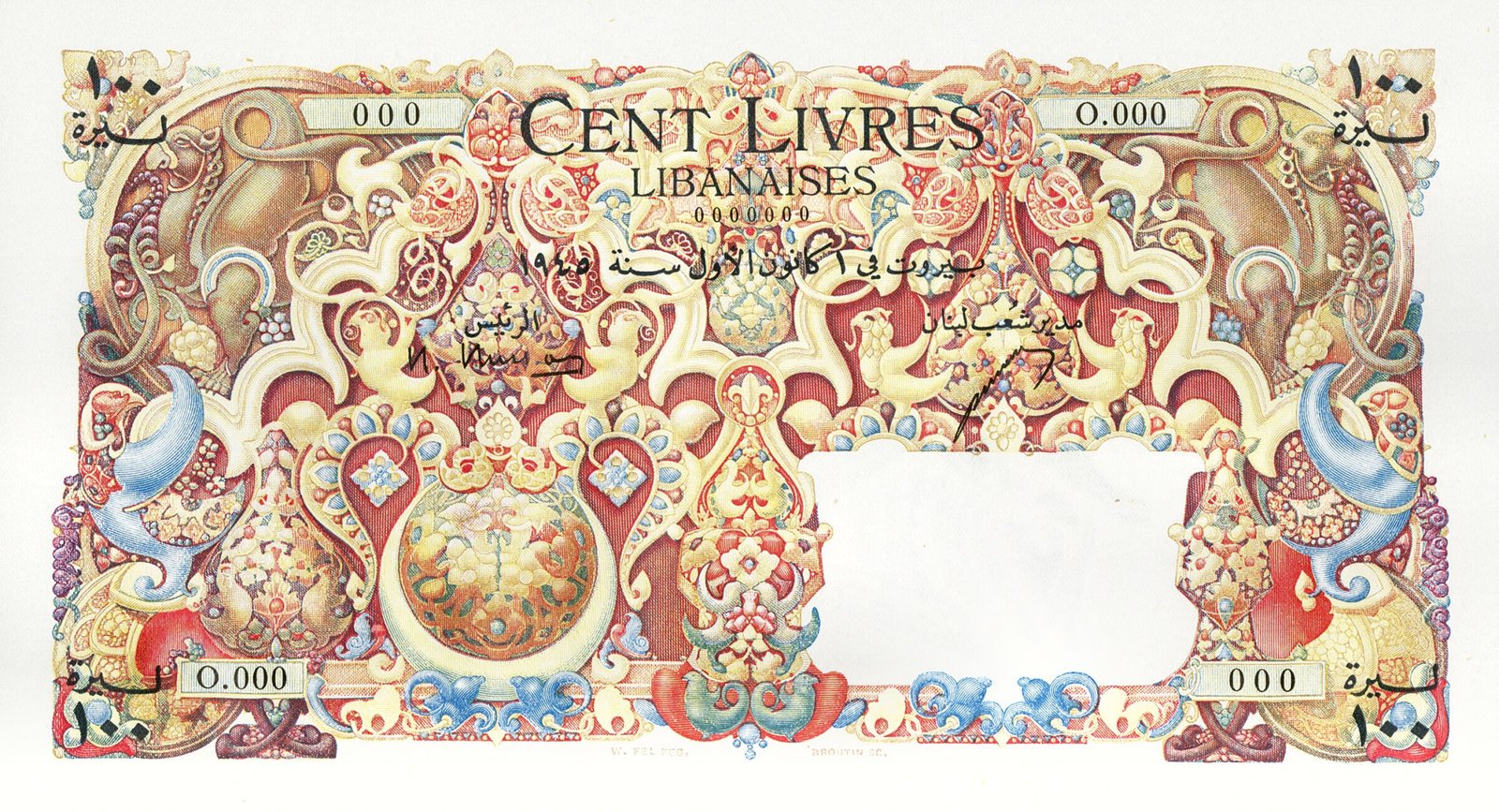
The visual design was created by William Fel, while the engraving work was carried out by Joseph Broutin and Robert Armanelli. The obverse of the banknote is dominated by a rich ornamental composition. The colors, lines, and decorative elements are shaped to create an almost textile-like impression. It is precisely this visual similarity to a carpet that is the reason why the banknote received its well-known nickname among collectors.
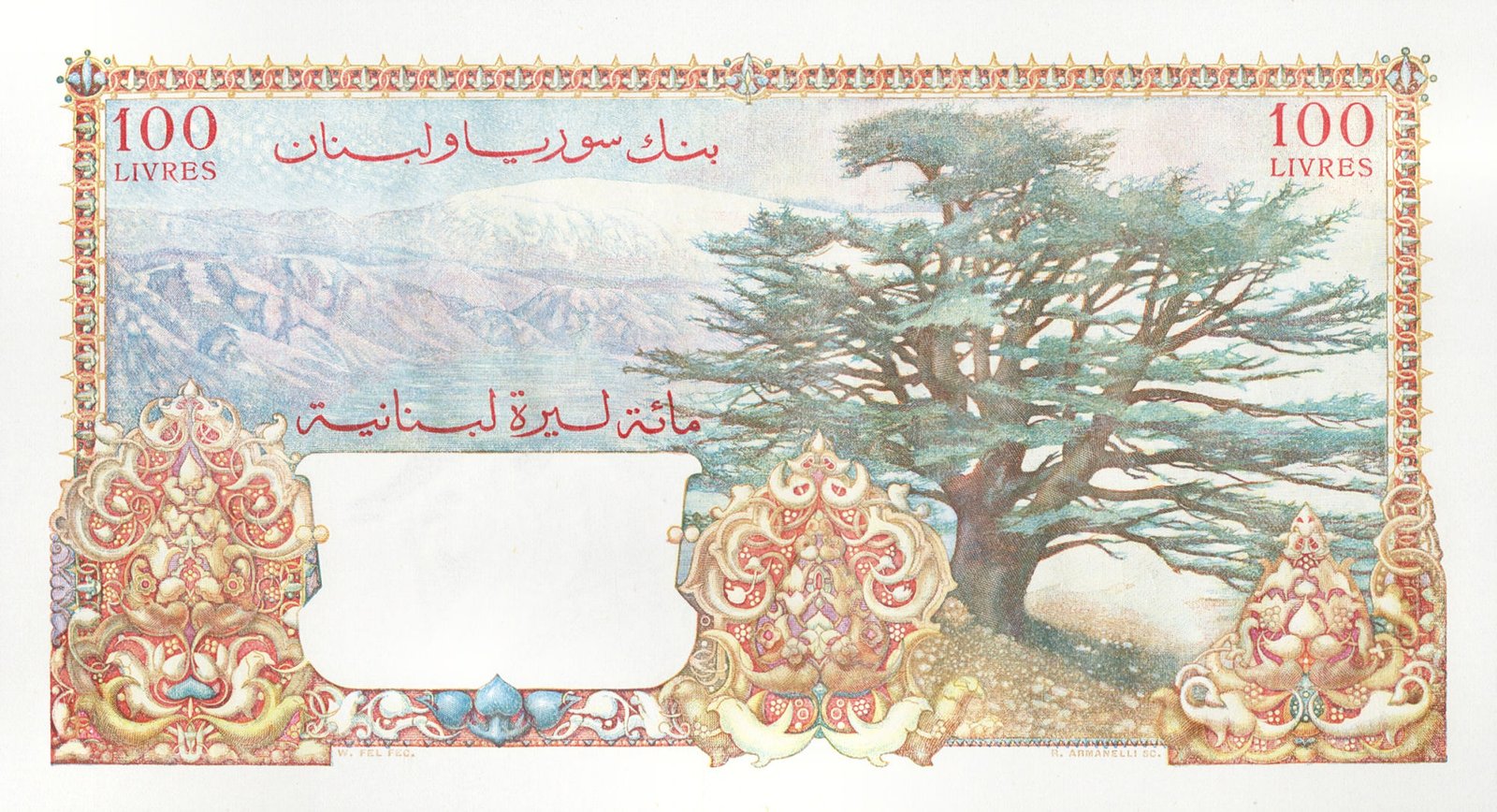
On the reverse side, there is a depiction of a cedar tree and a mountain landscape. The cedar is one of the most recognizable symbols of Lebanon. It is also featured on the Lebanese flag and, in a broader symbolic sense, represents the longevity, steadfastness, and historical continuity of the Lebanese region. Combined with the mountain motif, the reverse side of the banknote clearly points to Lebanon and its identity.
Large format and luxurious design
The 1945 Lebanese 100 Pound banknote belongs to the 1945 and 1950 issue series. Its catalog number is Pick 53, and in The Banknote Book it is listed as TBB 223. It was a regular circulating note in its time, but it was withdrawn from circulation and today is found only in numismatic circles.
As a large-format banknote, it is particularly sensitive to damage. Such paper money in circulation easily bent, wore out, got dirty, and became damaged at the edges. Because of this, specimens in a high grade of preservation are today particularly rare and valued. With banknotes like this, the difference between an average and an exceptionally preserved specimen can be very large, because every damage is clearly visible on the broad paper surfaces and rich multicolored printing.
A special value is also given to this banknote by the fact that it was printed at the Banque de France, one of Europe's most reputable banknote printing works. The French tradition of banknote production is known for its high level of engraving work, security features, and artistic culture. On this Lebanese banknote, that is very clearly visible. It simultaneously carries French printing precision and a Middle Eastern ornamental spirit.
Why is the “magic carpet” in such high demand on the numismatic market?
Collectors value this banknote primarily for its beauty. It is an issue that is memorable at first glance. Unlike many other banknotes that fit into standard state-issue patterns, this banknote has a distinctly recognizable character. Its design does not feel coldly administrative, but rather almost artistic and decorative.
Another important reason for its popularity is its connection to the history of Lebanon and the French mandate period. The banknote belongs to a time of great political changes, immediately after the Second World War and during the period of the shaping of modern Lebanon. In that sense, it is not only a beautiful collector's item, but also a historical document.
The third reason is her international recognition. The nickname “magic carpet” made her famous even outside the circle of specialized collectors of Lebanese currency. She is often mentioned as one of the most beautiful Middle Eastern banknotes, and due to her striking appearance, she also attracts collectors who do not normally collect Lebanon.
We can also see that this banknote is very attractive and sought after on the numismatic market from the auction results.
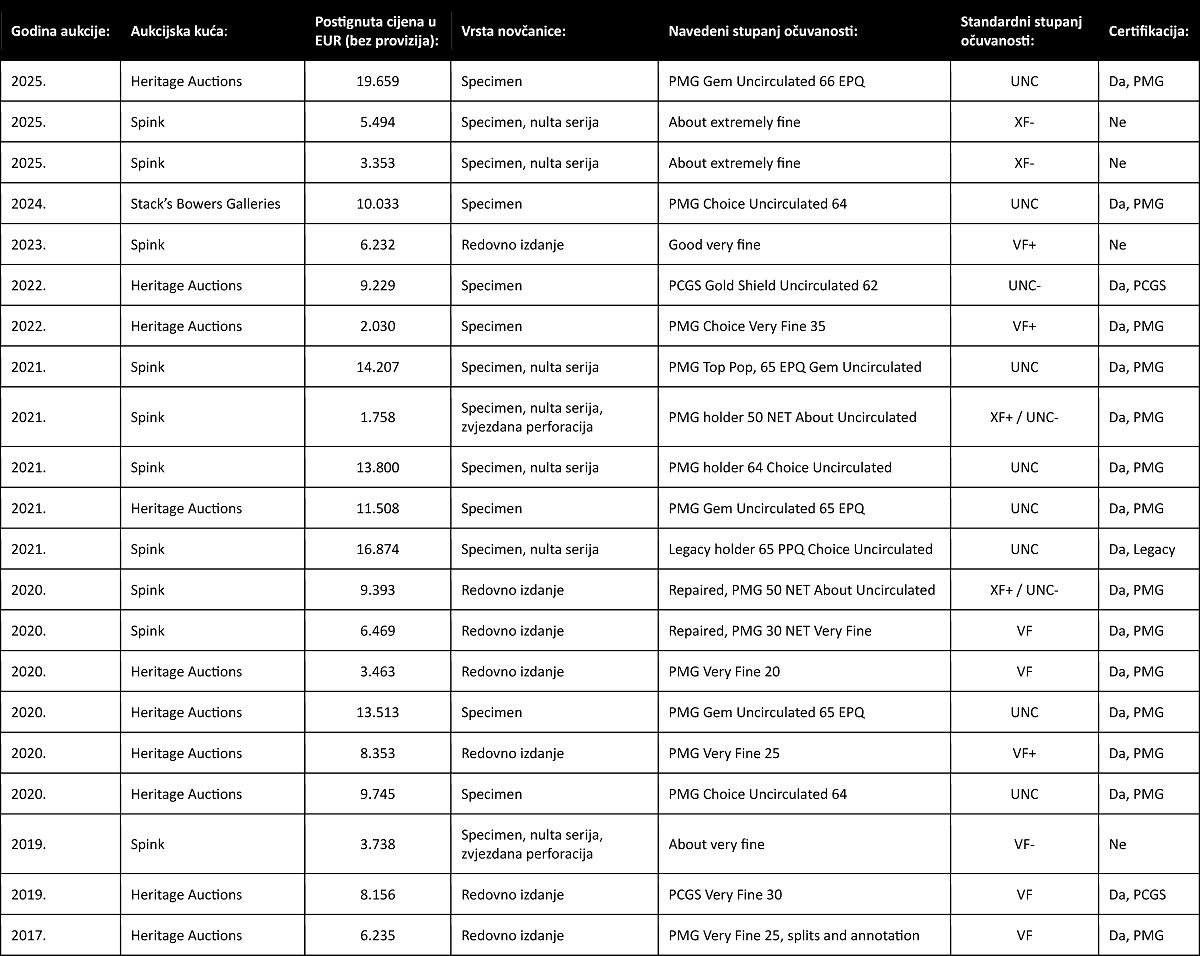
When auction results are observed over time, a clear growth in the banknote's market value is visible, especially in the highest grades of preservation. Older auction realizations from the 2017–2020 period should be viewed with an inflationary corrective, because the prices from back then are realistically higher in today's purchasing power than they appear nominally.
Despite this, the results from 2021-2025 show that growth is not only the result of inflation, but also of increased international demand. The highest auction results are, as expected, achieved by certified specimen pieces with a zero serial number in UNC condition. The top of the market is confirmed by the result of 19.659 EUR in 2025. NGC Gem Uncirculated 66 EPQ.
Regular issues are also in high demand, but their price depends more on condition, repairs, and visual appeal. VF/VF+ copies of regular issues range in a significantly lower bracket, yet still fetch high prices for Middle Eastern banknotes. Copies with a NET designation, i.e., with repairs or damage, fetch substantially lower prices compared to problem-free copies of the same nominal grade.
In any case, the market is showing realistic long-term growth, with the strongest potential in certified, top-condition specimens.
The fusion of top-tier numismatics, history, and art
This banknote is particularly interesting because it combines several different levels of meaning. It is money, yet at the same time it is a work of art. It is a product of the French printing school, but it bears Lebanese symbols. It belongs to a politically complex period, yet today we most often regard it as an object of exceptional aesthetic value.
At a time when modern banknotes are increasingly designed for functionality, security, and standardization, such issues recall a period when paper money played a strong representative role. Back then, a banknote was meant to demonstrate the seriousness of the issuer, the security of the currency, and also the cultural identity of the region to which it belonged.
The 1945 Lebanese 100-pound banknote therefore rightfully holds a special place in the world of paper money collecting. Its lavish ornamentation, large format, Lebanese symbolism, and French craftsmanship make it one of those issues that are viewed not merely as money, but as small historical and artistic objects. Exactly for this reason, this Lebanese “magic carpet” continues to attract the attention of collectors worldwide today.
Author: Zlatko Viščević with AI assistance
Photos: Heritage Auctions