






One of the most famous romantic and political entanglements of antiquity is that between the Roman general Mark Antony and the Egyptian queen Cleopatra VII. Their relationship was at once a passionate romance and a cold political alliance. What was once love to them often looked to Rome like a threat and an attempt to create a new, Eastern power that could overshadow the might of the Senate and the Roman aristocrats.
That story did not unfold only in the palaces of Alexandria and on the battlefield near Actium, but also on currency. Tetradrachms featuring their portraits are today among the most desirable ancient coins, because in a small piece of silver they combine politics, propaganda, and one of history's most famous love stories.
Who was Mark Antony?
Mark Antony (Marcus Antonius), born around 83 BC in Rome, came from a distinguished, though not the most illustrious, Roman family. His childhood was marked by the loss of his father and stepfather and a rather chaotic upbringing. The young Antony early on indulged in vices, but he also discovered early that he possessed two important advantages: military talent and an exceptional ability to win people over to his side.
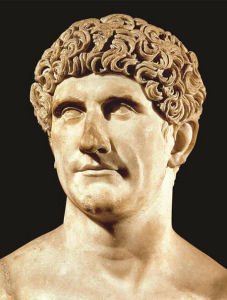
Source: Wikipedia [en.wikipedia.org].
As a cavalry commander, he distinguished himself in the wars in the East, and then became the most loyal associate of Gaius Julius Caesar. He participated in the Gallic Wars, in the decisive battle of Pharsalus, and was Caesar's closest man in Rome – magister equitum, „commander of the cavalry,” effectively the second man of the state.
Following Caesar's assassination in 44 BC, Antony found himself at the center of the struggle for succession. With Octavian (the future Emperor Augustus) and Lepidus, he formed the Second Triumvirate, settled accounts bloodily with Caesar's opponents, but soon found himself in a new conflict, this time with that very same Octavian. It was precisely his relationship with Cleopatra that would turn him, in the eyes of the Roman people, from a glorious military commander into a „traitor enslaved by an Eastern queen.”.
Who was Cleopatra VII?
Cleopatra VII Philopator was the last queen of ancient Egypt from the Ptolemaic dynasty. Therefore, an Egyptian of Greek roots. The Ptolemies were of Macedonian origin, descendants of the general of Alexander the Great, who took over Egypt after his death.
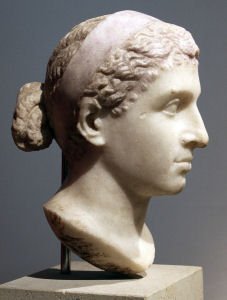
Source: Wikipedia [en.wikipedia.org].
Unlike many of her predecessors, Cleopatra perfectly understood the land she ruled. According to ancient sources, she spoke multiple languages, including Egyptian, which was rare among the Ptolemies. She was also educated in philosophy, rhetoric, mathematics, and astronomy. She was a ruler who combined charm, intelligence, and cold political reason.
She formed an alliance (and love affair) with Caesar that helped her consolidate power in Egypt. She bore him a son, Caesarion, and for a time it seemed that this boy could become the future of both Egypt and Rome. But after Caesar's assassination, Cleopatra turns to a new key player, her until-yesterday „right hand“ – Mark Antony.
Ptolemaic Egypt
Ptolemaic Egypt was one of the wealthiest states of the Hellenistic world. The fertile soil of the Nile, developed agriculture and trade, the powerful port of Alexandria, the famous library, and a large number of Greek cities made it a true gem of the Mediterranean.
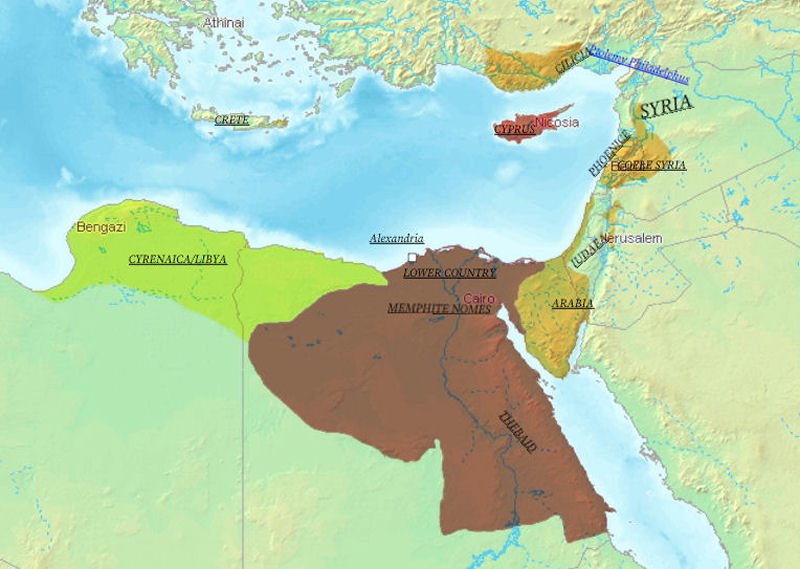
Source: Reddit [www.reddit.com].
Yet, behind the splendor, numerous problems were hidden: dynastic struggles, religious tensions, pressure from other Hellenistic kingdoms, and the ever-growing power of Rome. Egypt was formally independent, but in reality, it depended on the goodwill of Roman commanders and politicians. Cleopatra's main mission was: how to keep Egypt at least partially free in a world where Rome was becoming the master of everything.
How did the relationship between Cleopatra and Mark Antony begin?
They first saw each other when Cleopatra was still a girl and Antony was a relatively young soldier in the East. However, the crucial meeting takes place after Caesar's death, when Antony, as one of the triumvirs, turns to the East to secure support for the war against Caesar's opponents and later against Octavian.
Cleopatra comes before him in Tarsus, in present-day Turkey, in an almost theatrical scene: lavishly decorated, on a richly appointed ship, surrounded by luxury and the scents of the East. Ancient writers claim that she captivated Antony not only with her looks, but above all with her wit, intelligence, and flair for performance.
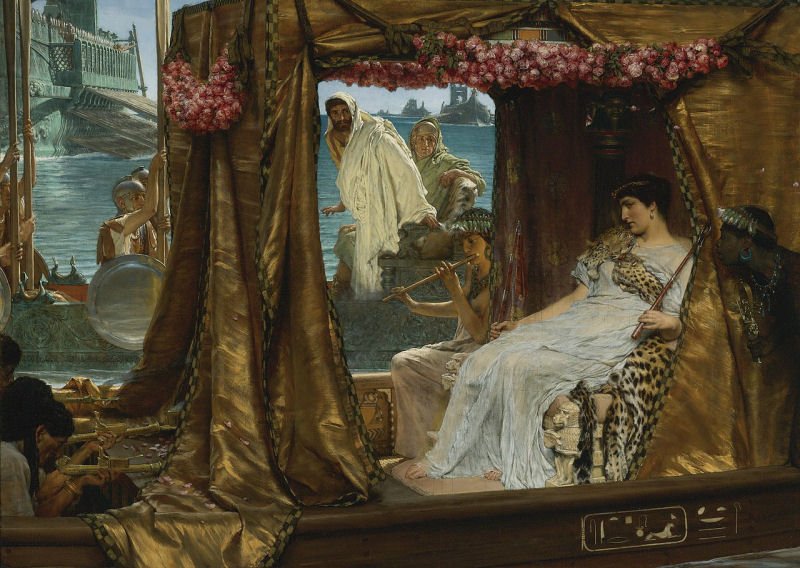
Source: Wikipedia [en.wikipedia.org].
Their relationship quickly transcends the boundaries of ordinary political cooperation. Antony spends the winter of 41/40 BC in Alexandria in lavish feasts and games, and Cleopatra bears him twins: Alexander Helios and Cleopatra Selene. Years later, they have another son, Ptolemy Philadelphus. Thus, their love also turns into a dynastic project: through Antony, Cleopatra tries to secure kingdoms for her children across the Eastern Mediterranean.
Political consequences of a romantic-political relationship
Antony was not only a lover, but also the supreme Roman commander in the East. While Octavian consolidates power in Italy, Antony distributes lands and power from Alexandria. Cleopatra and their children receive territories: Seleucid lands, Syria, Cilicia, Cyrenaica, Libya... Cleopatra is proclaimed „queen of kings,” and Caesarion (Caesar's son) is proclaimed the legitimate heir of Gaius Julius Caesar.
In Rome, this causes anger and fear. Octavian skillfully uses propaganda: he portrays Antony as a Roman who has „fallen under the charms of the Eastern queen” and is ready to sacrifice Rome's interests for her and their children. Particularly scandalous is the fact that Antony is formally divorcing Octavian's sister Octavia and publicly recognizing Cleopatra as a partner, and their children as heirs.
When Cleopatra's portraits and names also began to appear on Roman coins, in the eyes of many Romans that was already too much: the queen of Egypt on Roman coins looked like a symbol of a possible new dynasty that would rule Rome from Alexandria.
The end of the story
The conflict between Antony and Octavian eventually turns into an open war. The naval battle at Actium in 31 BC, off the coast of present-day Greece, is decisive. The fleet of Antony and Cleopatra suffers defeat; at a crucial moment, Cleopatra leaves the battlefield with a portion of the ships, and Antony follows her, a move that his contemporaries never forgave him for.
A year later, Octavian conquers Alexandria. According to tradition, Antony receives the (false) news that Cleopatra is dead. Devastated, he stabs himself with his own sword. However, he does not die immediately, but passes away in Cleopatra's arms after being brought to her in the palace.
Cleopatra realizes that Octavian will not allow her to retain power, nor for her children to inherit Egypt. Rather than facing humiliating captivity and being marched in a Roman triumph, she decides to die. Tradition says she committed suicide by the bite of a venomous snake (asp), though the details remain unclear. With her death in 30 BC, the independent Egyptian state ceased to exist, becoming a special Roman province and the personal property of Octavian Augustus.
Tetradrachm with the portraits of Cleopatra and Mark Antony
Numismatically speaking, the relationship between Cleopatra and Mark Antony left behind one of the most interesting types of late Hellenistic and early Roman coinage: silver tetradrachms with their double portrait.
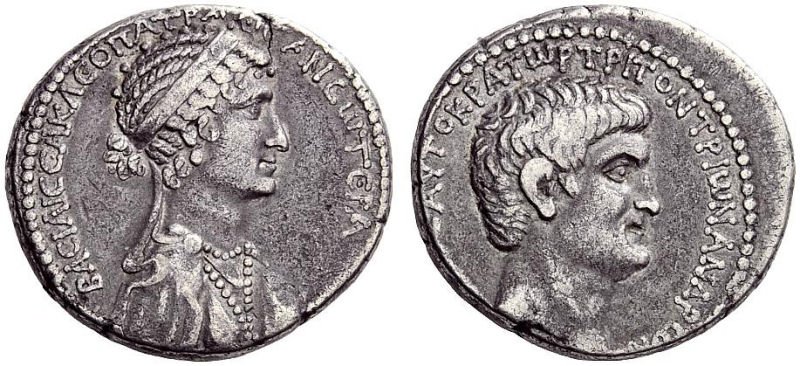
Source: Numismatica Ars Classica [www.arsclassicacoins.com].
The coin most frequently mentioned is attributed to Antioch or southern mints within Cleopatra's sphere of influence, around 36 BC. The obverse features Cleopatra, diademed, with the Greek legend BACIΛICCA KΛЄOΠATPA ΘЄA NЄωTЄPA („Queen Cleopatra, New Goddess”). The reverse features Mark Antony, with the Greek legend ANTωNIOC AYTOKPATωP TRITON TPIωN ANΔPωN („Antony, Imperator, one of the three men”).
It is interesting that in those portraits neither Cleopatra nor Antony look like idealized movie heroes. The faces are elongated, with a pronounced nose, strong chin, and prominent features. Many have noticed how Cleopatra's portrait takes on some of Antony's features, almost as if the coin engraver is emphasizing their connection and shared destiny. On the other hand, Cleopatra retains the „dominant” side of the coin – the face (obverse) – which well reflects her strong political role.
Compared to idealized Greek goddesses or later Roman empresses, the two of them on these coins appear somewhat „heavy,” even unattractive. Yet precisely this realism makes them so appealing, because we are looking at real, historical figures rather than embellished mythological characters.
How much is one „piece“ of this historical story worth?
Such tetradrachms of Mark Antony and Cleopatra are among rare and sought-after coins. They combine historical importance, a dramatic story, interesting iconography, and a relatively short mintage period. Therefore, it is no surprise that extremely high prices are achieved at auctions, especially for specimens with fine portraits and good metal.
Here are some recorded results:
- 2022, Heritage Auctions, Auction 3097, Lot 30065 – Sold for: 114,737 EUR
- 2022, Classical Numismatic Group, Auction 121, Lot 696 – Sold for: 66,399 EUR
- 2021, Classical Numismatic Group, Triton XXIV, Lot 915 – Sold for: 57,663 EUR
- 2021, Jean Elsen & ses Fils, Auction 148, Lot 287 – Sold for: 46,000 EUR
- 2019, Leu Numismatik, Auction 4, Lot 588 – Sold for: EUR 57,903
- 2019, The New York Sale, Auction 45, Lot 244 – Sold for: 187,651 EUR
- 2011, Numismatica Ars Classica, Auction 62, Lot 2013 – Sold for: EUR 56,690
- 2010, Numismatica Ars Classica, Auction 54, Lot 284 – Sold for: 48,972 EUR
One certainly „stands out“ is the price achieved at The New York Sale auction in 2019, when a specimen like this was sold for a staggering EUR 187,651.
Prices otherwise depend on the condition, the style of the portrait, the quality of the strike, the patina, and the provenance. However, from these results it is clear that these are coins of the highest collector rank. For most collectors, they will forever remain „dream money”.
…
In a small circle of silver, on a single tetradrachm, the destinies of two people who changed history intertwine: a Roman general who lost everything for love (or ambition) and an Egyptian queen of Greek origin who tried to save her country until her last breath. Their love may have ended tragically, but thanks to money, it remained forever recorded.
Author: Zlatko Viščević with the help of AI
Photos: Numismatica Ars Classica [www.arsclassicacoins.com], Reddit [www.reddit.com], Wikipedia [en.wikipedia.org].