




Although common sense dictates that coins, like other collectibles, should be handled carefully so as not to damage them, many people are still quite careless when it comes to handling them. This might be due to negligence or, even worse, ignorance.
No matter what kind of coins you collect or the way you collect them, proper handling is crucial for preserving their condition and, consequently, their numismatic value. Every scratch, dent, damage, fingerprint, cleaning mark, or similar flaw can diminish their numismatic value, sometimes by several tens of percent. Therefore, it is important to handle coins with care.
This is especially important for specimens struck in proof technique (polished plate) as well as those in BU (brilliant uncirculated) and UNC (uncirculated) quality. Their luster, mirror-like surface, and sharp details make them attractive, but also extremely sensitive to damage. Caution should also be exercised with coins in XF quality, while a certain amount of flexibility is possible with VF and lower qualities.
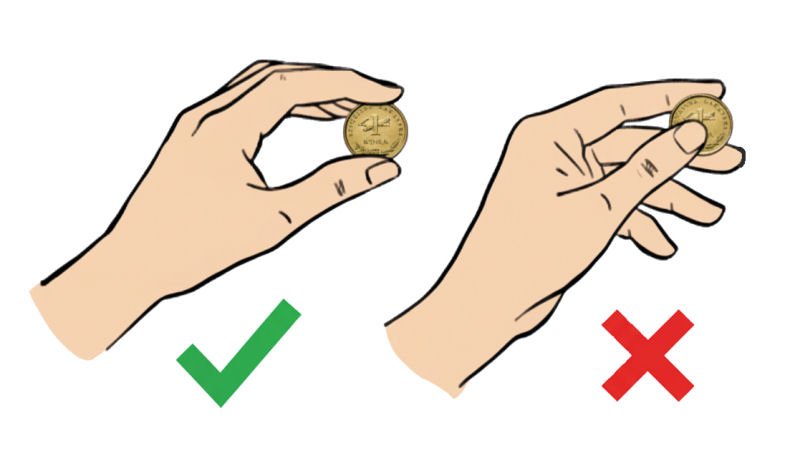
Below we present the basic rules that will help you keep your coins in the best possible condition.
1. Always hold a coin by its edge
- Never touch the obverse and reverse of the coin with your fingers.
- Sweat and dirt from fingers remain on the coin and cause chemical reactions that leave traces on the metal.
- This is especially true for proof, BU, and UNC coins.
2. Wash your hands before handling or use gloves
- Wash your hands thoroughly with soap and dry them after washing.
- Clean hands reduce the risk of transferring sweat, grease, and dirt onto coins.
- When handling high-quality coins, it is advisable to use gloves.
3. Use a softly cushioned work area
- Place a soft terry towel, spongy material, or a thick cloth on the table.
- If a coin slips from your fingers, the fall will be cushioned and no damage will occur.
4. Never blow smoke on a coin and do not drool on it
- Blowing leaves tiny droplets of saliva that can cause corrosion (pitting).
- This is particularly delicate with proof coins, which have a mirror-like surface that reveals every imperfection.
- “Cleaning” a coin with saliva and rubbing almost always leaves traces.
5. Handle coins only when necessary
- The less handling, the lower the risk of damage.
- Coins should be stored in a suitable place, not left out all the time or on the table.
6. Store them in a cool and dry place
- Moisture and heat accelerate tarnishing, corrosion, and the reactions of metals with the environment.
- It is an ideal place with a constant temperature and low humidity.
Proof coins that come in special packaging (capsules) are best left in the capsules – do not take them out or touch them with your fingers. Unfortunately, such coins can very often be seen with fingerprints, and as such they are not attractive to collectors and their numismatic value is significantly reduced.
When showing your collection to someone, especially those without numismatic knowledge, warn them to just look and not touch.
Author: Zlatko Viščević