


The 10-dinar banknote dated September 22, 1939, issued by the National Bank of the Kingdom of Yugoslavia, belongs to the group of the most interesting and intriguing issues of pre-war and wartime Yugoslav currency. Although it was formally prepared for regular circulation, its actual destiny is inextricably linked to the dramatic events of April 1941, which gives it a special place in numismatic and historical literature.
Technical specifications and emissions
The dimensions of the banknote are 128 × 72 mm, while the size of the design is 115 × 60 mm. It was printed in green and yellowish colors, with a watermark as a security feature. It was manufactured at the Institute for Manufacturing Banknotes in Belgrade. The date on the banknote is September 22, 1939. It was de facto put into circulation on April 8, 1941, and remained in circulation from April 8, 1941, to April 2, 1942, when it was exchanged under occupation conditions.
The banknote was manufactured on the basis of the decision of the Minister of Finance No. 102/VIII from April 1940, in agreement with the National Bank. An official announcement regarding the release into circulation on April 8, 1941, was also prepared, but the bombing of Belgrade on April 6, 1941, and the cessation of the publication of the „Official Gazette” prevented public notification. Consequently, this issue entered a zone of legal and historical ambiguity: it was in circulation, but without formal proclamation.
According to data from post-war reports, 10-dinar banknotes were exchanged in the territory of occupied Serbia from November 10 to 21, 1941, and in some regions until April 2, 1942, which confirms that they were indeed in circulation.
Royal portrait and the bridge that „connects“
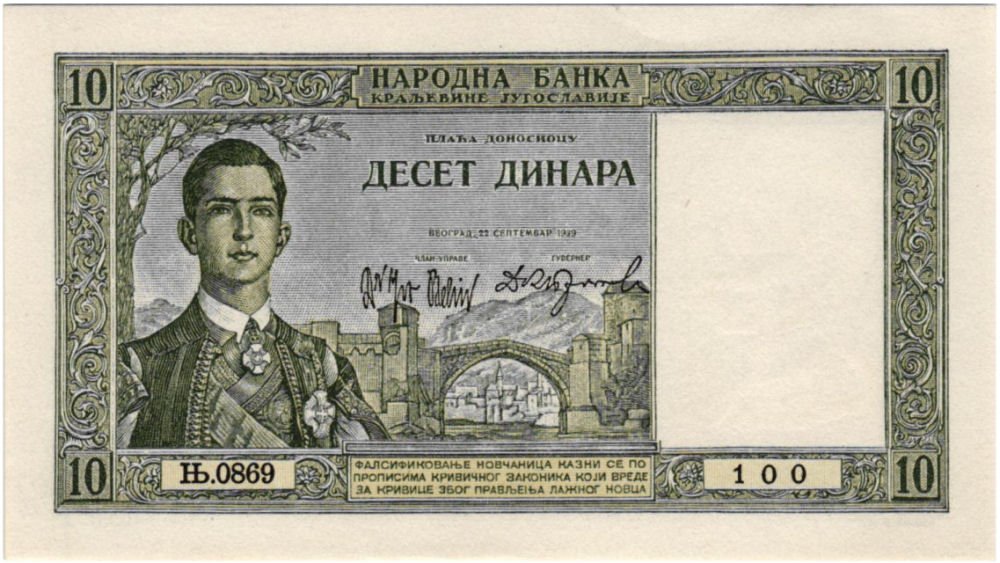
On the left side of the face is the bust of King Peter II Karađorđević, shown frontally, in Montenegrin-Herzegovinian folk costume, with the Order of Karađorđe's Star around his neck and on his chest. The portrait is formal yet youthful, emphasizing dynastic continuity and the symbolism of the state's future. Above the figure, in the upper corner, is an overhanging branch as a symbol of growth and the future.
In the lower central part, the Old Bridge in Mostar is depicted, an architectural motif of strong symbolism. The bridge as a motif connects banks, regions, and peoples, and suggests the idea of state unity. In the context of 1939, when political tensions were pronounced, the choice of the bridge as the central landscape motif carries a clear message of connection and integration.
The text part on the face, entirely in Cyrillic, reads:
NATIONAL BANK
KINGDOM OF YUGOSLAVIA
PAY TO BEARER
TEN DINARS
BELGRADE, SEPTEMBER 22, 1939
With the signatures of board member Dr. Ivo Belin and Governor Dr. D. K. Protić.
An 8 mm wide ornamental frame, richly stylized in the spirit of academic realism and Art Nouveau decorativeness, encloses the composition. In all four corners are the numbers 10, clearly emphasized and graphically balanced. In the lower parts of the frame are spaces for serial marks and numbering, and in the central part is text warning about the penalization of counterfeiting.
Female counterpart on the reverse side
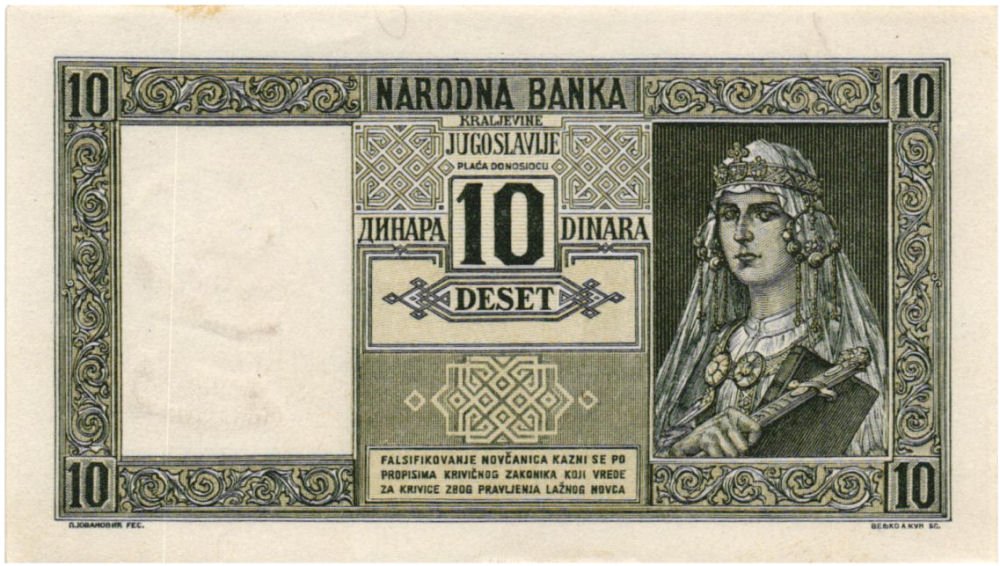
On the right side of the reverse side is a stylized female figure in noble attire with a veil and a diadem. In her right hand she holds a sword, and next to her is a book, a symbol of the union of strength and knowledge. The figure is slightly turned toward the center of the banknote, thereby establishing a visual balance with the typographical center.
The central text, this time predominantly in the Latin alphabet, repeats the name of the bank and the denomination:
NATIONAL BANK
KINGDOMS
YUGOSLAVIA
PAY TO BEARER
DINARA (in Cyrillic) 10 DINARA
TEN
This partially achieves a balance in the use of the Cyrillic and Latin alphabets, which was a characteristic of the state policy and visual identity of the banknotes of that period. Although on the reverse side, the dominance of the Latin alphabet is nevertheless „disrupted“ by the Cyrillic text.
The space between the text blocks is filled with stylized geometric ornamentation, while the frame is identical to the one on the obverse with the number 10 in the corners.

The author and the ideal blend of painterly and graphic mastery
The artist's signature on the reverse reveals two prominent artists, Paja Jovanović as the designer of the visual solution and Veljko Andrejević Kun as the engraver.
Jovanović's academic realism is manifested in the refined portrait of the king and in the allegorical figure, while Kuna's engraving precision is visible in the fine lines of the ornamentation and the sureness of the drawing. The whole appears harmonious, balanced, and technically exceptionally polished.
Watermark as a reminder of the continuity of the ruling dynasty
In the right blank field of the obverse, or the left on the reverse, a rectangular space is provided for a watermark featuring the image of King Peter I the Liberator in a general's uniform. This detail carries a strong symbolism of dynastic and state continuity: Peter I as the founder of the modern Yugoslav state, and Peter II as his successor.
Legal dilemma regarding putting into circulation
In literature, this banknote is often listed among the issues that were manufactured, but were not formally proclaimed to the public before the Axis powers' attack on April 6, 1941. Nevertheless, there are clear indications that it was in circulation during the first days of the war, likely without an official announcement.
Following the occupation, these banknotes were replaced, which confirms their actual circulation. Thus, this issue remains „on the border“ between legal tender and an emergency wartime issue, and as such is the subject of expert discussions and special collecting interest.
Artistic value and meaning
From an artistic standpoint, the 10-dinar banknote from 1939 represents one of the most aesthetically successful smaller denominations of the Kingdom of Yugoslavia. The composition is clearly divided, yet not rigid; the portrait and landscape create a narrative whole, while the allegory on the reverse introduces a symbolic dimension.
The dominant green color contributes to a sense of stability and seriousness, while the dark engraving provides depth and precision. The ornamentation, although rich, does not overwhelm the composition, but rather serves as a rhythmic framework that connects all elements into a unified whole.
This banknote stands as a visual document of a turning point. Created in peacetime, put into circulation in the chaos of war, and withdrawn during occupation, it embodies state representation, artistic excellence, and historical drama, making it exceptionally interesting from a numismatic and art-historical perspective.
Author: Zlatko Viščević
Photos: Numex – Coins, Banknotes & Militaria Store [www.numex.hr]