
It is not uncommon in numismatic collections from our region, especially older ones, to find unusual tokens with various motifs and the inscription “SPIEL MARKE”. One such example is this token with the aforementioned inscription and the depiction of a pig. At first glance, this motif may seem ordinary and simple, but in a cultural and symbolic sense, it carries a very clear and deeper message.
Inscription “GAME BRAND”means game token. This, therefore, was not official money, but rather a token used in gaming, entertainment, calculation, or as a keepsake, a “lucky charm” souvenir. Such tokens were common during the 19th and early 20th centuries, particularly in Central Europe and German-speaking countries. This specimen can be roughly dated to the late 19th and early 20th century.
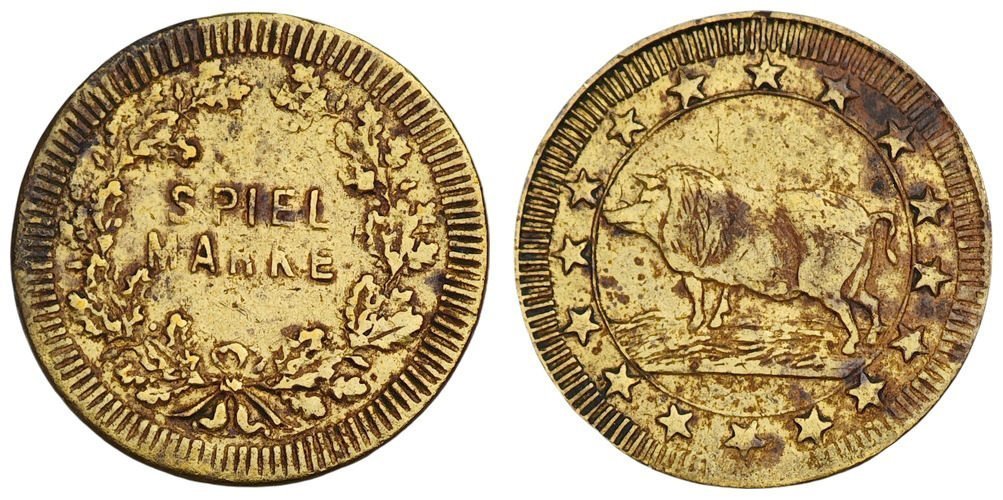
On the face of the token, there is the inscription “SPIEL MARKE”, placed within a wreath of oak branches. This type of depiction is common for gaming tokens of that period, as it gives them an appearance similar to a coin, even though they had no monetary function. The reverse of the token is considerably more interesting due to the depiction of a pig, surrounded by stars and a decorative border. A “mane” is also faintly visible on the figure of the pig, so it is possible that it is a wild boar rather than a domestic one.
The motif of the pig holds a special place in German and Central European symbolism. The pig is traditionally associated with luck, abundance, prosperity, and a good outcome. In the German language, there is the well-known saying “Lucky break”, which can be translated as “He was lucky”. Precisely because of this meaning, the pig often appears as a symbol of good luck, especially in the context of the New Year.
In German and Austrian New Year tradition, the pig is one of the most recognizable symbols of good luck. It appears on greeting cards, decorations, figurines, keychains, and commemorative items that are given as gifts with wishes for a happy and successful year. In this context, the motif of the pig also appears on certain tokens, small medals, and similar items intended for play, gifting, or symbolically invoking good fortune.
On this token, the pig is not merely a decorative motif, but likely the bearer of precisely such a message. Since it is a game token, the symbolism of luck is further emphasized. Play, uncertainty, and the possibility of winning are naturally linked to motifs that invoke a favorable outcome. In that sense, the pig is a very suitable choice: it does not represent a ruler, state symbols, or a nominal value, but rather the desire for good luck.
The depiction of a pig within a circle of 16 stars gives the token a distinctly symbolic character. The motif can be interpreted as an invocation of luck, abundance, and a favorable outcome, in accordance with the Central European tradition in which the pig held precisely such a meaning.
Author: Zlatko Viščević
Photos: Numex – Coins, Banknotes & Militaria Store [www.numex.hr]