Believe it or not, last year the EU received its own decoration. Yes, you read that right: after the common currency, common directives, common funds, common crises, and the common feeling that no one knows what was actually decided in Brussels, the European Union has also received its own order of merit.
It is officially called European Order of Merit, or European Order of Merit, and it was established on May 5, 2025, on the occasion of the 75th anniversary of the Schuman Declaration. The European Parliament describes it as the first European decoration of its kind awarded by EU institutions. It is intended for individuals who have made a significant contribution to European integration or the promotion and defense of the values enshrined in the Treaties of the European Union.
So, the idea is noble in principle, but… Peace, democracy, human dignity, the rule of law, European integration, etc., etc. Everything that sounds lofty on paper and is far from that in practice is being rewarded with this European piece of phaleristics.
The order politicians conceived for, well, mostly politicians
According to the official rules, nominations for the award may be submitted by the President of the European Parliament, the President of the European Council, the President of the European Commission, the heads of state or government of the member states, and the presidents of the national parliaments of the member states. The decision is made by a special committee consisting of the President of the European Parliament, two Vice-Presidents of the European Parliament, and four prominent European figures.
In other words, the political leadership proposes, the political-bureaucratic leadership decides, and then the decoration is awarded to individuals who, lo and behold, very often come from the same political-institutional universe.
Of course, it is officially emphasized that the Order is intended for individuals, and not necessarily politicians. Moreover, members and staff of EU institutions, bodies, offices, and agencies cannot receive it during their term of office or duration of service. That is a nice caveat. However, the very construction of the entire system can hardly be viewed as an award that spontaneously arises from Europe's civic life. It looks more like a decoration that the political world bestows upon the political world, with the occasional inclusion of someone from culture, sports, or public life, purely so that it doesn't all look like a closed session of yet another European bureaucratic body.
Thus, we received an award that feels less like a civic recognition for ordinary Europeans and more like a ceremonial lapel ornament for the salon-style European political-bureaucratic elite, complete with the occasional guest celebrity for form's sake (and for the journalists' sake).
It even looks decent
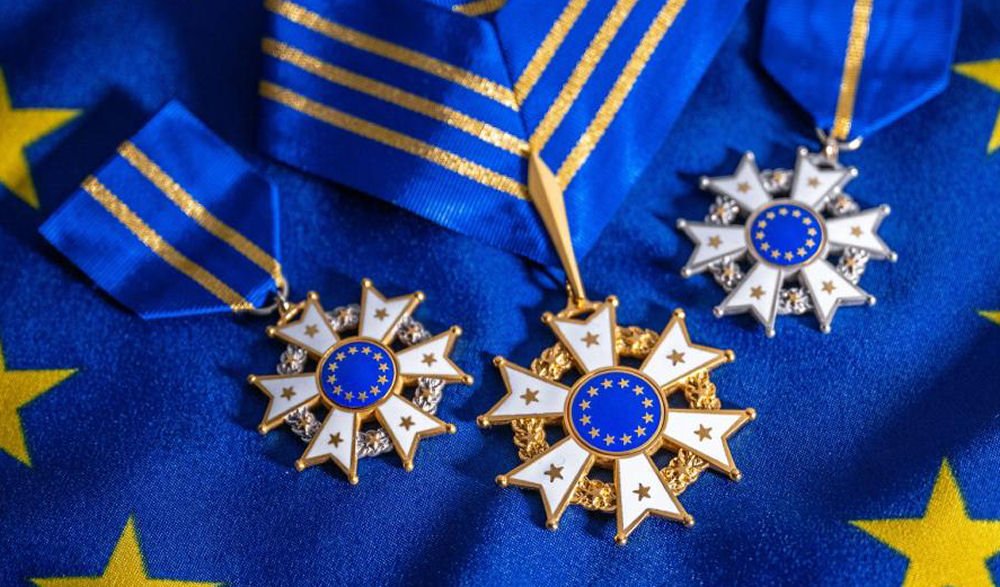
One still has to be fair (and less cynical): From a design perspective, the decoration even looks good. The images give the impression of solidly crafted, modern-type decorations rather than cheap souvenirs from a flea market stall. The shape, enamel, ribbon, and overall impression look elegant, serious, representative, and attractive enough that this decoration doesn't necessarily have to end up right away in a drawer with IDs, USB sticks, and forgotten badges from European seminars.
For enthusiasts and researchers of phaleristics, that is an important detail. The decoration is not only a political symbol, but also an object that reflects an era, a culture, and a system of values. It must have weight, materiality, symbolism, and visual authority. The European Order of Merit, at least judging by the available photographs, passes that test better than would be expected from an institution capable of producing a 146-word sentence without a single verb to cheer anyone up.
Now we come to a bit of a problem.
Something original or a European copy of an American decoration?
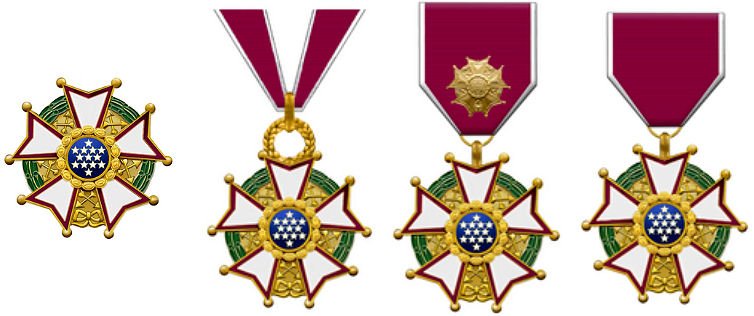
Despite the beautiful and elegant design, we cannot shake the impression that the European Order of Merit bears a very strong resemblance to the American decoration Legion of Merit. The similarity is not just in the general idea of the order of merit, but also in the visual part: a cruciform star with balls on the arms, blue and white enameled elements, a central medallion with stars, a wreath, and generally the impression of how the decoration looks.
The American Legion of Merit is one of the better-known American awards for merit. The European version, of course, lacks American iconography, nor could it have it, but the impression of borrowed phaleristic elements is hard to ignore.
Perhaps it is a coincidence. Perhaps it is inspiration. Or perhaps it is a complete lack of a sense for phaleristics and the importance of what a decoration must represent.
Three grades, but like out of a bad faleristics joke
The biggest phaleristic trouble, after all, is neither politics, nor design, nor possible American inspiration, but the grades of the Order themselves.
The European Order of Merit has three degrees:
- member of the Order
- distinguished member of the Order
- prominent member of the Order
And here a person has to stop.
In phaleristics, it is quite common for orders to have multiple grades. Sometimes these grades are named, for example, Grand Cross, Grand Officer, Commander, Officer, Knight, and the like. Such a hierarchy has tradition, logic, and clear symbolism. We can debate whether it is outdated, “aristocratic,” or too baroque, but at least we know where we stand. Some countries have simplified the whole story, so the grades only have numbering: 1st class, 2nd class, 3rd class, etc. Some just don't feel like complicating things.
With the European Order of Merit, we have something that sounds like membership levels in an endangered songbird preservation society: member, esteemed member, distinguished member. All that is missing is supporting member and member with paid dues for 2026.
This kind of grading feels clumsy, amateurish, and unconvincing from a phaleristic standpoint. It is as if someone really wanted to have an order with classes, but at the same time was afraid to use traditional names because they might sound too monarchical, militaristic, hierarchical, or, God forbid, interesting.
The result is a compromise that offends no one, but also thrills no one, perhaps only “raising the blood pressure” of people from the world of phalera collecting. So, very European.
Rights, obligations, and a minor threat of confiscation
Membership in the Order, in any degree, and the right to wear the corresponding insignia of the Order or the miniature insignia of the Order shall enter into force only after the decoration has been officially conferred.
The insignia of the Order and the miniature insignia of the Order are worn on the left side of the chest, except for the insignia of distinguished members of the Order, which is worn around the neck. Membership in the Order also confers the right of access to the official gallery of the town hall during plenary sessions of the European Parliament.
That is truly a nice privilege, even though we do not know how many people dream of receiving the opportunity to observe a plenary session of the European Parliament as a lifetime achievement award. In the world of decorations, there have been swords, sashes, stars, noble titles, pensions, and guards of honor. Europe offers a gallery. Modest, sustainable, institutional. Perhaps some refreshment in the form of coffee, tea, and bland biscuits is also included in this approach, we cannot know.
An order can also be revoked. For example, if a member of the Order or a selected recipient is found guilty of a criminal offense by a final judgment, if they demonstrate a failure to respect the values upon which the Union is founded, or if they misuse the insignia of the Order or the miniature insignia of the Order.
So, be careful with wearing it. No pinning medals to tracksuits, no selfies with the medal in an inappropriate context, and absolutely do not use it as a keychain for the official car. European phaleristics may be young, but it obviously already has its own code of conduct. And phaleristically speaking, that is fine.
Conclusion: relatively good acting, but a bad story
The European Order of Merit is interesting in principle for phaleristics enthusiasts, as it marks the beginning of something the EU has not had until now: its own official system of decorations. As an object, at least according to available depictions, it appears high-quality and representative. As a political message, it is predictably noble, solemn, and somewhat self-complacent. As a phaleristic system, however, it suffers from the ailment of modern bureaucracy: it has the form of tradition, but not its language.
The biggest failure is neither the laureates, nor the ceremony, nor the European rhetoric, but the awkward degree titles. Member, esteemed member and distinguished member They simply don't sound like a hierarchy of decorations, but rather like a seating arrangement at a formal academy.
However, the fact remains for collectors: the EU received an order of merit. The first of its kind. Generally nice, new, politically charged, and somewhat confused in terms of phaleristics.
There might be more of that in the future, but, hopefully, at a slightly higher phaleristic level.
Author: Zlatko Viščević
Photos: European Parliament, Wikipedia