From the Middle Ages until 1918, the title of King of Croatia existed continuously, which clearly testifies to the thousand-year legal and historical continuity of Croatian statehood. With the disappearance of the native Croatian ruling dynasty, the Croatian royal title did not disappear as well; rather, it continued to live on in the titulature of the Hungarian and subsequently the Habsburg rulers. Thus, medieval Croatian statehood was not abolished, but was maintained within the framework of new dynastic and political relations, which was customary for Christian European countries of that era. Precisely this durability of the title of King of Croatia shows that Croatia retained its legal and political distinctness through the centuries, all the way until the collapse of the Austro-Hungarian Monarchy in 1918.
This constitutional and legal continuity is visible not only in historical documents and state acts, but also on currency. In the early modern period, coins were one of the most important public media of royal authority. They displayed ruler portraits, coats of arms, symbols, and titles. The inscription on a coin was not a random decoration, but an official political message. One such example can be seen precisely on the posthumous thaler of Ferdinand I, minted in Hall in Tyrol between 1573 and 1576. This thaler is a fine example that holds special significance for Croatian numismatics and Croatian constitutional and legal history.
On the obverse of this thaler is an inscription listing Ferdinand I as “King of the Romans, Hungary, Bohemia, Dalmatia, and Croatia.” This makes the thaler an important material witness to the fact that the title of King of Croatia was an integral part of the official Habsburg titles. Particularly important is the inscription “DAL · CROAT · REX,” as it confirms that the title of King of Croatia was an integral part of the official titulature of Ferdinand I, and that Dalmatia and Croatia were separate kingdoms within the Habsburg Monarchy.
Posthumous Thaler of Ferdinand I, Holy Roman Emperor
The displayed specimen belongs to the group of posthumous thalers of Ferdinand I, minted in the Hall mint in Tyrol. It is a silver thaler with a mass of 24.64 grams and a silver fineness of .930. It was minted between 1573 and 1576, thus after Ferdinand's death in 1564. In the literature, this type is listed under the catalog references Moser-Tursky 211 and 213; Hahn 86, and Davenport 8030.
The thaler was produced using the roll-minting technique, which is why it is referred to in German literature as Walzentaler. This method of coin production was an important technological advance compared to older manual striking. Instead of striking individual dies with a hammer, the motifs were impressed onto a metal strip using rollers. This made production more regular, uniform, and suitable for larger issues. Hall in Tyrol was one of the important centers of such advanced coin production in the Habsburg lands.
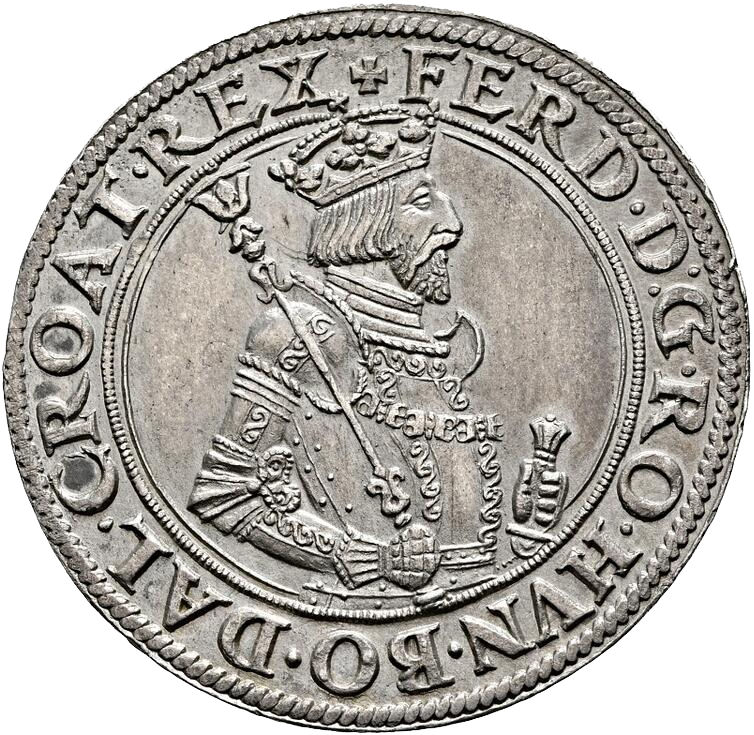
The obverse of the thaler depicts the armored bust of Ferdinand I facing right. The ruler is shown wearing a crown, in richly decorated armor, with royal insignia. In his right hand he holds a scepter, while with his left hand he supports the pommel of a sword. These elements are not merely decorative. The crown signifies royal authority, the scepter ruler dignity, and the sword the ruler's military and protective function. In the context of Ferdinand's rule over Croatia, this symbolism carries additional weight, as defense against the Ottomans was precisely one of the main reasons why the Croatian nobility elected Ferdinand as King of Croatia in 1527.
Ferdinand's bust is depicted in a solemn and representative manner. The portrait strives not only for physical likeness, but above all for emphasizing the ruler's authority. The armor, crown, and insignia create the image of the ruler as the bearer of legitimate, hereditary, and military power. Such a depiction was in accordance with Renaissance and early modern ruler iconography, in which currency also served as a means of political communication.
The inscription on the obverse reads: “+ FERD · D : G · RO · HVN · BO · DAL · CROAT · REX”
This is an abbreviated form of the inscription: “Ferdinandus Dei Gratia Romanorum, Hungariae, Bohemiae, Dalmatiae, Croatiae Rex”
In translation: "Ferdinand, by the grace of God King of the Romans, of Hungary, of Bohemia, of Dalmatia and of Croatia."“
This inscription is extremely important because it explicitly mentions Croatia in the official royal titularity. The abbreviation “CROAT” refers to Croatiae, that is, of Croatia, while the final REX refers to the king. The part of the inscription “DAL · CROAT · REX” should be read as King of Dalmatia and Croatia. This means that Croatia is not just indirectly included in the broader Hungarian title, but is named by its own name.
That very detail gives this thaler a special place in Croatian numismatics. It shows that the Croatian royal title was part of the official language of government and as such was found on coinage. The coin was an object of everyday circulation, but at the same time also a bearer of an official message. Every such thaler publicly confirmed Ferdinand's titulature and the political order to which Croatia also belonged.
It is important to emphasize that this is not a matter of later national loading of meaning into old currency. The inscription is an original historical piece of data. It shows how Ferdinand I titled himself and which lands he considered part of his sovereign rule. Croatia is clearly listed among them. Because of this, this thaler is valuable not only as a specimen of Habsburg silver coinage, but also as a numismatic document of Croatian legal and state history.
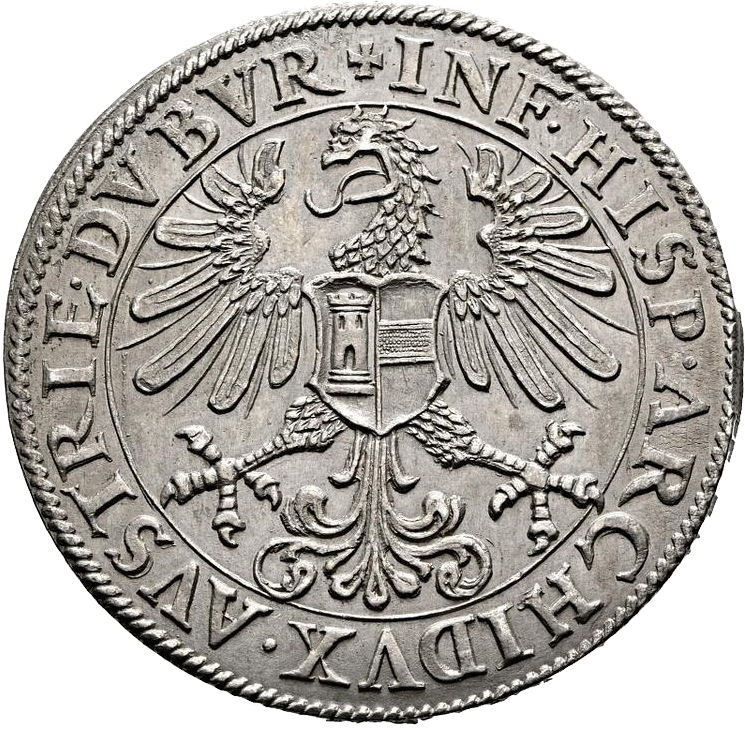
On the reverse is the Tyrolean eagle with spread wings, its head turned to the left. The eagle is depicted without a crown and without a halo, and on its chest it bears a shield with the coats of arms of Castile and Austria. This depiction points to Ferdinand's dynastic origins and the broad European framework of Habsburg rule.
The inscription on the reverse reads: “+ INF · HISP · ARCHIDVX · AVSTRIE · DV · BVR”
It is an abbreviated form of the inscription: “Infante Hispaniae, Archidux Austriae, Dux Burgundiae.”
In translation: “Spanish infante (royal prince), Archduke of Austria, Duke of Burgundy.”
The reverse thus highlights the second part of Ferdinand's identity: his Habsburg, Austrian, Spanish, and Burgundian heritage. Ferdinand was the son of Philip the Handsome and Joanna of Castile, the grandson of Emperor Maximilian I, and the grandson of Ferdinand the Catholic and Isabella of Castile. His person connected several great European dynastic traditions, and his rule encompassed various lands, crowns, and hereditary possessions.
When observed together, the obverse and reverse of the thaler provide a concise political image of Ferdinand I. On the obverse, he is depicted as the King of the Romans, Hungary, Bohemia, Dalmatia, and Croatia, and on the reverse as the Spanish Infante, Austrian Archduke, and Duke of Burgundy. This combination of titles reveals the complexity of Habsburg rule in the 16th century, as well as the special position of Croatia within that broader dynastic entity.
Auction specimen from the H. D. Rauch auction
The specimen shown was sold at an auction by the auction house Auktionshaus H. D. Rauch, auction no. 112, lot 1040, held on June 10, 2021. In the auction description, it is listed as a nondated thaler, minted in Hall, bearing the mintmaster mark of Jakob Bertof. It is described as a posthumous machine-struck thaler (Walzentaler), minted in 1573/1576, fourth die roll combination IV/1.
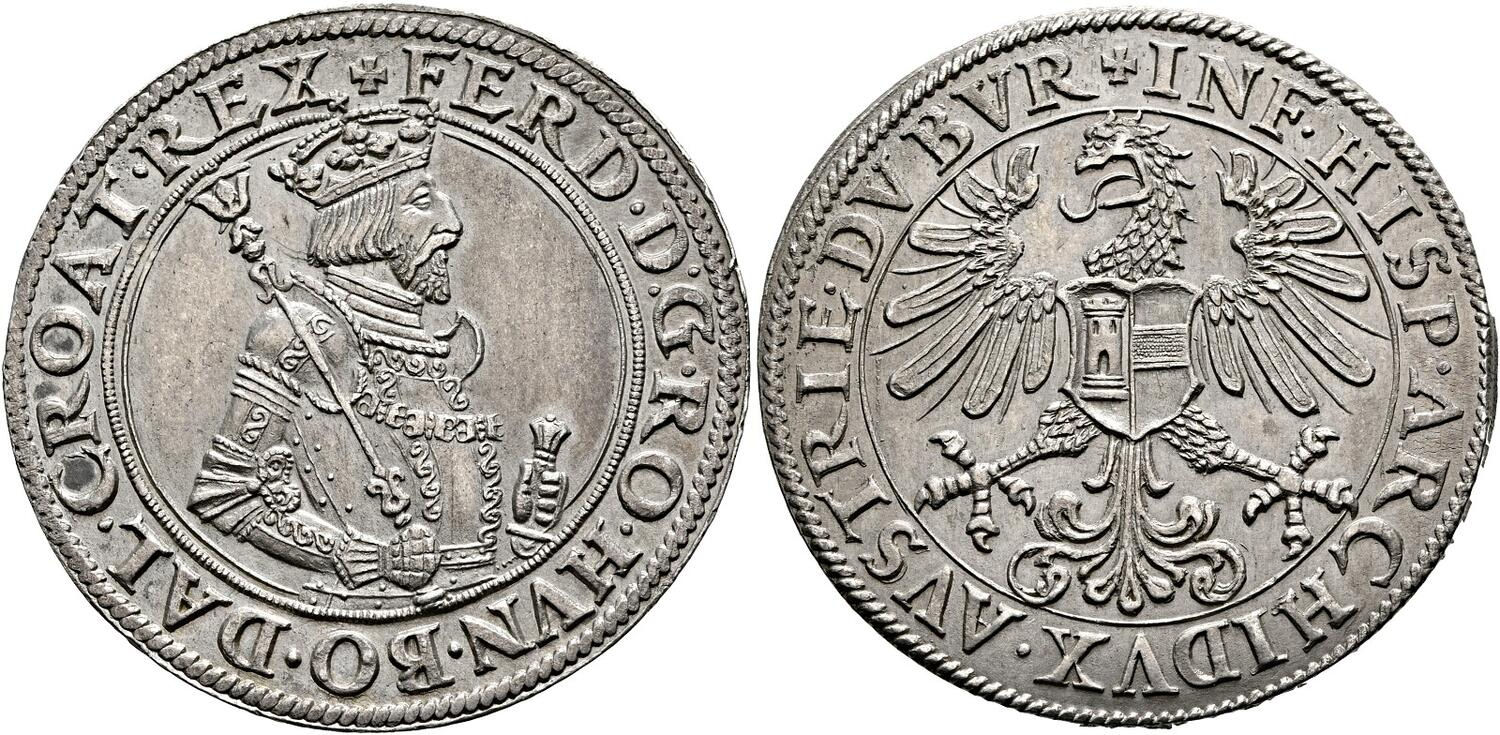
The description lists the references: Davenport 8030 var., Hahn 86, and Moser-Tursky 211. The auction house described the specimen as "Prachtexemplar mit herrlicher Patina," meaning an outstanding specimen with a beautiful patina. The condition is listed as "R f.stplfr.," indicating a rare and very well-preserved specimen.
The starting price was 1,000 EUR, and the achieved price was 3,400 EUR (excluding auction commission, taxes, and other costs).
That result shows that it is a very market-attractive type of thaler, especially when the specimen is well preserved and nicely patinated. For collectors of Habsburg, Austrian, and Tyrolean coinage, it is an important and desirable type, and for Croatian collectors it holds additional value due to the explicit mention of Croatia in the ruler's inscription.
Ferdinand I as Croatian King
Ferdinand I was born on March 10, 1503, in Alcalá de Henares near Madrid, and died on July 25, 1564, in Vienna. He was an Austrian archduke, King of Bohemia, King of Hungary and Croatia, and Holy Roman Emperor. With his ascension to the Croatian throne, the Habsburg period of Croatian history began, which lasted until 1918.
A crucial moment for Croatia occurred after the Battle of Mohács in 1526. In that battle, King Louis II was killed, which opened the question of the succession to the Croatian-Hungarian throne. Ferdinand based his right to the throne on earlier succession treaties between the Habsburgs and the Jagiellonians, but of particular importance to Croatian history is the fact that the Croatian nobility elected him as the Croatian king on January 1, 1527, at the parliament in Cetinje.
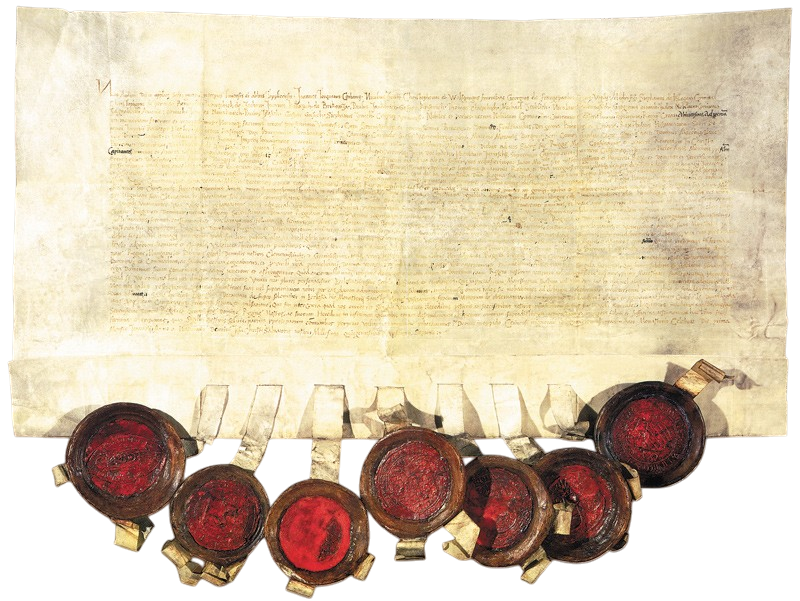
Cetin or Cetingrad Parliament i Charter of Cetingrad belong to the most important events in Croatian history. The Croatian estates were not passive observers there, but a political body that made the decision on the election of the ruler. Under the circumstances of an immediate Ottoman threat, the Croatian nobility chose Ferdinand because they expected military assistance and the defense of the country from him. This choice confirms Croatia's constitutional and legal distinctiveness and the fact that in the early modern period Croatia continued to act as a political community with its own estates and rights. By this move, in very unfortunate military and political circumstances, Croatia managed to preserve its constitutional and legal distinctiveness and identity, and avoided the fate of its southern and eastern neighbors – of becoming just another province of the Ottoman Empire and completely losing its political identity.
Ferdinand's rule was not easy. At the time, Croatia was heavily pressured by Ottoman incursions, and a large part of its territory was directly threatened or lost. Despite limited financial and military capabilities, Ferdinand's rule marked the beginning of a stronger integration of Croatian defense with the Habsburg military system. It was precisely during this period that the defensive structures which would later become part of the Military Frontier gradually took shape.
Ferdinand I is also important as one of the creators of the Habsburg Monarchy. Under his rule, the Austrian lands, Bohemia, Hungary, and Croatia were united. These lands did not immediately become a single centralized state, but long retained their distinct legal positions, estates' institutions, and historical traditions. Within this framework, Croatia remained a kingdom, and the title of King of Croatia continued to be part of the official royal titulature.
Numismatic and historical value of this thaler
The posthumous thaler of Ferdinand I from Hall is important on multiple levels. As a numismatic item, it belongs to the early period of roller coining and bears witness to the technological development of minting production in the 16th century. As an art object, it presents a strong ruler's portrait and a carefully crafted heraldic composition. As a historical source, it records the official titling of one of the most important rulers in Central European history.
For Croatian numismatics, its importance is even greater. The inscription on the obverse clearly mentions Croatia and confirms that Ferdinand I bore the title of King of Croatia in his official titles. Thus, this thaler becomes material evidence of the continuity of the Croatian royal title after the Middle Ages.
On the relatively small surface of a silver coin, a great historical message is condensed. Croatia there does not appear as a geographical footnote, but as a kingdom in the ruler's titulature. This is especially important for understanding Croatian history from the 16th to the 20th century. During that period, Croatia was part of larger state entities but retained its state-legal identity, its name, and its royal title.
Because of this, the thaler of Ferdinand I from Hall transcends the narrow framework of collecting interest. It is a numismatic monument of the Croatian tradition of state law. Its inscription testifies that the title of King of Croatia continued to be used even after the medieval period of native rulers, and that it was part of official European royal practice. Precisely for this reason, this thaler deserves a special place in Croatian numismatics.
Author: Zlatko Viščević with AI assistance
Photos: H. D. Rauch Auction, Wikipedia