The outbreak of the First World War caused an exceptionally large shortage of small coins in Austria-Hungary. Several days before the start of the war, due to a tense situation that did not bode well, the population began to massively withdraw their savings from savings banks. At the same time, gold coins disappeared from circulation, followed immediately by silver coins, and even small coins made of nickel and copper.
The state reacted very quickly to the shortage of small change by issuing the 2-crown banknote prepared in haste, which the Austro-Hungarian Bank had already put into circulation on 16 August 1914.¹, just 19 days after the outbreak of the war and eleven days after the decision to issue it was made. This alleviated the shortage of silver small change, but the problem of a shortage of lower-value money remained.
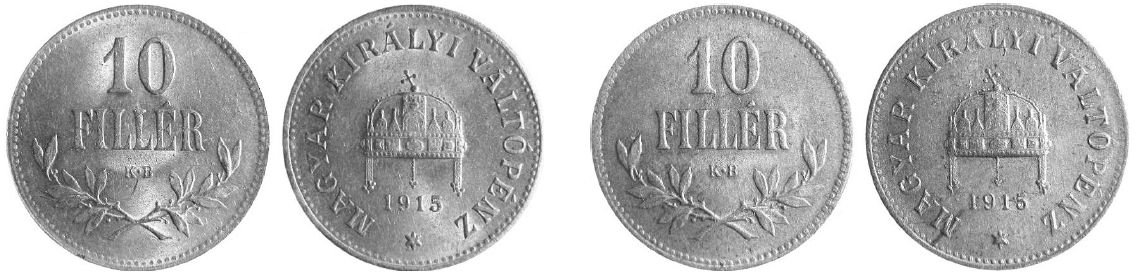
On May 10, 1915, the government issued new 10-filer² coins made of an impoverished alloy containing 50% copper, 40% zinc, and only 10% nickel³, instead of the previous coins made of pure nickel. There was still a large value gap between this coin and the 2-crown banknote, and the smallest denominations were also lacking, which further increased the cost of purchasing everyday necessities.
This unsustainable situation lasted almost the entire 1916 year. In September, people began to make do by cutting 2-crown banknotes into halves and quarters⁴ and thus obtaining temporary small change worth one or half a crown.
The supply of small banknotes was only arranged before the end of the year. The government first issued the iron-based small banknotes of 2 filira⁵ on August 3, the 2 filira⁶ coin on November 10, and the paper money of one krona⁷ on December 21.
Numismatic literature, primarily catalogs, lists Hungarian iron coins of 10 filares from the years 1915 onwards, but does not explain the circumstances of their creation. Because of this, numismatists who have these coins in their collections may mistakenly conclude that Hungary solved the shortage of small change during the war by issuing iron ten-filare coins. However, that was not the case.
Austro-Hungary was also a monetary union of Austria and Hungary as a dualist state, which meant that both halves of the Monarchy issued coins with the same technical characteristics, similar to how it is the case today with the euro. The coins of the same nominal value in both halves of the Monarchy were made from identical metal alloys, had the same dimensions and mass, and differed only in the artistic design. As a legal means of payment, they were equally valued in both halves of the Monarchy.
The amounts that were intended to be minted for both issuers were determined by pre-determined quotas, in the same proportion in which Austria and Hungary shared their sovereign debts as well.⁸ The issuance of new types of money in both halves of the Monarchy was even timed to coincide.
Therefore, it was legally impossible for Hungary to legally issue a coin of the same nominal value made from a different metal alloy than Austria. Half-crown coins were also never issued because the two halves of the Monarchy were unable to agree until its dissolution on whether they should be made of nickel or silver.
All issues of new coins and banknotes, both during the peaceful pre-war period and in the midst of the most difficult war years, were consistently published in the official gazette⁹, along with the corresponding regulations. This was necessary, after all, because the public would not accept money whose validity was not officially guaranteed and confirmed by the authorities.
In addition, the daily newspapers¹⁰ during the war also devoted a great deal of attention to the shortage of small coins, and regularly announced, published, and commented on all new broadcasts. However, not a word was published about the Hungarian 10-filer iron coin.
All this leads to the conclusion that this coin was not issued during the war. What actually happened?
Evacuation of the mint from Kremnica
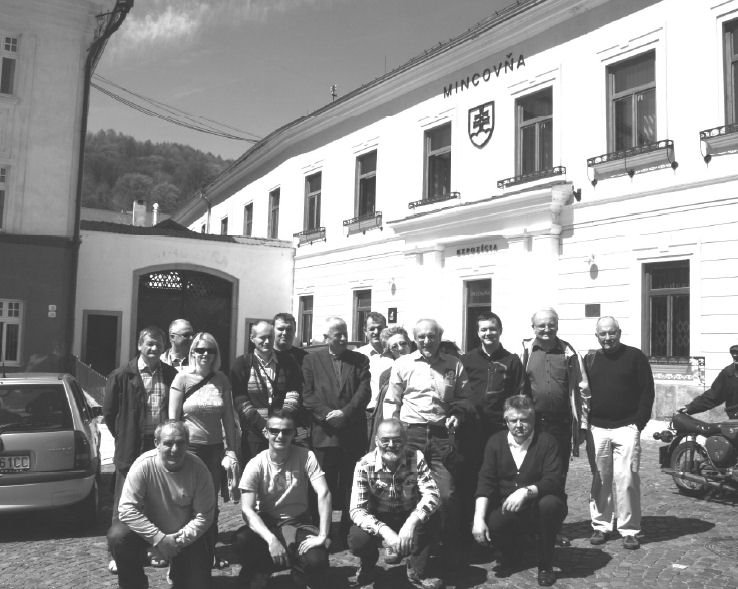
Both halves of the Austro-Hungarian Empire had their own mints. The Austrian one was located in Vienna, and the Hungarian one in Kremnica. From 1871, Kremnica was the only mint in Hungary, and the government, long before the war, was thinking about moving it to the capital and modernizing it.
In the autumn of 1918, it became increasingly clear that the war would end. On October 31, Emperor Charles IV appointed Mihály Károlyi¹² as Prime Minister with the intention of preserving the monarchy in Hungary. On November 11, Charles renounced his participation in Austrian state affairs and subsequently also the Hungarian-Croatian throne.
Just a few days later, on November 16, Károlyi proclaimed Hungary a Democratic Republic with a provisional government, and himself president of the state. On March 21, 1919, a coup led by Béla Kun founded the Hungarian Soviet Republic, which lasted until August 1, when it was defeated by the Romanian army.
Due to the foreseeable outcome of the war in October 1918 and the penetration of the Czechs, who had already begun the process of independence, towards northern Hungary, today's Slovakia, the Hungarians decided to evacuate the mint from Kremnica to Budapest.¹⁴ According to one source, between October 25 and 30, 1918, the machinery was disassembled and, along with the stocks of precious metals, it was temporarily transported to the tobacco warehouse in Soroksár, the southern suburb of Budapest.
According to Slovak sources¹⁵, the disassembly of the equipment and its removal from Kremnica took considerably longer. The Hungarian management of the mint did not pay attention to the creation of Czechoslovakia. After the proclamation of the independent state on October 28, 1918, the mint continued to produce Hungarian iron coins of 2 and 20 filiars.
As events in the new state developed, the Hungarian officials became increasingly concerned and decided to take more serious measures to save what might still be of use to the „Danube part of the Austro-Hungarian Monarchy“.
On November 5, 1918, the Minister of Finance in Budapest ordered the removal of precious metals from the mint. Four days later, the first loaded truck left Kremnica, and on November 14, a telegraphic order arrived from Budapest for the dismantling and removal of the machinery and equipment.
Production of Hungarian iron coins continued until November 30, and the equipment that was gradually removed was used until the last moment. The removal of the machines, equipment, and raw materials continued smoothly until December 15.
On that day at 17 o'clock, the Czechoslovak army occupied Kremnica. The occupation of the railway station prevented the further removal of the mint's assets. The mint was taken over by a commission of Czechoslovak authorities led by Dr. Ľudovít Medvecký, who found the premises devastated and the inventory destroyed. What the Hungarian authorities failed to remove was deliberately damaged so that it could no longer serve the new legal owner.
The situation was similar with the employees as well. Some remained loyal to the old regime, while others enthusiastically welcomed the creation of the new national state. Part of the staff whose attitudes or actions did not fit the goals of the new government were dismissed and left to their own devices.
The leadership in Budapest could not reconcile itself with the loss of the mint. Both the management of the mint and the Hungarian government considered the evacuation to be only a temporary measure. As early as late December 1918, the Hungarian government allocated 200,000 crowns for the salaries of the employees and officers of the mint. They still believed that the situation would stabilize and that the country would return to the old Austro-Hungarian path.
Mining in Csepel
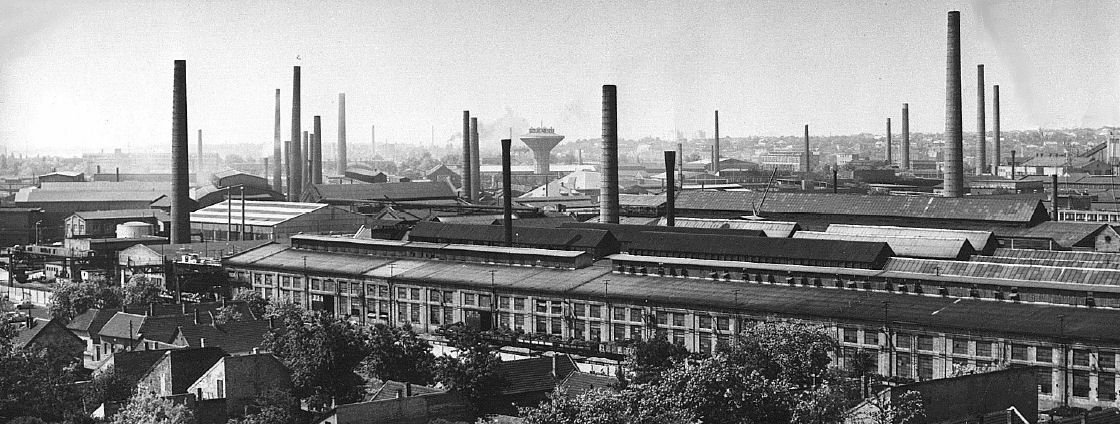
During the reign of Károlyi, there simply wasn’t enough time in Hungary to solve the shortage of small coins and organize their minting. Only on the basis of a decree of the Soviet Republic was the equipment transferred to Manfred Weiss’s fire-arms and ammunition factory in Csepel.
Work in iron and steel plants has begun 3 April 1919., First, by minting iron coins of 20 filers with the years 1916 and 1918., and then by minting iron coins of 10 filers over the years 1915, 1916 and 1918.
Existing, partially worn metal molds with old age were used for their production; they were delivered from Kremnica during October and November. Because of this, the newly minted twenty-filer coins were identical to the wartime specimens, while the iron ten-filer coins from the wartime pakfong (alpaca, new silver) The specimens with the same years were distinguished only by the metal from which they were made.
Preparations were also made for the forging of gold coins, but due to the collapse of the Soviet Union this did not happen. After its collapse, only the forging of small coins continued.
At the beginning of 1920, the Ministry of Finance ordered the forging of iron coins of 10 and 20 filers. These were also made using the same metal molds brought from Kremnica, but this time with the appropriate years. 1920, 1921 and 1922. However, the mark of the Kremnica mint remained unchanged on them. „K. B.“ (Körmöcbánya).
Meanwhile, the location for the new foundry has also been selected. The building at the address Ullői út 102 in Budapest It began to be built on August 2, 1925, according to the project of Gustáv Reich, and production began in it in March 1926.
The coins with the war years were actually minted in 1919.
The 10-foil iron coins bearing the war years on them actually date back to a time when The Hungarian Soviet Republic in the spring of 1919., and not from the war period.
They were not a legal means of payment in other areas of the Austro-Hungarian Empire that were already dissolved at the time, but only in Hungary. Despite this, they belong to Slovenian numismatics as they were in circulation for a certain period of time in part of Slovenian territory.
After its founding The states of Slovenes, Croats and Serbs on October 29, 1918., Prekmurje remained part of Hungary. Especially after the suppression of the short-lived Mures Republic rebellion, the situation in the province became extremely difficult, so even the Paris Peace Conference of August 12, 1919, called for its annexation to the Kingdom of Serbs, Croats and Slovenes.
The Yugoslavian army occupied the province without bloodshed, and on August 17 the administration of the Kingdom of SHS was established there.
From the beginning of minting in April until the annexation of Prekmurje to the Kingdom of SHS in mid-August, the iron coins of 10 filers were there formally a legal means of payment.
Since the coronation banknotes in the area of the Kingdom of SHS were stamped as early as January¹⁶, in Prekmurje this procedure was carried out immediately after accession, in the second half of August or the beginning of September.¹⁷
It is not known what happened next with the 10-filer iron coins because no Yugoslav regulation mentions them, nor do newspaper reports speak of the iron small change.¹⁸ The population probably spent them in neighboring border towns.
Given the distance of Prekmurje from Budapest and other larger centers, as well as the relatively short period of their circulation, from April to August, it can be assumed that these iron coins were not particularly common in the Prekmurje area.
When replacing stamped crowns with dinars, Austro-Hungarian nickel coins of 10 and 20 filers, which were formally still withdrawn from circulation during the war but remained in large numbers among the population, as well as pakfong (alpaca, new silver) 10-filer coins, in the territory of the Kingdom of SHS are equal to the coins of 10 or 20 pairs.¹⁹
Iron coins of 20 filers remain in circulation with a value of 5 pairs²⁰, and that until November 30, 1931²¹
The smallest small denominations of 1 and 2 filiars, as well as the Hungarian iron coins of 10 filiars, are not mentioned in any domestic regulation, and they have simply disappeared from circulation.
In Hungary, the 10-filer iron coins have officially ceased to be a legal means of payment, along with all Austro-Hungarian coins., December 31st, 1926²², although inflation had already practically completely debased them.
Notes
1. Reichgesetzblatt for the kingdoms and countries represented in the Reichstag, CXIX / 19. August 1914.
2. Reichgesetzblatt for the kingdoms and countries represented in the Reichstag, LI / 7. 5. 1915.
3. Pakfong (alpaca, new silver), Silver-colored alloy of copper, zinc and nickel.
4. Slovenian, On September 20, 1916, and Laibacher Zeitung, September 22, 1916.
5. Reichgesetzblatt for the kingdoms and countries represented in the Reichstag, CVII / 31 July 1916.
6. Reichgesetzblatt for the kingdoms and countries represented in the Reichstag, CLXXX / 7. 11. 1916.
7. Reichgesetzblatt for the kingdoms and countries represented in the Reichstag, CXCV / 10. 12. 1916.
8. The ratio of the Austrian and Hungarian quotas was 70 : 30. The regulations on the issuance of new coins allowed Austria to mint up to 14,000,000 crowns. pakfong (alpaca, new silver) small coins of 10 forints, and to Hungary up to 6,000,000 crowns; iron coins of 20 forints to Austria up to 35,000,000, and to Hungary up to 15,000,000 crowns; iron coins of 2 forints to Austria up to 5,600,000, and to Hungary up to 2,400,000 crowns.
9. Reichgesetzblatt for the kingdoms and countries represented in the Reichstag.
10. Vitomir Čop, „On the loot from the First to the Second World War (Part 1)“, Numismatic newsletter, No. 42, Ljubljana, 2016.
11. Charles I, Habsburg-Lorraine, full name Karl Franz Josef Ludwig Hubert Georg Maria von Habsburg-Lothringen, last Austrian Emperor and King of Hungary as Charles IV, born on August 17, 1887 in Persenbeug, died on April 1, 1922 in Funchal on Madeira.
12. Graf Mihály Ádám György Miklós Károlyi de Nagykároly, 4th April 1875 – 19th April 1955.
13. Béla Kun, born Kohn; pseudonyms Emmerich Schwarz, Elemér Schwarz and Imre Schwarz; Szilágycseh, February 20, 1886 – Moscow, August 29, 1938, Hungarian revolutionary.
14. The Hungarian gold coins (hu.wikipedia.org).
15. Marcel Pecník, „Peripeties of the Kremnica Mint in the First Half of the 20th Century“, Acta historica Neosoliensia, 9, 2006.
16. Official Gazette of the National Government of SHS in Ljubljana, January 8, 1919.
17. Newspapers (Murska Sobota), September 13, 1919:
„Money is stamped in Prekmurje; the population can already help itself now and you can buy anything everywhere.“
18. Newspapers (Murska Sobota), January 16, 1921:
„The Filiri will be temporarily withdrawn from circulation, that is, they will no longer be valid.“
Newspapers (Murska Sobota), May 15, 1921:
„The 20 and 2 filira iron money is worth nothing because the state does not recognize it.“
Newspapers (Murska Sobota), June 19, 1921:
„Iron small coin of 20 filers. The Minister of Finance ordered that all state treasuries must receive iron coin small money of the former Austro-Hungarian Monarchy at its established value, namely 20 filers for 5 para.“
Mörszek land, May 27, 1923:
„By order No. 26,809 of 4 May 1923, the Ministry of Post prohibited the receipt of iron coins of 20 filers in postal offices, although until then they had been equalized with the new 5 para coins. Any complaints regarding this order should be addressed to the General Inspectorate of the Ministry of Finance in Belgrade.“
Mörszek land, August 19, 1923:
„The iron money of 20 forints is still valid, but since it is being imported from Austria and Hungary, it must not be accepted in Prekmurje and at border stations.“
19. Official Gazette of the Provincial Government for Slovenia, April 30, 1920.
20. Official Gazette of the Provincial Government for Slovenia, On May 11, 1921 and June 10, 1921.
21. Official newspaper of the Kingdom of Yugoslavia, On November 30, 1931, and Official Gazette of the Royal Banovina Administration of the Drava Banovina, December 12, 1931.
Author: Vitomir Čop
Source: Numismatic Bulletin, No. 44, Numismatic Society of Slovenia, Ljubljana, 2018.
The article was originally published in the Numismatic Herald and is reproduced here with the author's permission, for which we thank him.
Did you notice an error in the text or a linguistic inconsistency? Please report it to us via the page for Contact how we could fix it. Thanks in advance!