


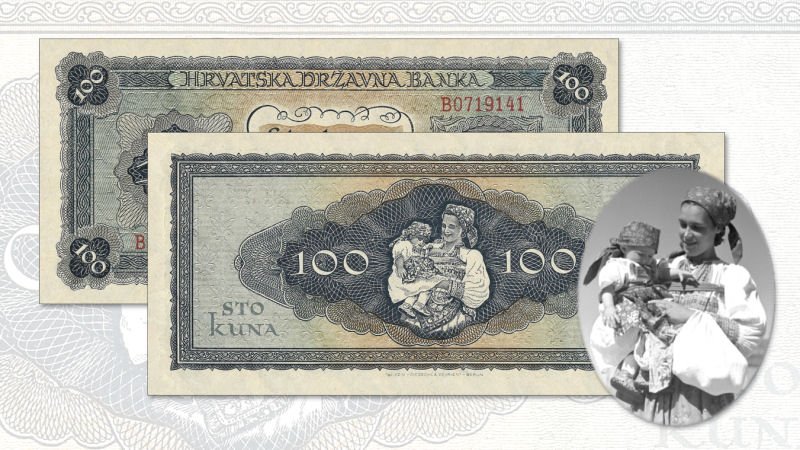
The ethnographic motif on the 100 Kuna banknote from 1943 represents the main visual element of the reverse, located in its central part. It consists of the depiction of a woman with a little girl in her arms, dressed in traditional folk costume characteristic of certain settlements in the Zagreb suburban area. At the time the banknote was created, these settlements were in the immediate vicinity of Zagreb, while today they belong to that city. Although the costumes in these settlements differ slightly, typologically they belong to the same group and are known under the common name of the Šestine folk costume. It got its name after one of those settlements – Šestine.
The name Šestine folk costume became established in the public consciousness as a result of the people of Šestine coming to Zagreb in their costumes. Since the people of Zagreb did not distinguish the details among the costumes, all Prigorje costumes were eventually called Šestine. This type of costume is characteristic of the Prigorje settlements located in the area from the Kustošak stream in the west to the settlements of Čučerje and Granešina in the east.
The Šestine folk costume, due to its rich embroidery and diverse weaving, ranks among the most colorful Croatian folk costumes. Over time, it ceased to be an everyday garment and today is worn exclusively on special occasions—traditional celebrations, holidays, and for the purposes of folklore societies. The selection of this very costume as an ethnographic motif on one of the banknotes of the Independent State of Croatia is a reflection of the national cultural, social, and historical awareness of the time, as well as the prevailing political atmosphere.
Banknote designer Vladimir Kirin had previously designed and depicted these exact same two female figures dressed in the Šestine folk costume on one of his postcards from the series of Croatian folk costumes, published in late 1939 or early 1940. The description of that postcard, numbered 34, states that it depicts the Croatian folk costume from Zagreb – Šestine.
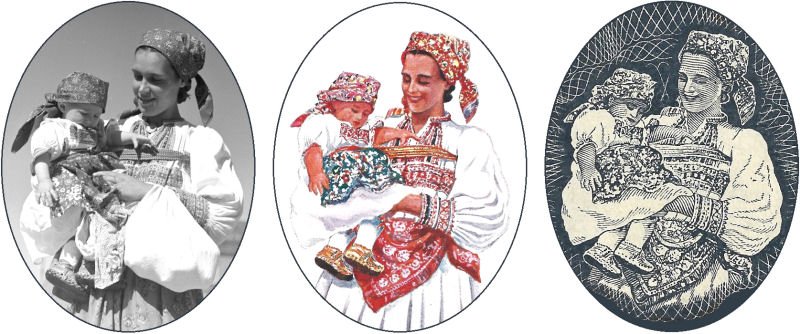
The characters shown on the postcard and the banknote are not fictional, but are based on real people. Based on his research, the author of the book concluded that Vladimir Kirin used a photograph by Tošo Dabac as a model for his drawing, which was published multiple times between 1940 and 1944. By studying the background details in that photograph, he determined that it was taken in Jelačić Square in Zagreb, the main city square.
Author: Vedran Kušelj
Source: Vedran Krušelj, Banknotes of the NDH: Untold Stories, 1st edition, Zagreb, 2025.
This text was originally part of the book:“Banknotes of the NDH: Untold Stories”author Vedrana Krušelj.
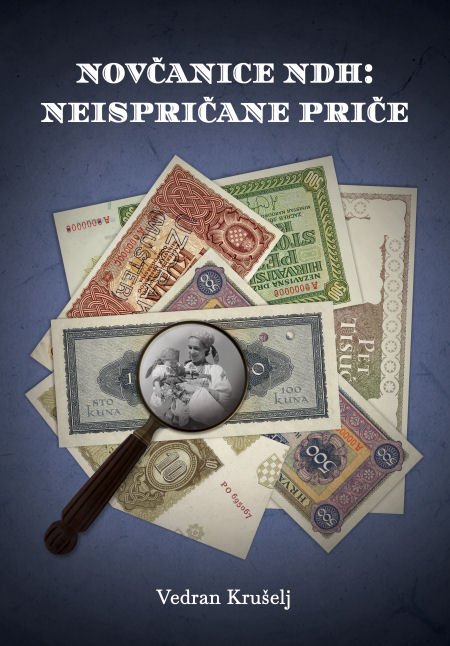
Vedran Krušelj's book“Banknotes of the NDH: Untold Stories”is the result of the author's multi-year, persistent, and systematic research into the aforementioned subject matter, and represents a complete and comprehensive overview of the numismatic history of the Independent State of Croatia (NDH) with an emphasis on banknotes. For the first time in literature, all the data necessary for professional analysis are gathered in one place, described in context, and supported by numerous original documents, newspaper articles, and photographs. The technical, symbolic, and iconographic features of the banknotes are soundly explained, and the ‘stories are told’ about the figures whose portraits appear on them.
In the book, among other things, a sketch of the 50,000 Kuna banknote from 1945 is presented for the first time, and every buyer receives as a gift a separately numbered reproduction of its graphic reconstruction.
More textual details from the book can be found on the author's social media profile: https://www.facebook.com/vedran.kruselj
Hardcover, A4 format, 392 pages, color illustrations.
The planned book release is in the month of in December of this year.
Regular price books will be taken out 90 EUR + shipping costs.
It is possible to order it now on presale at a price of 80 EUR + shipping costs.
Take advantage of this purchase benefit that will last only until mid-October.
You can place your order via:
Email: vedran.kruselj@gmail.com
To phone or WhatsApp: +385 91 506 9477