Among the Latin American coins of the early 19th century, a special place is held by the Chilean silver peso commonly known by the popular name “Volcano Peso. It is one of the most recognizable coins of the early Republic of Chile, and its motif of an erupting volcano has been attracting the attention of numismatists, historians, and collectors for over two centuries.
This coin was first minted in 1817, during the period of Chile's struggle for liberation from Spanish colonial rule. In numismatic terms, it is not only a medium of exchange, but also a political message in silver. Its artistic program clearly speaks of the new state, freedom, unity, and the strength of the government that was just being established.
Historical context
The early 19th century was a period of great change in the Spanish colonies in America. The weakening of Spain, wars in Europe, and the strengthening of local independence movements led to the creation of new states in the territory of present-day Latin America. In this process, Chile went through a turbulent period of political and military conflicts, in which the issue of money had both practical and symbolic significance.
Minting its own currency was one of the clear signs of sovereignty. The new government did not want to just replace the old colonial currency, but also to show that Chile had its own political identity. Exactly for this reason, the early Chilean peso from 1817 carries such strong symbolism.
Coin design
Silver coin 1 peso, that is, the monetary value that in the older system can be associated with the tradition of the Spanish 8-real silver coin. It is made of silver of fineness .902, mass around 27 grams and a diameter of approximately 39.5 mm. It was forged in the forge. Mint of Chile in Santiago.
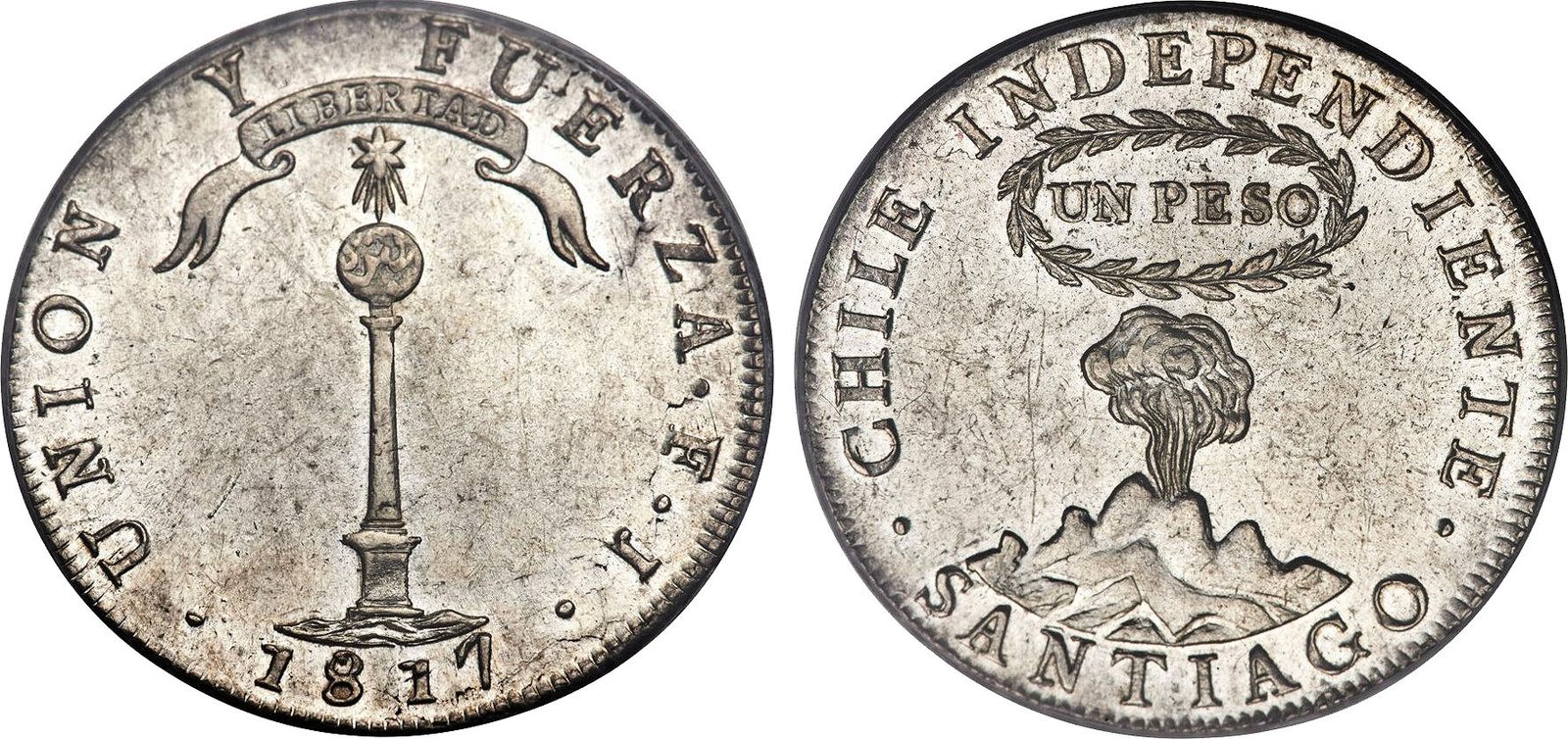
On the front of the coin is a pillar on which there is a terrestrial globe, above which is a star. Above the pillar is a ribbon with the inscription “FREEDOM“, which means freedom. Along the edge is the inscription“UNION AND STRENGTH“, i.e., “unity and strength”. These are elements from the Chilean coat of arms at the time. In the lower part is the year, on the displayed specimen 1817.
The reverse shows an erupting volcano beneath a laurel wreath. In the center of the wreath is the inscription “ONE PESO” (one peso), and along the edge the inscription “INDEPENDENT CHILE“", or "independent Chile". In the lower part, the mint mark is shown, “SANTIAGO”.
Vulcan as a political symbol
The most famous feature of this coin is undoubtedly the volcano. That's why it has earned the name among collectors. “Volcano Peso”. An erupting volcano can be interpreted as a powerful metaphor for a new state breaking free from colonial rule. This is not a peaceful, neutral motif, but rather a motif of energy, strength, and political awakening.
In that sense, the coin is very typical of the period of the creation of new states. Money did not serve only for everyday trade, but was also a means of state propaganda. Through inscriptions and images, a message was conveyed: Chile is independent, free, and capable of standing on its own.
Inscription “UNION AND STRENGTH” further emphasizes that idea. The new state needed internal unity and strength to sustain itself after liberation. The inscription “LIBERTY” On the ribbon above the pillar is an even more direct political message and one of the key concepts of the revolutionary period in Latin America.
Forging period and variants
The tip with the volcano was forged from from 1817 to 1834, with certain minor variations. In the “Standard Catalog of World Coins” it is listed under the number KM# 82, along with subvariants that differ in the stylization of the volcano, the globe, the placement of the letters, and the marks of the engraver or mint master.
With this type, variations in letter placement are known. Y in the inscription on the front. In one variant, the letter Y is located above the pillar, while in the other it is placed to the left of the pillar. Behind the inscription “UNION AND STRENGTH” mint marks also appear, such as: FD, FJ, FI, I i IJ.
Known years of minting include 1817, 1818, 1819, 1820, 1821, 1822, 1823, 1824, 1825, 1826, 1830, 1831, 1832, 1833, and 1834. Mintage figures vary considerably. For example, for the year 1818, a mintage of approximately 371,000 copies, for 1819 about 236.000, while some later years are significantly rarer. Years with low emissions stand out in particular, such as 1825 with about 3,400 copies in 1826 with about 6,111 copies.
Collector value
The Chilean “Volcano Peso” is a highly sought-after coin today. Its value depends on the year, variety, state of preservation, marks, patina, any signs of cleaning, and overall visual appeal. As with most large silver coins from the early 19th century, preservation plays a decisive role.
Copies in poorer condition may be more accessible, but nicely preserved pieces, especially in higher grades, fetch significantly higher prices. Early dates, rare variants, and specimens with clear details of the volcano, wreath, pillar, and inscription are particularly valued. Coins from 1817 have an added historical appeal as they are linked to the beginning of this type and the early years of Chilean independence.
Due to its attractive design, historical significance, and clear political symbolism, this peso is a frequent subject of interest at international numismatic auctions. For collectors who gather Latin American currency, revolutionary issues, or coins with motifs of national independence, the “Volcano Peso” represents one of the more important types.
The specific specimen from the image above was sold at Heritage auction no. 3115 from 2024 for EUR 14,888 (excluding buyer's premium).
Numismatic and historical significance
This coin combines several elements that are particularly important for numismatics: a historical moment, strong iconography, state symbolism, and high-quality technical minting. Its design is not merely decorative, but clearly speaks of the time in which it was created.
The volcano on the coin is not an ordinary natural motif. It represents an explosion of political energy, the emergence of a new state onto the historical stage, and a break with its colonial past. That is why the Chilean “Volcano Peso” is much more than a silver coin. It is a small metallic document of a great historical upheaval.
Author: Zlatko Viščević with AI assistance
Photos: Heritage Auctions