





The 20 dinar gold coin of the Kingdom of Serbs, Croats and Slovenes from 1925 is one of the best-known and most sought-after gold coins of the Yugoslav monetary system. It is a specimen that has held a special place for decades among coin collectors of the Kingdom of SCS and the Kingdom of Yugoslavia, as well as among those who view gold coins from an investment perspective.
This gold coin used to appear on the market more often than it does today. In older collections, dealer offers, and at fairs, it could be encountered relatively regularly, especially in medium and better grades of preservation. Today, the situation is different. Although it is not an extremely rare gold coin in the absolute sense, its market availability is significantly lower than before. Quality specimens, especially those without traces of cleaning, bumps, or heavy circulation, are offered less and less, and when they do appear, they regularly attract attention.
The uniqueness of this gold coin lies not only in its gold content. It also has a strong historical and symbolic dimension. It represents one of the rare gold issues of the Kingdom of SCS in the national currency featuring the image of King Alexander I Karađorđević. Among the common people and merchants, it was also known as the „aleksandor,” after the French expression „Alexandre d'or,” modeled after older names such as „napoleondor” and „milandor.” This fact alone shows that this gold coin assumed a special place in monetary and commercial practice at a very early stage.
Historical context of coin minting
The minting of the 20-dinar gold coin from 1925 was not the result of an actual need for gold currency in everyday circulation. Although it was formally legal tender, this money was not used in practice as ordinary circulating currency. Its role was different. It served as a physically shaped state gold deposited with the National Bank as part of the gold backing for banknotes in circulation and other demand liabilities, as well as a means for hoarding gold in private hands.
In other words, the 20-dinar gold coin was more of a monetary, financial, and symbolic instrument than everyday money. Its minting should be viewed in the context of the state's attitude toward gold at the time, the stability of the national currency, and the desire for the Kingdom of SCS to have its own representative gold coinage. Literature also suggests the interpretation that the minting of this gold coin was connected to the ruler's ambition for King Alexander, like earlier Serbian rulers, to have his own gold money.
The legal basis for minting the gold coin was the Financial Act for 1924/25. By this act, the Minister of Finance was authorized to mint and put into circulation one million pieces of 20-dinar gold coins. It was also stipulated that the minister should prescribe the fineness, size, inscriptions, and other characteristics of the gold coins, and that state gold held at the National Bank should be used for the minting. The new gold coins were to be handed over to the National Bank in the value of the gold that was withdrawn for their minting.
To implement these legal provisions, the Ministerial Council adopted the Regulations on the Minting of National Gold Coins on November 18, 1924. These regulations prescribed technical conditions, including metal composition, mass, permitted tolerances, diameter, and the basic description of the gold coins.
Although the gold coin bears the year 1925, according to the literature, its minting took place in 1927. The minting was carried out at the Paris Mint, specifically the French state mint Monnaie de Paris. For the planned emission of one million pieces, 5,806.45 kilograms of pure gold were required. This gold was secured from the state depository at the National Bank, reportedly in the form of Austro-Hungarian gold crowns received from the liquidation estate of the Austro-Hungarian Bank in 1921. However, it should be emphasized that for some numismatic authors, this information is unverified and questionable.
Basic information
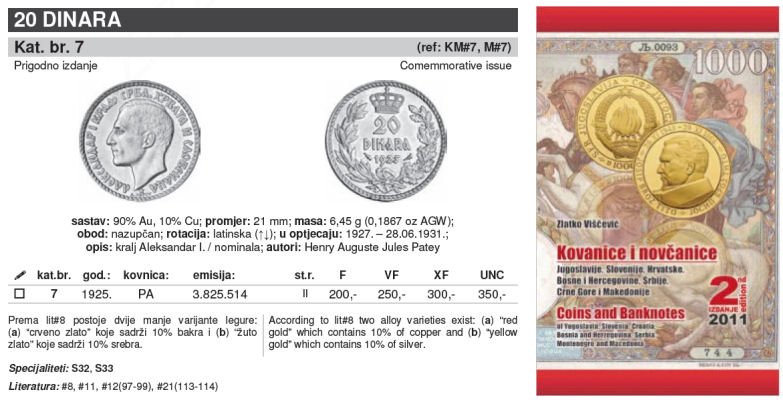
Basic information about the 20 dinar gold coin from 1925:
- Country: Kingdom of Serbs, Croats and Slovenes
- ruler: Alexander I Karađorđević
- metal: gold 900/1000
- mass: 6,4516 g
- diameter: 21 mm
- shape: round
- minting technique
- orientation: Latin coin orientation (↑↓)
- rim: toothed
- mint: Monnaie de Paris, Paris
- engraver: Henri-Auguste Patey
- face value: 20 dinars
- year on the money: 1925.
- cessation of legal tender status: June 28, 1931.
The technical characteristics of this gold coin comply with the standards of the Latin Monetary Union of 1865 for a 20-denomination gold coin. The gold coin is made of 900/1000 fine gold, with the addition of 100/1000 copper. The prescribed mass is 6.45161 grams, and the diameter is 21 millimeters.
Facial description
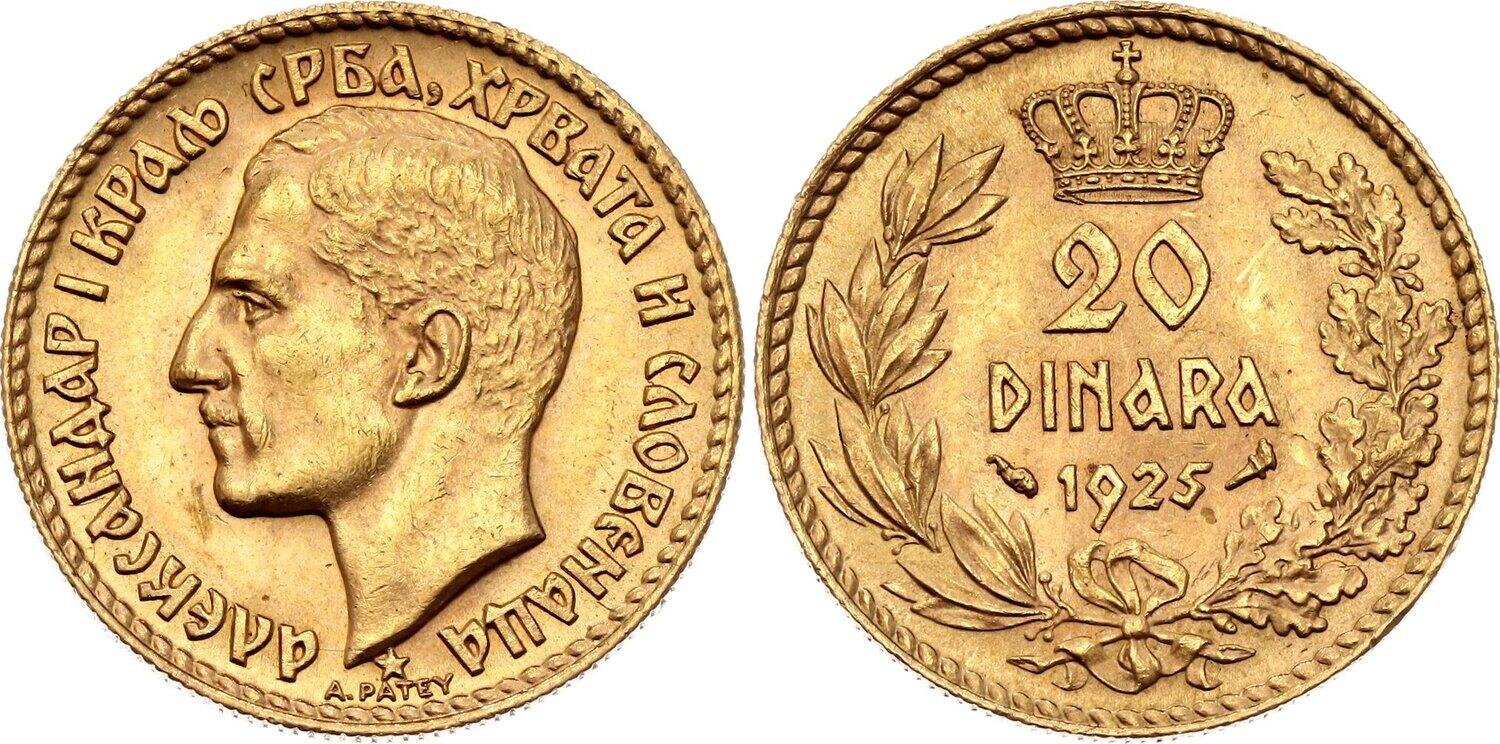
On the obverse is the head of King Alexander I Karađorđević in left profile. Around the portrait is an inscription in Cyrillic: „АЛЕКСАНДАР КРАЉ СРБА, ХРВАТА И СЛОВЕНАЦА”. Below the portrait is the engraver's name „A. PATEY”, along with a star as his mark. Along the edge of the face, there is a circular row of tiny dots.
The artistic design of the obverse reflects the French school of medal making and the style of official portrait representations from the early 20th century. The portrait is calm, measured, and representative, without exaggerated decoration, thereby placing the emphasis on the ruler's figure and state authority.
Description of the reverse side
On the reverse side, in the center, is the numerical value „20”, below which is the inscription „DINARA”, and at the bottom is the year „1925”. The central inscription is framed by a wreath consisting of a laurel branch on the left and an oak branch on the right. The branches are tied at the bottom with a ribbon, while above them is a crown.
Along with the year, there are also the mint marks of the Paris Mint. The cornucopia indicates the French mint, while Mercury's rod, or rather the torch, indicates the chief engraver Henri Patey. As on the obverse, along the edge of the reverse is a series of tiny dots.
The reverse is compositionally simple, but very clearly shaped. The denomination and year are in the center, while the wreath and crown give the issue an official and state character. The combination of laurel and oak points to the classical European symbolism of honor, strength, durability, and statehood. It should be emphasized that the crown above the denomination mark is imaginary. Namely, the crown used in the Kingdom of Serbia, SCS, and Yugoslavia looks different.
Emission and circulation
In most catalogs, as well as in the National Bank's annual report for 1926, an issue of one million pieces is stated. However, some literature mentions the possibility that the actually minted quantity was smaller. This question remains interesting for numismatic discussion, especially when comparing the officially stated mintage with the current frequency of appearance of this gold coin on the market.
The gold coin was conditionally put into circulation in 1927. Although it was legal tender, it was not put into circulation in the usual way. It could be purchased at the National Bank for its equivalent value in other gold coins, for example, for a 20 French franc gold coin, with an additional payment of 2 dinars per piece for minting costs.
Such a method of distribution confirms that this was not money intended for everyday use. The gold coin was, above all, a form of standardized state gold in coin format. Therein lies the reason for its long-lasting appeal. It is interesting to collectors as an important specimen of Yugoslav numismatics, while to a broader circle of buyers it is also interesting due to its gold content, recognizability, and historical symbolism.
The status of legal tender ended on June 28, 1931. Despite this, the gold coin continued to live on in collections, private vaults, and commercial practice. Precisely for this reason, the 20 dinar coin from 1925 is today one of those specimens that simultaneously belong to the fields of numismatics, monetary history, and the investment gold market.
Numismatic significance
The 20 dinar gold coin from 1925 holds a special place in the numismatics of the Kingdom of SCS and the Kingdom of Yugoslavia. Technically crafted according to the internationally recognized gold standard, it was minted in one of Europe's most reputable mints and shaped by the hand of the renowned French engraver Henri-Auguste Patey. At the same time, it bears the likeness of King Alexander I and the name of the state of Serbs, Croats and Slovenes, giving it a strong historical and political context.
For coin collectors of the Yugoslav region, this gold coin is an almost mandatory specimen. Unlike many other gold coins that are viewed primarily through their metal value, the 20 dinars of 1925 also has a clearly expressed numismatic value. Its market price depends not only on the price of gold, but also on its condition, demand, availability, and buyer interest.
Precisely for this reason, this gold coin deserves a separate market trend analysis. Later in the article, we present auction results, realized sales, and the current market supply, especially regarding the grade of preservation and the ratio to the value of the contained gold.
Auction results
For the 20 dinar gold coin of the Kingdom of SHS from 1925, an extensive sample of auction results covering the period from 2001 to 2025 has been collected. The table features leading European and American auction houses, among which Heritage Auctions, Fritz Rudolf Künker, Katz Auction, Auktionshaus H. D. Rauch, Emporium Hamburg, Hess Divo, Spink, Stack’s Bowers Galleries, Teutoburger Münzauktion, and others stand out in particular.
A total of 242 auction results were recorded, which provides a sufficiently broad overview of market trends. The table contains several data columns that are essential for analyzing the trends of auction and market prices for this specimen.
The table contains the following columns:
- Achieved price (EUR) – Achieved auction price in euros. The amount for which the coin was sold at auction, expressed in euros. The stated price does not include auction commissions and additional costs (tax, shipping, etc.).
- Value of gold (EUR) – Market value of the gold in the coin at that time in EUR. The estimated value of the pure gold contained in this gold coin in the year of the auction. The exact exchange value on the day of sale was not taken into account, but rather the annual average. This column shows how much the coin was worth solely as gold, without the numismatic premium.
- Ratio of achieved price to gold value (%) – The ratio of the achieved auction price to the exchange price of gold in percentages. The percentage showing how much higher or lower the auction price was than the average annual value of the gold in this gold coin. For example, if it is stated +50%, which means the coin was sold for 50 % more than the value of the gold. If it is stated -5%, meaning that 5% was sold below the average annual value of gold at that time.
- Degree of preservation (orig.) – The degree of preservation originally stated for a specific item at auction. Original grade as stated by the auction house or grading service. It can be written in different systems, for example: MS64, Exquisite, Brilliant uncirculated, XF, UNC, AU58, FDC and the like. It should be taken into account that some auction houses overestimate the condition of the items they sell.
- Level of preservation – Grade of preservation according to standard classification (UNC / XF / VF / F). Simplified and standardized condition grading. Since auction houses use different terms and languages, this column translates everything into a comparable system: UNC, XF, VF, F and transitional markers such as UNC-, XF+, XF-. This allows for easier comparison of the results.
- Certification – Is the coin certified? Information on whether the coin was in a certification holder, meaning it was professionally graded and encapsulated by a grading service. If it was, it is stated, for example,. NGC, PCGS, ANACS or ICG. If it is not certified, it says No.
- Auction – Auction house. The name of the auction house through which the coin was sold. This information is important because different auction houses have different audiences, reputations, and market reach, which can affect the final price achieved.
- Year – Auction Year. The year in which the auction was held (completed). This column allows tracking price trends over time and comparing auction results with the gold price at that time.
| Achieved price (EUR): | Value of gold (EUR): | Ratio of achieved price to gold value (%): | Conservation status (orig.): | State of preservation (standard): | Certification: | Auction: | Year: |
|---|---|---|---|---|---|---|---|
| 950 | 681 | 39 | MS64 | UNC | NGC | Pegasus Auctions | 2025. |
| 750 | 681 | 10 | vz-St | XF+ | No | Fritz Rudolf Künker | 2025. |
| 632 | 681 | -7 | MS64 | UNC | NGC | Spink | 2025. |
| 700 | 681 | 3 | Almost excellent | XF- | No | Fritz Rudolf Künker | 2025. |
| 1000 | 681 | 47 | MS65 | UNC | PCGS | Stack's Bowers Galleries | 2025. |
| 600 | 681 | -12 | MS64 | UNC | NGC | Heritage Auctions | 2025. |
| 722 | 681 | 6 | MS63 | UNC | NGC | Heritage Auctions | 2025. |
| 1106 | 471 | 135 | MS66 | UNC | NGC | Heritage Auctions | 2024. |
| 687 | 471 | 46 | MS64 | UNC | NGC | Heritage Auctions | 2024. |
| 536 | 471 | 14 | MS 61 | UNC | NGC | The Coin Cabinet | 2024. |
| 460 | 471 | -2 | MS-64 | UNC | PCGS | Ira & Larry Goldberg | 2024. |
| 680 | 471 | 44 | f.stplfr. | UNC- | No | Auction House H. D. Rauch | 2024. |
| 578 | 471 | 23 | MS64 | UNC | NGC | KATZ Auction | 2024. |
| 552 | 471 | 17 | MS65 | UNC | NGC | Heritage Auctions | 2024. |
| 596 | 471 | 27 | MS64 | UNC | NGC | KATZ Auction | 2024. |
| 550 | 471 | 17 | UNC with full mint luster | UNC | No | KATZ Auction | 2024. |
| 600 | 471 | 27 | vs - p. | XF+ | No | Heidelberger Münzhandlung | 2024. |
| 460 | 471 | -2 | exquisite, small scratches | XF | No | Teutoburger Coin Auction | 2024. |
| 623 | 471 | 32 | MS65 | UNC | NGC | Heritage Auctions | 2024. |
| 576 | 471 | 22 | MS62 | UNC | NGC | KATZ Auction | 2024. |
| 600 | 471 | 27 | For investment gold in... | UNC | No | Gorny & Mosch | 2024. |
| 578 | 348 | 66 | MS62 | UNC | NGC | KATZ Auction | 2023. |
| 635 | 348 | 83 | MS63 | UNC | NGC | KATZ Auction | 2023. |
| 585 | 348 | 68 | UNC with mint luster & minor hairline | UNC | No | KATZ Auction | 2023. |
| 775 | 348 | 123 | MS 67 | UNC | NGC | Fritz Rudolf Künker | 2023. |
| 550 | 348 | 58 | vz-St | XF+ | No | Fritz Rudolf Künker | 2023. |
| 520 | 348 | 49 | f.stplfr. | UNC- | No | Auction House H. D. Rauch | 2023. |
| 409 | 348 | 18 | MS-62 | UNC | NGC | Stack's Bowers Galleries | 2023. |
| 595 | 348 | 71 | MS64 | UNC | NGC | Heritage Auctions | 2023. |
| 883 | 348 | 154 | MS65 | UNC | PCGS | KATZ Auction | 2023. |
| 527 | 348 | 52 | MS64 | UNC | NGC | KATZ Auction | 2023. |
| 520 | 348 | 49 | vz | XF | No | Heidelberger Münzhandlung | 2023. |
| 500 | 348 | 44 | vz-st | XF+ | No | Emporium Hamburg | 2023. |
| 430 | 348 | 24 | Exquisite | XF | No | Fritz Rudolf Künker | 2023. |
| 580 | 348 | 67 | MS 63 | UNC | NGC | KATZ Auction | 2023. |
| 587 | 319 | 84 | MS 64 | UNC | NGC | KATZ Auction | 2022. |
| 581 | 319 | 82 | MS63 | UNC | NGC | Heritage Auctions | 2022. |
| 575 | 319 | 80 | vz | XF | No | Heidelberger Münzhandlung | 2022. |
| 380 | 319 | 19 | Scratches in the obverse field, about extremely fine | XF | No | Fritz Rudolf Künker | 2022. |
| 445 | 319 | 40 | UNC | UNC | No | KATZ Auction | 2022. |
| 650 | 319 | 104 | scratching sign approx. +/- fine storage marks. | XF+ | No | Auction House H. D. Rauch | 2022. |
| 500 | 319 | 57 | Prachtex., f.st/st | UNC | No | Emporium Hamburg | 2022. |
| 568 | 319 | 78 | MS65 | UNC | NGC | Heritage Auctions | 2022. |
| 497 | 319 | 56 | MS64 | UNC | NGC | Heritage Auctions | 2022. |
| 560 | 319 | 76 | MS63 | UNC | NGC | Heritage Auctions | 2022. |
| 580 | 319 | 82 | vz-st | XF+ | No | Emporium Hamburg | 2022. |
| 650 | 319 | 104 | Mint State 64 Plus | UNC | NGC | Pegasus Auctions | 2022. |
| 567 | 319 | 78 | MS64 | UNC | PCGS | Heritage Auctions | 2022. |
| 550 | 319 | 73 | vz-St | XF+ | No | Teutoburger Coin Auction | 2022. |
| 438 | 319 | 38 | FDC choice | UNC | No | Spink | 2022. |
| 486 | 297 | 63 | MS63+ | UNC | NGC | Heritage Auctions | 2021. |
| 400 | 297 | 34 | vz-St | XF+ | No | Fritz Rudolf Künker | 2021. |
| 420 | 297 | 41 | XF/UNC | XF+ | No | Heritage Europe | 2021. |
| 440 | 297 | 48 | XF/UNC | XF+ | No | Heritage Europe | 2021. |
| 420 | 297 | 41 | XF | XF | No | Heritage Europe | 2021. |
| 420 | 297 | 41 | XF | XF | No | Heritage Europe | 2021. |
| 420 | 297 | 41 | XF | XF | No | Heritage Europe | 2021. |
| 387 | 297 | 30 | MS63 | UNC | NGC | Heritage Auctions | 2021. |
| 390 | 297 | 31 | Brilliant uncirculated | UNC- | No | Fritz Rudolf Künker | 2021. |
| 462 | 297 | 55 | AUNC | XF+ | No | KATZ Auction | 2021. |
| 694 | 297 | 133 | MS-65 | UNC | NGC | Stack's Bowers Galleries | 2021. |
| 800 | 297 | 169 | Brilliant uncirculated | UNC- | No | Fritz Rudolf Künker | 2021. |
| 452 | 297 | 52 | MS61 | UNC | NGC | Heritage Auctions | 2021. |
| 430 | 297 | 45 | MS64 | UNC | NGC | Heritage Auctions | 2021. |
| 336 | 297 | 13 | MS63 | UNC | NGC | Heritage Auctions | 2021. |
| 492 | 297 | 66 | MS64 | UNC | NGC | Heritage Auctions | 2021. |
| 533 | 297 | 79 | MS62 | UNC | NGC | Heritage Auctions | 2021. |
| 739 | 297 | 149 | MS66 | UNC | NGC | Heritage Auctions | 2021. |
| 657 | 297 | 121 | MS65 | UNC | NGC | Heritage Auctions | 2021. |
| 476 | 297 | 60 | MS64 | UNC | NGC | Heritage Auctions | 2021. |
| 517 | 297 | 74 | Mint State 64 Plus | UNC | NGC | Heritage Auctions | 2021. |
| 460 | 297 | 55 | f.st | UNC- | No | Emporium Hamburg | 2021. |
| 597 | 297 | 101 | MS65 | UNC | NGC | Heritage Auctions | 2021. |
| 635 | 297 | 114 | MS65 | UNC | NGC | Heritage Auctions | 2021. |
| 542 | 297 | 83 | MS62 | UNC | NGC | Heritage Auctions | 2021. |
| 545 | 297 | 84 | MS65 | UNC | NGC | Heritage Auctions | 2021. |
| 545 | 297 | 84 | MS62 | UNC | NGC | Heritage Auctions | 2021. |
| 623 | 297 | 110 | MS65 | UNC | NGC | Heritage Auctions | 2021. |
| 581 | 297 | 96 | MS64 | UNC | NGC | Heritage Auctions | 2021. |
| 986 | 297 | 232 | MS65+ | UNC | NGC | Heritage Auctions | 2021. |
| 380 | 297 | 28 | Min. scratches, excellent | XF | No | Fritz Rudolf Künker | 2021. |
| 430 | 297 | 45 | bzgl./stplfr. | XF+ | No | Auction House H. D. Rauch | 2021. |
| 420 | 297 | 41 | cf. | XF | No | Auction House H. D. Rauch | 2021. |
| 330 | 297 | 11 | Scratches, polished | VF+ | No | Auction House H. D. Rauch | 2021. |
| 457 | 297 | 54 | Mint State 64 Plus | UNC | NGC | Heritage Auctions | 2021. |
| 490 | 287 | 71 | MS 64 | UNC | NGC | KATZ Auction | 2020. |
| 575 | 287 | 100 | vz | XF | No | Heidelberger Münzhandlung | 2020. |
| 388 | 287 | 35 | Very fine | XF+ | No | Lugdunum | 2020. |
| 420 | 287 | 46 | UNC | UNC | No | KATZ Auction | 2020. |
| 380 | 287 | 32 | vz-St | XF+ | No | Teutoburger Coin Auction | 2020. |
| 460 | 287 | 60 | Choice Extremely Fine | XF+ | No | Numisma | 2020. |
| 317 | 287 | 10 | MS64 | UNC | NGC | Heritage Auctions | 2020. |
| 280 | 256 | 10 | see +. | XF+ | No | Auction House H. D. Rauch | 2019. |
| 270 | 256 | 6 | cf. | XF | No | Auction House H. D. Rauch | 2019. |
| 290 | 256 | 13 | c. Chr., f.st | UNC- | No | Emporium Hamburg | 2019. |
| 350 | 256 | 37 | MS64 | UNC | PCGS | Spink | 2019. |
| 266 | 256 | 4 | Uncirculated | UNC | No | Bugatti Divo | 2019. |
| 711 | 256 | 178 | MS 65+ | UNC | NGC | Bugatti Divo | 2019. |
| 520 | 256 | 103 | st | UNC | No | Emporium Hamburg | 2019. |
| 300 | 256 | 17 | Exquisite | XF | No | Fritz Rudolf Künker | 2019. |
| 500 | 256 | 95 | MS 64 | UNC | NGC | A. Karamitsos | 2019. |
| 244 | 256 | -5 | Genuine Cleaned Unc Details | UNC | PCGS | Stack's Bowers Galleries | 2019. |
| 247 | 210 | 18 | AU58 | UNC- | PCGS | The Coin Cabinet | 2018. |
| 250 | 210 | 19 | Exquisite. | XF | No | Solidus Numismatics | 2018. |
| 300 | 210 | 43 | vz-St | XF+ | No | Teutoburger Coin Auction | 2018. |
| 300 | 210 | 43 | vz-St | XF+ | No | Teutoburger Coin Auction | 2018. |
| 258 | 210 | 23 | Grade: UNC- | UNC- | No | Numimarket.pl Auction House | 2018. |
| 324 | 210 | 54 | f.st. | UNC- | No | Emporium Hamburg | 2018. |
| 260 | 210 | 24 | Fast vz | XF- | No | Gorny & Mosch | 2018. |
| 302 | 210 | 44 | About uncirculated / Almost uncirculated. | UNC- | No | Sincona | 2017. |
| 283 | 210 | 35 | MS61 | UNC | NGC | Heritage Auctions | 2017. |
| 220 | 210 | 5 | MS62 | UNC | NGC | Heritage Auctions | 2017. |
| 350 | 210 | 67 | Fast St | UNC- | No | Gorny & Mosch | 2017. |
| 300 | 210 | 43 | Fast St | UNC- | No | Gorny & Mosch | 2017. |
| 393 | 210 | 88 | MS65 | UNC | NGC | Heritage Auctions | 2017. |
| 299 | 210 | 43 | MS64 | UNC | NGC | Heritage Auctions | 2017. |
| 300 | 204 | 47 | f.st. | UNC- | No | Emporium Hamburg | 2016. |
| 300 | 204 | 47 | Min. edge defects, excellent + | XF+ | No | Fritz Rudolf Künker | 2016. |
| 300 | 204 | 47 | almost uncirculated, magnificent specimen | UNC- | No | Teutoburger Coin Auction | 2016. |
| 360 | 204 | 76 | St. | UNC | No | Emporium Hamburg | 2016. |
| 300 | 204 | 47 | Exquisite | XF | No | Fritz Rudolf Künker | 2016. |
| 240 | 204 | 17 | cf. | XF | No | Auction House H. D. Rauch | 2016. |
| 424 | 204 | 107 | MS64 | UNC | NGC | Heritage Auctions | 2016. |
| 299 | 204 | 46 | MS63 | UNC | NGC | Heritage Auctions | 2016. |
| 260 | 188 | 38 | vz-St | XF+ | No | Teutoburger Coin Auction | 2015. |
| 320 | 188 | 70 | Brilliant uncirculated | UNC- | No | Teutoburger Coin Auction | 2015. |
| 241 | 188 | 28 | Exquisite | XF | No | Bugatti Divo | 2015. |
| 271 | 188 | 44 | MS64 | UNC | NGC | Heritage Auctions | 2015. |
| 263 | 188 | 39 | MS64 | UNC | NGC | Heritage Auctions | 2015. |
| 516 | 188 | 174 | MS66 | UNC | NGC | Heritage Auctions | 2015. |
| 338 | 188 | 79 | MS65 | UNC | NGC | Heritage Auctions | 2015. |
| 250 | 188 | 33 | Light scratches, excellent | XF | No | Fritz Rudolf Künker | 2015. |
| 280 | 188 | 49 | Exquisite | XF | No | Fritz Rudolf Künker | 2015. |
| 260 | 188 | 38 | Exquisite | XF | No | Fritz Rudolf Künker | 2015. |
| 408 | 188 | 116 | MS66 | UNC | NGC | Heritage Auctions | 2015. |
| 480 | 183 | 162 | st | UNC | No | Emporium Hamburg | 2014. |
| 250 | 183 | 36 | vz-pfr. | XF+ | No | Gorny & Mosch | 2014. |
| 320 | 183 | 75 | vz-St | XF+ | No | Fritz Rudolf Künker | 2014. |
| 220 | 183 | 20 | Exquisite | XF | No | Fritz Rudolf Künker | 2014. |
| 304 | 183 | 66 | MS63 | UNC | NGC | Heritage Auctions | 2014. |
| 439 | 183 | 140 | About mint state | UNC- | No | Baldwin's Auctions | 2014. |
| 280 | 183 | 53 | cf. | XF- | No | Auction House H. D. Rauch | 2014. |
| 280 | 183 | 53 | Exquisite + | XF+ | No | Fritz Rudolf Künker | 2014. |
| 347 | 183 | 89 | MS66 | UNC | NGC | Heritage Auctions | 2014. |
| 276 | 163 | 69 | MS 63 | UNC | PCGS | Creusy Numismatics | 2013. |
| 314 | 163 | 92 | MS64 | UNC | NGC | Heritage Auctions | 2013. |
| 280 | 163 | 71 | cf. | XF- | No | Auction House H. D. Rauch | 2013. |
| 300 | 163 | 84 | cf. | XF- | No | Auction House H. D. Rauch | 2013. |
| 250 | 163 | 53 | vz/bfr | XF | No | Frühwald | 2013. |
| 260 | 163 | 59 | cf. | XF | No | Auction House H. D. Rauch | 2013. |
| 340 | 163 | 108 | Exquisite | XF | No | Fritz Rudolf Künker | 2013. |
| 349 | 163 | 114 | FDC | UNC | No | Bugatti Divo | 2013. |
| 260 | 163 | 59 | Extremely fine | XF | No | Baldwin's Auctions | 2013. |
| 410 | 163 | 151 | f.st | UNC- | No | Emporium Hamburg | 2013. |
| 350 | 163 | 114 | Exquisite | XF | No | Fritz Rudolf Künker | 2013. |
| 340 | 163 | 108 | Exquisite | XF | No | Fritz Rudolf Künker | 2013. |
| 340 | 163 | 108 | Exquisite | XF | No | Fritz Rudolf Künker | 2013. |
| 282 | 163 | 73 | MS64 | UNC | NGC | Heritage Auctions | 2013. |
| 350 | 241 | 45 | vz | XF | No | Heidelberger Münzhandlung | 2012. |
| 310 | 241 | 29 | Exquisite | XF | No | Fritz Rudolf Künker | 2012. |
| 416 | 241 | 73 | MS65 | UNC | NGC | Heritage Auctions | 2012. |
| 320 | 241 | 33 | Exquisite | XF | No | Fritz Rudolf Künker | 2012. |
| 300 | 241 | 25 | cf. | XF | No | Auction House H. D. Rauch | 2012. |
| 233 | 241 | -3 | almost uncirculated | UNC- | No | Bugatti Divo | 2012. |
| 299 | 241 | 24 | Exquisite | XF | No | Bugatti Divo | 2012. |
| 340 | 241 | 41 | MS65 | UNC | NGC | Heritage Auctions | 2012. |
| 340 | 241 | 41 | Exquisite | XF | No | Fritz Rudolf Künker | 2012. |
| 300 | 241 | 25 | Exquisite | XF | No | Fritz Rudolf Künker | 2012. |
| 394 | 241 | 64 | MS65 | UNC | NGC | Heritage Auctions | 2012. |
| 335 | 241 | 39 | MS65 | UNC | NGC | Heritage Auctions | 2012. |
| 340 | 227 | 49 | bzgl./stplfr. | XF+ | No | Auction House H. D. Rauch | 2011. |
| 320 | 227 | 41 | f.st | UNC- | No | Emporium Hamburg | 2011. |
| 278 | 227 | 22 | Exquisite+ | XF+ | No | Bugatti Divo | 2011. |
| 295 | 227 | 30 | Exquisite | XF | No | Bugatti Divo | 2011. |
| 280 | 227 | 23 | Exquisite | XF | No | Fritz Rudolf Künker | 2011. |
| 300 | 227 | 32 | approval stamp. | XF+ | No | Auction House H. D. Rauch | 2011. |
| 221 | 227 | -3 | UNC Details | UNC | NGC | Heritage Auctions | 2011. |
| 238 | 227 | 5 | AU58 | UNC- | NGC | Heritage Auctions | 2011. |
| 238 | 227 | 5 | MS62 | UNC | NGC | Heritage Auctions | 2011. |
| 238 | 227 | 5 | MS63 | UNC | NGC | Heritage Auctions | 2011. |
| 257 | 227 | 13 | MS63 | UNC | NGC | Heritage Auctions | 2011. |
| 440 | 227 | 94 | MS64 | UNC | NGC | Heritage Auctions | 2011. |
| 192 | 227 | -15 | Almost Uncirculated | UNC- | No | Stack's Bowers Galleries | 2011. |
| 280 | 227 | 23 | f.stplfr. | UNC- | No | Auction House H. D. Rauch | 2011. |
| 300 | 227 | 32 | cf. | XF | No | Auction House H. D. Rauch | 2011. |
| 320 | 227 | 41 | cf. | XF | No | Auction House H. D. Rauch | 2011. |
| 300 | 227 | 32 | Exquisite | XF | No | Fritz Rudolf Künker | 2011. |
| 320 | 227 | 41 | Brilliant uncirculated | UNC- | No | Fritz Rudolf Künker | 2011. |
| 320 | 227 | 41 | Brilliant uncirculated | UNC- | No | Fritz Rudolf Künker | 2011. |
| 350 | 227 | 54 | vz | XF | No | Gorny & Mosch | 2011. |
| 275 | 199 | 38 | Fast Street. | UNC- | No | Gorny & Mosch | 2010. |
| 348 | 199 | 75 | Almost uncirculated | UNC- | No | Bugatti Divo | 2010. |
| 280 | 199 | 41 | Exquisite | XF | No | Fritz Rudolf Künker | 2010. |
| 271 | 199 | 36 | BRILLIANT UNCIRCULATED | UNC | No | Stack's Bowers Galleries | 2010. |
| 229 | 199 | 15 | Uncirculated | UNC | No | Bugatti Divo | 2010. |
| 270 | 199 | 36 | cf. | XF | No | Auction House H. D. Rauch | 2010. |
| 305 | 199 | 54 | Extremely fine | XF | No | Baldwin's Auctions | 2010. |
| 412 | 199 | 107 | MS66 | UNC | NGC | Heritage Auctions | 2010. |
| 300 | 199 | 51 | Brilliant uncirculated | UNC- | No | Fritz Rudolf Künker | 2010. |
| 260 | 199 | 31 | Exquisite | XF | No | Fritz Rudolf Künker | 2010. |
| 328 | 199 | 65 | MS64 | UNC | NGC | Heritage Auctions | 2010. |
| 239 | 163 | 46 | FDC | UNC | No | Bugatti Divo | 2009. |
| 240 | 163 | 47 | Exquisite | XF | No | Fritz Rudolf Künker | 2009. |
| 260 | 163 | 59 | Exquisite | XF | No | Fritz Rudolf Künker | 2009. |
| 171 | 163 | 5 | AU-UNC | XF+ | No | Heritage Auctions | 2009. |
| 206 | 163 | 26 | nice BU | UNC | No | Heritage Auctions | 2009. |
| 260 | 163 | 59 | Exquisite | XF | No | Fritz Rudolf Künker | 2009. |
| 220 | 163 | 35 | cf. | XF | No | Auction House H. D. Rauch | 2009. |
| 251 | 163 | 54 | MS 65 | UNC | NGC | Bugatti Divo | 2009. |
| 300 | 163 | 84 | Brilliant uncirculated | UNC- | No | Fritz Rudolf Künker | 2009. |
| 190 | 154 | 24 | ss-vz | XF- | No | Gorny & Mosch | 2008. |
| 260 | 154 | 69 | vz-St | XF+ | No | Fritz Rudolf Künker | 2008. |
| 167 | 154 | 9 | MS62 | UNC | ICG | Heritage Auctions | 2008. |
| 167 | 154 | 9 | MS63 | UNC | ICG | Heritage Auctions | 2008. |
| 181 | 154 | 18 | Gem BU | UNC | No | Heritage Auctions | 2008. |
| 180 | 154 | 17 | cf. | XF | No | Auction House H. D. Rauch | 2008. |
| 220 | 154 | 43 | bzgl./stplfr. | XF+ | No | Auction House H. D. Rauch | 2008. |
| 225 | 154 | 46 | Brilliant uncirculated | UNC- | No | Fritz Rudolf Künker | 2008. |
| 240 | 154 | 56 | Exquisite | XF | No | Fritz Rudolf Künker | 2008. |
| 442 | 154 | 188 | MS66 | UNC | NGC | Heritage Auctions | 2008. |
| 225 | 125 | 80 | vz | XF | No | Heidelberger Münzhandlung | 2007. |
| 280 | 125 | 124 | vz-St | XF+ | No | Fritz Rudolf Künker | 2007. |
| 193 | 125 | 54 | MS64 | UNC | NGC | Heritage Auctions | 2007. |
| 220 | 115 | 91 | vz-St | XF+ | No | Fritz Rudolf Künker | 2006. |
| 260 | 115 | 126 | exquisite, mint condition | XF+ | No | Meister & Sonntag Auctions | 2006. |
| 157 | 115 | 36 | brilliant choice UNC | UNC | No | Heritage Auctions | 2006. |
| 155 | 95 | 64 | Exquisite | XF | No | Fritz Rudolf Künker | 2005. |
| 149 | 95 | 57 | nice UNC | UNC | No | Heritage Auctions | 2005. |
| 122 | 95 | 29 | MS64 | UNC | ANACS | Heritage Auctions | 2005. |
| 130 | 65 | 102 | Almost excellent | XF- | No | Fritz Rudolf Künker | 2004. |
| 167 | 65 | 159 | MS65 | UNC | NGC | Heritage Auctions | 2004. |
| 110 | 66 | 67 | MS61 | UNC | ANACS | Heritage Auctions | 2003. |
| 142 | 56 | 153 | MS60 | UNC | ANACS | Heritage Auctions | 2002. |
| 101 | 56 | 80 | MS61 | UNC | ANACS | Heritage Auctions | 2002. |
| 133 | 55 | 142 | vz-St | XF+ | No | Fritz Rudolf Künker | 2001. |
The oldest recorded result in the table dates back to 2001, when a specimen graded Vorzüglich-Stempelglanz, or approximately XF+, fetched 133 EUR. At that time, the bullion value of the gold coin was around 55 EUR, meaning the auction price was 142% higher than the gold value. This clearly demonstrates that the numismatic premium of this gold coin already existed at the beginning of the observed period.
In the early years of the 21st century, prices generally ranged from approximately 100 to 250 EUR, depending on the condition and the point of sale. Specimens in higher grades of preservation, especially those graded as MS or UNC, were already achieving higher prices than ordinary market specimens at that time. For example, in 2004, a certified MS65 specimen achieved 167 EUR, while in the same year a specimen in a lower grade of preservation, XF-, achieved 130 EUR.
From 2008 to 2013, there is a visible increase in the number of recorded auction results, as well as a gradual expansion of the price range. During this period, prices most commonly ranged between 200 and 350 EUR, but the finest examples separated themselves from the average. Particularly noteworthy is the result from 2008, when a specimen in MS66 condition achieved 442 EUR, which was then 188% above the gold value of this gold coin.
Between 2014 and 2019, the market became more stable and clearly differentiated. Common specimens in XF and UNC condition often sold for 250 to 350 EUR, while certified specimens in higher MS grades achieved significantly higher prices. In 2015, an MS66 specimen was sold for 516 EUR, and in 2019, an MS65+ specimen for 711 EUR. These results show that a separate market category was beginning to form for above-average and very high grades of preservation.
A particularly strong period occurred from 2021 to 2023. In 2021, as many as 36 results were recorded, which is the highest number in the entire table. The average price achieved that year was around 510 EUR, with a median of 468 EUR. The highest result from 2021 was 986 EUR for a certified MS65+ specimen, which is also one of the highest results in the entire observed period. That same year, specimens in MS65 and MS66 grades also regularly achieved prices well above average.
The years 2022 and 2023 confirm the continuation of a strong market. The average price in 2022 was about 527 EUR, with a median of 560 EUR. In 2023, the average price rises to about 586 EUR, with a median of 578 EUR. The highest result in 2023 was 883 EUR for an MS65 (PCGS) specimen sold at Katz. Another important result from the same year is 775 EUR for an MS67 specimen at the Fritz Rudolf Künker auction, which confirms that exceptionally high grade can significantly change the market price.
The year 2024 brings an average of about 608 EUR, with a median of 578 EUR. The highest result that year was 1,106 EUR for an MS66 specimen at Heritage. That is the highest single price in the entire analyzed table. The year 2025 brings an even higher average price, around 765 EUR, with a median of 722 EUR, but with an important note: at the same time, the bullion value of the gold in the coin rose to about 681 EUR. Because of this, the relative premium compared to gold has decreased significantly.
When looking at the highest individual results, it is clearly visible that the market particularly values certified specimens in high MS grades. Among the highest results are MS66 for 1,106 EUR, MS65 for 1,000 EUR, MS65+ for 986 EUR, MS64 for 950 EUR, MS65 for 883 EUR, and MS67 for EUR. On the other hand, poorer or problematic specimens, including those with traces of cleaning, scratches, or lower preservation, are significantly closer to the value of gold.
Price movement analysis
The price movement of the 20-dinar gold coin from 1925 shows long-term growth, but that growth is not linear. It is the result of a combination of several factors: the rise in the price of gold, increased interest in historical gold coins, the development of the international market for certified coins, and the increasingly pronounced difference between average and top-tier specimens.
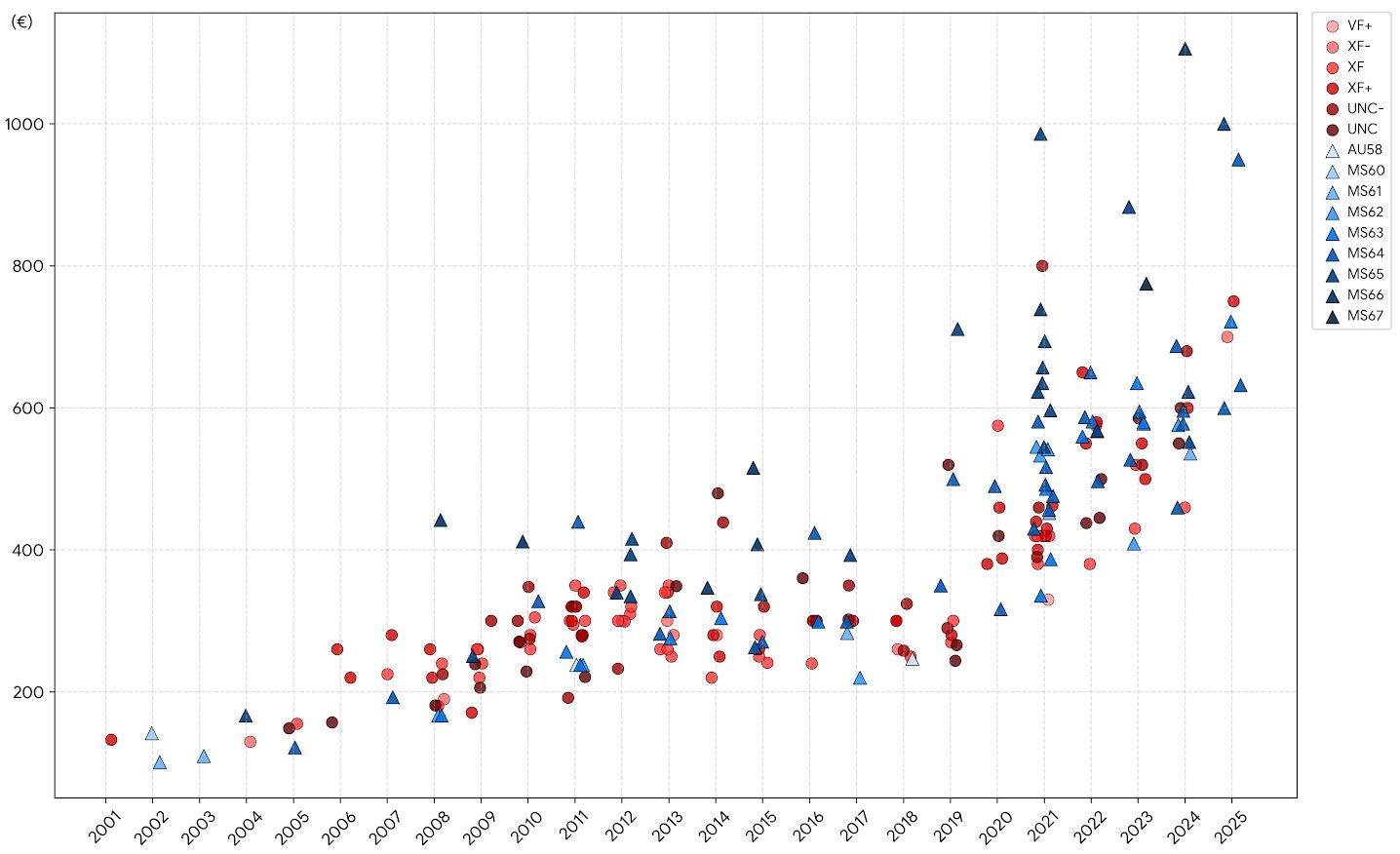
At the beginning of the observed period, from 2001 to 2005, prices were relatively low in absolute terms. They ranged mostly between 100 and 170 EUR. However, this does not mean that the gold coin lacked a numismatic premium (added value) at that time. On the contrary, since the value of the gold in the coin was significantly lower back then, the relative difference between the auction price and the metal value was often very high.
Between 2006 and 2010, a noticeable shift occurs. Prices increasingly move above 200 EUR, and better specimens exceed 300 and 400 EUR. This is a period when the 20 dinar gold coin of 1925 ceases to be viewed merely as a regional gold coin and increasingly fits into the broader international market for gold and historical gold coinage. The appearance of specimens at major international auctions, particularly at Heritage Auctions and Künker, contributes to greater visibility and comparability of prices.
From 2011 to 2018, the market is relatively stable. Average prices generally range from 280 to 330 EUR, with occasional exceptions for better specimens. During that period, it is clearly visible that ordinary specimens in XF preservation still have limited growth, while specimens in UNC and higher MS grades gradually create an additional premium. Certification is becoming increasingly important, especially for buyers who purchase at international auctions and want greater certainty regarding preservation.
The period from 2019 to 2023 brings stronger growth. In 2019, the average price was around 373 EUR, in 2020 around 430 EUR, and in 2021 already around 510 EUR. In 2022 and 2023, the average increases further, to around 527 and 586 EUR, respectively. This growth should not be interpreted solely through the price of gold. During this period, an increased interest in quality specimens is also evident, especially for certified pieces in MS64, MS65, and higher grades.
The year 2021 is particularly interesting. It brings the highest number of recorded results and several very high prices. Although the bullion value of the gold in the coin was about €297 at the time, some specimens sold for €600, €700, €800, and even almost €1,000. This shows that at that time, the numismatic component was very strong for the better examples. An MS65+ example sold for 986 euros achieved a price 2,32% higher than the value of the gold, which is the highest relative result in the entire table.
The years 2024 and 2025 bring a new situation. Absolute prices continue to rise, so the 2025 average climbs to around 765 EUR. However, since the value of the gold in the coin has also risen sharply, the relative premium compared to the metal is becoming smaller. In 2025, results below the exchange value of the gold in the coin were also recorded when looking at the annual average. For example, an MS64 was sold for 600 EUR and an MS64 was sold for 632 EUR, while the value of the gold in the table is listed as 681 EUR as an annual average. Such results show that in moments of rapid gold growth, auction prices do not always immediately align with the new metal base.
If the results are viewed by condition, the difference is very clear. Specimens in XF condition have an average price of about 315 EUR and a median of 300 EUR. Specimens in XF+ condition have an average price of about 373 EUR, but that average is partly driven up by certain more recent and stronger results. Specimens in UNC condition have an average price of about 453 EUR and a median of EUR. Even more importantly, the highest individual results almost always pertain to UNC or high MS specimens.
Certification also has a noticeable impact on price. Certified specimens in the table have an average price of around 465 EUR, while uncertified specimens average around 349 EUR. Of course, this difference does not stem solely from the certificate itself, but also from the fact that higher-quality specimens are more frequently sent for certification. Nevertheless, on the international market, a certificate clearly increases buyer confidence and makes it easier to achieve higher prices, especially for more expensive pieces.
The general conclusion from the auction results is that the 20 dinar gold coin from 1925 has, over the past twenty years or so, gone from being a relatively accessible gold coin with a moderate numismatic premium to a sought-after piece where condition, certification, and market timing play a major role. The average market price has increased significantly, but at the same time, the price structure has changed: for lower-grade specimens, the metal value now makes up a large part of the total price, while for top-grade specimens, the numismatic premium remains very pronounced.
Price movements relative to the value of gold
Since the 20 dinar gold coin from 1925 is made of 900/1000 fine gold and has a mass of 6.4516 grams, it contains approximately 5.806 grams of pure gold. Because of this, its market value cannot be viewed separately from the price of gold. However, this specimen is not just an investment gold coin. It also has a clear numismatic value, so its price is generally formed as the sum of its melt value and a numismatic premium.
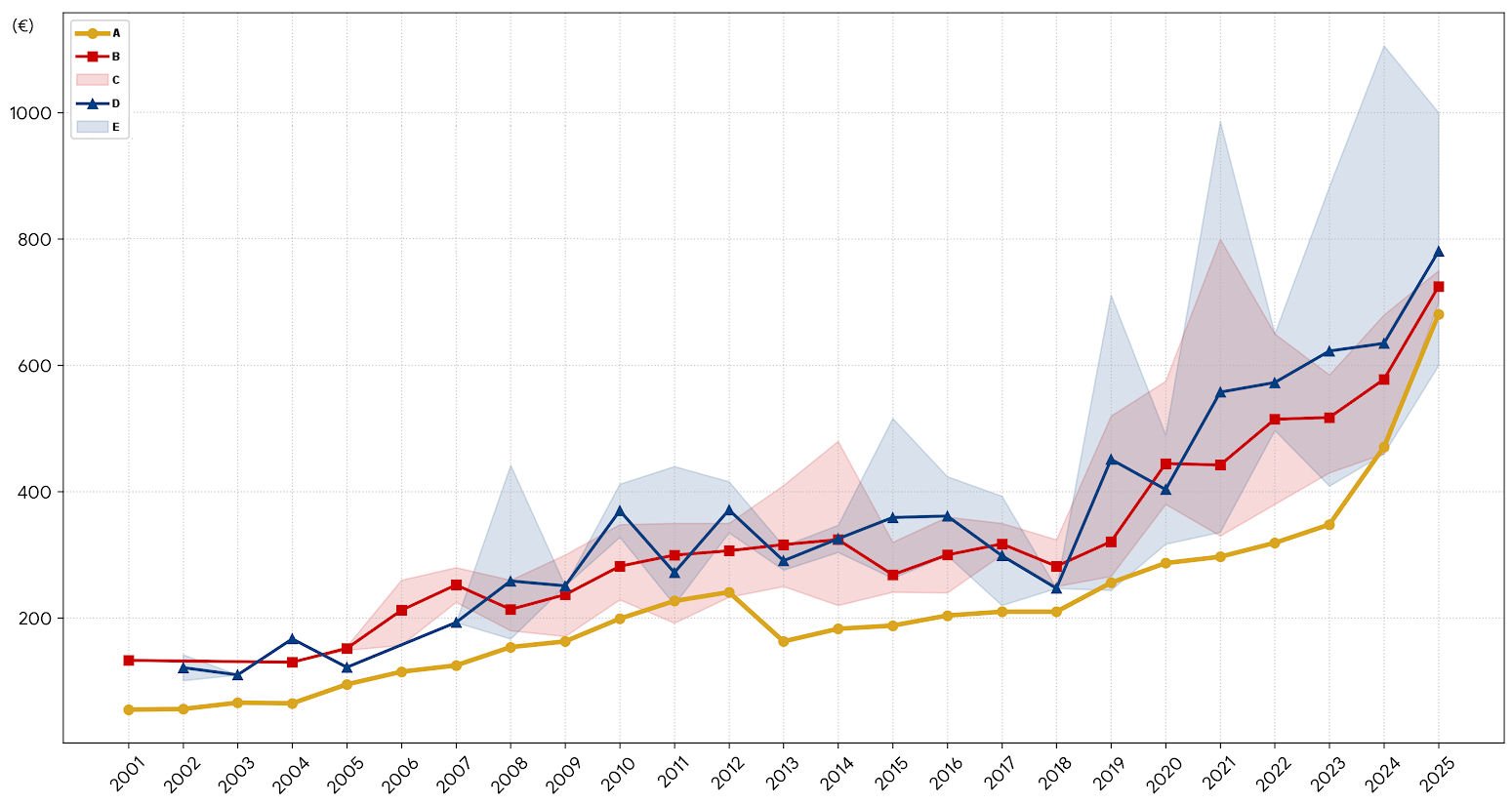
At the beginning of the observed period, the value of gold in the coin was very low compared to today's levels. In 2001, it was around 55 EUR, in 2002 around 56 EUR, and in 2004 around 65 EUR. At the same time, auction prices ranged from about 100 to 170 EUR. This means that the relative premiums were very high, often above 100%. However, it should be borne in mind that the starting value of gold was low at the time, so even a smaller absolute difference gives a high percentage.
From 2008 to 2012, the value of gold in the coin increased significantly. In 2008, it was about 154 EUR, in 2010 about 199 EUR, and in 2012 about 241 EUR. Auction prices during this period generally followed the growth of gold, but retained an additional numismatic premium. The average price in 2010 was about 298 EUR, and in 2012 about 328 EUR. This shows that the market did not decouple from the metal, but it did not reduce to just the metal value either.
Interestingly, in certain years the relative premium decreases despite the growth of absolute prices. For example, in 2011, the average auction price was around 291 EUR, while the value of the gold in the coin was about 227 EUR. The average premium was around 28%. In that year, certain results below the value of gold were also recorded, which shows that the auction market is not always perfectly aligned with the stock market movement of gold, especially when it comes to weaker, problematic, or less attractive specimens.
The period from 2013 to 2017 shows a strengthening of the numismatic component. The value of gold in the coin at that time mostly ranged between 163 and 210 EUR, while average auction prices were around 300 to 324 EUR. The relative premium was often between 45% and 90%, depending on the year and the structure of the sold specimens. During this period, better and certified pieces stood out in particular, with prices significantly exceeding the value of the metal.
The years 2018 and 2019 present a different picture. The gold value of the coin in 2018 was about 210 EUR, and the average auction price was about 277 EUR. The average premium was about 32%. In 2019, the value of gold rose to about 256 EUR, and the average price to about 373 EUR. However, the median was 295 EUR, which means that the average was significantly raised by a few very high results, especially certified pieces in high grades.
From 2020 to 2023, the gold coin once again achieved a very good ratio to the value of the metal. The value of the gold in the coin in 2020 was about 287 EUR, and the average auction price was about 430 EUR. In 2021, the value of the gold was about 297 EUR, and the average auction price was about 510 EUR. In 2022, the value of the gold was about 319 EUR, and the average price was about 527 EUR. In 2023, the value of the gold was about 348 EUR, while the average price was about 586 euros.
That period shows a very healthy numismatic premium. For average specimens it was moderate to strong, and for the best specimens extremely high. Particularly notable are the MS65, MS65+, and MS66 specimens, where the price was determined not only by gold, but primarily by preservation, rarity in that quality, and the interest of international buyers.
The years 2024 and 2025 bring strong growth in the value of the gold in the coin itself. In 2024, it amounts to about €471, and in 2025, about €681. Auction prices in absolute terms are also rising, but the relative premium is falling. The average premium in 2024 was about 29%, while in 2025 it fell to about 12%. The 2025 median premium was only about 6%. This is a very important data point, as it shows that in the most recent period, the market for average specimens has approached the value of gold.
Such movement does not mean that the numismatic value has disappeared. On the contrary, the best specimens still achieve significantly higher prices. An MS65 specimen sold in 2025 for EUR 1,000 and an MS64 specimen sold for EUR 950 show that high-quality pieces still carry a premium. However, in the case of average and lower-quality specimens, especially if they are not attractively preserved or if the market at the time of sale is not strong enough, the price can get very close to the bullion value of gold, and sometimes even drop below it (if looking at the annual average).
It follows that the 20 dinar gold coin from 1925 should be viewed today through two levels of value. The first is the metal value, which provides the lower market base. The second is the numismatic premium, which depends on the condition, certificate, aesthetic impression, the auction house through which it is sold, the timing of the sale, and demand. For poorer and average specimens, the metal value plays an increasingly important role today. For extraordinary specimens in high MS grades, the numismatic premium can still be very large.
Precisely for this reason, the analysis of this gold coin must not be limited merely to a comparison with the price of gold. Although gold is the foundation of its value, the market clearly shows that buyers distinguish ordinary specimens from top-tier ones. The 1925 20-dinar gold coin is simultaneously an investment-grade piece of gold and an important numismatic item. This dual nature explains why its price tracks gold during some periods, while significantly outperforming it in others.
Current eBay offers
At the time of writing this article, on June 13, 2026, there was no active offer of the 20 dinar gold coin from 1925 recorded on domestic classified ads. This fits the general impression from the market: a specimen that could previously be found occasionally in regional offerings now appears much less frequently, especially in better grades of preservation.
Two certified examples in NGC MS64 grade are currently offered on eBay:
- The first copy was offered for $1,699.99, or approximately €1,469, with shipping of about €35.
- The second copy was offered for USD 1,625, or approximately EUR 1,405, with shipping of about EUR 6.
The sold items section also records an uncertified specimen in XF condition, shown as sold for $1,444.84, which is approximately €1,249, with shipping of about €49.
You should still approach eBay sold items with a certain reservation, because it is not always possible to know whether the sale was actually completed or subsequently cancelled. It should also be taken into account that eBay commissions are high, so the seller is left with a noticeably smaller amount than the displayed price after the sale.
Despite this, the current eBay offer shows that the 20 dinar gold coin from 1925 is offered on the international market today at very high prices, especially when it comes to certified specimens in high quality.
Final review
The 20 dinar gold coin from 1925 shows how, with quality historical gold coins, the value is based not only on the value of the gold, but also on demand, preservation, and market availability. Auction results confirm long-term price growth, as well as the widening gap between average specimens and those in high, especially certified, grades of preservation.
Although the price of gold is an important basis for valuation, the best specimens of this gold coin still achieve a noticeable numismatic premium. Because of this, the 20 dinars 1925 remains one of the most interesting and sought-after gold coins of the Kingdom of SCS in today's market.
Author: Zlatko Viščević with AI assistance
Photos: Katz Auction